Skip to content
DevMeme
575 of 7435
The Compiler's Relentless Pursuit of Bugs
Bugs Post #658, on Sep 11, 2019 in TG

The Compiler's Relentless Pursuit of Bugs

Why is this Bugs meme funny?

Level 1: Hide and Seek

Imagine you’re playing a game of hide-and-seek. You’ve found the sneakiest hiding spot, and you think, “No one will ever find me here.” But your friend who’s “It” has a special talent: they always find you, no matter what. In this meme, the compiler is like that super good hide-and-seek friend, and the “you” it’s talking to are the little mistakes in your code. The meme is joking that the compiler – basically the computer’s code-checker – is saying in a tough movie voice: “You can hide, but I’ll still find every mistake you made!” It’s funny because it takes a very serious movie scene (imagine a hero on the phone threatening a villain) and uses it to talk about something as ordinary as fixing typos and errors in code. It’s like if your teacher graded your homework with the intensity of an action hero, saying “I don’t know where the error is, but I will find it.” That mix of dramatic tone with a normal everyday situation (finding mistakes) makes people laugh. Programmers laugh at this meme because it feels true: whenever they think they’ve written perfect code, there’s always that one little error hiding – and the moment they run the code, the computer finds it, just like a diligent seeker in hide-and-seek.

Level 2: Compile-Time Drama

Let’s break down the joke in simple technical terms. A compiler is a program that takes your source code (say in C++ or Java) and converts it into a form the computer can run (like machine code or bytecode). But while doing so, it also checks your code very strictly. If it finds anything wrong, it throws compiler errors (also called compile-time errors) and refuses to create an executable until you fix those issues. The meme imagines this process as if the compiler is speaking with dramatic determination. The line “I don’t know where you are” is like the compiler saying it can’t locate something in your code – for instance, if you use a function or variable that isn’t defined anywhere (this is known as an unresolved symbol or missing reference error). The next line “But I will compile you and I will find you” humorously implies that once you run the compile, the compiler will indeed find every such mistake hiding in your program.

Think of writing code as writing an essay for a very strict teacher. The compiler is like that teacher who will mark every single spelling and grammar mistake in red ink. Did you forget a semicolon at the end of a statement? The compiler will immediately point it out as an error. Did you call a function that you never actually wrote (or imported)? The compiler will stop and say, “I have no idea what doSomething() is, you need to define it.” For example, consider this tiny C++ snippet:

#include <iostream>

int main() {
    std::cout << "No errors?" << std::endl  // Oops, missing semicolon here
    return 0;
}

// Compiler output:
// error: expected ';' before 'return'

In the code above, everything looks fine except we forgot one ;. The compiler doesn’t just gloss over that – it immediately finds it and gives an error saying essentially “Hey, I was expecting a ; and it’s not here!” This is what the meme refers to: no matter how minor or hidden the mistake, the act of compiling code is how we discover it. The phrase “compile you” in the meme is a playful way to say “I’m going to run the code through the compiler,” and “find you” means “find the error.” It’s turning a routine developer task into a melodramatic promise.

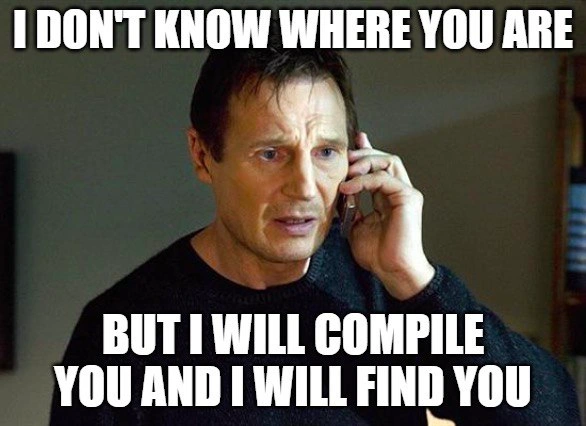
The image used is from an intense scene in an action movie (the film Taken). In that scene, the character (played by Liam Neeson) is on the phone with a bad guy, saying he will find him. It’s life-and-death in the movie. Now, seeing that serious image paired with silly programmer text is what makes it funny. It’s an action_movie_phone_call trope applied to programming. The top text in big white Impact font, “I DON’T KNOW WHERE YOU ARE,” matches the idea of a developer staring at the screen thinking, “I have no clue where the bug in my code is.” The bottom text, “BUT I WILL COMPILE YOU AND I WILL FIND YOU,” matches the idea that by running the compiler, they’ll track down that bug. This contrast between dramatic threat and mundane coding is classic TechHumor. We’re basically laughing at the notion that a compiler (an unfeeling piece of software) could sound as intense as an action hero.

Now, the caption “When you’ve had no errors after an 8 hour coding session” sets up the scenario. If you’ve been coding all day and haven’t seen any errors, it usually means you haven’t run the code yet or you’re extremely, almost superhumanly, careful. Most developers would be a bit nervous in that situation, because it’s likely there’s a mistake hidden somewhere. The meme jokes that the compiler is about to swoop in like, “Alright, it’s been 8 hours of silence… time to flush out the errors!” This is a nod to DebuggingFrustration: often the errors only reveal themselves when you finally compile or execute the program after a long coding spree. And sure enough, the compiler might spit out a list of issues that you then have to troubleshoot. It’s a shared experience: everyone remembers the first time they wrote a lot of code and confidently hit “compile,” only to be met with a wall of error messages. It’s practically a rite of passage in learning to program. You realize pretty quickly that it’s better to compile your code in smaller chunks regularly, rather than writing 500 lines and compiling at the end.

So in simpler terms, this meme is saying: “You can’t hide from your mistakes. The compiler will find them.” It frames that message in a comically over-the-top way by referencing a famous movie threat. The CompilingCode process becomes an exaggerated hero on a mission. All the tags like CompilerErrors, BugsInSoftware, and Debugging_Troubleshooting point to this idea of finding and fixing mistakes in code. By mixing a pop culture reference (the Taken phone call) with coding, it creates a joke that programmers find hilarious and relatable. It’s both a parody of the movie scene and an accurate reflection of how it feels to chase down a stubborn error in your code. No matter how small an error is – a missing semicolon, a misspelled variable, an omitted library – the compiler will call it out. And that’s ultimately a good thing! It’s just funnier to imagine the compiler doing it with a grave, menacing tone.

Level 3: No Error Escapes

This meme riffs on Liam Neeson’s famous phone monologue from the action thriller Taken. In the movie, he threatens the bad guys by saying he will track them down no matter what. Developers have cheekily remixed that ominous line into: “I will compile you and I will find you.” It’s a perfect storm of DeveloperHumor: taking a intense Hollywood moment and applying it to the everyday battle with code. For experienced developers, the humor lands immediately because we’ve all felt that unstoppable force that is the compiler when you finally hit “build.” After an 8-hour coding session with no obvious issues, a savvy engineer knows better than to celebrate prematurely. There’s a well-worn industry joke: if your code compiled on the first try, you probably missed something. 🙂 In real life, writing code for hours without running it is just begging for a surprise. The moment you do compile the code, the CompilingCode process can feel like a SWAT team kicking down the door of your program, revealing all the hidden mistakes you made throughout the day. The meme dramatizes that by casting the compiler as a determined hero (or anti-hero) delivering a threat to every last bug or compiler error lurking in the source.

The top caption, “I DON’T KNOW WHERE YOU ARE,” resonates with any developer staring at a cryptic error message. Often, when something breaks, you initially have no clue where that error is coming from in the code – much like a frantic search for a bug hiding somewhere in thousands of lines. The bottom caption, “BUT I WILL COMPILE YOU AND I WILL FIND YOU,” hits home the idea that running a compile is akin to unleashing a hound that sniffs out all errors. It’s funny because it personifies the compiler as this relentless agent: you can almost hear it growling “No error can hide from me.” This rings true in practice: try to slip an undefined variable or a missing function past a compile – you’ll get slapped with errors or debugging frustration inducing messages until you fix it. The meme captures that dramatic compilation threat vibe: something mundane (code compilation) is elevated to an action-movie showdown. Seasoned devs are chuckling because they’ve lived this scenario. You think your code is clean? Compile it, I dare you. Sure enough, the compiler might return with 10 errors, some warnings, and a sarcastic "Build failed" – essentially saying "Found you!" for each mistake.

There’s also an element of shared pain being laughed at here. The Debugging_Troubleshooting tag is apt: fixing compile errors often feels like debugging before the program even runs. Maybe you forgot to include a library, or you mis-typed a variable name in one place. For example, you confidently write calculateResults() everywhere, but one time you wrote calculateResult() (missing the “s”) – oops, now the compiler halts with an error about an undefined reference. That trivial typo could halt your entire build. It really can feel like the compiler is hunting down even your smallest slip-ups with a vengeance. Experienced developers have internalized this process so much that many follow the mantra “compile early, compile often.” We know that letting 8 hours of code pile up without a test-compile is asking for a barrage of errors later. The meme’s scenario – “no errors after an 8 hour coding session” – is both the holy grail and a red flag. It likely means no errors seen yet. A senior dev reading that caption might smirk and think: "Just wait until you actually try to run it..." because they know some sneaky bug is probably lying in wait.

The image choice (a determined man on a phone in a dim room) adds to the humor by mirroring how a coder might feel at 2 AM when the code just won’t compile: deadly serious, one last bug holding the project hostage. By referencing an action_movie_phone_call scene, the meme taps into a pop culture moment for dramatic effect. It’s exaggeration, of course – compilers don’t actually threaten us (though it feels that way when error 57 pops up after you fix error 56!). But that exaggeration helps vent the frustration in a funny way. It says, “Yes, we all know that feeling when the build seems to have a vendetta.” The Compilers category here is literal: it’s about the compiler software, and the BugsInSoftware / errors it relentlessly exposes. The comedy is in the contrast: Liam Neeson’s character was dealing with kidnappers, which is life-or-death serious, whereas a compiler is just a tool to catch mistakes – yet we’re giving those mundane errors the same gravitas as a hostage situation. It’s poking fun at how dramatic we feel things are when a compile fails at the end of a long day.

To a seasoned dev, it’s a familiar script every time you hit the build button:

Developer’s Thought Compiler’s Reaction
“No errors so far, this should be fine.” error: expected ';' before '}' (oops, missed a semicolon!)
“It compiled on the first try, I’m a genius!” undefined reference to 'missingFunction()' (spoke too soon…)

In short, compiling code is portrayed as an unstoppable force in this meme. It will methodically check everything and find anything incorrect. The phrase “I will find you” gets a tech twist: for devs, it means the moment of truth when the compiler combs through your work. Everybody who’s struggled with a stubborn compile error can relate to the feeling that the compiler will not rest until it has pointed out every mistake. That shared experience is what makes the meme instantly relatable and laugh-out-loud funny among programmers. We laugh because it’s true — and because thankfully, compilers aren’t actually sentient bounty hunters, even if their error lists sometimes make them seem just as unforgiving.

Level 4: Semantic Search & Destroy

At the deepest technical level, this meme highlights how a compiler acts like a relentless detective in your code. Modern compilers break down source code through multiple phases (lexical analysis, parsing, semantic checks, code generation), each phase designed to hunt down flaws methodically. They use a formal grammar (think of it like the language’s rulebook) to parse your code into an Abstract Syntax Tree (AST). If you slip up on syntax – say a missing semicolon or a misplaced brace – the parser immediately throws a fit with a syntax error. It's as if the compiler growls, "I don't know where you (that missing ;) are, but I will find you." During semantic analysis, the compiler builds a symbol table (a catalog of every variable, function, and class you defined). When it encounters a name or reference that isn’t in that table – for example, calling a function that was never declared – it’s game over: an unresolved symbol error erupts. In other words, the compiler will not proceed until it knows exactly "who" and "where" every symbol is. This is like the compiler scouring every corner of your codebase for an entity it doesn’t recognize. Even after that, during the linking stage (which ties together code from different files or libraries), any missing reference will trigger a loud failure. The build process essentially says, "You can’t hide that undefined function from me – I will locate it or halt everything."

This ruthless completeness is by design: in compiled languages (C++, Java, Go, etc.), compile-time errors must be resolved before the program can run. There’s no mercy – your program won’t even compile with one stray error. (Many of us have seen a single missing } cascade into dozens of errors; compilers can be dramatic that way.) The upside is that by catching errors early, the compiler prevents those mistakes from causing worse problems at runtime. It has a “particular set of skills” (to quote Liam Neeson) acquired over decades of language design and optimization research – skills that make it a nightmare for bugs you try to hide. The theoretical foundation here is solid: compilers implement formal language theory and rigorous static analysis. They enforce the rules of the language grammar and type system with machine efficiency. Any code that violates these rules – no matter how deep in a file or dependency – is tracked down via deterministic algorithms that traverse AST nodes and check every symbol’s definition and type. It’s essentially performing a graph traversal of your code’s structure, ensuring every path leads to a valid definition. If something doesn’t resolve, it’s flagged with precision. In fact, advanced optimizing compilers go even further, performing data-flow analysis and control-flow checks that can spot unused variables, unreachable code, or suspicious constructions, emitting warnings (or errors if you’re using -Werror to treat warnings as fatal). In other words, beyond just finding outright errors, the compiler can also sniff out potential issues – it’s like it not only finds the hidden “bad guy” errors, but also side-eyes the innocuous bystanders (giving warnings) just in case.

Under the hood, this relentless error-hunting is a consequence of decidability in formal systems: things like mismatched types or undeclared identifiers are decisively wrong, so the compiler will catch them. (Of course, not every bug can be found at compile time – the famous halting problem and undecidability mean some logic errors only show at runtime – but the errors that are checkable statically, the compiler will expose.) That’s why the meme’s dramatic threat rings true in a nerdy way: a compiler is inexorable within its domain of checking. It’s literally built to find every violation of the language rules. So when the caption says “I will compile you and I will find you,” it’s tongue-in-cheek, but technically it aligns with how compilers behave. A well-behaved compiler operating on correct code does nothing visibly, but the moment there’s an inconsistency – an extra parenthesis, a type mismatch, a missing function – alarms go off. The compiler issues error messages with file names and line numbers, pinpointing the location of each offense. It’s like a GPS homing in on the coordinates of your mistakes. The debugging_troubleshooting aspect comes from us, the developers, interpreting those error messages and fixing the code. And indeed, after each fix, we recompile, and the compiler again sweeps through the code, determined to find the next issue. This iterative search-and-destroy mission continues until no errors remain. In a way, the compiler’s job is exactly to “hunt down every last error” in terms of language correctness. No wonder seasoned programmers jokingly anthropomorphize the compiler as this unyielding agent of justice – it truly never lets a guilty error get away.

Description

This is a meme based on the well-known 'I will find you' scene from the movie 'Taken,' featuring actor Liam Neeson. In the image, he is on the phone with a serious and determined expression. The top text reads, 'I DON'T KNOW WHERE YOU ARE,' and the bottom text says, 'BUT I WILL COMPILE YOU AND I WILL FIND YOU.' The meme cleverly replaces the original quote's target with a software bug. The joke personifies the compiler as a relentless hunter, and by extension, the developer who uses it. It captures the intense determination a developer feels when hunting for an elusive bug somewhere in the codebase. The act of compiling is the first step in this manhunt, eventually leading to the bug's discovery and extermination

Comments

7
Anonymous ★ Top Pick My compiler makes the same promise every time. The problem is, it finds the bug, but then the linker comes in like a crooked cop and tells me the crime scene is in another jurisdiction
  1. Anonymous ★ Top Pick

    My compiler makes the same promise every time. The problem is, it finds the bug, but then the linker comes in like a crooked cop and tells me the crime scene is in another jurisdiction

  2. Anonymous

    Eight hours, zero compile errors - congrats, you’ve only made it to the part where UB-san calmly growls, “I have a very particular set of segfaults; I will find you… in prod.”

  3. Anonymous

    Eight hours without errors isn't a clean codebase, it's a compiler that's been plotting its revenge and waiting for the most architecturally significant moment to unleash every race condition you thought you'd fixed

  4. Anonymous

    The compiler is the ultimate bounty hunter with an infinite attention span and perfect memory - it doesn't care if you commented out that function, renamed that variable at 2 AM, or thought you could hide that type mismatch in a deeply nested generic. It will traverse your entire dependency graph, check every symbol table, and surface every violation of the language spec with the cold, methodical precision of a deterministic finite automaton. Unlike Liam Neeson, it doesn't need 'a very particular set of skills' - just a grammar definition and unlimited patience for your creative interpretations of the type system

  5. Anonymous

    Senior build engineer energy: undefined reference appears; recompile -O0, check -L/-I, run nm and ldd on the artifact - yes linker, I will find you

  6. Anonymous

    Incremental builds let bugs hide like interns in standups; full clean compile is Neeson calling them out

  7. Anonymous

    Staff mantra: it compiles - now ld, nm, and a very particular set of tools will track your undefined reference hiding three repos deep behind a transitive Bazel target

Use J and K for navigation