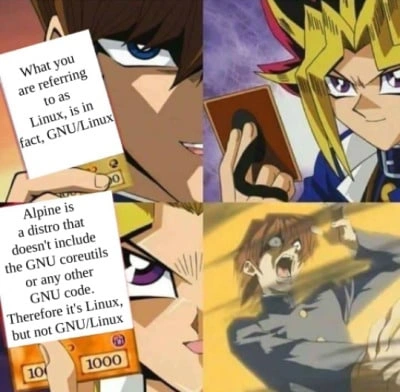
Alpine dev counters the classic 'GNU/Linux' card in anime duel showdown
Why is this OperatingSystems meme funny?
Level 1: No Ingredient, No Credit
Imagine you have a friend who always insists on getting credit for your cookies because you use his special sugar mix in the recipe. Every time you share cookies, he butts in and says, “Actually, those are Tom-and-You’s cookies, because I gave you that sugar mix to use!” It’s a bit annoying – he wants the treat to be named after him too, not just “your cookies,” since his ingredient is in there.
So one day, you decide to bake a new batch of cookies without using his special sugar at all. You find a different sweetener and make the cookies entirely on your own. When you show up with these cookies, your friend tries to jump in with the same old line: “Actually, those are Tom-and-You’s cookies—” But you stop him and say, “Nope! I didn’t use any of your sugar mix this time. These are 100% my cookies.”
Your friend’s eyes go wide, and he’s totally shocked – he has no reply because you’ve just proven he didn’t contribute to this batch at all. The cookies are delicious and clearly made without his help, so calling them “Tom-and-You’s cookies” would be silly. In that moment, it’s like you played a magic card in a game that completely defeats his argument. He’s left speechless (maybe with a funny flailing fall, just like in cartoons), and you get to enjoy your victory and your cookies with a grin.
This is exactly what’s happening in the meme: one character is like the friend demanding extra credit (saying “call it GNU/Linux!”), and the other character finds a clever way to show that credit isn’t needed (“this Linux has none of your GNU stuff”). It’s a funny “gotcha!” moment that even someone outside tech can understand – nobody can claim credit for an ingredient that isn’t even in the recipe!
Level 2: Linux Without GNU
Let’s break down what’s happening here in simpler terms. This meme uses scenes from an anime card duel (think Yu-Gi-Oh!) to dramatize a showdown between two ideas about operating systems. On the left side (the smug rival in the first panel), we have someone playing the “GNU/Linux” card, which basically says: “Actually, you shouldn’t call the operating system just Linux, you should call it GNU/Linux.” This argument comes from some people in open-source communities – especially the Free Software Foundation – who believe that since the OS is made up of the Linux kernel plus lots of programs from the GNU project, we should give GNU credit in the name. In other words, they say Linux by itself is just the engine (kernel) of the car, and GNU built many of the other parts, so the whole car should be called GNU/Linux. This can come across as a bit pedantic or nitpicky, but it’s a well-known stance in dev culture and Unix philosophy circles about giving proper attribution.
Now, in the right side (the hero with the determined face in panel 2 and 3), we see the counter-argument card being played. The text on that card basically explains Alpine Linux: it’s a Linux distribution (a version of an operating system) that doesn’t use the usual GNU components at all. Alpine still uses the Linux kernel (so it’s definitely Linux), but it replaces the GNU parts with other lightweight alternatives. Specifically, Alpine uses a tool called BusyBox instead of the typical GNU Core Utilities (often called GNU coreutils).
What are these things? Let’s clarify:
GNU coreutils: This is a collection of basic command-line programs that are found in almost every Linux system. These include everyday commands like
ls(to list directory contents),cp(to copy files),rm(to remove files),echo,cat, and many more. They are part of the GNU Project’s offerings. In an Ubuntu or Fedora system, when you runlsorgrep, you’re actually running the GNU versions of these utilities. So most Linux-based operating systems rely on lots of GNU code in day-to-day use.BusyBox: BusyBox is often described as a “Swiss Army knife” of Linux commands. It’s a single executable that packs in stripped-down implementations of a bunch of common commands (including versions of
ls,cp,echo, etc.). BusyBox was created to be super small and efficient, mainly for environments where storage and memory are limited (like embedded systems, routers, or very small containers). Because BusyBox’s versions of commands are simpler and lighter (sometimes with fewer features) than full GNU coreutils, using BusyBox can make an operating system’s footprint tiny. Alpine Linux chooses BusyBox for its userland, meaning when you type commands in Alpine, you’re usually using the BusyBox-provided version, not the GNU version.Linux (the kernel): The kernel is the core part of the operating system – it talks to the hardware and manages resources. Linux is a kernel originally created by Linus Torvalds in 1991. On its own, the kernel isn’t a full operating system that humans can use; you also need libraries, shells, and utilities around it. That’s where distributions (distros) come in: they bundle the Linux kernel with various other tools to make a complete OS.
Alpine Linux (the distro): Alpine is a distribution that is designed to be very small, secure, and simple. Instead of using the common GNU tools and libraries, Alpine uses alternatives:
- It uses BusyBox for most command-line tools (replacing GNU coreutils).
- It uses musl libc as the C standard library instead of GNU’s glibc. (The C library is a core piece that many programs need to run.)
- It often uses a simpler shell (BusyBox provides a shell that’s a variant of
shcalled ash) instead of the GNU Bash shell. - Because of these choices, Alpine’s base installation is just a few megabytes in size! This is why Alpine is very popular for Docker base images in containerized applications – it makes images tiny.
So, when the hero in the meme says “Therefore it’s Linux, but not GNU/Linux,” he’s pointing out a technical gotcha: Since Alpine doesn’t contain GNU software, calling it “GNU/Linux” would actually be wrong – it’s just Linux (with BusyBox, musl, etc.). This is a bit of a tongue-in-cheek way to one-up the rival. The rival’s argument only applies if your operating system includes GNU components. Alpine is a counterexample that breaks the rule.
Now, why is this funny to developers? A few reasons:
- It’s a nerdy counterargument: The insistence on saying “GNU/Linux” is often seen as overly correct or academic. By having a ready example where that insistence fails (Alpine), the meme humorously “defeats” the nitpick. It’s like someone very smug corrects you, “Actually, you should call it X,” and you reply, “Well, in this case, calling it X is actually wrong.” That reversal is satisfying if you’ve been on the receiving end of that correction before.
- Distro wars and pedantry: Within the Linux world (the dev communities that use Linux, contribute to open source, etc.), there’s a long history of playful rivalry between different “distros” (distributions). People argue about which text editor is best, which distribution is best, even what you should call the OS. These debates can be sincere but also a bit silly. This meme pokes fun at one of those debates – the naming one – by using an anime battle scene for dramatic effect. It exaggerates the drama to highlight how absurd the argument can feel.
- Anime duel format (Yu-Gi-Oh! meme): The format itself is part of the joke. Yu-Gi-Oh! is a show where characters duel with monster cards, shouting moves and counter-moves. It’s often used in memes because of its over-the-top dramatization of playing a card. Here, the “cards” have text about Linux on them. So, one character “plays” the GNU/Linux card (a serious argument card), and the other “plays” the Alpine Linux card (an unexpected counter card). The final panel shows the opponent literally blown away, which is how the show portrays a duelist losing all their life points. The life-point counters reading 1000 and 1000 suggest the hero still has 2000 points – meaning he didn’t lose any points in this argument battle. It’s a fun way to visualize an internet argument: one side loses spectacularly when a rare but decisive fact is dropped.
To a newer developer or someone outside this culture, the meme might look simply like two anime characters with tech text on their cards. But with the context above, it’s clear that:
- The opponent’s claim is “You should always call a Linux OS GNU/Linux (to credit GNU).”
- The hero’s retort is “Here’s Alpine, a Linux OS with no GNU in it, so calling it GNU/Linux would be incorrect.”
- The result: The opponent has no comeback, because the statement about Alpine is factually true. It undercuts the absolute nature of the “you must call it GNU/Linux” rule.
In summary, the meme uses a bit of tech history and software context to land a joke. It highlights Alpine Linux as an example that not all Linux-based systems include GNU code, thereby playfully jabbing at those who correct others with “Um, actually, it’s GNU/Linux.” For many in the tech world, it’s a chef’s kiss moment of geek humor: precise, educational, and a little sassy.
Level 3: The BusyBox Gambit
In this meme’s high-stakes operating system duel, we witness a naming conventions showdown decades in the making. The smug rival holds up a card with the infamous correction:
“What you are referring to as Linux, is in fact, GNU/Linux.”
This is the classic pedantic play from Free Software Foundation (FSF) enthusiasts who insist on crediting GNU in the name. It’s a reference to a real lecture by Richard Stallman (GNU’s founder) and a long-running holy war in open-source communities. The idea is that the term Linux alone refers only to the kernel – the core program of the operating system – while the full system includes GNU’s userland tools (like GNU compilers, shell, and core utilities). According to this purist view, if you’re running a typical distro like Ubuntu or Fedora, you’re actually running GNU/Linux since the GNU project’s code (the GNU coreutils, GNU C library, Bash shell, etc.) makes up a huge part of the OS that sits on top of the Linux kernel.
But here comes our protagonist with a determined glare, slamming down a counter-card: Alpine Linux. The text on his card essentially says: “Alpine is a distro that doesn’t include the GNU coreutils or any other GNU code. Therefore it’s Linux, but not GNU/Linux.” This is the ultimate trap card for this argument – a true distro wars power move. Alpine Linux is a real minimalist distribution whose user-space is built not on GNU software, but on BusyBox and musl libc. BusyBox is a single binary that provides simplified versions of common Unix commands (replacing GNU core utilities like ls, cp, grep with its own lean implementations), and musl is an alternative C standard library replacing GNU’s glibc. In other words, Alpine runs the Linux kernel without any GNU-provided userland. It’s a fully functional Linux OS that intentionally contains zero GNU code by default. So calling Alpine “GNU/Linux” would actually be incorrect – a deliciously nerdy technicality.
This clever countermove exploits the Unix philosophy of modular design and alternatives. It’s a reminder that GNU isn’t the only provider of userland tools. The rival’s expression in the final panel – blasted backward in shock – represents the naming pedant’s defeat when confronted with Alpine’s existence. The two bright orange “1000” life-point cards by the hero hint that his score remains undefeated (2000 points total), a direct nod to Yu-Gi-Oh! duel mechanics where outmaneuvering your opponent leaves you unscathed. Essentially, the protagonist played an UNO Reverse Card in an anime context: the very argument used to demand GNU credit is turned on its head. For seasoned developers, this hits on multiple layers of humor:
- Historical Irony: The FSF spent years insisting on “GNU/Linux” to get recognition for GNU’s role. Yet here’s Alpine, a niche distro originally built for minimalism (often used in Docker base images for containers), proving you can have a complete Linux system without GNU at all. The mighty GNU is, for once, absent – and nobody can insist on calling it GNU/Linux. It’s like discovering an Achilles’ heel in a long-held argument.
- Technical Detail as Punchline: Only folks deep in Linux lore know about BusyBox and musl. The meme’s punchline isn’t a generic joke; it’s a specific technical fact. This makes the humor extra satisfying for insiders – a bit of developer culture chestnut where somebody finally uses esoteric knowledge to shut down a well-known bit of pedantry.
- Community Satire: Within open source dev communities, the “actually, it’s GNU/Linux” correction is often seen as pedantic gatekeeping. Many devs roll their eyes when someone pulls that card in conversation. Here, Alpine’s counter is cathartic – it satirizes the correction itself. It’s basically saying, “Sure, buddy, I’ll call it GNU/Linux when it applies… but checkmate, it doesn’t apply here!” That shared eye-roll sentiment at overly zealous corrections is what makes fellow developers smirk at this meme.
All these elements – the anime duel format, the specific reference to GNU vs. BusyBox, and the historical naming debate – combine to create a multilayered joke. It’s not just about Linux or Alpine; it’s poking fun at the grand tradition of nitpicking in tech. Only in our world do you get flamewars over what to call an OS. Here, that grand debate is condensed into a dramatic Yu-Gi-Oh! battle, capturing the absurdity: one combatant brandishes a well-worn ideological argument as if it’s an Exodia piece, and the other slaps down a niche technical fact as the winning monster card. For veteran devs, it’s equal parts nostalgic (we’ve all seen that argument) and hilarious (seeing it so perfectly overturned). In short, the meme triumphantly declares: sometimes the best way to counter GNU/Linux naming pedantry is with an even nerdier fact – Alpine’s got your back on that. And judging by the defeated look of our anime antagonist, no amount of insistence on terminology can withstand a well-played BusyBox gambit.
Description
Four-panel Yu-Gi-Oh! meme. Panel 1 shows an anime rival smirking while holding up a duel card that reads, “What you are referring to as Linux, is in fact, GNU/Linux.” Panel 2 zooms to the protagonist brandishing his own card with determined eyes. Panel 3 reveals the protagonist’s card text: “Alpine is a distro that doesn’t include the GNU coreutils or any other GNU code. Therefore it’s Linux, but not GNU/Linux,” and his life-point counter shows two orange ‘1000’ cards. Panel 4 depicts the rival blasted backward in shock, arms flailing, as if defeated. Visually it features bold anime colors - purple sky, blue school uniforms, dramatic speed lines. Technically, the joke riffs on the perennial naming debate around the Linux kernel versus the GNU user-land and highlights Alpine’s BusyBox-based userspace common in container images, poking fun at distro-wars pedantry within open-source communities
Comments
34Comment deleted
Nothing ends an “actually, it’s GNU/Linux” monologue faster than `FROM alpine`; 5 MB later they realise the lecture has been statically linked out
The real power move is running Alpine in production while your monitoring stack alone uses more RAM than Richard Stallman's entire GNU manifesto - because nothing says 'minimal container footprint' like a 2GB Prometheus instance watching a 5MB base image
The irony is delicious: Stallman spent decades insisting we call it 'GNU/Linux' to acknowledge GNU's contributions, only for Alpine to come along and prove that Linux is perfectly happy running without a single GNU component - using musl, BusyBox, and OpenRC instead. It's the ultimate 'well actually' counter to the original 'well actually,' and the fact that Alpine became the de facto standard for Docker base images means millions of containers are now running 'Linux, not GNU/Linux' in production. The real trap card was assuming the kernel needed GNU to be useful
Stallman's dream distro: pure Linux kernel bliss. Architects' nightmare: BusyBox ash at 3AM in prod containers
The “call it GNU/Linux” pedant just got unit-tested by Alpine - name equality fails when your definition couples kernel and userland, and musl+BusyBox mocks out GNU at runtime
“It’s GNU/Linux.” - “Cool, then why does FROM alpine break your glibc‑linked binary? Turns out Linux is a kernel, GNU is optional, and BusyBox is the smug roommate.”
what is made by gnu? what are the alternatives? Comment deleted
Lots of Unix utilities has a version made by GNU that has performance optimizations and features over its Unix version Comment deleted
most of the core utils, like cat, tree, ls, etc. Comment deleted
let's rewrite it all in rust Comment deleted
you say that as a joke, but there's a rust alternative for every one of them. ok maybe not gcc, but still Comment deleted
rust compiler Comment deleted
You don't need gcc if everything is in rust ¯\_(ツ)_/¯ Comment deleted
are them in aur? can i just install them and delete gnu's? Comment deleted
they're usually different binaries, e.g. exa instead of ls. In the case of exa, you can drop-in replace it via a PATH reroute, but idk about the other ones. Comment deleted
glibc, git Comment deleted
git is not gnu. git was made by Linus Torvalds and is currently maintained by someone else, but not the GNU team. Comment deleted
my bad Comment deleted
major ones: glibc, utils, gcc, bash, ncurses, gdb, grub Comment deleted
can't be reproduced in firefox Comment deleted
aye, I use Firefox for webdev, so I only noticed this bug once my friend tested it Comment deleted
"just use Firefox" Comment deleted
Funny misreply Comment deleted
oh this is misreply Comment deleted
what does it use instead of gnu? Comment deleted
let's riir Comment deleted
kinda thought it was "gnu iteration tools" Comment deleted
lmao Comment deleted
yeah nope Comment deleted
kek Comment deleted
yeah, I already checked Comment deleted
... so it appears I mistook "GNU interactive tools" for it Comment deleted
but they are now spelled "gnuit" Comment deleted
manual labor Comment deleted