Skip to content
DevMeme
4006 of 7435
The True Full-Stack: From Fermions to Frontend
IndustryTrends Hype Post #4362, on May 5, 2022 in TG

The True Full-Stack: From Fermions to Frontend

Why is this IndustryTrends Hype meme funny?

Level 1: Build the Car, Then Drive

Imagine someone told you, “You’re not a real driver until you can build a car from scratch.” They insist that you should know how to mine the metal for the engine, forge the parts, assemble the whole car, and only then are you allowed to drive it on the road. Sounds silly, right? That’s exactly the kind of joke this meme is making about programmers. In the meme, being a “true full-stack developer” is compared to knowing how to do everything from the tiniest basics (like particle physics, which is like mining raw materials) up to the final product (like coding the user interface, which is like driving the car). It’s funny because nobody really expects one person to do all those things. We usually specialize: just like drivers rely on car manufacturers, software developers rely on the work of physicists, electrical engineers, and other specialists for the tools we use. The humor comes from the absurd exaggeration — the checklist in the tweet goes way beyond what a normal programmer would ever need. It makes us laugh and say, “Haha, yeah right, as if I need to know how atoms work to make a website!” The heart of the joke is about impossible expectations. It reminds us that calling someone “full-stack” is relative, and no one can literally know everything. In simple terms: the meme is funny because it’s like teasing someone, saying, “You don’t truly know how to bake a cake unless you planted the wheat, milled the flour, built the oven, and then baked the cake.” It playfully highlights how crazy it would be to demand that much knowledge from one person.

Level 2: Atoms to Apps

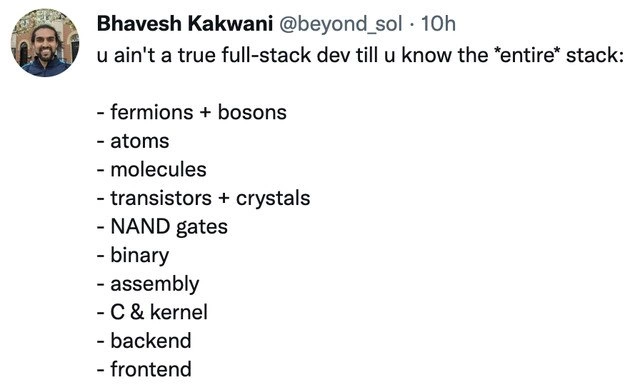
Let’s break down this “full stack” step by step, from the very bottom (physics) to the top (user interface). The tweet’s bullet list is basically listing every layer of technology that eventually leads to a working application. Here’s what each item means in plain terms:

  • Fermions & bosons: These are terms from fundamental physics. Fermions are the particles that make up matter (for example, electrons, protons, neutrons), and bosons are particles that carry forces/energy (like photons which make light, or gluons in nuclear forces). In simple terms, think of fermions as the “stuff” everything is made of, and bosons as what makes forces like electricity or gravity work. They’re the absolute bottom of the stack – tiny particles smaller than atoms. Including this in the checklist is a joke, implying you should even know particle physics to be a developer (don’t worry, you really don’t need to for programming!).

  • Atoms: Atoms are the basic units of matter – the tiniest bits of elements like hydrogen, carbon, or silicon. Everything solid, liquid, or gas you touch is made of atoms. In computers, a very important atom is silicon, because computer chips (the processors, memory, etc.) are made from silicon material. When the tweet mentions atoms, it’s continuing the joke: “do you even know what atoms your computer is built from?” Normally, software developers don’t need to know chemistry or atomic science to write code, but the joke is that a true full-stack dev supposedly would.

  • Molecules: Molecules are groups of atoms bonded together. This is a small step up from atoms. In the context of computers, you can think about the materials used: for instance, silicon dioxide (SiO₂) is a molecule used as an insulator on chips, and various plastics (which are molecules in polymers) make up circuit boards and computer cases. Again, no one expects a coder to know molecular chemistry. The meme is humorously extending the stack: from particles to atoms to molecules – basically covering the basics of materials science that eventually leads to electronics.

  • Transistors & crystals: Now we’re at the electronics layer. A transistor is a tiny electronic switch that can turn on or off the flow of electricity. It’s the fundamental building block of all modern electronic devices. Transistors can be combined to store data (as memory) or perform calculations (as logic gates). They’re made on silicon crystals, which refer to the silicon wafers (slices of a silicon crystal) used to create microchips. The word “crystals” here might also hint at crystal oscillators, which are quartz crystals used to keep time in circuits (like the clock that ticks inside your CPU). But most likely it just means the silicon crystal lattice of a chip. Essentially, “transistors + crystals” is saying the hardware aspect – know how computer chips are physically made and operate. This is deep hardware knowledge. In reality, software developers might have a basic idea (“the CPU has transistors”), but building or designing a transistor is typically the job of electrical engineers and physicists!

  • NAND gates: This brings us into digital logic. A NAND gate is a basic logic circuit that takes two inputs and outputs a 0 only when both inputs are 1 (otherwise it outputs 1 – it’s the NOT of an AND operation). In binary terms, NAND outputs “false” only if all inputs are “true”. This might sound technical, but basically, logic gates are how computers do decisions and calculations using 1s and 0s (true/false values). The reason NAND is mentioned is that it’s a fundamental gate type; you can build any other kind of logic circuit just using NAND gates. In constructing a processor, engineers use combinations of gates (AND, OR, NOT, NAND, etc.) to create adders, multiplexers, memory storage, and so on. The meme implies a true full-stack dev even understands these digital logic basics, the kind of thing you learn in a computer engineering class. For a regular developer, it’s neat to know of NAND gates, but you almost never directly work with them — they’re buried deep in the CPU’s design.

  • Binary: Binary is the language of computers at the lowest software level – just zeros and ones. Everything you see on a computer (text, images, programs) ultimately breaks down into binary digits (bits). For example, the letter "A" in ASCII is 65, which in binary is 01000001. Binary is how instructions and data are stored and processed by electronics. The reason we use binary is because transistors have two states (on/off), so it’s natural to represent things with two symbols (1 and 0). When the tweet lists “binary”, it means understanding that behind all software, there are bits being flipped. It humorously suggests you should be able to think in pure binary to be a true developer. In practice, while developers use binary for some tasks (like bit manipulation or understanding file formats), we usually write code in higher-level languages and let compilers/assemblers handle the binary translation. Only in very specialized scenarios would you literally work with binary code (like writing a very low-level firmware or debugging a corrupted file in a hex editor).

  • Assembly: Assembly (or assembly language) is a human-readable form of a computer’s machine code. Every CPU has its own set of instructions (its instruction set architecture), which are operations like “add these two numbers”, “store this value in memory”, “jump to this part of the program if a condition is met”, etc. In binary, these instructions are just patterns of 1s and 0s. Assembly language lets you write them in a slightly more readable way using short words (called mnemonics). For example, in x86 assembly you might write ADD EAX, 5 to add 5 to a register EAX, which under the hood might be 00000101... in binary opcodes. Assembly is considered low-level programming because it’s very close to the hardware – you’re telling the CPU exactly what to do, step by step. It’s powerful but hard to use for building large programs (imagine writing a whole web browser in assembly – yikes!). Most developers today never need to write assembly from scratch, as we have high-level languages like C, Java, Python, etc. But it’s still taught in computer science to understand how computers execute instructions. The tweet saying “you ain’t full-stack till you know assembly” is part of the joke: it’s implying you should be able to write or at least read the raw machine-level code that your high-level code turns into. It’s a playful exaggeration because while knowing some assembly is great for debugging or optimization, it’s not a common requirement for, say, building a web app.

  • C & kernel: Here we move into system software. C is a programming language that has been hugely influential (created in the early 1970s, it’s still heavily used). It’s much higher-level than assembly but still gives you direct control over memory and hardware through things like pointers. Many operating systems and performance-critical programs are written in C because it’s efficient and fairly low-level, but easier to manage than writing pure assembly. The kernel is the core part of an operating system (like Linux, Windows, or MacOS). It’s the program that directly talks to the hardware and manages resources like CPU time, memory, and device drivers, and provides an environment for other programs to run. Saying “C & kernel” suggests you’d know how to program in C and possibly understand OS kernel internals (maybe even code an operating system). That’s heavy stuff! Typically, only specialized system programmers or OS developers need to know this deeply. The average developer might use C for specific tasks or at least be aware that the OS kernel is handling things under the hood, but not actually modify the kernel. The meme including this means a true full-stack dev is, in theory, also a system-level programmer who could whip up their own custom Linux kernel patch or manage memory allocation details. It’s definitely not expected in normal developer jobs — this is part of why the tweet is funny, because it bundles an almost academic level of systems knowledge into the “full-stack” definition.

  • Backend: Now we’re at the traditional starting point of what many consider “full-stack development.” The backend is the server side of an application – all the behind-the-scenes logic that powers what the user eventually experiences. For a web application, the backend could be the web server, application server, database, and the code that runs on the server to handle requests, do computations, and send responses. Backend developers work with things like server frameworks (for example, Express for Node.js, Django for Python, Spring for Java), databases (like MySQL, PostgreSQL, MongoDB), and APIs. They focus on things like data processing, business logic, and performance on the server side. If you see a website and login to your account, the code that verifies your password and fetches your account info from a database is backend code. The tweet including “backend” is expected – any self-described FullStackDevelopment implies doing backend work. By placing it near the end of the list, after so many low-level layers, the joke emphasizes: “only now we’ve gotten to something a typical software dev might list on their resume!”

  • Frontend: Finally, the frontend is the client side of an application – what runs on the user’s end. In web development, frontend usually means the part of the website that runs in your browser and what you directly interact with. This includes the layout, design (HTML & CSS), and dynamic interactive features (JavaScript/TypeScript frameworks like React, Vue, or Angular). Frontend developers focus on creating a good user experience, responsive design, and often work closely with visual design and user interface considerations. It’s quite a different skill set from backend development. Where backend might involve database queries and server logic, frontend involves making buttons look good and ensuring the site is accessible and works on different devices. In the meme’s list, “frontend” is the last item – which is fitting because it’s the top layer that users see. By having it last, the tweet culminates at the end-user experience, having started from the tiniest particles. In reality, a full-stack developer is someone who can work on both frontend and backend (basically the whole application code). But clearly, nobody actually expects that person to literally know every layer below that (like CPU design or quantum physics).

In summary, each bullet in that tweet represents a layer of abstraction in computing:

  • We start from physics (fermions, bosons),
  • move to chemistry/materials (atoms, molecules),
  • then to electronic hardware (transistors on silicon crystals),
  • then basic digital logic (NAND gates),
  • then the machine code layer (binary),
  • then a thin layer above that, low-level programming (assembly),
  • then a higher-level but still system layer (C and OS kernel development),
  • and finally the typical software application layers (backend server code and frontend user interface).

The meme exaggerates what “knowing the entire stack” means by including all those layers. It’s essentially mapping out the full spectrum of knowledge from the very physical foundation of computers all the way to the software that users interact with. Realistically, professionals split these layers: for example, electrical engineers worry about transistors, computer engineers about logic gates and CPU design, systems programmers about kernels and C, and application developers about backend/front-end. Being knowledgeable in one or two adjacent layers is common (like a kernel programmer will know some assembly and C, or a web dev might know some design and some server code). But no one is an expert in all of them at once — that would require decades of study in each sub-field! If you’re a junior developer or just learning, seeing this list might be intimidating, but remember: it’s meant to be over-the-top for humor. You do not need a PhD in physics to make a webpage! The tweet is using absurdity to poke fun at the term “full-stack.” Understanding broadly what each layer is can make you appreciate how a computer actually works, though. It’s actually quite cool: your code in, say, JavaScript (frontend) eventually triggers operations that go all the way down to electrons moving in transistors. But thankfully, you can be a great developer without diving into every one of those steps in detail. Each layer is complex in its own right, which is why the joke lands — it’s a stack far too tall for any single person to fully climb.

Level 3: NAND Gatekeeping

For experienced engineers, this meme is a chef’s kiss to the absurdity of full-stack job expectations and tech one-upmanship. It reads like satire of those legendary job postings or conference brags where someone expects a developer to practically be a one-person IT department, hardware lab, and software studio combined. The tweet’s author essentially says, “If you’re going to call yourself full-stack, you’d better know EVERYTHING (literally from particle physics to UIs)”. This is classic tech gatekeeping humor: setting an impossibly high bar as a joke about people who set the bar too high in seriousness. Anyone who’s been around the industry long enough has seen a bit of this attitude — e.g., the senior developer who jokes that real programmers code in assembly, or the interview that asks trivia about CPU caches and TCP/IP flags for a front-end role. Here it’s cranked up to 11. Seasoned devs find it hilarious because it parodies our occasional elitism. It’s making fun of the idea that you’re not a “true” programmer unless you suffer through all layers of the tech stack. It’s as if someone took the phrase “jack of all trades, master of none” and said “if you’re not jack of all trades and master of all too, you ain’t for real.” By listing fermions and NAND gates in the same breath as backend and frontend, the meme highlights how ridiculous such gatekeeping is. It resonates with that shared eye-roll we have when a recruiter or tech lead acts like one person should be an expert in databases, UI design, network protocols, and now apparently quantum physics as well.

In practice, even senior developers specialize. A backend guru might profile database queries all day but have only a foggy memory of how a MOSFET transistor works. A front-end expert could create stunningly efficient React apps without knowing how to invert a NAND gate’s truth table. And that’s perfectly fine! The industry is so broad now that expecting one individual to deeply know hardware, low-level firmware, kernel development, plus high-level app development is unrealistic. This meme gets a laugh because every experienced dev has felt a bit overwhelmed by the sheer breadth of knowledge out there. It’s reminding us: no matter how much you know, there’s always another layer below (or above) that you don’t. The good news (which the joke implicitly leans on) is that abstraction is our friend. We don’t need to juggle quarks while writing JavaScript because countless layers of engineering let us treat a computer almost like magic. We trust the hardware works as intended and focus on our layer. A true "full-stack" web developer might be comfortable switching between writing an API route in Node.js and tweaking CSS for a button — that’s already a wide range. But none of us are debugging quantum electrodynamics equations during a code review. The meme exaggerates to show how silly it would be if someone took “full-stack” too literally.

There’s also a historical wink here for the TechHistorian types: decades ago, in the earliest days of computing, a “full-stack” practitioner was a lot closer to this ideal (though not quite at the fermion level!). In the 1970s or 80s, a personal computer enthusiast might actually solder together a kit (dealing with transistors or integrated circuits), then write assembly to make it do something, then perhaps build both the back-end logic and front-end interface for their application because they were the only developer on it. Think of pioneers who designed hardware and wrote software for it, like the early Apple engineers or console programmers who needed to know some hardware trickery to optimize games. But even they relied on existing physics knowledge and chip manufacturing done by others. As systems got more complex, specialization grew. By the time we have the modern web stack, the roles have diverged massively: hardware engineers, systems programmers, front-end developers, DevOps, etc. No one individual can practically have expert-level knowledge in all layers from silicon to UX design – there’s just too much depth in each. This tweet plays on that fact by compiling every possible layer into one taunting checklist. It’s a form of comedic hyperbole that seasoned devs appreciate because we’ve seen how the definition of “full-stack” keeps expanding. (These days it might even include “DevOps” or “machine learning” in some job ads — the list keeps growing, though thankfully not usually down to atoms!).

The humor lands especially well with those familiar with the term “full-stack developer” being thrown around in job listings. Often, it’s a bit of a misnomer or a stretch: companies want someone who can do it all, but in reality, everyone has strengths and weaknesses. We joke that a “full-stack dev” inevitably ends up doing deployment scripts (DevOps), database tuning, UI tweaks, and maybe even tech support – wearing all the hats. The meme drily says “Why stop there? Wear the particle physicist hat and the electrical engineer hat too!” For an experienced developer who’s maybe been pressured to know a new framework every year or handle tasks outside their expertise, this hits home. It satirizes that pressure by imagining a cartoonishly overqualified developer. It’s also a gentle ribbing of those among us who brag about being full-stack ninjas. You know the type: the ones with CVs listing 25 programming languages and every buzzword framework. By adding fermions and NAND gates, the tweet effectively says, “Sure, and do you also split atoms in your free time? No? Then pipe down.” It’s a playful call-out that no matter how "rockstar" you are, there's always a deeper layer you're not touching. In other words, humility via humor.

The reference to NAND gates also sneaks in a pun for those who catch it: it’s gate-keeping at the level of logic gates. The meme is literally gatekeeping (“you ain’t a true dev unless…”) and one of the criteria is knowing about NAND gates. That’s a delightful little Easter egg for engineers — mixing a social concept (gatekeeping) with a hardware concept (logic gates). Senior devs who have been through both software and a bit of hardware education might chuckle extra at that intersection. It’s the kind of layered joke where if you recognize the pieces (a NAND gate’s truth table or how it’s the foundation of digital circuits), you get an extra appreciation for the absurdity of lumping it in with, say, front-end web development.

This meme also highlights the ladder of abstraction that we climb in computing. A seasoned engineer knows these layers exist and might have a mental model of them, even if they’re not an expert in each. For instance, you might not design transistors for a living, but you know that ultimately your high-level code runs on binary machine instructions, which run on circuits made of transistors. Experienced devs often gain a little knowledge about layers above and below their own to debug tricky problems (like a performance issue might lead you to learn about CPU caches, or a strange browser behavior might lead you into how the JavaScript engine works in C++). So there’s a grain of truth in valuing broad knowledge. The joke just blows it out of proportion. It’s saying: “Oh, you value breadth? How about cosmic breadth!” In meetings or online, we often ironically echo this meme when someone uses the term “full-stack” too liberally — “Sure, Bob over there is full-stack… but does he know his bosons? 😏 ” It immediately gets the point across that full-stack is a fuzzy term.

In essence, a senior perspective sees this tweet as a commentary on the tech industry’s penchant for overloaded expectations and the way we sometimes idolize the mythical “10x engineer” who can do everything. It’s funny because it’s true to an extent — computing does involve all those layers — but absurd to expect one person to personally master them all. The laughter comes with a side of relief: thank goodness our job interviews don’t actually quiz us on quantum chromodynamics! We can all bond over the fact that being a developer is already challenging enough without having to crack open a physics textbook and a circuit schematic every time we call ourselves “full-stack.” This shared realization, wrapped in a witty overstatement, is what makes the meme pure DeveloperHumor gold.

Level 4: Subatomic Abstractions

At the quantum end of this “entire stack,” computing stops being about code and turns into physics and materials. The meme kicks off with fermions and bosons, which are concepts from particle physics. Fermions (like electrons and protons) are the matter particles that make up atoms, while bosons (like photons) carry forces and energy. Why start there? Because everything in a computer ultimately runs on physical phenomena: the electricity coursing through circuits is essentially a herd of electrons (fermions) moving under electromagnetic fields (carried by bosons). Engineers don’t typically think about quantum fields when programming, but fundamentally, every bit in memory is stored by physical states of matter and energy. In fact, the solid-state physics of semiconductors hinges on quantum behavior — for example, how electrons quantum-tunnel through transistor junctions or how a photon lithography etches chip patterns. It’s a deep reminder that the digital world is built on an analog, physical reality. Modern computing even bumps into physics limits: there’s a minimum energy to erase a bit of information (Landauer’s limit, from thermodynamics), and quantum effects can cause leakage in tiny transistors. So in a tongue-in-cheek way, the meme says a true developer’s knowledge would start from the literal physics that enables computing. It’s humorously astronomical (or rather sub-atomical) in scope, but it highlights the ultimate bedrock of our tech stack: nature itself. 🧬

From there, the checklist ascends into chemistry and solid-state electronics. We go from atoms to molecules, hinting that a real full-stack dev would even grasp how those particles combine into materials. For instance, silicon atoms bond into a crystal lattice, and by introducing impurity atoms (doping), we get semiconductors with special properties. Those crystals of doped silicon are what our chips are made of. The meme explicitly mentions transistors + crystals, pointing to the fundamental hardware pieces. A transistor is the tiny electronic switch that is the building block of all modern circuits: it can allow or block current, effectively representing binary 1s and 0s. They’re fabricated in huge numbers (billions on a chip) on a thin slice of pure silicon crystal. Fun fact: the term “silicon” in Silicon Valley comes from these silicon wafers used to make chips. Transistors rely on quantum-mechanical properties of those silicon crystals — an area of study in solid-state physics — but a “full-stack dev” in this joke is assumed to know even that level of detail. It’s like saying you should understand band gaps, electron holes, and how doping silicon with boron versus phosphorus creates P-N junctions. Of course, in reality software engineers don’t need to solve Schrödinger’s equation for a transistor’s behavior, but this exaggeration riffs on the idea of comprehensiveness. The humor lies in the absurd implication that to be truly competent, you’d need knowledge spanning from quantum mechanics to circuit design to high-level coding. No one person could genuinely master the entire span, but it’s entertaining to imagine a mythical uber-engineer who has Maxwell’s equations and JavaScript frameworks equally on speed-dial.

Crucially, NAND gates show up in the list as we climb out of physics and into logical design. In digital electronics, a NAND gate is a simple logic gate that outputs “False” only when all its inputs are “True” (in binary terms, it outputs 0 only if all inputs are 1). Why NAND specifically? Because it’s functionally complete — you can build any other logic function (AND, OR, NOT, XOR, even whole adders and CPUs) using just NAND gates wired together. It’s the LEGO brick of all computer logic circuits. In a real computer chip, clusters of transistors form these logic gates. For example, a single CMOS NAND gate might be built from four transistors. The meme highlighting NAND gates is a wink to hardware engineers: if you really know your stuff, you could design the entire CPU logic from the ground up using NAND gates (a nod to projects like the educational NAND-to-Tetris course, where one literally builds a minimal computer starting with NAND). It’s a playful inclusion because typical FullStackDevelopment never goes this low-level — this is firmly HardwareHumor territory. We’re talking about knowledge a chip designer or computer engineer would have, not your average web developer. By including NAND gates, the tweet bridges the gap between material hardware and the binary abstraction, implying our “true full-stack dev” can think in terms of boolean algebra and circuit schematics. At this level of abstraction, we’ve left physics and entered computer architecture. An expert here understands how to implement memory, adders, multiplexers, etc., from logic gates. It’s the realm where one worries about propagation delay, clock signals (often stabilized by quartz crystals, another likely reference in “transistors + crystals”), and how to squeeze millions of gates into a chip design. It’s a low-level programming of its own kind, except the “code” is hardware logic tables and circuits. The seasoned engineers reading this meme might chuckle because once upon a time (say, early in a computer engineering education) they may have literally built a half-adder from NAND gates on a breadboard or designed a tiny CPU in VHDL/Verilog. It’s a far cry from writing JavaScript, which is exactly why bundling all this knowledge under one “full-stack” umbrella is comically overblown.

Continuing up the ladder, we hit binary and assembly – the domain where hardware and software meet. Binary is the native language of computers: streams of 1s and 0s that encode instructions and data. It’s ultimately what all software becomes when running on a CPU. The meme’s “true full-stack dev” is expected to be fluent in raw binary, which is amusingly extreme. In practice, very few humans read or write pure binary (we usually represent machine code in hex or assembly mnemonics), but the list implies you’d handcraft bytes if needed. If you’ve ever opened a binary executable in a hex editor or written raw machine code, you’re in a pretty niche corner of LowLevelProgramming. That’s why this resonates with veteran programmers: it reminds us of the good old days or hardcore scenarios where one might debug at the bit level (like toggling switches on a front panel of an Altair 8800 to enter boot code in binary, old-school style). Following binary, we have assembly, which is a human-readable form of those machine instructions. Each assembly instruction corresponds to a low-level operation (like moving data, arithmetic, jumps) that the CPU knows how to execute. Assembly language is specific to a processor architecture (x86, ARM, RISC-V, etc.), and it’s notoriously tedious to write large programs in. Nonetheless, it’s foundational for things like writing an OS bootloader or performance-critical routines. The tweet’s checklist says our ultimate developer should know assembly – implying they could debug at the instruction level or even write programs for a microcontroller from scratch. This is a notch above what even many experienced devs do daily, unless they work in embedded systems or OS development. The inclusion of assembly in the list is a nod to the old-school programmers and systems programmers: the people who have seen code at the metal. It signals a depth of knowledge that is far beyond typical application development. In humor terms, it’s like saying “Okay, maybe you can write Python, but can you write machine code? If not, are you truly full-stack?” – clearly an exaggerated purity test.

Next up is C & kernel – stepping further into software but still very much on the systems side. C is a high-level language by some definitions, but it’s often called a “high-level assembly” because it lets you manage memory directly and compile into very efficient machine code. Many operating system kernels (the core of the OS) are written in C (with a sprinkle of assembly), because C gives low-level control with enough abstraction to not go insane. The kernel is the master program that interfaces directly with hardware: it drives the CPU, manages memory, handles device I/O, and provides system calls for user programs. So to “know C & kernel” means understanding how operating systems work and maybe how to write one. This is the territory of serious systems programmers — the folks who read books like Operating Systems: Three Easy Pieces, implement scheduling algorithms, or write device drivers. The meme implies a true full-stack dev isn’t just a web developer but also someone who could hack the Linux kernel or write their own OS from scratch. It’s a playful jab at the gatekeeping notion: “Oh, you can build a website? Call me when you’ve also built your own operating system kernel in C!” For veteran engineers, this hits a sweet spot of humor because many of us admire kernel devs and low-level gurus, but we know that’s a very specialized area. Demanding that plus all the other skills is just hilariously unrealistic. Yet, having a bit of kernel knowledge does sometimes help even a backend developer — e.g., understanding how the OS manages threads or networking can make you better at debugging performance issues. So some senior devs pride themselves on being “closer to the metal” than the average. The meme pokes fun at that pride by extending it to absurdity. It’s also a nod to how broad the field of programming is: even within software, there’s a huge difference between kernel hacking and making a pretty web UI.

Finally, we arrive at the familiar territory of backend and frontend – the layers most people actually mean by full-stack development. Backend refers to the server-side of applications: databases, server logic, APIs, the behind-the-scenes processing that users don’t directly see. Frontend refers to the client-side: the part of the application the user interacts with, typically a graphical interface in a web browser or mobile app (think HTML/CSS/JavaScript for web frontends). In modern web development, a full-stack developer is someone who can work with both the backend (say, writing a Node.js or Python server, designing a database schema, handling business logic) and the frontend (crafting the user interface, making the user experience smooth with a framework like React or Angular). It’s already a lot to learn! Backend and frontend involve different technologies and mindsets — one more about systems, scalability, data, and the other about design, interactivity, user experience. The original tweet lists these last, almost as a punchline: after going through physics and C and everything, you end on the mundane “backend, frontend” as if oh yeah, those too. It’s a brilliant way to exaggerate: it frames the usual meaning of full-stack (which stops at backend/frontend) as just the tip of a colossal iceberg of knowledge. The seasoned dev knows that no job actually expects you to know particle physics; the contrast itself is the joke. In effect, the meme stacks Hardware and low-level engineering humor on top of classic FrontendHumor and BackendHumor, uniting audiences across the spectrum. It’s a bit like a unifying theory of tech humor: whether you’re a transistor-tweaker, a systems coder, or a web designer, there’s something in that list that touches your realm — and then a whole lot that doesn’t, which is why it’s funny. It underscores how impossibly broad the term “full-stack” would be if taken literally.

So in summary at this deep-dive level: the meme constructs an entire stack from subatomic particles to software interfaces. It slyly suggests a “true” developer would comprehend each abstraction layer that makes computing possible. From quantum physics (fermions/bosons) → to electronics (atoms, molecules, transistors, logic gates) → to computer architecture (binary machine code) → to low-level programming (assembly, C, OS kernel) → to high-level software (backend services) → to user interface (frontend). It’s a monumental span of knowledge. The humor spark here is partly an appreciation of how these layers beautifully interconnect — each is built on the one below it — and partly the absurdity of expecting any single human to be a master of all. This entire_stack_meme is like an extreme scavenger hunt through every major field that makes a modern app possible. Only a polymath or a team of specialists rolled into one could tick every box. By exaggerating to include fermions_and_bosons (basically physics PhD territory) up through physics_to_frontend concerns, the tweet parodies the gatekeeping mindset in tech (“You’re not legit until…”). It reminds us, with a wink, that what we call full-stack is always relative — and there’s always a “lower level” beneath, all the way down to the laws of physics.

Description

This image is a screenshot of a tweet from a user named Bhavesh Kakwani. The tweet humorously and absurdly defines what it means to be a 'true full-stack dev.' It reads: 'u ain't a true full-stack dev till u know the *entire* stack:'. This is followed by a bulleted list that represents the layers of abstraction in computing, starting from the most fundamental level of physics and moving up to user-facing applications. The list includes: 'fermions + bosons', 'atoms', 'molecules', 'transistors + crystals', 'NAND gates', 'binary', 'assembly', 'C & kernel', 'backend', and finally 'frontend'. The joke is a satirical critique of the ever-expanding scope of the 'full-stack' developer role. By extending the stack down to the quantum level, the tweet hilariously points out the impossibility of mastering every layer of technology involved in modern software. For senior engineers, it’s a relatable jab at the industry's often unrealistic expectations and the buzzword-driven nature of job descriptions
Comments

8
Anonymous ★ Top Pick I tried to be a true full-stack dev but got stuck debugging a race condition between a quark and a gluon. Turns out quantum chromodynamics has terrible documentation
  1. Anonymous ★ Top Pick

    I tried to be a true full-stack dev but got stuck debugging a race condition between a quark and a gluon. Turns out quantum chromodynamics has terrible documentation

  2. Anonymous

    Reviewer comment: “Nice CRUD API, but could you abstract the fermion layer so the Standard Model isn’t a hard dependency?”

  3. Anonymous

    I once interviewed at a startup that wanted a 'full-stack developer.' After three rounds discussing React and Node.js, the CTO asked if I could also handle their quantum computing initiative because 'it's all just electrons anyway.' I should have known something was up when the job posting required '5+ years experience with fermions.'

  4. Anonymous

    Job req: full-stack engineer, must own everything from boson coupling to CSS centering - comp band still says 'mid-level'

  5. Anonymous

    Finally, a job description that's honest about expectations. Next sprint: refactoring the Standard Model because the Higgs boson is causing performance issues in production. The real reason we can't ship features faster? Quantum tunneling keeps introducing race conditions at the transistor level, and management won't approve the budget for a new universe with better physical constants

  6. Anonymous

    By this definition of full-stack, the RCA for a prod incident starts at the Standard Model, detours through standard cells, and ends with the CSS reset

  7. Anonymous

    Full-stack from fermions to frontend: NAND's universal, but try convincing a PM your qubit entanglement fixed that CORS nightmare

  8. Anonymous

    “Full-stack” only counts when your RCA traces an outage from a cosmic-ray bit flip in a NAND gate to a kernel panic to a CSS hotfix - and you’re on call for every layer

Use J and K for navigation