The Accidental Expert in SQL Syntax
Why is this DevCommunities meme funny?
Level 1: Shouting Your Way to Success
Imagine a kid is really excited about learning to play the piano. He asks a music teacher, “Should I learn to play piano?” but he asks it really loudly, practically shouting with excitement. The teacher laughs and says, “Yes, you should! In fact, you’re already off to a great start – piano teachers love loud kids because you need a strong sound to play the piano. Keep it up and you’ll be a star in no time!” Of course, just being loud isn’t what makes you good at piano, but the teacher is being playful and encouraging. In the same way, this meme shows a beginner developer who’s shouting (by typing in all uppercase letters) while asking if they should learn SQL (a database language). The experienced friend jokes, “Yes, and you’re already prepared because SQL commands are written in big capital letters!” It’s a funny, friendly way to say “Go for it!” The joke turns the newbie’s shouting into a superpower. The message is simple: sometimes the things you already do (even silly things, like using big letters) can be seen as steps toward learning something new. It’s both supportive and humorous – making the beginner feel happy and motivated to continue, just like that loud kid being told his big voice is great for the stage.
Level 2: SQL and All-Caps Style
So what’s going on here? The meme is referencing SQL, which stands for Structured Query Language. SQL is the language used to talk to databases – basically, it’s how developers ask a database to give me some data or store this new data. If you’ve ever seen a webpage that shows a list of users or products, somewhere a developer wrote an SQL query like SELECT * FROM products to get that list from the database. In SQL, there are special words called keywords (like SELECT, INSERT, UPDATE, DELETE) that tell the database what to do. By convention, a lot of developers write these SQL keywords in uppercase letters. It’s not a hard rule – the computer doesn’t care if you write select or SELECT (SQL is usually case-insensitive, meaning it treats lowercase and uppercase the same) – but writing them in all caps makes those words stand out. It’s easier for human eyes to pick out the commands in a query. Think of it like writing important words in a textbook with all capital letters or highlighting them.
Now, in the Discord conversation, an aspiring front-end dev is asking if they should learn SQL. A front-end developer typically works on the parts of a website or app you see and interact with – like buttons, layouts, and styling (think HTML, CSS, JavaScript). Backend development is more about the behind-the-scenes stuff – servers, application logic, and databases (where SQL comes in). Juniors often wonder, “Hey, I build web pages, do I also need to know how to work with databases?” It’s a common question on any LearningCurve for someone aiming to be more versatile or full-stack. In this meme, the community’s answer is both genuinely encouraging and a joke. One person just says “yah” (yes, you should learn it). Another person responds with an over-the-top enthusiastic YES in all caps, humorously implying: “Absolutely! And guess what – you’re already on the right track because you’re typing in all caps, and SQL likes caps for its keywords!”
Why is that funny? Because obviously knowing how to use Caps Lock isn’t what makes you good at SQL 😄. The inside joke is that the beginner’s habit of writing their question in all caps – which in a chat is like shouting – coincidentally matches a styling habit in SQL. The reply exaggerates this coincidence: “You are already prepared!” It’s as if writing in uppercase were a certification in database query writing. They even say “KEEP IT UP AND YOU ARE SURE TO GO PLACES!” which is friendly encouragement, but also comically suggests that if you keep using Caps Lock, you’ll become a database wizard. It’s RelatableHumor because a lot of developers have seen or used SQL and know about the uppercase thing, and they also remember being beginners worrying about what to learn next. The meme pokes fun at how, when you’re new, even the silliest little thing (like knowing to capitalize SQL keywords) can feel like a win. And the experienced folks love to playfully tease that small win. Essentially, the Discord helper is mixing sincere advice (“Yes, learning SQL is good for you as a front-end dev”) with a lighthearted jest about the newbie’s chat style. For any junior developer, it’s a nice reminder that the developer community can be both supportive and joking at the same time. You ask a serious question and you get an answer that makes you smile and think, “Okay, maybe I got this!” By acknowledging the question in a goofy way, the responder makes the newcomer feel welcome – turning a potentially dry answer into a memorable, funny moment. Now that newbie will never forget that SQLKeywords often appear in uppercase! And they’ve learned a tiny bit about developer culture: sometimes answers come with a side of humor.
Level 3: Caps Lock Certified
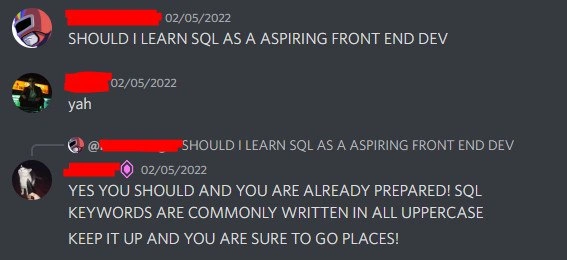
At first glance, this Discord chat is a perfect example of developer humor blending Databases and newbie enthusiasm. In the screenshot, a user excitedly (and loudly) asks in all caps:
SHOULD I LEARN SQL AS A ASPIRING FRONT END DEV
Usually, writing in all caps online is like shouting in a quiet room – a bit cringe to seasoned folks. But here another user replies with a tongue-in-cheek affirmation, also in uppercase:
YES YOU SHOULD AND YOU ARE ALREADY PREPARED! SQL KEYWORDS ARE COMMONLY WRITTEN IN ALL UPPERCASE KEEP IT UP AND YOU ARE SURE TO GO PLACES!
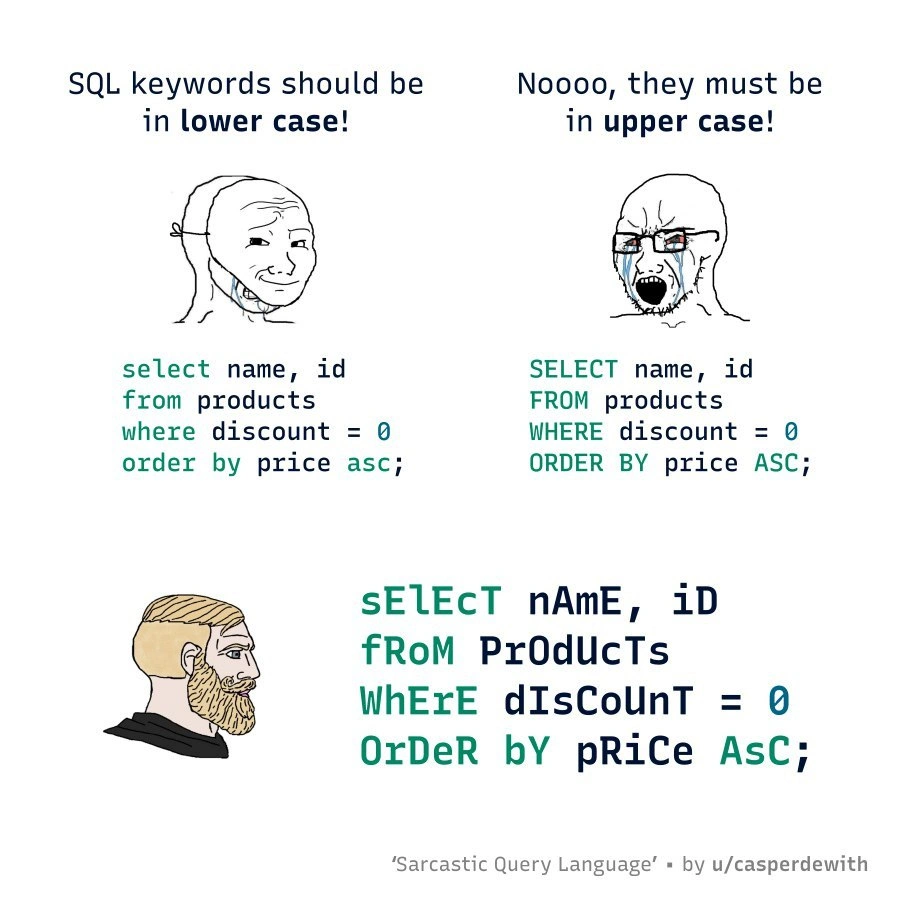
The punchline taps into a long-standing SQL convention: writing SQL keywords in ALL CAPS. For example, database queries often look like:
-- Example SQL query with uppercase keywords:
SELECT name, age
FROM users
WHERE status = 'active';
Notice the commands SELECT, FROM, WHERE are in uppercase – a common style in SQLQueries for readability (though not strictly required). The meme jokingly reassures the newbie that by typing with Caps Lock on, they’re unintentionally following a best practice of SQL! It’s a playful spin on the learning curve: the beginner’s overenthusiastic chat etiquette (all_caps_chat) is reframed as a pro skill.
Seasoned devs find this hilarious because it mixes two worlds: front-end newcomers fretting about backend skills, and the inside joke that shouting text = SQL proficiency. It satirizes those early career moments where juniors desperately seek guidance (“Should I learn X as a Y developer?”) and the community’s humorous, supportive responses. In reality, becoming good at SQL involves understanding databases, not just uppercase letters. But the experienced responder chooses absurd positivity: “You’ve mastered Caps Lock, so you’re basically halfway to writing solid SQL queries!” It’s a reassuring pat on the back wrapped in DatabaseHumor. Many of us remember being that overly eager junior, worried about all the things we should learn. This meme captures that energy and says, “Chill, you’re doing fine – you even accidentally did something right!” The RelatableHumor comes from how low-stakes the advice is. It needles the habit of gatekeeping complex skills, implying that sometimes the bar isn’t as high as it seems (or at least we can joke that it’s not). For senior developers, it’s a fun reminder of how far they’ve come – from confusing SQL with “shouting in code” to actually optimizing queries and designing schemas. And for anyone who’s been in a LearningToCodeJourney, it’s a nod that we’ve all asked innocent questions and gotten cheeky answers that oddly made us feel better. By turning a netiquette faux pas into a résumé bullet point, the meme highlights a truth: early learning is as much about confidence as it is about syntax. And if using Caps Lock gives that confidence, well, SELECT * FROM enthusiasm WHERE attitude = 'positive'; 🎉
Description
This image is a screenshot of a conversation from a Discord server with a dark grey background. The first user, with a red censorship bar over their name, asks in all capital letters: 'SHOULD I LEARN SQL AS A ASPIRING FRONT END DEV'. A second user gives a simple one-word reply: 'yah'. The third user, replying to the original question, responds with enthusiastic encouragement, also in all caps: 'YES YOU SHOULD AND YOU ARE ALREADY PREPARED! SQL KEYWORDS ARE COMMONLY WRITTEN IN ALL UPPERCASE KEEP IT UP AND YOU ARE SURE TO GO PLACES!'. The humor comes from the sarcastic connection made by the third user. They are playfully mocking the original poster for typing in all caps (often seen as 'shouting' online) by reframing it as a perfect qualification for learning SQL, where, by convention, keywords like 'SELECT', 'FROM', and 'WHERE' are written in uppercase. For experienced developers, this is a funny and familiar type of gentle ribbing found in online communities, where a junior's minor mistake in etiquette is turned into a clever, domain-specific joke
Comments
8Comment deleted
SELECT * FROM Users WHERE Attitude = 'LOUD'; -- Found our next SQL expert
SQL onboarding according to Discord: ENABLE CAPSLOCK; GRANT ALL PRIVILEGES; then act surprised when the junior’s “SELECT * FROM everything” locks the whole cluster
Finally, a frontend developer who won't need three ORM abstractions and a GraphQL layer just to avoid writing a JOIN statement
Twenty years in and the real reason SQL keywords are uppercase remains the same: so the query looks as angry as the person debugging it
Ah yes, the classic frontend-to-fullstack pipeline: accidentally master SQL conventions by never turning off caps lock. While junior devs stress about learning SELECT, JOIN, and WHERE clauses, this developer has already internalized the most critical SQL skill - aggressive uppercase typing. Who needs query optimization when you've got QUERY INTIMIDATION? By the time they write their first SELECT statement, the database will be too scared not to return results instantly. Bonus points: their Git commit messages probably look like they're perpetually angry at the codebase, which, let's be honest, is just authentic senior engineer energy
SQL's case-insensitive, but spotting uppercase keywords separates the fullstack tourists from the database denizens
Yes - learn SQL. Start with Caps Lock; it’s the only optimization the ORM won’t undo, and it makes a 12‑table JOIN look like you meant it
CAPS LOCK is a solid SQL syllabus; now learn EXPLAIN, indexes, and why your ORM turns “yah” into a 5,000-row IN clause