Skip to content
DevMeme
2409 of 7435
The Trailing Comma Hill
Languages Post #2678, on Jan 25, 2021 in TG

The Trailing Comma Hill

Why is this Languages meme funny?

Level 1: The Extra Wrapper

Imagine you ask for a stack of papers, but someone puts the whole stack inside one envelope before handing it to you. You still have the papers, but now they are wrapped in an extra layer. The meme is funny because one tiny comma adds that extra wrapper, and Python acts like that was obviously what you meant.

Level 2: The Comma Makes It

In Python, a tuple is an ordered group of values that cannot be changed in place. It is often written with parentheses, like this:

point = (10, 20)

But the important part is the comma. A one-item tuple must include a comma:

single = ("file.txt",)

So when the image shows:

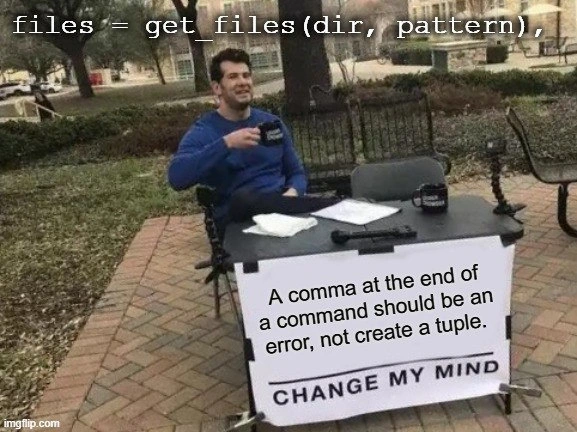
files = get_files(dir, pattern),

Python treats it like:

files = (get_files(dir, pattern),)

For someone learning the language, this is confusing because a trailing comma often feels like punctuation, not a major instruction. In this case, it changes the value from "the files returned by the function" into "a tuple containing the files returned by the function."

The practical fix is simple: remove the comma unless you really want a one-item tuple.

Level 3: The Singleton Trap

The meme uses the "Change My Mind" format because this is exactly the sort of hill a developer will choose after losing an afternoon to LanguageGotchas. The overlaid line files = get_files(dir, pattern), looks like a harmless trailing comma at the end of a command. In Python, it silently changes the value's type.

If get_files(...) returns a list like this:

["a.py", "b.py"]

then the code in the image assigns this:

(["a.py", "b.py"],)

That is a tuple with one item, and that one item is the list. The bug can be maddening because printing the value still looks "file-ish." It has brackets, strings, and familiar data. But the outer container is wrong, and the wrongness appears only when the code assumes normal list behavior.

This is why DynamicTyping cuts both ways. Python lets you move fast because you do not have to annotate every variable with a rigid type. It also lets a tiny syntactic accident cross the room wearing a valid type badge. The runtime does not say, "That comma seems emotionally suspicious." It says, "Congratulations, you made a tuple."

The sign's complaint is not unreasonable. Many languages treat a dangling comma differently depending on context: arrays, argument lists, object literals, enum declarations, or syntax errors. Python deliberately makes trailing comma tuple syntax valid in expression contexts. This creates elegant idioms like returning multiple values:

return status, payload

But it also creates this exact footgun when a line is edited, wrapped, copied, or autoformatted. The industry pattern underneath is familiar: a feature designed for expressiveness becomes a SubtleBug when it overlaps with a common typo. The language is technically consistent. The developer is technically annoyed. Both positions can be correct, which is the worst kind of correct.

Level 4: Grammar Is Destiny

The visible code is tiny, but the parser sees a very different shape than the developer probably intended:

files = get_files(dir, pattern),

Python's tuple syntax is not fundamentally "parentheses around things." It is commas between expressions, with parentheses often used only to group or disambiguate. That is why x = 1, creates a one-element tuple just as surely as x = (1,). The trailing comma in the meme is not decorative punctuation to the grammar; it is the tuple constructor.

At the abstract syntax tree level, the right-hand side is not just a call expression. It becomes a tuple expression containing one element: the result of get_files(dir, pattern).

files = get_files(dir, pattern),
# parsed conceptually as:
files = (get_files(dir, pattern),)

That distinction matters because Python's parser is doing exactly what the language specifies. The sign says:

A comma at the end of a command should be an error, not create a tuple.

The counterargument from Python's design history is consistency: if commas make tuples in expression lists, then a single expression followed by a comma is a one-element tuple. This avoids needing a special case where tuple construction requires two or more elements. It also makes function calls, unpacking, assignment targets, and literal-like tuple syntax follow a coherent grammar. Coherent, unfortunately, is not the same thing as merciful.

The deep irritation is that the parser cannot infer the programmer's intent. It has no reason to know whether the comma was accidental, whether the developer wanted a singleton tuple, or whether a formatter left it there after a refactor. A statically typed language might catch the mismatch earlier if files has a declared list type. In dynamic Python, the tuple can survive until much later, where some unrelated line discovers that files[0] is the entire list, iteration is nested one level too deep, or an API receives (list_of_files,) instead of list_of_files.

Description

A "Change My Mind" meme shows a man at an outdoor table with a code line overlaid at the top: "files = get_files(dir, pattern),". The sign on the table reads, "A comma at the end of a command should be an error, not create a tuple." The joke targets Python's syntactic rule where a trailing comma can turn an expression into a tuple, creating subtle type surprises instead of an obvious syntax failure.

Comments

14
Anonymous ★ Top Pick Python looked at a dangling comma and decided the parser was fine, but your type assumptions needed character development.
  1. Anonymous ★ Top Pick

    Python looked at a dangling comma and decided the parser was fine, but your type assumptions needed character development.

  2. @sylfn 5y

    a compilation error

    1. @mvolfik 5y

      More like complication error

    2. Deleted Account 5y

      Computation error 🌚

  3. @misesOnWheels 5y

    yes

  4. @GTRst 5y

    third-degeneration

  5. @sam0and 5y

    Python4?🤔

    1. @serghei_k 5y

      this

  6. @abel1502 5y

    At most a warning, but definitely not an error - it fits perfectly into the grammar model, and there aren't many reasons strong enough to force python to break its abstractions (which is its most wonderful aspect, in my opinion)

    1. Deleted Account 5y

      look at the walrus operator

      1. @abel1502 5y

        I've skimmed through pep572 (the one regarding exactly that), and while I wouldn't have considered this addition necessary on my own, it doesn't seem to break any pre-established abstractions, and the developers' rationale is compelling enough for me to accept it

        1. Deleted Account 5y

          well, you sould be fine then with comma too, bc both would require to just put parenthesis around those expressions

          1. @abel1502 5y

            That is quite reasonable, I agree. I guess the top-level tuple syntax is maybe allowed as one of the explicitly desired language features - tuple assignment (x, y = y, x), in particular. But you've got a good point nonetheless

            1. Deleted Account 5y

              oh crap, i thought that swap thing was magic, that's a good point too then

Use J and K for navigation