Java's Incomparable Type-Safe Punchline
Why is this Languages meme funny?
Level 1: Apples vs Oranges
Imagine you have three friends who each have their own funny way of saying “yes” or “no.” One friend, let’s call him C, doesn’t use the words “yes” or “no” at all – he just uses numbers. For C, 0 means “no” and 1 means “yes” (and actually, any number that isn’t 0 also counts as “yes” to him!). It’s a bit like if you asked C, “Is it raining?” and C answered “1” for yes, it sounds odd, but that’s just how he is. Now another friend, Python, does have words for “yes” and “no” (let’s say Python uses True for yes and False for no), but Python also secretly thinks of “yes” as the number 1 and “no” as the number 0. So if you asked Python the same rain question, he might say “True,” but if you gave Python five cookies and two were yes-cookies, he’d happily add them up like 2 (because to Python, True+True = 2 in a weird cookie-counting way!). He’s pretty flexible – he’ll use the words or the numbers, whatever makes sense at the time.
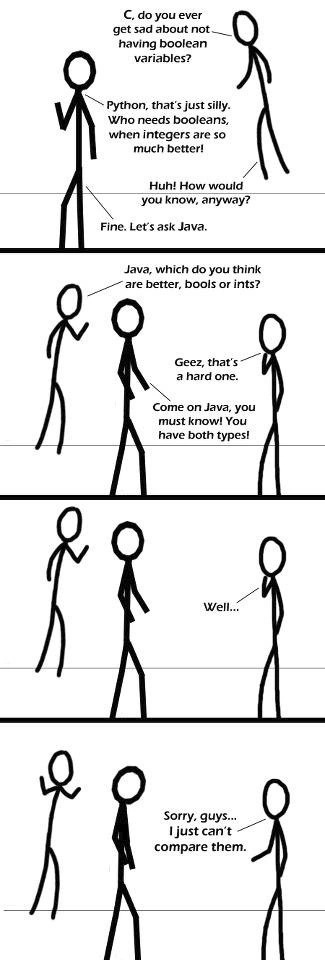
Finally, there’s Java, the very strict friend. Java has distinct words for “yes” (true) and “no” (false), and also regular numbers for counting. But Java has a strict rule: he will not mix up yes/no words with numbers. If you ask Java, “what’s better, saying yes/no or using numbers?”, Java gets uncomfortable. It’s like asking Java to compare apples and oranges. He just won’t do it because it doesn’t follow his rules. In the comic, Python and C are playfully arguing over whose way is better. They ask Java to decide since Java knows both ways (he has yes/no words and numbers). But Java basically shrugs and says, “Sorry, I can’t compare them,” because in Java’s world, those two things don’t belong on the same scale at all.
This is funny in a simple way: it’s as if two kids are arguing whether words or numbers are better for saying something, and the teacher (Java) says, “I refuse to even answer that question.” It’s a joke about how different people (or languages) follow different rules. C is super casual and will use numbers for anything, Python is easygoing and will use whichever (words that secretly also act like numbers), and Java is a stickler for the rules who says “you just can’t mix those!” The humor comes from seeing these differences clash – a simple question turns into a confusion because everyone’s using their own language. It’s like trying to play a game together but all three friends brought their own rulebook. The result? A funny stalemate where the strict friend just won’t play along. The comic makes us laugh because it shows how something as simple as yes/no can become complicated when everyone insists on doing it their own way!
Level 2: Bools vs. Ints Showdown
Let’s break down what’s happening in simpler terms. We have three programming languages – C, Python, and Java – talking about a very basic topic: booleans versus integers. In programming, a boolean (often just called a bool) is a data type that can only have two values: usually true or false (like a yes/no switch). An integer (an int) is a number with no decimal part (like ... -2, -1, 0, 1, 2, 3 ... etc.). The conversation in the comic is asking: “Which is better, bools or ints?” – it sounds silly because they’re different things, but it’s really poking fun at how each language handles truth values.
In C, especially in older versions of C, there wasn’t a dedicated boolean type. That means C didn’t originally have a built-in
trueorfalse! Instead, C programmers just used integers to represent truth: by convention, the integer0means false, and any integer that’s not 0 means true. So if you wrote5or-1in a condition, C would treat it as “true” because it’s not zero. For example, in C you might see:int done = 0; // 0 means false (not done) // ... later ... done = 1; // 1 means true (done) if (done) { printf("We are done!\n"); }Here,
if (done)checks the integerdone. Ifdoneis 1, it’s true, and if it’s 0, it’s false. C simply treats the int as a boolean in that context. So in the comic, when Python asks C if he misses having “real” booleans, C basically says, “That’s silly, who needs booleans when integers are so much better!” – reflecting C’s viewpoint that having a separate bool type is unnecessary (at least historically). C is essentially saying “I can use my ints for everything, thank you very much.” (Fun fact: modern C does have a_Booltype and a header<stdbool.h>where you can usebool, but a lot of C code still sticks to the old style out of habit or for backward compatibility.)Python is a dynamically-typed language, which means it doesn’t require you to declare types and it figures things out as it runs. Python does have a bool type with
TrueandFalse. But here’s an interesting quirk: in Python,TrueandFalseare actually treated as numbers under the hood (specifically, they are subclasses of the int type). That means Python considersTrueto be equal to1andFalseequal to0when you compare them or do math. For example:True == 1 # This will be True, because Python considers True equal to 1 False == 0 # True as well, False is equal to 0 True + 5 # This gives 6, because True acts like 1 False + 5 # This gives 5, because False acts like 0So Python is pretty flexible and coerces (converts or treats) booleans as integers when needed. In a Python
ifstatement, you can actually put many things and Python will decide if they count as true or false (for instance,if 5:is allowed and treated as true since 5 is non-zero;if 0:would be false). Python’s philosophy is more relaxed about types: it will try to make sense of what you write as the program runs. In the comic, Python is depicted as more open-minded about booleans, almost poking C like, “You really never felt the need for a bool type?” Python likely thinks having a clearTrueandFalseis neat, but also Python doesn’t mind mixing them with ints because it does that by design.Java is a statically-typed language, which means it checks types at compile time (before the program runs). Java is also strongly typed in the sense that it doesn’t allow you to mix unrelated types without explicit conversion. Java has a distinct primitive type called
boolean(for true/false) and numeric types likeintfor integers. Critically, Java does not allow you to treat anintas a boolean or automatically convert between them. If you try to compare a boolean and an int in Java, the compiler will throw an error and stop you. Even something like:int x = 1; if (x) { // ... do something }is invalid in Java — you’ll get an error because the
ifexpects a boolean condition, andxis an int. You must explicitly provide a boolean, likeif(x != 0)to check if x is non-zero. In the same way, doingif (myBool == myInt)is not allowed unless you convert one side to the other type. The error from Java is along the lines of: “incomparable types: boolean and int” or “bad operand types for operator '=='”. This is Java saying “I can’t even compare these two things – they’re not the same type,” much like a referee stopping a game because the players are from different sports!
Now the comic’s scenario makes sense: Python and C are debating which is “better” – booleans or integers – essentially whose way is superior. They turn to Java as a neutral party since Java has both booleans and integers as separate things. But Java responds with, “Sorry, guys... I just can’t compare them.” This is literally true in Java’s world: you cannot compare a boolean to an int. It’s like asking Java to do something that breaks its strict rules. Java’s response is both a joke and a reference to a real compilation error you’d get in code.
The TypeSystems of each language shape this conversation:
- C’s system is more old-fashioned and weakly typed in this context: it’ll let you treat numbers as truth values without fuss (which can be powerful, but also error-prone if you make a mistake).
- Python’s system is dynamically typed and somewhat flexible: it decides at runtime and will allow comparisons like
==between different types by trying to interpret them (with rules, of course:True == 1is True, but if you didTrue == "1"(string "1"), that would be False because different types and Python doesn’t auto-convert string to number). - Java’s system is statically and strongly typed: it requires that when you compare two things, they are the same type (or one can be explicitly converted to the other in a permitted way). This prevents certain mistakes but also means Java is less forgiving if you try to do something unconventional.
So, the meme humorously highlights a LanguageComparison: each language character is basically saying how their language deals with bools and ints, and it ends with Java essentially throwing up its hands due to its strict typing rules. If you’ve started programming, you might have run into these differences:
- Maybe you wrote some C or C++ and got surprised that
if (5)actually runs (because 5 is “true”). - Or in Python, you might have been surprised that
True + Truegives 2, using booleans like numbers. - And in Java, you might have tried to do a quick check and had the compiler yell at you for comparing the wrong types.
The comic is funny because it personifies these exact quirks. It’s like watching three people with very different habits try to agree on something simple and failing. Once you know how booleans and integers are treated in each language, the punchline “I just can’t compare them” is a perfect in-joke: Java physically can’t handle the question in code, turning a friendly debate into a compilation error! In summary:
- TypeSafety: Java’s strict type safety stops the comparison.
- TypeCoercion: Python’s willing to coerce or equate
Truewith1. - LanguageQuirks: C’s historical quirk of using ints for bools sparks the whole conversation.
This is a lighthearted way to learn that what’s “True” in one language may be just 1 in another, and some languages won’t mix the two. It’s an everyday programming lesson wrapped in a joke: always be mindful of how your language handles data types, or you might end up with an “incomparable” situation!
Level 3: Strictly Not Comparable
For seasoned developers, this meme hits on the hilarious reality of language quirks and TypeSafety. It personifies three popular languages to poke fun at how they each handle the question “Is True better than 1?” – something that sounds silly, but in programming terms translates to comparing a boolean with an integer. Each panel is essentially a nod to the culture and design of these languages:
C (the stick figure on the left in panel one) is the old-timer who came from an era when memory was precious and simplicity was king. Historically, C didn’t have a dedicated
booltype (until C99 introduced_Bool), so it uses integers (usually0for false,1for true) for logical values. When Python asks, “Don’t you miss having booleans?”, C scoffs: “Who needs booleans? Integers are so much better!” This is a classic C attitude – minimalistic and a bit boastful about not needing fancy extras. Many C programmers have proudly usedint flag = 0;for false andflag = 1;for true, and even abused the fact that any non-zero int is treated as “truthy.” The humor here: C is basically saying “I don’t need your newfangled boolean type; I’ve been doing just fine with 0s and 1s since the ‘70s!” It’s the grizzled engineer approach – fewer types, more freedom (and also more rope to hang yourself with, as any C veteran knows when an integer sneaks into anifaccidentally).Python (the other figure in panel one) represents the dynamic, high-level crowd. Python does have a concept of
TrueandFalse, but internally bools are a subclass of ints. In Python’s design,True == 1andFalse == 0, and you can even do arithmetic likeTrue + True == 2. Python developers often leverage this quirk: for example, summing up a list of boolean conditions gives you a count of how many were true (sinceTrueacts like1). So Python’s viewpoint in the comic is a bit smug: it’s asking C if it feels bad for not having an official bool type, implying Python has that abstraction. C’s dismissive “Integers are better!” gets a retort from Python: “Huh! How would you know, anyway?” – implying “You’ve never even had real booleans, so how can you judge?” This is a playful jab at C’s old-school nature from Python’s more modern perspective. It reflects real-life tech banter: dynamic-language folks might tease C for being primitive, and C folks tease back about over-engineered features.Enter Java in panel two, the enterprise giant known for being strongly typed and verbose. Python and C turn to Java as the tie-breaker since “Java has both types!” – indeed Java has a primitive
booleanand numeric types likeint. One might expect Java to have a clear opinion. This mirrors how in real discussions, developers often look to Java as a language that tried to combine C’s performance with higher-level abstractions (including a boolean type). In panel three, Java goes “Well…”, hesitating. Every Java developer can sense what’s coming: that awkward realization that Java can’t even engage in this debate! Java’s language design forbids directly mixing booleans and integers. In Java, you cannot use anintin a place where abooleanis expected or vice versa. For example, doing something like:boolean flag = true; int num = 1; // The following line would cause a compile-time error in Java: // "error: incomparable types: boolean and int" if (flag == num) { System.out.println("This won't compile!"); }Java’s compiler will flat-out refuse this with an error (essentially turning our friendly “debate” into a literal compilation error). This restriction was intentionally designed: it prevents bugs like the infamous C mistake of using
=(assignment) instead of==(comparison) in anifcondition. In C,if (flag = 5)compiles and even runs (treating 5 as true), which is usually a logic bug. Java wanted none of that confusion – if you put an assignment or a non-boolean in anif, Java will not have it. So Java’s response in the comic, “Sorry, guys… I just can’t compare them,” is a clever double entendre. It’s funny because Java literally cannot compare a bool to an int in code, and it’s also portraying Java as a strict rule-following person who just refuses to pick a side in this argument. It’s the language equivalent of someone saying, “Those two things are in different categories, I can’t even discuss which is better.”
This resonates with experienced devs because it’s languageComparison in a nutshell: each language’s type system dictates what you can or cannot do, and we’ve all encountered these gotchas. Perhaps you’ve tried a quick hack in Java only to get slapped with a compile error because you weren’t playing by the type rules. Or you’ve seen C code where integers are abused as booleans and thought, “Is that a bug or a feature?” Python, being dynamically typed, rarely stops you upfront — you’ll only find out at runtime if something doesn’t work. So when languages are anthropomorphized like this, it highlights their LanguageQuirks:
- C is loose about types (comparatively “weak” typing when it comes to booleans), trusting the programmer to know that 0 means false.
- Python is flexible at runtime and will happily say
True == 1without complaint (since it coerces/treats them as the same under the hood). - Java is super strict, enforcing that a boolean is an entirely separate kind of data from an int — no mixing allowed, period.
The meme tickles developers because it’s a scenario we find absurd and relatable at the same time. We’ve all sat in those debates about “strong typing vs dynamic typing,” or scratched our heads over a language’s odd type rule. Here it’s dramatized: a simple question “bools or ints, which is better?” escalates into an impasse thanks to Java’s uncompromising TypeSafety. It’s reflective of real programming life: sometimes the TypeSystems themselves dictate what questions are even meaningful to ask in code. And as the final one-liner “Wish you have incomparable Friday!” hints, these differences can be incomparable – both in a technical sense (Java raising an error about incomparable types) and in the sense that every language has its own philosophy, making direct comparisons a bit of a Friday geek debate that never truly gets resolved. The senior dev chuckles because they’ve been there: caught between languages and their type doctrines, turning what should be a straightforward check into a small saga of conversion or refactoring.
Level 4: The Formality of Truth
At the most theoretical level, this comic touches on type theory and the formal rules different languages apply to truth values (booleans) versus numbers (integers). Under the hood, languages have type systems that act like strict mathematical rules. In a statically-typed language such as Java, the type system is almost like a formal logical system: a value of type boolean is treated as a logical proposition (true or false), whereas a value of type int is a number. In formal type theory (hinting at the Curry-Howard correspondence, where types correspond to logical propositions), asking Java to directly compare a boolean and an int is like asking a logician to declare if a statement (true/false) is “greater” or “less” than a number — it’s a category error. The Java compiler enforces a strict axiom: only like-types are comparable. This is rooted in sound language design and avoids ambiguous operations. After all, what does it mean to compare true to 1? Should true be treated as 1, or should it throw an error? Java’s answer is clear: it’s meaningless, so it’s not allowed.
Meanwhile, C’s classic design (from the 1970s) didn’t originally include a dedicated boolean type, relying on the integer value 0 as false and 1 (or any non-zero) as true. This is a pragmatic but weakly-typed convention from an era closer to the machine’s binary reality — in hardware, everything is bits and bytes anyway. In theoretical terms, C blurs the line between the boolean algebra (true/false logic) and integer arithmetic by treating truth values as just tiny integers. Python, on the other hand, comes from a high-level dynamic typing philosophy but still inherits some ideas from mathematics: True and False are distinct boolean objects, yet Python cheekily makes them a subclass of integers (so True == 1 by design yields True). Academically, you could say Python’s type system is more fluid: it trusts runtime to handle type comparisons, effectively bypassing a compile-time proof of “type correctness.” It’s as if Python says: “We’ll allow comparing different types and decide what to do on the fly,” akin to automatic reasoning at execution time rather than strict proof before running.
The humor emerges from these deep-seated design choices. We have three language paradigms personified: one follows a formal rigorous rule (Java’s type safety is almost axiomatic), another adheres to a pragmatic yet old-school simplification (C’s truthiness is an integer in disguise), and the last embraces dynamic flexibility (Python’s willingness to mix types at runtime). The “debate” becomes a compilation error because in a formal sense, the question is ill-typed – Java, embodying a strongly typed system, literally cannot formulate an answer without breaking its logical rules. It’s a playful illustration of how fundamental type theory principles manifest in everyday programming: what one language deems perfectly fine (treating True as 1 or comparing them loosely) another language’s logic rejects as invalid. The comic distills a bit of programming language theory into a joke — highlighting the incomparable differences born from each language’s core type system design.
Description
A four-panel stick figure comic strip illustrating a conversation between characters personifying programming languages. In the first panel, a character (Python) asks another (C) if it's sad about not having boolean variables. C dismisses this, claiming integers are better, and they decide to ask Java. In the second panel, they ask Java which is better, 'bools or ints,' noting that Java has both. Java finds the question difficult. After a moment of thought in the third panel, Java apologizes in the final panel, stating, 'Sorry, guys... I just can't compare them.' The humor is a multi-layered technical pun. While C historically used integers (0 for false, non-zero for true) for boolean logic, and Python's booleans are a subclass of integers, Java enforces strict type safety. In Java, the primitive types 'boolean' and 'int' are fundamentally distinct and cannot be compared or cast to one another, making the punchline literally true from the language's perspective

Comments
7Comment deleted
A C developer, a Python developer, and a Java developer walk into a bar. The bartender asks, 'True or False?' The C dev says '1', the Python dev says 'True', and the Java dev throws a TypeMismatchException
Java can happily autobox an Integer, but the moment a boolean asks for a comparison the compiler files a restraining order - type safety has its lawyers on speed-dial
Java's type system is like that senior architect who refuses to make a decision between microservices and monoliths - technically correct that they're incomparable domains, but everyone's still waiting for the build to finish
The punchline brilliantly exploits Java's strict type system - while C uses integers for booleans (0/1) and Python treats them as interchangeable (bool is a subclass of int), Java's strong static typing makes boolean and int fundamentally incomparable types. The comic's genius lies in Java literally being unable to 'compare them' - both as a metaphor for choosing between the approaches AND as a compile-time type error. It's the programming equivalent of asking someone to pick their favorite child, except the compiler won't even let you ask the question. Any senior engineer who's debugged a ClassCastException or explained why `if(1)` works in C but not Java will appreciate this multilayered type system commentary disguised as a simple dad joke
Enterprise best practice: store booleans as TINYINT(1) so Python’s True == 1 works - then let Java be the only adult in the room by refusing to compare them at compile time
C treats everything as int, Python subclasses truth from int, and Java files a compile-time HR complaint - strict typing as corporate policy
Python bools: subclassing int since 2000, because why limit truth to just true or false when you can add 1?