Skip to content
DevMeme
4974 of 7435
Developer Priorities: Memes First, Code Later
DevCommunities Post #5441, on Sep 13, 2023 in TG

Developer Priorities: Memes First, Code Later

Why is this DevCommunities meme funny?

Level 1: Dessert Before Dinner

Imagine you have two stands in front of you at school. One stand is giving out free candy and funny comics, and it has a huge line of kids excited to get a treat. The other stand is handing out homework assignments and help with studying math, and there’s nobody in line there – the teacher at that stand is just sitting and waiting with no one to help. Which line would you want to stand in? Probably the candy and comics, right? Most kids (and even adults) would pick the fun, sweet stuff over the hard work if they could.

This picture is showing the same idea but with grown-up programmers. Instead of candy, the “treat” is silly jokes about coding (that’s the fun stuff for them, like candy for the brain). And instead of homework, the hard work is actually writing code for their job or projects. The joke is that all the programmers are lined up to enjoy the fun things (the memes), and almost no one is going to do the hard thing (the coding) even though that’s what they’re supposed to be doing. It’s funny because it’s a little bit true – just like how you might sneak an extra dessert and avoid your chores or homework, sometimes adults avoid their work by doing fun little things. They know they shouldn’t, but it’s so tempting! This cartoon makes us laugh and admit, “Yep, sometimes we eat the dessert before dinner.” It’s a friendly reminder that we all need to do our chores (or coding) eventually… but it sure is easy to get distracted by the yummy candy (or in this case, the funny coding memes).

Level 2: Memes vs Code

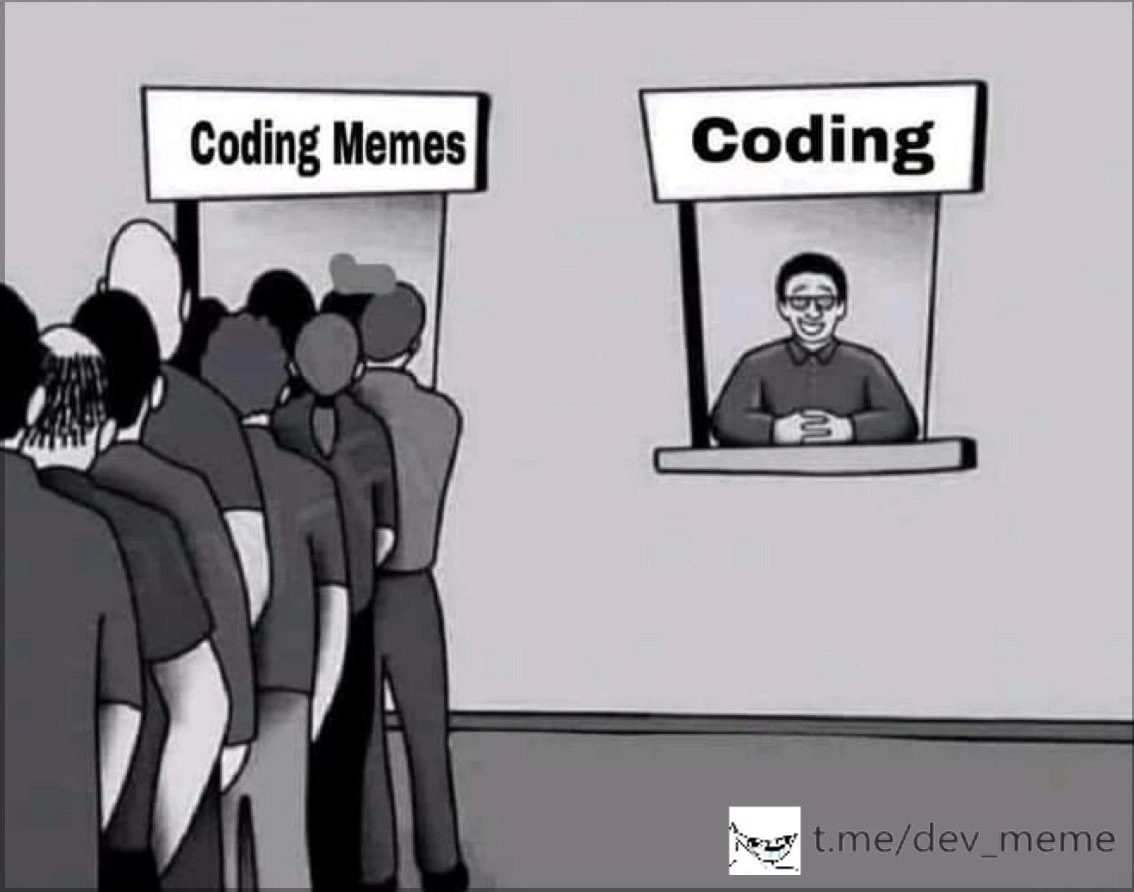
For those newer to the developer world, let’s break down what’s happening in this cartoon. We have two service windows side by side. One window is offering “Coding Memes” – these are jokes or funny images about programming. Think of memes as the inside jokes of the internet; in this case, they’re all about coding life (silly errors, computer puns, that sort of thing). The other window is offering “Coding” – which means actually doing programming work: writing code, fixing bugs, building apps, all the real stuff developers do.

In the picture, there’s a huge line of people waiting excitedly at the “Coding Memes” booth. These people represent developers who would rather spend time enjoying funny posts about coding. At the “Coding” booth, we see just the attendant sitting there, looking a bit bored and lonely because no one is lining up to do actual coding at that moment. The joke is clear: given the choice, a lot of us (even those whose job is coding!) often prefer consuming entertainment over doing work. It’s poking fun at our tendency to procrastinate. Procrastination means delaying or postponing something that needs to be done – like when you have homework but you keep finding other things to do instead. Here, the “other thing” to do is scrolling through memes.

Let’s connect this to some everyday developer context:

  • Developer communities: These are groups or platforms where programmers hang out, share knowledge, and often share humor. For example, many teams have a Slack workspace with channels for different topics. One might be a serious project channel, and another might be a fun “meme channel” where everyone shares jokes. Online forums like Reddit (e.g., the subreddit r/ProgrammerHumor) or Telegram groups (see the watermark t.me/dev_meme in the corner) are also popular places to trade funny coding memes. Being part of such a community means you’ll constantly see new jokes and memes flying around.
  • Developer productivity: This term refers to how much useful coding work a developer gets done. It’s something both developers and their managers care about. Staying productive means focusing on coding tasks, solving problems, and not getting too sidetracked. But staying productive can be hard! Distractions are everywhere – and for developers, tech memes are a very tempting distraction because they feel relevant to work (they’re about coding, after all). Checking a meme or two might seem harmless, but it can snowball. Every minute spent on memes is a minute not spent writing or reviewing code. If you’ve ever found that a quick phone check turned into an hour lost, you get the idea.
  • Memes_over_work (a playful tag used here): This isn’t a formal term, but it encapsulates the joke – choosing memes over work. It’s a lighthearted way to label the habit of browsing funny content instead of doing one’s job. Many of us have done this at some point. It’s basically a sign of procrastination. We know the code is waiting, but the meme feed is just too enticing right now.
  • Queue for memes, lonely coding booth: This describes exactly the image. The “queue for memes” is that long line of devs eager for the next joke. The “lonely coding booth” is the empty spot where actual work is offered. The contrast is what makes the scene funny. It’s like a comic exaggeration of an office scenario: imagine an office where the break room (with a TV playing funny videos) is packed with programmers, while the meeting room where they’re supposed to be working is empty. Of course, in reality not every developer is slacking off all the time – but it often feels like everyone (including ourselves) would rather be in the fun line.

If you’re just starting out, you might notice this pattern in yourself or others. Maybe you set aside time to practice coding, but then you catch yourself scrolling TikTok or reading jokes on Twitter about how tough coding is. It’s a bit ironic, right? You seek out content about coding struggles as a way to escape actually struggling with code. Don’t worry – this happens to even the most experienced engineers. The important thing is to be aware of it. Enjoying some memes or taking short breaks can be refreshing, but if you spend too much time in the meme line, you won’t make progress on your coding skills or projects. The meme is a gentle reminder (with humor) of that balance we all need to find.

To put it simply: coding is challenging and sometimes it feels tedious or frustrating, while memes are fun and easy. The cartoon uses that fact to get a laugh. It’s saying “look at all these developers (including us) who’d rather goof off because it’s instantly rewarding, and look at poor coding sitting there unloved.” It’s a playful nudge to not forget about the actual work. After all, those funny memes about programming wouldn’t exist if no one did any programming! So, while it’s okay and even healthy to take a breather and enjoy the community’s humor (we all bond over these jokes), this meme encourages us to recognize when the balance tips too far. When you catch yourself with a long meme queue but an empty code editor, you’ll remember this cartoon and hopefully smile and then get back to coding.

Level 3: Meme-Driven Development

At a glance, this cartoon hits senior developers right in the feels because it’s so true. We’ve all seen it (and done it): sitting down to code a complex feature or debug a gnarly bug, and somehow ending up in a rabbit hole of TechMemes and joke threads instead. The left booth in the image is labeled “Coding Memes” and has a long line of developers eagerly waiting. The right booth, labeled “Coding,” has a friendly attendant with absolutely no one in line. This humorous contrast speaks volumes about our daily battles with focus and procrastination. Why is this funny? Because it exaggerates a real pattern in tech culture: given the choice between doing hard work (writing code can be mentally taxing and sometimes frustrating) versus consuming easy entertainment (funny memes give instant joy with no effort), our brains tend to queue up for the latter. It’s like the comic is saying: “Look, everyone’s waiting for the fun stuff while actual work sits there like a support engineer on an empty helpdesk, twiddling thumbs.”

This scenario is a staple of RelatableDeveloperExperience. In many modern Dev teams – especially with remote work and vibrant DevCommunities on Slack, Discord, or Telegram – it’s common to have a #random or #memes channel buzzing all day. You’ll see meme after meme about coding life: jokes about failed deployments, caffeine overload, or the classic “works on my machine” gag. Meanwhile, the serious project channels, or the actual code review boards, are comparatively quiet. The meme highlights this by showing a literal queue for memes. It’s as if developers collectively sometimes prioritize sharing or enjoying CodingHumor over actually coding. We chuckle because it’s a bit of a self-own: we know we should be in the “Coding” line, but hey, the “Coding Memes” line is where all our friends are hanging out and laughing.

There’s an unspoken camaraderie in these procrastination habits. Slack-channel culture encourages casual interaction and bonding, often through humor. A senior engineer might drop a spicy Kubernetes meme in the morning stand-up channel to lighten the mood. Pretty soon, half the team is posting their favorite comic strips from XKCD or sarcastic tweets about the latest JavaScript framework. It’s fun, it’s team-building… and let’s be honest, it’s also a productivity black hole if it gets out of hand. The term dopamine loop gets thrown around here: each new meme or notification gives your brain a tiny hit of pleasure (dopamine). It feels good, so you want another. Before you know it, you’ve spent 30 minutes scrolling and laughing, while your IDE is sitting in the background with that function still half-written. Senior devs privately acknowledge this productivity drain with a mix of guilt and resignation. We joke about it publicly (“LOL I spent all afternoon looking at memes”), but deep down we know those features won’t code themselves. It’s the classic struggle between short-term enjoyment and long-term goals.

Why is fixing this habit so hard? For one, writing code – especially tough, creative coding – requires being in a flow state, a zone of deep concentration. Getting into flow takes effort and uninterrupted time. By contrast, enjoying a meme is instantaneous and effortless. The meme line is full because it’s the path of least resistance: it takes zero effort to consume a funny picture, and it gives an immediate reward (a laugh, a feeling of “I’m not alone in this craziness”). On the other hand, starting a coding task often means facing possible frustration or uncertainty (Will the code work? Where do I start?). The human brain, if not strictly disciplined, will naturally drift towards the activity that is comfortable and rewarding now. This is the same reason we see queue_for_memes in real life: open any developer’s web browser, and alongside Stack Overflow you might find a Reddit tab for r/ProgrammerHumor or a YouTube video about tech jokes playing in the corner.

From an organizational perspective, this meme also pokes fun at how companies try to cultivate culture. Many workplaces explicitly encourage some fun to keep morale up – think Meme Wednesdays or Casual Fridays. The post even greets us with “Have a nice Wednesday evening my friends – did you like this meme-wednesday?” indicating that sharing memes mid-week is a ritual. It’s a double-edged sword: on one side, DeveloperProductivity can actually benefit from short breaks and laughter. A quick meme break can reduce stress, unblock creative thinking, or build team rapport (a team that laughs together, lasts together… or something like that). But on the flip side, it’s easy for short break to turn into extended procrastination. Senior developers have witnessed or experienced “I’ll just take a 5-minute meme break” turning into an hour of lost time. We’ve sat in sprint retrospectives hearing jokes about how the real blocker was the meme channel. The humor in the cartoon is a gentle roast of ourselves and our peers: even the most experienced engineers, who know every productivity trick in the book, can fall victim to the meme queue.

The meme’s reference to priority inversion is especially delicious for the experienced crowd because it frames this everyday struggle in tech jargon. It’s essentially saying our personal priorities have flipped upside down: trivial amusements are running at high priority while critical tasks languish at low priority. We laugh, perhaps a bit nervously, because it rings true. As a seasoned dev, you might recall critical production issues you’ve solved heroically at 2 AM – yet here you are at 2 PM, ignoring a relatively simple ticket while you chuckle at the latest “it’s always DNS” meme. The contrast between what we should be doing and what we are doing couldn’t be starker. And that slice of humility is what makes the meme hilarious and a tiny bit painful. It’s basically a comic mirror held up to our face.

To paint the picture in code-like logic, here’s a pseudo-routine that many of us unconsciously follow:

# Developer's daily focus loop (simplified):
while work_hours_remaining():
    if slack_channel.has_new("memes"):
        consume_memes()    # quick dopamine hit from TechMemes
    else:
        write_code()       # do the real Coding work
# End result: day is over, and we wonder where the time went...

Notice how the if condition favors checking for new memes over writing code. It’s a tongue-in-cheek way to illustrate that memes_over_work tendency. In a well-balanced day, that if should probably be inverted (check work first, then allow memes as a break). But as the long queue in the cartoon shows, our internal logic might lean the other way around. Experienced devs grin at this because we thrive on efficiency and optimization in code, yet our own behaviors are sometimes the opposite of optimized. The meme gently teases this inconsistency.

In summary, from a senior perspective, this meme is funny because it’s an exaggeration anchored in truth. It lampoons the universal developer experience of procrastination humor – using coding jokes as a tempting escape from actual coding. It also serves as a cheeky self-reminder: maybe it’s time to step out of the meme line and get back to the code window. We laugh, we nod, and then… well, maybe we share the meme with our team before finally closing that Slack tab to concentrate (at least until the next dopamine ping comes in).

Level 4: Priority Inversion Paradox

In computer science, priority inversion is a fascinating (and dangerous) scenario where a lower-priority task blocks a higher-priority task from running. It’s as if a trivial job holds a resource (like a mutex lock) that a critical job needs, causing the important work to wait behind the less important work – an inversion of expected priorities. Real-time operating systems have to handle this carefully: if they don’t, even a tiny background task can stall a mission-critical process. A famous example occurred on NASA’s Mars Pathfinder in 1997. The spacecraft’s computer experienced repeated resets because a high-priority thread (handling important data) was waiting on a mutex held by a low-priority thread. Meanwhile, a medium-priority thread (unrelated housekeeping) kept running, preventing the low-priority one from ever releasing the mutex. The result? The all-important high-priority task couldn’t run when it needed to. NASA engineers fixed it by enabling a feature called priority inheritance, which temporarily boosted the low-priority thread’s priority so it could finish its work and free the resource. This real incident highlights how serious priority inversion can be in concurrent systems – it nearly jeopardized a Mars mission!

Now, think of a developer’s mind as a scheduler juggling multiple “threads” of work. Ideally, “Coding” (the real development work) should be the high-priority thread in our day, while browsing “Coding Memes” should be a low-priority background thread we only run during breaks. But in practice, the brain’s “task scheduler” often gets it backward. The low-priority task (scrolling memes on Slack or Reddit) might hold our attention lock, and the high-priority task (writing code for that looming deadline) gets starved of CPU time in our head. It’s a cognitive priority inversion: the fun, unimportant activity blocks the important work. The meme’s title, “Priority inversion,” is a clever geek pun – it takes this niche scheduling concept and applies it to everyday developer life. Just like an OS bug where the system’s priorities get flipped, we developers humorously admit our priorities can flip too (with memes preempting work). In essence, our DeveloperProductivity can stall because the “meme thread” isn’t yielding to the “coding thread.” The analogy runs deep: constant task switching (context switches) between code and memes also incurs a cache miss in our brain (losing focus, forgetting where we left off in the code). In computing, context-switch overhead slows down throughput; in programming life, distraction overhead slows down progress. The meme captures this inverted priority phenomenon with a simple visual: a long queue for memes and an idle stall for coding. It’s a tongue-in-cheek acknowledgment that even the best algorithms in our brain’s scheduler can be subverted by the allure of a quick laugh. In short, the meme not only jokes about procrastination but does so using a term that resonates with any senior engineer who’s dealt with threading issues – a double nerdy reference that makes the joke richer for those in the know.

Description

A grayscale cartoon meme depicting two adjacent service booths. On the left, a booth labeled 'Coding Memes' has a very long queue of people waiting eagerly. On the right, an identical booth labeled 'Coding' is completely empty, with a single attendant sitting alone with a placid smile. The image humorously illustrates a common trope in developer culture: the act of programming is often solitary and requires deep focus, while the community and humor surrounding it - like memes - are highly popular and engaging. It's a meta-commentary on how developers often prefer to engage with relatable content about their work rather than doing the work itself, highlighting procrastination, the need for community, and shared humor as integral parts of the developer experience. A watermark for 't.me/dev_meme' is visible at the bottom right
Comments

7
Anonymous ★ Top Pick The 'Coding' booth is where you implement the feature. The 'Coding Memes' queue is where you find the principal engineer who remembers the obscure Stack Overflow answer that explains why the feature was a bad idea in the first place
  1. Anonymous ★ Top Pick

    The 'Coding' booth is where you implement the feature. The 'Coding Memes' queue is where you find the principal engineer who remembers the obscure Stack Overflow answer that explains why the feature was a bad idea in the first place

  2. Anonymous

    Our sprint velocity metric says we ship 12 memes per iteration - unfortunately Jira still shows zero story points accepted

  3. Anonymous

    After 20 years in tech, I've learned that the time spent debating tabs vs spaces in meme threads could've refactored our entire legacy monolith twice over - but at least we'd miss out on the collective therapy session that is sharing our production incident war stories

  4. Anonymous

    This perfectly captures the eternal paradox of software engineering: we'll spend hours debating tabs vs spaces, arguing about framework choices, and sharing memes about our pain - but ask us to actually sit down and write production code? Suddenly everyone's got a standup meeting to attend. It's the technical equivalent of having 47 browser tabs open with 'Learn Rust' tutorials while you're actually just refactoring the same JavaScript function for the third time because 'this time it'll be cleaner.'

  5. Anonymous

    After two decades tuning kernels, the only scheduler I can’t fix is my own: the memes thread runs SCHED_FIFO at 99 and starves coding via priority inversion

  6. Anonymous

    The 'Coding Memes' queue is basically a low-latency, four-nines dopamine microservice; the 'Coding' booth is a monolith blocked on context switching and 47 Slack tabs

  7. Anonymous

    Devs scale meme replication to infinity, but coding throughput remains embarrassingly single-threaded

Use J and K for navigation