The Optimization Paradox: Two Kinds of Wasted Time
Why is this DeveloperProductivity meme funny?
Level 1: The Long Shortcut
Imagine you have two friends who each have to clean up their messy room. The first friend, Alex, just grabs a trash bag and starts picking up toys and clothes by hand. Alex spends about 15 minutes cleaning the room. It’s a bit boring, but it gets the job done.
Now the second friend, Ben, hates cleaning and thinks, “I’m going to be clever about this!” Ben decides to build a little robot that will clean the room automatically. Ben spends the whole afternoon with LEGO and code, tinkering to make a mini cleaning machine. After 4 hours, the robot is finally ready. It whirrs around and picks up a few toys (yay!). Ben feels very proud and says to Alex, “Ha! You wasted time cleaning because you didn’t automate it. I automated my cleaning. We are not the same.”
But here’s the funny thing: both friends ended up spending a lot of time on this chore in one way or another. Alex spent 15 minutes actually cleaning. Ben spent 4 hours building a robot plus a few extra minutes letting it do the cleaning. In the end, Ben’s room got clean, but he invested way more time than Alex. Ben calls Alex’s work “useless” because Alex didn’t build a cool process. Meanwhile, Alex might think Ben’s effort was “useless” because Ben could have cleaned the room much faster by hand. The meme is just like this story. One person spends time doing a task over and over, the other person spends even more time trying to avoid doing that task by creating a fancy solution. The punchline is that both of them spent hours on something that could have taken far less time.
It’s like taking a long shortcut – a path that’s supposed to save time but actually takes much longer. The second friend is essentially bragging, “I’m smarter because I made a machine to do it!” But we can see it’s a bit silly because the result (a clean room) was achieved by both, and Alex was done in 15 minutes while Ben was working the whole day. So, the humor comes from Ben thinking he’s superior for “optimizing” (making a robot), even though he ended up working more. Both friends wanted to be efficient, but one tried to be too clever. The lesson is simple: sometimes the simple, direct way is fine, and trying to shortcut with a big process or machine can backfire. In other words, if you spend more time on the shortcut than the task itself, you’re not really saving any time at all. And that’s why this scenario is funny – it reminds us of a kid who builds an elaborate contraption for something they could easily do, just to say “Look how cool this is!” while the other kid already finished the chore.
Level 2: Premature Optimization
Let’s break down what’s going on in this meme in simpler terms. First, consider the idea of automation. Automation is when you write a program or script to do a task for you, so you don't have to do it by hand every time. In software development, automation is usually meant to improve developer productivity – for example, automatically running tests or deploying code so that developers save time and avoid mistakes. Tooling refers to the tools and scripts that help automate these tasks (like a build script, a deployment pipeline, or a Continuous Integration server such as Jenkins or GitHub Actions). In principle, automating repetitive tasks is great: if you have to do something over and over, writing a little program or script can save you time in the long run.
However, this meme is highlighting a funny overengineering scenario. Overengineering means designing a solution that's far more complicated or fancy than necessary for the problem at hand. In the top text, Person A is accused of “doing useless work because you don’t optimize your processes.” This implies Person A might be doing things the “manual” way every time – perhaps manually clicking through steps or copy-pasting code – and thus spending extra hours over months or years because they never set up any automation or improved their workflow. They haven’t optimized how they work, so they waste time on repetitive chores.
Now, the middle text is Person B’s rebuttal: “I spend hours doing useless work because I optimize my processes.” This is where the irony kicks in. Person B does automate their tasks – they optimize their process – but in doing so, they also ended up doing “useless work” for hours. How can optimizing lead to useless work? Imagine a task that takes 5 minutes to do manually. If Person B spends 5 hours writing an automation script or building a whole tool to do that task, that’s a huge upfront time cost. Unless that task is going to be run dozens of times, Person B won’t earn back those hours. In other words, Person B over-optimized. They fell into the trap of premature optimization, a term in programming that means trying to make something more efficient before you actually know if it’s needed. A famous programmer, Donald Knuth, said “premature optimization is the root of all evil” to warn developers not to optimize things too early or unnecessarily. In our context, Person B optimized their workflow prematurely – they spent time making a super efficient process for a task that maybe didn’t need that level of effort.
So the meme sets up a comparison: both Person A and Person B have spent hours on “useless work,” but for opposite reasons. Person A wasted time by not automating (doing things the slow way every time), and Person B wasted time by over-automating (building a complex solution that wasn’t worth the time for the benefit it gives). The bottom punchline “We are not the same.” is said by Person B in a smug tone. This phrase comes from the “we_are_not_the_same” meme format, where someone brags about how their approach is superior. Here it’s used ironically: Person B is acting superior (“I optimize my processes, unlike you”), but the joke is that both approaches resulted in wasted time. Person B’s process automation irony is that optimizing became its own form of procrastination or busywork.
To a newer developer, this highlights a valuable lesson in optimization tradeoffs. Not every problem needs a high-tech solution. Sometimes writing a quick one-off script or even doing a task manually is perfectly fine if it’s infrequent. Other times, if a task is repetitive and error-prone, investing time to automate it can pay off handsomely. The key is to judge the ROI (Return on Investment) of automation. ROI in this context just means: will the time/effort you invest in making a tool be worth the time you save later by using it? For example, if it takes you 10 hours to develop a tool that saves 1 hour of work per week, then in about 10 weeks you break even and after that you’re saving time. But if it takes 10 hours to build a tool that saves 5 minutes a year, you’ll probably never get back the time you spent building it! Person B’s mistake (and the humor of the meme) is treating “optimize all the things” as a rule, without thinking about this balance. They essentially performed automation overkill – like using a sledgehammer to crack a nut.
Let’s illustrate with a concrete example: Say you have to update the title on a document in 30 different files. Person A might open each file and change the title manually. That could take maybe 30 minutes of tedious work. Person B, on the other hand, hates doing that kind of repetitive task and decides to write a Python script to do it. But writing and testing that script, making sure it works for all files, ends up taking 3 hours. In the end, both people achieve the same result (titles updated). Person A spent 30 minutes on manual edits; Person B spent 3 hours coding an automation script – which is six times longer! If this was a one-time task, Person B’s effort doesn’t pay off. Person B might proudly say, “Now I have a tool for it!” – which is true, and if tomorrow they need to update titles again, they can reuse that script. But if this task never comes up again or only once a year, the time saved is minimal. Both approaches had waste: Person A wasted time repeatedly (each manual edit is slow), Person B wasted time upfront (building a tool that wasn’t really needed). The meme humorously has Person B declare “We are not the same” as if being the one who automated somehow makes them superior. The laugh comes from realizing that, in the end, both persons lost time in different ways.
The relatable humor here is strong for developers. Many of us love to automate things – it’s in our nature to solve problems with code. It even feels more fun to write a script than to do a boring task manually. But as a junior dev, it’s important to learn that more code and more process isn’t automatically better. There’s maintenance to consider too: every script or tool you write can break or need updates (for example, Person B’s fancy pipeline might fail if the environment changes, requiring even more work to fix). This is sometimes jokingly called the “automation tax” or process overhead – the extra effort that comes with managing all those optimizations. On the flip side, doing everything manually can lead to errors and doesn’t scale if you really do need to repeat a task often. So, the wisdom is in finding a balance. Optimize when it truly helps, and keep things simple when the task is small or rare. The meme’s satire reminds new developers not to be blindly proud of automation for its own sake. The goal is to actually save time and effort, not just appear “efficient” on paper. In essence, efficiency isn’t efficient if it costs more than it saves.
Level 3: Yak Shaving ROI
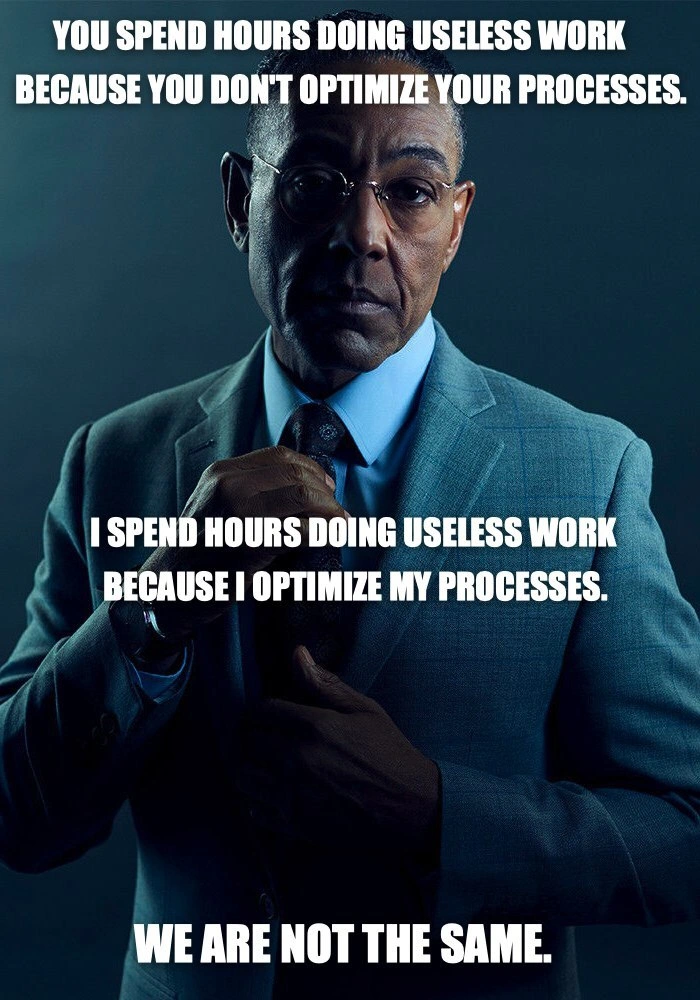
This meme brilliantly skewers the optimization paradox we encounter in software development. The top caption scolds someone for not optimizing processes – implying they spend hours on repetitive, inefficient work. The middle retort flips the script: “I spend hours doing useless work because I optimize my processes.” Here, a developer proudly admits they sank an egregious amount of time into automation or tooling, all in the name of efficiency. The punchline “WE ARE NOT THE SAME.” drips with ironic superiority. In reality, both individuals wasted hours on useless work; the difference is only how they wasted it. One neglected automation, the other over-engineered it – and the meme humorously declares one as if better than the other. It’s a textbook case of overengineering where the solution costs more time than the problem ever would.
This irony lands so well because it’s a relatable developer experience. Many senior engineers have fallen into the yak shaving trap: you start with a simple goal, then realize to do that you need to “shave a yak” (perform a series of tedious prerequisite tasks). For example, imagine needing to run a one-time database migration. A straightforward approach might be to execute a SQL script manually in 5 minutes. But an automation addict might decide, “Let’s build a CI pipeline to handle database migrations automatically!” Suddenly they’re writing YAML configs, containerizing a tool, setting up a Jenkins job, and tweaking bash scripts for hours. By the time everything works, the single migration is long done – the yak has been fully shaved 🐃. The term yak shaving perfectly captures this spiral of process overkill, and the ROI (Return on Investment) on that effort is laughably negative if the task was a one-off.
The meme’s chic image (a poised man in a teal suit adjusting his tie) amplifies the tongue-in-cheek tone of superiority. It’s modeled on the “We Are Not The Same” meme template, often featuring a confident figure proclaiming how their approach sets them apart. Here, the well-dressed man symbolizes a dev who’s proud of being an efficiency guru. The joke is that his pride is misplaced – he devoted ten hours to automate a task that might’ve taken one hour manually. It’s like constructing a Rube Goldberg machine (an overly complex contraption) to do something trivial. The Automation category tag shines here: we see automation taken to absurd heights. And the DeveloperProductivity angle is twisted – is it really productive to spend a day writing a script that saves you an hour? This is a classic example of premature optimization (optimizing before it’s actually needed) and misjudging optimization tradeoffs.
Every experienced dev has that war story of tooling gone awry: perhaps you introduced a heavyweight build script or a custom deployment automation to save future time, only to realize you invested far more effort than the old manual process ever demanded. Maybe you’ve refactored a working script into an ultra-flexible framework “for reuse,” only to never reuse it. The humor cuts deep because the industry preaches “Automate all the things!” – continuous integration, infrastructure as code, one-click deploys – yet we rarely discuss the overhead those optimizations introduce. In truth, automation follows a law of diminishing returns. A small daily task (say, 2 minutes a day) is worth automating if you’ll run it hundreds of times. But a 5-minute task you’ll do twice a year? Automating that might be pure overkill. This meme highlights that blind spot: the automation overkill where processes themselves become a form of useless work. It’s pointing out a common optimization tradeoff failure: not accounting for the time investment vs. payoff.
There’s also a subtle poke at engineering culture and management thinking. Teams are often divided between those who “just get it done” and those who “build a system to get it done.” The first person in the meme might be seen as a laggard by process-obsessed managers: “Why didn’t you streamline this? You’re wasting time!” Meanwhile, the second person is the engineer who impresses management by instituting a fancy process – even if it cost more hours than it saved. The meme exposes the absurdity: process for process’ sake can be as wasteful as having no process at all. It’s a premature optimization in workflow. We feel both characters’ pain: one drowning in mundane tasks, the other drowning in self-made complexity. The seasoned engineer reading this likely smirks because they’ve lived both sides. Perhaps they recall staying late to script an “elegant” solution that no one asked for (or that promptly broke and required even more time to fix at 3 AM). In the end, the joke’s on both parties – neither is actually ahead. The meme’s bold claim “We are not the same” is a sarcastic nod to how developers justify their time sinks. It reminds us that being busy isn’t the same as being productive, and that true developer productivity sometimes means not building the elaborate automated solution. After all, the best engineers learn when to keep it simple versus when to optimize all the things.
Description
This meme uses the 'We Are Not the Same' format, featuring a stern, well-dressed Giancarlo Esposito as Gus Fring from the TV series Breaking Bad, adjusting his tie against a dark background. The image is overlaid with bold, white, all-caps text. The top text reads: 'YOU SPEND HOURS DOING USELESS WORK BECAUSE YOU DON'T OPTIMIZE YOUR PROCESSES.' The middle text contrasts this with: 'I SPEND HOURS DOING USELESS WORK BECAUSE I OPTIMIZE MY PROCESSES.' The punchline at the bottom declares: 'WE ARE NOT THE SAME.' The meme captures a sophisticated developer irony: while inefficiency leads to wasted time for some, the drive to perfect and automate processes can lead experienced engineers down a rabbit hole of over-optimization, another form of 'useless work'. It's a commentary on yak shaving and premature optimization, where the time spent automating a task vastly exceeds the time saved

Comments
9Comment deleted
You waste a day because you don't know the command. I waste a day writing a Go utility to wrap the command in a bespoke CLI with interactive prompts and a config-driven plugin architecture. We are not the same
Sure, the cronjob only replaces two manual clicks, but it’s idempotent, unit-tested, and proudly wasted my entire sprint
After 15 years, you realize the real optimization was the technical debt you accumulated along the way - and that bash script you spent 3 days writing to save 5 minutes monthly? It's now a critical production dependency nobody understands
Ah yes, the senior engineer's paradox: spending three days optimizing a function that saves 50ms in a process that runs once a month. We've all been there - writing custom memory allocators for a CRUD app, implementing our own hash table because 'the standard library isn't optimal,' or refactoring perfectly functional code into an elegant abstraction that nobody else understands. Donald Knuth warned us that 'premature optimization is the root of all evil,' but we interpreted that as 'I'm experienced enough to know when optimization ISN'T premature' - spoiler alert: we're usually wrong. The real kicker? Both engineers in this meme end up in the same place: explaining to their PM why the feature took two sprints instead of two days
I’ll spend two days wiring Bash, Makefile, and pre-commit hooks to automate a 30‑second chore - break-even in 2043, but at least the pipeline is idempotent and observable
I optimized the pipeline to save 38 seconds per PR; the approval queue still adds 48 hours - premature optimization meets corporate reality
You brute-force inefficiency; I Big-O my way to elegant pointlessness - same useless hours, superior asymptote
So what should I do to stop doing useless work?😥 Comment deleted
It’s ok that part of your actual work includes something that seems useless If it’s not too much - focus on the result Otherwise you always can try to cut reasons of your time being wasted ❤️ Comment deleted