The Sorting Hat of Corporate Onboarding
Why is this LegacySystems meme funny?
Level 1: The Unwanted Chore
Imagine you’re at school and there’s a big, messy classroom that no one has cleaned in ages. It’s full of old papers and junk left behind over many years. On your first day, the teacher decides to pick someone to tidy it up. They put on a little game or ceremony to choose the student. You’re hoping and whispering, “Please not me… please not me.” But then, with a drumroll, the teacher points to you and says, “You will clean the messy classroom!” Everyone else cheers because they’re off the hook, and you’re standing there feeling unlucky and nervous. In this meme, that’s basically what’s happening: the new developer is like the new kid who just got picked to do the unwanted chore. The wizard hat is a fun imaginary way to choose, like drawing names out of a hat, but the outcome is the one thing the person really hoped to avoid. The manager is happy because the tough job finally has someone to do it, just like the teacher might be happy the classroom will get cleaned. The developer under the hat feels like the kid who now has to spend their afternoon in a dusty old room while everyone else gets to do more fun stuff. The joke is funny because we all know the feeling of being chosen for a task nobody else wanted – it’s a mix of “oh no!” and “of course it had to be me.” Even if you’re not a programmer, you can relate to that dreaded moment when you get picked to do the least fun job. Here, the magic hat was supposed to be impartial or even kind, but it ends up giving the new guy exactly the project everyone was afraid of. It’s like a fairy tale with a twist: instead of being chosen for a special reward, our hero got picked to take care of the oldest, messiest part of the kingdom. And while that’s unfair, we can’t help but laugh at how perfectly unlucky it is!
Level 2: Sorted into Spaghetti
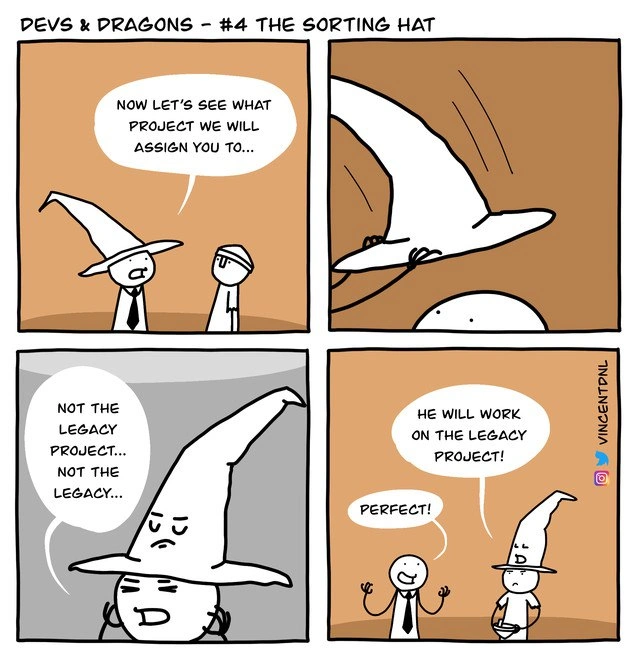
Let’s break down the joke for those newer to the developer world. The comic is a four-panel comic strip titled “DEVS & DRAGONS – #4 THE SORTING HAT.” It’s mixing fantasy elements with software development scenarios (hence the series name Devs & Dragons, a play on Dungeons & Dragons). In this strip, a manager (guy in a business suit) puts a big wizard’s hat on a fresh developer’s head to decide which project the newbie will work on. This is directly spoofing the Sorting Hat from the Harry Potter books/movies – in Harry Potter, a magical hat is placed on new students’ heads to assign them to a school house (like Gryffindor or Slytherin). Here, instead of houses, the hat will assign the developer to a project team. It’s a fun, geeky way to depict a usually mundane office situation: project assignment.
Now, what’s the “legacy project” everyone is fearful of? In tech, a legacy codebase (or legacy project) refers to an old software system that’s still in use. Think of a big application written years ago (sometimes decades), using older technology or outdated practices. It’s called “legacy” because it’s inherited from the past – the people who originally wrote it might have left the company, and the code may not follow modern standards. Such systems often have a lot of technical debt, which means they have unresolved problems or quick-and-dirty solutions from the past that make them hard to work with today. An example of technical debt: imagine a programmer took a shortcut to meet a deadline, saying “I’ll fix this properly later,” but later never came. Multiply that by hundreds of fixes over years, and you get a system that’s very brittle and hard to maintain.
Spaghetti code is a common slang for code that’s tangled and messy, like a heap of cooked spaghetti. In a spaghetti codebase, functions and modules twist around and reference each other in confusing ways. There might not be clear structure – no clean separation of concerns – so understanding or changing one part is difficult because everything is interwoven. A legacy project often contains spaghetti code due to many people altering it over time without a guiding plan. There might be large files with thousands of lines of code, cryptic variable names (var1, var2, temp, data123 everywhere), or sections that nobody understands but are too scared to remove. It’s the opposite of fresh, well-documented code.
Now imagine you’re a new developer joining a company. You’re hoping to work on something exciting, maybe a new app with a modern programming language or a sleek product feature. Instead, on your first week, your manager tells you that you’ll be working on “the legacy project.” This is that project everyone jokes about – the one with all the oldest, hardest-to-read code, possibly written in a language nobody uses much anymore. It might be crucial to the company (for example, handling all the payment processing or customer data), but it’s not glamorous. Maintaining it can be daunting because if you introduce a bug, it could break something that’s been working (however clunkily) for years. There often isn’t good documentation (i.e. written guides or explanations) for legacy systems. The original authors might have moved on, so there’s no one to ask, “Hey, why does this code do that weird thing?”
The comic shows the hat’s internal monologue saying “Not the legacy project... not the legacy...” This is a direct reference to Harry Potter, where Harry thinks “Not Slytherin” because he doesn’t want to be placed in Slytherin house. Here both the hat and the developer are hoping he won’t get placed on the legacy system. That’s how dreaded this assignment is – even the hat knows it’s a tough one. When the hat finally shouts, “He will work on the legacy project!”, it’s basically like it yelled “Slytherin!” in the Potter universe, except instead of a potentially evil house, it’s sending him to do LegacyCode maintenance. The manager’s reaction, “Perfect!”, shows that from the management perspective, this solves a problem: they needed somebody to work on that neglected project, and now they have a victim—er, volunteer. Managers or Project Managers (PMs) often have to allocate people to projects that need help, and the legacy system is usually always in need of help. Unfortunately, they might assign a newcomer because the seasoned devs are either too valuable elsewhere, or honestly, they avoid it after surviving it before.
Why is this humorous to developers? It’s relatable humor. Many developers have experienced being “volunteered” for an unpleasant task or project that no one else wants. It’s a running joke in tech: Welcome to the team, here’s a 10-year-old codebase full of mysteries – good luck! The Harry Potter twist just exaggerates it in a nerdy way we all recognize. By using the wizard hat scene, the comic artist (notice the credit “@vincentdnl” in the corner) taps into something we know from pop culture and connects it to an office scenario. If you’ve ever had a job where the least desirable work gets passed to the newest team member, you’ll chuckle at this. The contrast between the manager’s cheerful demeanor and the developer’s defeated stance is classic DeveloperHumor – we laugh so we don’t cry. It’s making fun of the tendency in some workplaces to treat project assignment like fate dealt by a higher power (in this case, a talking hat) when really it’s just dumping the toughest job on the newcomer.
Let’s also clarify tech debt a bit more, since it’s key to why the legacy project is feared. Technical debt is a metaphor: when teams take shortcuts or postpone improvements in the code, they “borrow” time, but they’ll “pay for it” later with complexity. Just like credit card debt, interest accumulates – the codebase gets harder to change as this debt grows. A legacy system has a huge “debt” – lots of parts that should have been refactored (cleaned up) or rewritten, but never were. So working on it means you’re constantly encountering odd, kludgy solutions that you must work around or carefully fix. For a junior developer, that’s intimidating. They might be afraid to change anything because they could break something unintentionally. There’s also usually poor test coverage (automated tests that ensure everything still works) in such projects, which means if you make a mistake, you often won’t know until a user or customer finds a bug. Scary, right? That’s why the hat thinking “not the legacy project” is so poignant – it captures that fear of being put in charge of a fragile, messy system when you’re not fully confident yet.
The term LegacySystemsAndModernization points to a broader theme: companies often talk about updating old systems (for example, rewriting an old module in a new programming language, or moving from a monolithic design to microservices). But modernization projects are challenging – they require time, money, and expertise. So instead, many places keep the old system running with patches and assign developers to keep it afloat. Being assigned to one can feel like you’ve been exiled from the shiny new development and sent to the “dungeon” to perform maintenance. It might even become a niche role – you could become known as “the person who handles that old system,” which is both job security and a potential career trap (since you aren’t learning the new stuff). That’s why when the manager in the comic says “Perfect!”, it’s darkly funny: he’s treating this like a great solution, whereas the developer might be thinking their growth opportunities just got put on hold.
In summary, the meme is a harry_potter_parody that uses the Sorting Hat metaphor to joke about legacy project assignment in software teams. Each panel reinforces the gag: the formal setup (like a fantasy ceremony for something utterly un-magical), the internal dread (everyone knows the legacy codebase is bad news), and the inescapable outcome (the newbie gets the short end of the stick). It’s relatable humor for anyone who’s been the new developer or seen a newbie get thrown at an old, creaky project. You don’t need to catch every reference to get it – the exaggerated expressions and the familiar Sorting Hat scene make it clear that the legacy project is the “losing” outcome. If you’re a junior developer reading this, don’t worry – not every company does this to newcomers! But it happens enough that jokes about it are common in TechHumor circles. And if you do end up on a legacy system, take heart: tackling it can teach you a ton (even if it feels like fighting a dragon in a dungeon sometimes).
Level 3: Cursed Codebase Inheritance
This meme conjures a scene every senior developer dreads: being ceremoniously assigned to maintain a legacy codebase laden with years of technical debt. It parodies the Harry Potter Sorting Hat ritual, but instead of sorting a young wizard into a Hogwarts house, a manager in a suit is “sorting” a new engineer into a project. In the first panel, the manager places an oversized wizard hat on the unsuspecting new hire and intones, “Now let’s see what project we will assign you to…” – a moment dripping with dark anticipation for seasoned devs. The humor here is that the wizard hat is about to deliver a fate worse than any Slytherin: the dreaded legacy project.
In the Harry Potter story, the magical hat listens to the student’s pleas (Harry whispers “not Slytherin, not Slytherin” and the hat obliges). But in this comic’s third panel, we see the hat’s internal anxiety: “NOT the legacy project… not the legacy…” – echoing the new developer’s silent prayer. Every experienced engineer knows this desperate hope: please assign me to anything but that ancient system nobody wants to touch. The punchline hits in the final panel when the hat brazenly declares, “He will work on the legacy project!” The manager gleefully responds, “Perfect!” while the poor developer stands there, face obscured by the slumping hat, looking utterly resigned. It’s a spot-on satire of how management often handles undesirable LegacySystems maintenance: volunteer the newest person as tribute. The manager’s joyful “Perfect!” is comically sinister – he’s just relieved to have found someone to dump the high-risk spaghetti monster onto, blissfully ignoring the developer’s horror.
Why is this so funny (or painful) to seasoned devs? Because it’s too real. In many companies, inheriting the “legacy project” is practically a rite of passage (or a hazing ritual). It’s the software equivalent of being handed a ticking time bomb that’s been duct-taped together over a decade. The codebase likely has outdated frameworks no one remembers, spaghetti code structure with logic tangled like a bowl of noodles, and zero unit tests to act as a safety net. The comic nails the shared industry joke: the project everyone else dreads gets passed to the person with the least say in the matter. The new guy can’t protest much – after all, they’re eager to prove themselves – so they often end up assigned to the high-tech-debt system that all the veterans have been avoiding. It’s practically an unwritten rule in some orgs that “legacy maintenance” is the default welcome gift for junior hires or unlucky newcomers.
From a senior perspective, there’s bitter amusement in how predictably this scenario plays out. The technical debt in such legacy systems is massive – think of quick fixes and kludges accumulated release after release like layers of sediment. Now someone has to pay back that debt with interest, usually under pressure and without proper resources. The hat in the comic literally voices the dread (“not the legacy project...”) that any sane engineer would feel. And yet, just like in real life, the plea is ignored and the worst assignment is confirmed. It’s a humorous nod to the fact that management_PMs often prioritize plugging staffing gaps over considering an engineer’s fear or the project’s onboarding difficulty. The new dev essentially "inherits" a cursed codebase – one that might be critical to the business but is infamous internally for being a house of horrors. Seasoned devs swap war stories about inheriting “big ball of mud” architectures (systems with no recognizable design, just accreted patches). This comic expertly captures that moment of doom when you realize you’ve drawn the short straw and now must babysit a temperamental old system.
Notice the small details amplifying the humor: the sorting hat itself appears comically large and saggy, almost burdened by the weight of the decision. It covers the developer’s eyes entirely in panel 2, symbolizing how opaque and mystifying the legacy system is to the poor soul who’s about to enter it blind. The hat’s face in panel 3 looks distressed – even this magical object doesn’t want to be complicit in condemning someone to the legacy codebase! Yet by panel 4, the hat’s pronouncement is confident and cheery, mirroring how a manager might blithely assign a person to the toughest project with a smile. The new dev’s slumped posture says it all: they’ve been sorted into the one “house” nobody volunteers for. It’s a clever crossover of corporate reality with fantasy lore. The DevOps elder reading this can practically hear the groans of a thousand engineers who’ve been in those shoes, thinking “here we go again.”
Beyond the parody, there’s an implicit commentary on tech culture. Companies often have shiny new “greenfield” projects using modern tech that everyone wants to join, and then there are the crusty legacy systems that quietly keep the business running. Maintaining those legacy systems is usually thankless work – you spend your days untangling mysterious bugs and retrofitting new requirements into old code. There’s plenty of technical debt: perhaps global variables that magically change state, deprecated library calls, or modules written in a programming language that went out of fashion 15 years ago. It’s stressful because any change might break something else (Cue the veteran mantra: “If it ain’t broke, don’t touch it!”). Yet someone has to do it. The comic’s dark punchline is that this “someone” will be the newest developer, who has little context or clout to refuse. Seasoned engineers find this funny because they’ve lived it: it’s both a laugh and a groan of sympathy for the poor protagonist under that hat.
Historically, the industry has grappled with LegacySystemsAndModernization for decades. There are mission-critical programs written in COBOL or ancient Java that businesses still rely on daily. Everyone talks about modernization – “We should rewrite this in a modern language, break it into microservices, add tests, etc.” – but that plan keeps getting deferred because it’s risky and expensive. Instead, management assigns a caretaker (often a newcomer) to keep the old system on life support. This creates a cycle: new developers get burned out or become experts in an outdated tech stack, while the exciting new development happens elsewhere. The meme resonates especially with senior devs and TechHumor aficionados because it distills that whole saga into one absurd Sorting Hat ceremony. By invoking a Harry Potter parody, it adds a layer of nerdy pop-culture humor to a very real workplace problem. You can almost imagine the manager as Dumbledore, except instead of sending you to Gryffindor, he’s sending you to fend off the eldritch horrors in the dungeon of legacy code. Welcome to “House Technical Debt,” young coder – you’ll be here for a while!
Description
A four-panel comic strip titled 'DEVS & DRAGONS - #4 THE SORTING HAT'. In the first panel, a manager-like figure wearing a tie and a wizard hat tells a new employee, 'NOW LET'S SEE WHAT PROJECT WE WILL ASSIGN YOU TO...'. The second panel shows the large, white wizard hat being placed on the new employee's head, covering their eyes. The third panel is a close-up of the employee wearing the hat, with a look of intense concentration, thinking, 'NOT THE LEGACY PROJECT... NOT THE LEGACY...'. The hat itself has a stern, determined facial expression. In the final panel, the manager celebrates with a 'PERFECT!', while the hat announces, 'HE WILL WORK ON THE LEGACY PROJECT!'. The employee stands by, looking defeated. This comic humorously parodies the 'Sorting Hat' from Harry Potter, applying it to the corporate ritual of assigning new developers to projects. The joke lies in the universal dread developers feel towards being assigned to a legacy project - an old, often poorly documented, and difficult-to-maintain system. It satirizes the inevitability of this rite of passage in many tech companies, where the least desirable work is often given to the newest team members
Comments
10Comment deleted
Our Sorting Hat is just a bash script that greps the new hire's resume for 'passionate and enjoys a challenge,' then immediately assigns them to the undocumented COBOL monolith
The Sorting Hat just measures residual optimism; anyone above 0% gets sorted onto the 2-million-line monolith that still deploys via an NFS-mounted “prod” folder and an Ant script from 2007
Just like the Sorting Hat placing Harry in Gryffindor despite his protests, senior architects have an uncanny ability to assign junior devs to legacy codebases despite their silent prayers for greenfield projects - except instead of 'not Slytherin,' it's 'not the COBOL system from 1987.'
The Sorting Hat never assigns anyone to the greenfield microservices project - that's reserved for the chosen ones who somehow always avoid the COBOL codebase that's been 'temporarily' running the company's core business logic since 1987. Meanwhile, the rest of us get sorted into Slytherin's dungeon of undocumented stored procedures and global variables
In big-co Hogwarts, the sorting hat runs a greedy allocator: minimize perceived onboarding time by sending every new hire to the monolith with the least documentation and the most single points of failure
The Sorting Hat only says “legacy” to people who can read a flame graph and a 2009 migration script; congrats - you’re now the SRE, the architect, and the historian
Sorting Hat's true horror: assigning a senior dev to that unkillable COBOL hydra managers call 'perfect'
1 Comment deleted
That feel when you go for an interview and they tell you they work in python/go/whatever, but they do have a legacy app in php they're trying to retire... And you can know at that moment, this comic is what will happen. Comment deleted
yea, and this is will be your task for testing period of 2 weeks Comment deleted