Skip to content
DevMeme
2791 of 7435
The Unrealistic Expectations of a 'Full-Stack' Developer
Career HR Post #3087, on May 12, 2021 in TG

The Unrealistic Expectations of a 'Full-Stack' Developer

Why is this Career HR meme funny?

Level 1: One Person, Too Many Jobs

Imagine a school wants to hire one person to do everything: teach all the classes, drive the school bus, cook the lunch, run the school’s website, fix any broken computers, make posters for school events, ensure the school’s name comes up first on Google – and on top of that, coach the basketball team and slam dunk at the games. Sounds crazy, right? 😂 No single person could handle all of that without feeling completely overwhelmed. It’s a funny and ridiculous situation because each of those tasks is usually a separate job (or even a separate career!). This meme is making fun of the same kind of idea but in a software company. It jokes that a “full-stack developer” (normally a coder who makes both the visible website and the behind-the-scenes system) is now expected to also do every other tech job you can think of, plus be good at basketball. The reason it’s funny is because it’s obviously too much for one person – it’s like a job description that keeps piling on more and more duties until it’s just silly. Anyone reading a list of required skills that long would probably feel 😔 overwhelmed or just laugh at how unrealistic it is. The meme basically says, “Look how absurd this is!” in a way that even non-developers can understand: it’s as if your boss asked you to literally do it all. The emotion behind it is a mix of laughter and frustration – laughing because it’s exaggerated and ridiculous, but also a tiny bit of frustration because sometimes people really do expect one person to handle far too many tasks. In simple terms, the joke shows how a job for one person shouldn’t read like a list for an entire team – and that’s why it makes us smirk and shake our heads.

Level 2: Jack-of-All-Stacks

Let’s break down what this meme is listing, in more straightforward terms. A full-stack developer traditionally means a programmer who can build both the front end and back end of a web application. The front end is the part of software that users directly see and interact with – think of the layout of a website, the buttons, menus, and how things look in your browser. The back end is the behind-the-scenes part: servers, databases, and application logic that make the features work but aren’t visible to the user. In a normal job, being "full-stack" means you’re comfortable with both these sides: you might write the code that runs in the browser (like HTML, CSS, JavaScript for the front end) and also the code on the server (like Node.js, Python, or Java handling data and business logic). That alone is a broad skill set, but it’s still all about building software.

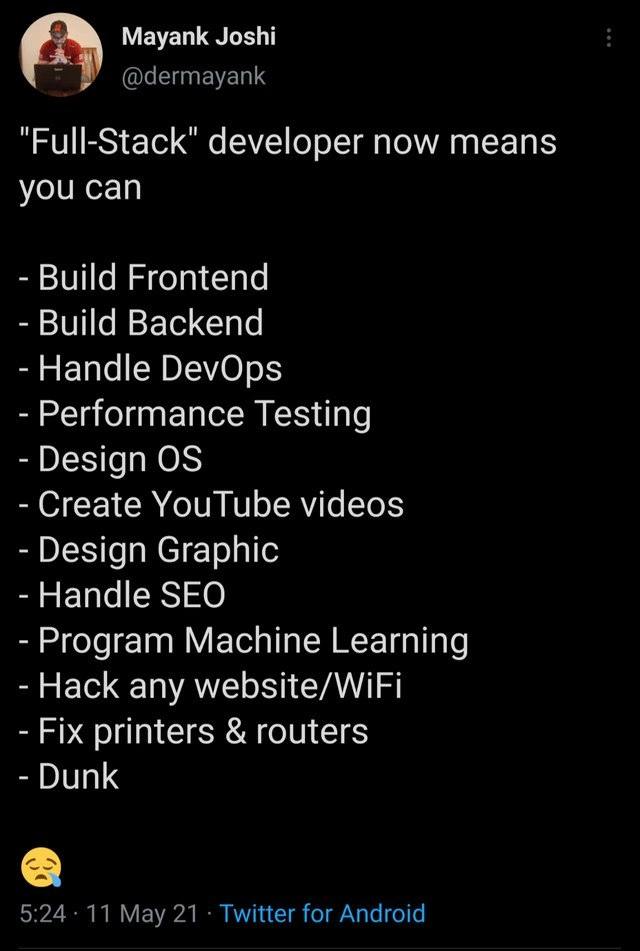
Now, the meme’s joke is that nowadays, some job postings expect way more than just that. The tweet lists a bunch of tasks as if one person should be able to do everything. Here’s what each item actually is, and why it’s crazy to bundle them all under one role:

  • Build Frontend: Create the user-facing part of a website or app (how it looks and behaves in a browser). This involves skills in UI design and technologies like React or Angular. It’s typically a full job by itself (front-end developer).
  • Build Backend: Develop the server-side logic and databases that power the application. This is what a back-end developer does, using languages like Java, Python, or JavaScript (Node.js) to handle things like storing data, processing user accounts, etc.
  • Handle DevOps: Short for Development Operations, this means managing deployments, servers, and the infrastructure that runs the application. A DevOps engineer sets up cloud services, CI/CD pipelines (which automate building and deploying code), monitors servers, and ensures everything stays up and running. It’s practically another separate job from writing the application code.
  • Performance Testing: This refers to testing how well the application performs under stress – for example, does the website stay fast if a million people use it at once? Performance testers or QA (Quality Assurance) engineers usually handle this. They use special tools to simulate heavy load and find bottlenecks. It’s a distinct skill to rigorously test and tune performance.
  • Design OS: “Design an Operating System” is something only systems engineers or specialized software engineers do, and it’s a massive undertaking (think of designing Windows, macOS, or Linux components). This is far outside the realm of typical web development. Including this in a list for a web developer job is absurd – it’s like asking a car mechanic to also be able to design a spaceship.
  • Create YouTube videos: This is basically asking you to be a content creator or possibly a marketing person. It means making tutorial or promotional videos, which involves video recording, editing, maybe being good on camera or at voiceovers. That’s not programming at all – it’s more like a digital marketing or educator role. Some developers do make YouTube tutorials for fun or community engagement, but it’s a whole separate skill set from coding an app.
  • Design Graphic: Probably means graphic design – creating visuals, logos, or UI graphics using tools like Photoshop or Illustrator. Graphic design is typically done by a graphic designer or UI/UX designer. It requires an artistic skill and knowledge of design principles (color theory, typography, layout). Again, it’s unrelated to writing code for a web app. Expecting a developer to also be a professional graphic designer is unrealistic (though some developers have basic design skills, it’s usually not at an expert level).
  • Handle SEO: Search Engine Optimization means improving a website so that it ranks higher on search engines like Google. This involves tweaking content, using the right keywords, ensuring the site loads fast, and maybe coding for better indexing. While a developer might implement some SEO recommendations (like making a site faster or adding meta tags), SEO is often a dedicated role in marketing or specialized consulting because it requires understanding of marketing trends and search algorithms. It’s not something a typical software developer focuses on day-to-day.
  • Program Machine Learning: Writing and training machine learning models (a branch of AI – Artificial Intelligence) is usually done by data scientists or ML engineers. It requires knowledge of statistics, data analysis, and frameworks like TensorFlow or PyTorch. It’s quite a specialized area of programming. Most web developers are not also experts in machine learning, because it’s like a whole other career path (imagine asking a chef to also be a professional pastry artist – related field, but usually people specialize).
  • Hack any website/WiFi: This implies being able to perform ethical hacking or penetration testing – essentially, being a security expert. That means finding vulnerabilities in websites or breaking into WiFi networks (legally, one hopes). Security professionals spend years learning how to do this safely and legally. Developers do write secure code, but being able to “hack any system” is an extreme expectation (and not part of a normal developer’s job!). It plays on the stereotype that if you're “good with computers” you can magically do anything related to computers, including illegal hacking – which is not true or fair to assume.
  • Fix printers & routers: This is basically the job of IT support or a help-desk technician. It means troubleshooting office equipment like printers, internet routers, or other hardware issues. Many of us in tech have experienced co-workers or family asking us to fix their printer or set up their WiFi just because we work with technology. But knowing how to code doesn’t automatically mean you know how to fix a paper jam or configure a network router. It’s a different technical skill set (more hardware and networking focused, less software/app code). Including this on a developer job list is poking fun at how non-technical folks lump all “tech stuff” together.
  • Dunk: This literally means dunking a basketball (jumping and scoring by putting the ball through the hoop). It’s obviously not a tech skill at all. It’s thrown in here as a hyperbolic joke. By adding an athletic requirement, the tweet makes it crystal clear that this list isn’t serious – it’s exaggerating to point out how ridiculous the expectations have become. No real job would ask a programmer to also be good at basketball, so it’s signaling, “see how silly this is?” It’s the meme’s way of saying the list has gone off the deep end.

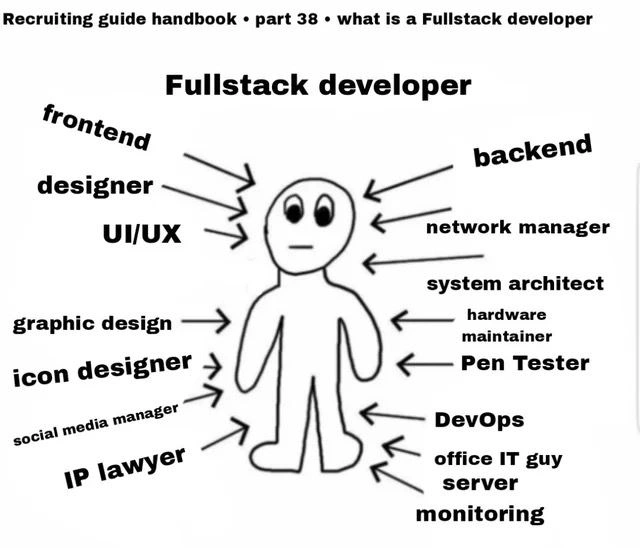
Reading this list from top to bottom is almost breath-taking for a junior developer (or anyone!). It spans so many different areas that it’s hard to imagine one person doing all of it. In real life, you might be familiar with job ads listing a bunch of programming languages and frameworks – that’s already a lot. But this crosses into every territory: development, operations, testing, design, marketing, security, support, and even sports.

For someone early in their career, encountering something like this can be intimidating or confusing. You might think, “Do I really need to know all these things to call myself a full-stack developer?” The reassuring answer is no, absolutely not! This meme is showing an extreme and joking example. In reality, job postings that look like this are often seen as red flags by developers. It means the employer might not understand the role or expects one person to do the work of what should be multiple jobs. If you’re a junior dev and you see a posting like this tweet, it’s okay to chuckle and realize it’s them, not you. No one is an expert in all these things at once. Even senior developers typically specialize or at least have depth in a couple of areas and familiarity in a few others – but not everything. The tweet uses humor to highlight a real issue: sometimes companies ask for an impossible skill set, and developers have learned to recognize that and sigh, as represented by that little 😔 emoji. It’s a bit of DeveloperExpectationsVsReality: the expectation (in the joke) is you’d be a superhero-of-all-trades; the reality is that’s unrealistic.

Many early-career developers also experience being asked to do things outside their job description simply because they’re “the computer person.” For example, you might be the new junior dev and someone hands you the office router to reset, or asks if you can edit a promotional video because you’re good with computers. It can feel overwhelming, but it’s also common enough that it’s become a joke. This tweet basically compiles all those extra asks into one big list. The key takeaway for a newcomer is: don’t take such lists at face value. It’s humor. Real “full-stack” work will involve multiple areas, but not to this extreme. And if a real job truly expects you to do all of this routinely, it's probably a sign of a very chaotic environment (and you have the right to be skeptical). The meme is popular with developers because it perfectly encapsulates that eye-rolling feeling when you read a job ad that expects one person to be a coder, tester, sysadmin, designer, marketer, security officer, tech support — and apparently also play basketball on the side!

Level 3: Full Stack Overflow

When a job posting labels one person a "Full-Stack" developer but then rattles off duties spanning every tech domain (plus an athletic feat), seasoned devs immediately sense the satire. This tweet reads like an entire IT department rolled into one role. It starts innocently enough: build frontend and build backend – the core of FullStackDevelopment. But then the list snowballs: DevOps (provisioning servers and CI/CD pipelines), performance testing (a QA specialty), even design an OS (low-level engineering usually reserved for companies like Microsoft or Apple). At this point, any experienced engineer smirks because no single human normally handles all those layers in one job. Yet the list marches on, blending wildly different professions: graphic design and SEO (typically marketing/design roles, not coding), YouTube content creation (so now you’re the company’s media personality?), and machine learning (a complex field of its own, requiring advanced math). Each added bullet amplifies the absurdity – it's a classic case of scope creep in a job description. By the time it says “hack any website/WiFi” (cybersecurity expert and network guru, why not?) and “fix printers & routers” (general IT support, the kind of random office tasks developers often get roped into because “you’re good with computers”), the pattern is clear: this role includes everything but the kitchen sink. Finally, the kicker: “Dunk” – yes, as in dunk a basketball. 🏀 That punchline pushes the humor over the top, highlighting how ridiculous the expectations have become. It’s as if the hiring manager thought, “We’ve listed literally every technical skill... might as well throw in physical prowess too!” The pensive 😔 emoji under the list perfectly captures a developer’s weary sigh: here we go again.

This combination of unrelated requirements is hilarious to experienced developers precisely because it’s not entirely fantasy – it caricatures real Career_HR postings. Many of us have seen those laundry-list job ads on LinkedIn or Stack Overflow Jobs asking for a unicorn developer. You know the ones: “must know 15 programming languages, manage Kubernetes single-handedly, market the product, and make coffee”. It’s an open secret in tech that some companies (often startups or clueless HR departments) write unrealistic_full_stack_role descriptions hoping to find a “one-man army” to save budget. This meme nails that trope. The line between FullStackDevelopment and “do All The Things” gets crossed far too often. By stringing together tasks from completely different careers, the tweet parodies that overreaching CorporateCulture. It’s both funny and a little painful – a form of DeveloperHumor where we laugh while recalling our own war stories of being handed out-of-scope tasks. (Ask any veteran dev about the time they were asked to fix a projector or set up the company WiFi just because they write code – they’ll roll their eyes in solidarity.)

Beyond the obvious comedy, there’s a darker subtext: this kind of everything_but_the_kitchen_sink_requirements mentality can lead straight to DeveloperBurnout. No matter how talented you are, being expected to juggle frontend JavaScript frameworks, backend architecture, cloud infrastructure, database tuning, testing, SEO tweaks, graphic design, and then pivot to data science and tech support is a recipe for exhaustion. Each of these bullets – frontend, backend, DevOps, etc. – represents a full career path in its own right. The meme exaggerates to make a point: piling all those roles onto one person isn’t just funny, it’s fundamentally unsustainable. In real life, a developer trying to fulfill such an expansive role would constantly context-switch and overextend themselves. Productivity would plummet (ironic, given how the company expects superhuman DeveloperProductivity), and critical expertise would be shallow in many areas because there’s only so much one human can master. Ultimately, quality suffers. There’s an industry saying, “Jack of all trades, master of none.” This tweet shows a “jack of all trades” job on steroids, and experienced devs recognize that the likely outcome is “master of burnout.” The DeveloperExpectationsVsReality gap has never been illustrated with such biting humor: reality is, no one can dunk if they’re carrying the weight of ten jobs on their back.

Technically, what’s being mocked here is the absurd scope_creep_in_developer_roles. Over time, companies kept expanding the definition of “full-stack.” It used to mean a web developer who could handle both the user-facing side and the server logic – for example, building a React front-end and a Node.js back-end, maybe even some database work. But somewhere along the line, some hiring managers took “full-stack” to mean “literally do everything end-to-end.” Operations? Sure, that’s now the developer’s job too (after all, devs can use AWS and Docker, so they must be DevOps engineers, right?). Testing and QA? Let’s have developers also be testers – who needs a QA team when you have 10x engineers? Need an engaging product demo on YouTube? Hey, the dev knows the product; let them record the video – never mind that video production is a whole skill. No designer? It’s okay, the “full-stack” dev can whip up the UI graphics and the company logo in Photoshop on the side. And while they’re at it, they should sprinkle in some Machine Learning magic because every product today claims to have AI. It’s a slippery slope, driven by either ignorance or budget-tight startups where one person truly does end up wearing multiple hats. The tweet exaggerates this to the point of designing an Operating System (absurd unless you’re literally hiring Linus Torvalds) and “hacking WiFi” (as if being a developer automatically means you’re Mr. Robot). The grand finale, “Dunk”, is the comedic haymaker: it lampoons how detached from reality these expectations are by adding something blatantly unrelated. It’s as if the author is saying, “If you believe one person can do all the above, you probably also think they can fly or dunk a basketball on command.” In other words, the meme calls out the CareerExpectations nonsense by pushing it into the realm of the impossible, which exposes the flaw in a way a straightforward complaint might not. Every senior dev reading this knows: this is the nightmare scenario of a job description that you back away from slowly. It’s both funny because of its exaggeration and not-so-funny because many of us have seen shades of this in reality.

Finally, consider the tone of the tweet itself – that weary, pensive emoji speaks volumes. It’s not a laughing-so-hard-I’m-crying emoji; it’s a sigh. This hints that underneath the humor lies genuine frustration. In the tech industry, especially in toxic CorporateCulture environments or early-career job hunts, developers often encounter postings like this and feel a mix of incredulity and stress. The humor is a coping mechanism. The tweet is basically an eye-roll in text form, something an experienced engineer might mutter sarcastically to their team: “Apparently ‘full-stack’ now means you run the entire company’s IT and also win the company basketball game.” It resonates because it’s TechIndustryHumor drawn from truth. By laughing at it collectively, developers call out the problem: job definitions like these are broken.

To illustrate just how over-the-top this “full-stack” checklist is, imagine writing a function to evaluate candidates against it. It would look something like this in code:

function qualifiesAsFullStack(dev) {
    return dev.skills.frontend             // Build Frontend
        && dev.skills.backend              // Build Backend
        && dev.skills.devOps               // Handle DevOps
        && dev.skills.performanceTesting   // Performance Testing
        && dev.skills.osDesign             // Design OS
        && dev.skills.contentCreation      // Create YouTube videos
        && dev.skills.graphicDesign        // Design Graphic
        && dev.skills.SEO                  // Handle SEO
        && dev.skills.machineLearning      // Program Machine Learning
        && dev.skills.ethicalHacking       // Hack any website/WiFi
        && dev.skills.itSupport            // Fix printers & routers
        && dev.athleticStats.canDunk;      // Dunk (basketball)
}

No surprise — this function is essentially impossible to satisfy! It’s a tongue-in-cheek way of saying that the only “candidate” who returns true here would be a mythical creature (maybe a robot with a jetpack 🦄). OverEngineering isn’t just for systems; here we see an over-engineered job description that tries to pack in every skill imaginable. The meme cleverly uses that overload to get a laugh and a knowing nod. In summary, the tweet brings to light a real industry gripe with sharp wit: calling someone “full-stack” shouldn’t be code for “literally do all the work (and sports) by yourself.”

Description

This image is a screenshot of a tweet from user Mayank Joshi (@dermayank). The tweet satirizes the ever-expanding and unrealistic job expectations for 'Full-Stack' developers. It reads: '"Full-Stack" developer now means you can' followed by a bulleted list of skills. The list starts with standard responsibilities like '- Build Frontend', '- Build Backend', and '- Handle DevOps', but quickly escalates to more specialized and unrelated tasks such as '- Design OS', '- Create YouTube videos', '- Handle SEO', '- Program Machine Learning', '- Hack any website/WiFi', '- Fix printers & routers', and finally, the comically absurd '- Dunk'. The tweet ends with a crying emoji, emphasizing the overwhelming pressure. This meme is a sharp commentary on 'scope creep' in job descriptions, where companies seek a single person to perform the work of an entire team. For senior engineers, it’s a relatable frustration with the dilution of the 'full-stack' title and the industry trend of expecting developers to be experts in everything, including basic IT support

Comments

7
Anonymous ★ Top Pick The modern full-stack interview: 'Can you architect a microservices backend, implement a responsive frontend, set up the CI/CD pipeline, and also, our office printer is making a weird noise. You get bonus points if you can dunk.'
  1. Anonymous ★ Top Pick

    The modern full-stack interview: 'Can you architect a microservices backend, implement a responsive frontend, set up the CI/CD pipeline, and also, our office printer is making a weird noise. You get bonus points if you can dunk.'

  2. Anonymous

    Recruiter: “We need a full-stack dev - React, Rust, Terraform, ML, SEO, printer repair, plus you’ll sub for the company basketball team.” Me: “Ah, so you’re migrating from microservices to a single, blocking thread called ‘me’.”

  3. Anonymous

    The evolution from 'full-stack' to 'full-universe' developer: where your sprint planning includes fixing Karen from accounting's printer, reverse-engineering the office WiFi password, and somehow becoming a YouTube influencer - all while the original JIRA ticket for a simple REST endpoint sits untouched at priority P0

  4. Anonymous

    Ah yes, the modern full-stack developer: expected to architect distributed systems in the morning, design Figma mockups before lunch, train neural networks in the afternoon, produce viral YouTube content by evening, and troubleshoot Janet's printer before going home - all while maintaining 99.99% uptime and dunking on the competition. Bonus points if you can do it all in a single sprint while the PM asks 'but can we also add blockchain?'

  5. Anonymous

    When a JD lists SEO, ML, and fixing the CEO’s Wi‑Fi, they’re not hiring a developer - they’re outsourcing their org chart to a single thread with bus factor = 1

  6. Anonymous

    Full-stack used to mean button-to-DB; now it’s TypeScript, Terraform, TensorFlow, SEO, office Wi‑Fi - and apparently basketball. Congrats, you’re the monolith they advertise as microservices

  7. Anonymous

    Full-stack used to mean mastering the MERN stack; now it's 'Manage Everything, Including Network printers' - because in lean teams, architects moonlight as sysadmins

Use J and K for navigation