Skip to content
DevMeme
3982 of 7435
When SonarQube scolds your code, submission is the only answer
CodeQuality Post #4336, on Apr 20, 2022 in TG

When SonarQube scolds your code, submission is the only answer

Why is this CodeQuality meme funny?

Level 1: Yes Mom, I’ll Clean It

Imagine you’ve built a really cool LEGO house, and you’re pretty proud of it. But then a strict teacher or your mom comes over, takes one look and says, “Hmm, that’s not the right way to do it. You should rearrange those pieces like this.” It’s like being told your way of doing it is wrong. How would you react? If arguing doesn’t help and you know they won’t let you move on until you comply, you’d probably sigh and say, “Okay… yes, I’ll do it,” and start rearranging the pieces their way just to make them happy. This meme is showing exactly that feeling, but for grown-up programmers with their code. SonarQube is like a super strict teacher for code. It points at something in the code and says “This is not good, do it differently.” The developer (the person who wrote the code) is drawn like a tired, defeated guy who just replies, “Yes honey,” kind of like saying “Alright, fine.” It’s funny because we usually think of programmers as the ones in charge of the computer, but here the computer tool is bossing the programmer around! It’s the same vibe as when your parent tells you to clean your messy room or do a chore exactly their way – even if you thought it was fine, you just say “Yes, Mom” and do it so you don’t get in trouble. The humor comes from that role reversal: the tool is the nagging authority, and the human is just obeying to keep the peace. In simple terms, the picture jokes that sometimes it’s easier to just do what the “code quality checker” says, rather than fight it, just like it’s easier to listen to your parent or teacher’s instructions even when you’re tired. Everyone laughs because we’ve all been in that situation of giving in, saying “okay, you’re right” even if we secretly wish we could do it our own way.

Level 2: Linter Lessons

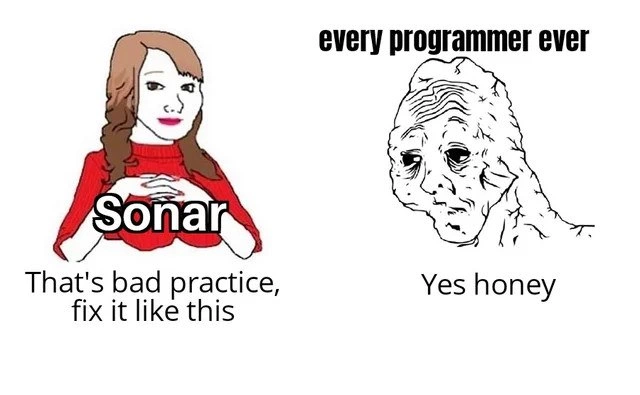
Let’s break down the meme in simpler terms. On the left, we have a woman in a red sweater with the label “Sonar”. This stands for SonarQube, which is a popular static code analysis tool. Think of SonarQube as an automated code reviewer or a linter on steroids. A linter is a program that checks your source code for potential errors, bad practices, or style issues (often called code smells when they’re about design/quality). The text under the woman says, “That's bad practice, fix it like this.” This represents SonarQube’s habit of pointing out something in your code that it considers poor practice or a mistake, and often it will even suggest a solution or at least demand one. For instance, SonarQube might say something like “This method is too long” or “You have a security vulnerability here” or “Rename this variable to match the naming convention.” It’s basically the tool tut-tutting at your work: “No no, dear programmer, you should do it differently.”

Now, on the right side, there’s a tired-looking Wojak character with the caption “every programmer ever”. Wojak is a meme cartoon used to represent generic people with various emotions – in this case, the wrinkled, weary Wojak face is often used to show someone who is exhausted or defeated. The Wojak here symbolizes developers of all stripes, from junior coders to senior engineers, who have all felt this feeling. Below him, the text says “Yes honey.” This is a punchline borrowed from a meme format often called the “yes honey” format or “Yes dear” response, where one person meekly agrees to whatever the other person said, typically to avoid further confrontation. It’s the same tone as a husband or wife saying “Yes, dear” to their spouse in a sitcom when they don’t want to argue.

So put together, the meme is showing SonarQube as the bossy partner saying “That’s bad practice, fix it like this,” and the programmer as the worn-out spouse just saying “Yes honey” in reply. Technically, it’s poking fun at how developers react to static analysis tools. Static analysis (context: static_code_analyzer) means checking the code’s quality and correctness without running it. Tools like SonarQube analyze the code statically to find bugs, code smells, or security issues. When SonarQube flags something, it often feels like the tool is scolding you: “Hey, your code isn’t good enough – do it better!” If you’re a newer developer, imagine writing what you think is a decent piece of code, and then an automated report comes back with a list of 10 things you did “wrong” or could improve. It might say your function is too complex, or that you repeated a chunk of code twice (a duplication issue), or maybe that you didn’t follow some naming rule. It can be a bit demoralizing, like getting a paper back from a teacher all marked in red ink.

The “every programmer ever” suggests this is a very common scenario. In reality, many teams configure SonarQube as part of their build process, meaning you can’t merge your code or mark a story done until you fix the issues SonarQube found. The phrase “submission is the only answer” (from the title/caption) humorously exaggerates that: it implies programmers have learned that it’s easier to just submit to SonarQube’s suggestions than to try to fight or ignore them. Picture a junior dev excitedly pushing code to a repository, only to have the CI pipeline fail with a big red “SonarQube Quality Gate failed.” The error report might say “4 Code Smells, 1 Vulnerability: that’s bad practice, fix it.” The dev might initially think, “But my code works… do I really need to change it because of these picky rules?” After a few such experiences, though, you realize arguing is futile – the fastest way to get your feature merged and deployed is to make the tool happy. So you sigh, maybe grumble under your breath, and then renaming that variable or adding that null-check as instructed. In short: Tool complains, developer complies.

This meme falls under Developer Humor and specifically targets themes of CodeQuality and Tooling in software development. It’s a form of developer self-deprecation because we’re laughing at ourselves for how quickly we give in. We jokingly portray ourselves (the programmers) as saying “Yes honey” to a piece of software. It highlights the almost absurd reality that in modern coding, an automated tool’s opinion can carry so much weight that it feels like the tool is the authority figure. New developers learn quickly that these tools, like SonarQube or ESLint or Prettier, are often integrated into projects to maintain consistency and quality. They’re very useful – they catch real problems! – but they also nitpick. The meme is basically one big inside joke: no matter how much pride you take in your code, when the static analyzer says it’s not up to standard, you’ll probably just fix it without much protest, just like every programmer ever has learned to do. It’s easier to let the tool have the last word, kind of like letting your bossy friend win the argument because you don’t want to prolong the fight. The end result? Your code passes the quality check (yay!), and you move on, shaking your head with a little chuckle at how even the toughest developer can be tamed by a tool saying, “I’m not angry, I’m just disappointed in your code.”

Level 3: Lint and Bear It

In practice, this meme hits home for any seasoned developer who’s integrated SonarQube or a similar static analysis tool into their build pipeline. The left panel’s red-sweater woman labeled “Sonar” represents the authoritative voice of the tool, confidently saying “That’s bad practice, fix it like this.” This is SonarQube acting as a Code Quality gatekeeper. It scans your code and reports issues ranging from minor style infractions to serious bug risks. The right panel shows the classic haggard Wojak (an archetype for the drained, world-weary developer), captioned “every programmer ever,” responding with a defeated “Yes honey.” This captures a scenario virtually every programmer has faced: their CI/CD pipeline failing due to a code quality rule, and the only way forward is to comply with the tool’s demands. It’s a humorous exaggeration of developer surrender: we might roll our eyes or groan, but we still end up dutifully refactoring variable names, adding that missing null check, or splitting that giant function into two just to make the quality gate go green.

Why is this so funny and relatable? Because it’s Developer Humor rooted in truth. Modern development tooling can feel like having a strict schoolteacher or an opinionated spouse reviewing your work. SonarQube’s static code analysis will flag things like: “God class – this class has too many responsibilities,” or “Duplicate code – you’ve copied this chunk elsewhere,” or the dreaded “Cognitive Complexity 16 – this function is too complex, must be <= 15.” The meme exaggerates SonarQube as a personified authority saying “fix it like this,” which is exactly how those Sonar issue descriptions read when you’re tired at 6 PM: pedantic, nagging, and oddly parental. The developer’s “Yes honey” response is a tongue-in-cheek way of saying, “Alright, alright…I’ll do it your way. Just please stop complaining so I can get on with my day.” It’s the same energy as a spouse sighing and agreeing to something just to keep the peace. In a software team context, SonarQube’s report often isn’t up for debate – if your code has a blocker issue or too many code smells, the build will fail or your merge request will be blocked. Arguing with an automated tool is usually pointless, especially when your tech lead or DevOps has configured “Quality Gates” that require zero critical issues. The fastest path to relief is to kiss the ring and fix what the tool wants, even if you quietly think the code was fine as-is.

This “Yes honey” dynamic also pokes fun at how developers, who are known for rational arguments over tabs vs spaces or the best design patterns, often swallow their pride when a tool scolds their code. It’s a form of developer self-deprecation: we like to think we write good code, but the moment an automated report says otherwise, we act like chastised partners in a relationship – “You’re right dear, I’ll change.” The meme’s humor comes from that universal experience of tooling trumping personal preference. No matter how senior you are, seeing a wall of SonarQube issues on your merge request can make you feel like a kid being told off. You might recall times when a trivial gripe—like a variable name not matching the regex rule, or a function having 1 too many lines—held up an entire release. For example, Sonar might insist on a default: case in a switch statement even if logically all cases are covered. The seasoned dev knows the code is fine, but Sonar’s not budging. So you grudgingly add a dummy default case to please the tool.

switch (eventType) {
  case "START": handleStart(); break;
  case "STOP":  handleStop(); break;
  // SonarQube: "Add a default case to this switch."
  default:
    // Fine, Sonar, have it your way – this should never happen, but here we are
    throw new IllegalStateException("Unexpected event type: " + eventType);
}

The comment in the code above might as well read, “// Sonar made me do it.” This is a real example of the tool_as_authority dynamic: even our source code ends up bearing comments that acknowledge we’re coding to satisfy a robot overlord. Seasoned engineers have plenty of war stories of wrestling with SonarQube or linters. Perhaps Sonar flagged a bunch of “critical” issues right before a deadline, forcing a scramble of fixes that didn’t truly improve the product but silenced the dashboard. Or a static_code_analyzer suggested a refactor that took hours, simply to make the code look cleaner to an algorithm (meanwhile the old-timers mutter that the original code was perfectly readable). The meme condenses all that frustration into a simple, hilarious power dynamic: the all-knowing Sonar says jump, and every programmer ever responds, “How high, honey?” with a sarcastic salute.

On a more serious note, the reason this scenario keeps happening is because static analysis tools do provide real value by catching bugs and enforcing consistency – so teams give them authority. We’ve collectively decided that enduring a few false alarms or tedious fixes is worth it for the CodeQuality gains in the long run. The shared laughter here is in recognizing that sometimes the tail wags the dog: the tooling meant to serve us becomes the boss of us. It’s a gentle roast of modern development culture, where an automated SonarQubeAnalysis can wield more day-to-day power over your code than the human architect who designed the system. And like any grizzled veteran who’s been on the losing side of an argument with a build tool, we laugh because the alternative is to cry… then say “Yes honey” and fix the damn code as instructed.

Level 4: Undecidably Clean

At the theoretical extreme, tools like SonarQube brush up against fundamental limits of computation. A static analyzer examines code without running it, constructing structures like an Abstract Syntax Tree (AST) and Control Flow Graphs to reason about program paths. However, determining with certainty whether a piece of code is “clean” or free of all possible bugs is computationally undecidable in the general case – a nod to the infamous Halting Problem. In formal terms, any non-trivial property of program behavior (e.g., “will this pointer ever be null on line 42?”) falls under Rice’s Theorem, meaning no algorithm can perfectly decide it for all possible programs. So static analysis must trade completeness for practicality: SonarQube’s analysis is a heuristic approximation. It uses a set of predefined rules and pattern-matching checks to catch common issues (like resource leaks or unused variables) and flag code smells. These rules are essentially distilled wisdom from decades of coding: they encode typical bad practices as pattern recognizers. For example, SonarQube might implement a rule for cyclomatic complexity, a concept from graph theory that counts distinct execution paths through a function. If a function’s complexity count exceeds some threshold (often 10 or 15), the tool marks it as a potential maintenance risk – a code smell. This threshold is arbitrary from a mathematical perspective, but it’s grounded in empirical studies suggesting humans struggle to reason about highly branched logic.

Under the hood, SonarQube’s linters perform data-flow analysis and abstract interpretation in limited ways. They symbolically walk through code branches to spot things like a variable that could be used uninitialized, or an exception that might not be handled. Because they can’t explore every path in complex, real-world programs (that would blow up exponentially or run into undecidability), they operate with assumptions and simplifications. The result is a pragmatic compromise: mostly-sound analysis that might err on the side of caution. This is why SonarQube will sometimes warn about a null pointer dereference or a SQL injection possibility that a developer knows can never happen in practice – the tool can’t prove it won’t happen, so it prefers to alert just in case. In static analysis lingo, it’s better to have a false positive (a warning about a non-issue) than a false negative (missing a real bug) when aiming for code safety. Each SonarQube rule encodes a little bit of computer science theory (from compiler design to software engineering principles), but applied in an imperfect, mechanical way. The humor in this meme has an undercurrent of these formal limits: the code quality tool plays the oracle of good coding, but even oracles get it wrong or overzealous, leading to the absurd scenario where the all-knowing “Sonar” pronounces judgment on code like a minor deity. And the weary developer yields, not because the code is definitely faulty in a provable sense, but because arguing with an automated oracle is a battle even theory says you can’t fully win.

Description

Two - panel Wojak-style meme on a white background. Left panel shows a red-sweater woman clasping her hands, overlaid with the large word “Sonar”. Underneath her the caption reads, “That's bad practice, fix it like this”. Right panel features a weary, wrinkled Wojak head with the heading “every programmer ever” above it and the reply text “Yes honey” below. Visually, the meme contrasts SonarQube’s automated static-analysis authority with the resigned attitude of developers who immediately accept its code-quality suggestions. Technically, it pokes fun at how linters and quality gates like SonarQube flag code smells and dictate refactors, while engineers, tired of arguing with tooling, simply comply to clear the pipeline

Comments

7
Anonymous ★ Top Pick SonarQube: “Cyclomatic complexity must be ≤15.” Me, 20 years in: “Sure - I'll just wrap the 200-line switch in a single lambda so the metric resets to 1 and we can both pretend this is fine.”
  1. Anonymous ★ Top Pick

    SonarQube: “Cyclomatic complexity must be ≤15.” Me, 20 years in: “Sure - I'll just wrap the 200-line switch in a single lambda so the metric resets to 1 and we can both pretend this is fine.”

  2. Anonymous

    SonarQube: the only relationship where "it's not you, it's your cyclomatic complexity" actually means something, and you still have to fix it before the next sprint review

  3. Anonymous

    Sonar says 'fix it like this,' and like any long marriage, the developer learned the secret to peace: // NOSONAR

  4. Anonymous

    SonarQube is like that senior architect who's technically correct about every code smell but doesn't realize you're on your 47th 'critical' violation this sprint. Sure, extracting that method would improve cyclomatic complexity by 0.3, but we both know the real technical debt is the meeting where we'll discuss why the quality gate failed because someone used a nested ternary operator in a throwaway script

  5. Anonymous

    Sonar: “Bad practice - reduce cognitive complexity.” Me: split the 80-line method into five microservices with a saga; Quality Gate green, pager red. Yes honey

  6. Anonymous

    SonarQube: Spotting every code smell except the one wafting from that untestable monolith holding prod together

  7. Anonymous

    Sonar says Quality Gate failed: 12 code smells; I add //NOSONAR and a one-line assertTrue(true) test; CI is green

Use J and K for navigation