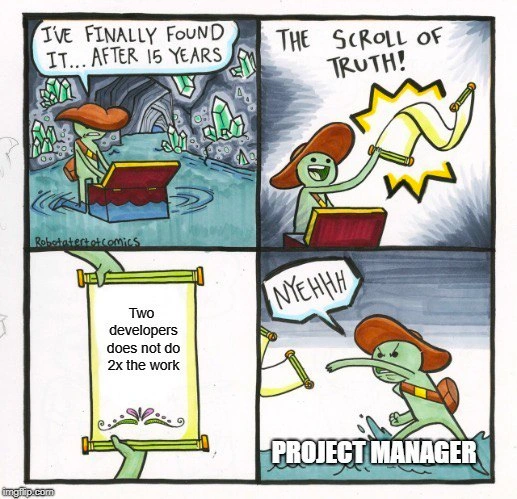
Brooks's Law as Revealed by the Scroll of Truth
Why is this ProjectManagement meme funny?
Level 1: Two Cooks, One Tiny Kitchen
If one kid can clean their room in an hour, can two kids clean it in thirty minutes? Anyone who's watched two kids "help" each other knows the answer: they bump into each other, argue about where the toys go, and one of them has to explain the whole system of which bin is for Legos. The comic shows someone finding a magic scroll that says exactly this — two helpers don't finish twice as fast — and the boss character hurling it away in fury, because he really, really wants the math to be that easy. The joke is that the truth was found, read, and thrown in the water anyway.
Level 2: Why Your New Teammate Slows You Down (At First)
Key concepts hiding in those four panels:
- Brooks's Law / The Mythical Man-Month: A classic software engineering book arguing that people and months aren't interchangeable. A "man-month" treats humans like identical batteries; software work doesn't divide that way.
- Coordination overhead: Every pair of teammates needs to sync — standups, code reviews, Slack threads, "wait, you're also touching that file?" Each new person adds links to everyone already there, not just one more worker.
- Onboarding cost: A new developer doesn't produce on day one. Someone must teach them the codebase, the deploy process, the tribal knowledge — and that someone stops producing while they do.
- Sequential work: Some tasks can't be parallelized. If step B needs step A's output, a second developer just... waits. Or worse, invents work that creates merge conflicts.
You'll live this early in your career from both sides: as the new hire who feels useless for a month (normal — you're paying the onboarding tax, everyone does), and later as the dev whose sprint slows down the week "help" arrives. When a manager promises a deadline because "we'll just add another engineer," you now know which panel of this comic you're standing in.
Level 3: The Mythical Man-Month, Rejected Again
The scroll's message — "Two developers does not do 2x the work" — has been settled engineering doctrine since 1975, when Fred Brooks published The Mythical Man-Month after watching IBM's OS/360 project get slower with every wave of reinforcements. Brooks's Law states it bluntly: adding manpower to a late software project makes it later. The comic's structure is the punchline's delivery mechanism: the adventurer searches "AFTER 15 YEARS" (roughly one full management career), finds the truth, reads it — and the final panel, labeled PROJECT MANAGER, flings it into the void with a "NYEHHH". Fifty years of evidence, discarded in one frame. That's not a gag; that's a quarterly planning meeting.
The math the scroll is hinting at is brutally simple. Communication paths in a team grow as n(n-1)/2 — quadratically. Two developers have one channel; five have ten; ten have forty-five. Every added person multiplies coordination cost while adding, at best, one unit of production. Then stack the hidden taxes: onboarding (your most productive senior now spends weeks explaining the codebase), work partitioning (some tasks are inherently sequential — Brooks's famous line that nine women can't make a baby in one month), merge contention (two people in one codebase means integration work that one person never had), and knowledge fragmentation (now nobody holds the whole system in their head).
The deeper satire is why the scroll keeps getting thrown. It's not stupidity — it's incentive structure. A PM's levers are headcount, scope, and deadline. Scope is contractually fixed, the deadline came down from above, so headcount is the only knob that looks like it turns. Spreadsheets reify the fallacy: capacity planning tools literally multiply developers × velocity, and no cell exists for "communication overhead grows quadratically." Saying "adding people will slow us down" sounds, in a status meeting, indistinguishable from "I don't want help" — so the truth is organizationally unsayable even when everyone technically knows it. The scroll isn't rejected because it's unread. It's rejected because accepting it would mean telling their boss the date is wrong, and the cave didn't have a scroll for that.
Description
A four-panel comic meme in 'The Scroll of Truth' format. In the first panel, an adventurer in a cave finds a chest, exclaiming, 'I'VE FINALLY FOUND IT... AFTER 15 YEARS'. The second panel shows the character triumphantly holding up a glowing scroll, labeled 'THE SCROLL OF TRUTH!'. The third panel is a close-up of the scroll, which reads, 'Two developers does not do 2x the work'. In the final panel, the character, now labeled 'PROJECT MANAGER', angrily throws the scroll away, yelling 'NYEHHH'. This meme humorously illustrates the fundamental software engineering principle known as Brooks's Law, which states that adding more people to a late software project makes it later. It satirizes the common managerial fallacy of assuming that developer productivity scales linearly, ignoring the realities of increased communication overhead, coordination challenges, and the indivisible nature of many programming tasks

Comments
8Comment deleted
Two developers don't do 2x the work, but they can definitely generate 4x the merge conflicts
Telling the PM that two devs aren’t 2× output is like invoking Amdahl’s Law to someone who thinks adding a thread removes lock contention - only thing that scales linearly is the number of stand-up updates
"Next sprint planning: 'We're behind schedule, so we're adding three more developers. Also, we need everyone to sync daily on the new integration points.'"
Adding a second developer doubles the velocity estimate and the standup length; the only thing that actually ships 2x is the merge conflicts
This meme perfectly encapsulates Brooks' Law from 'The Mythical Man-Month': adding developers to a late project makes it later. The 'Scroll of Truth' reveals what every senior engineer knows - two developers don't produce 2x output due to communication overhead, knowledge transfer costs, code review cycles, merge conflicts, and architectural coordination. The project manager's violent rejection mirrors the all-too-common response when engineering reality conflicts with delivery timelines. It's the eternal struggle between O(n²) communication complexity and management's dream of linear scaling - a truth so uncomfortable it gets yeeted into the void every sprint planning
If headcount scaled like throughput, we’d call it SIMD; instead it’s Brooks’ Law - O(n^2) meetings, O(weeks) ramp‑up, and a negative speedup
PM math: 2 devs = 2x velocity. Systems math: you just added a communication edge, a write lock on the spec, and Brook’s Law to the sprint
15 years to unearth what every architect knows: Brooks was right, man-months are mythical