From High-Level Architecture to Implementation Brawl
Why is this DesignPatterns Architecture meme funny?
Level 1: Easy to Agree on Dinner, War Over the Toppings
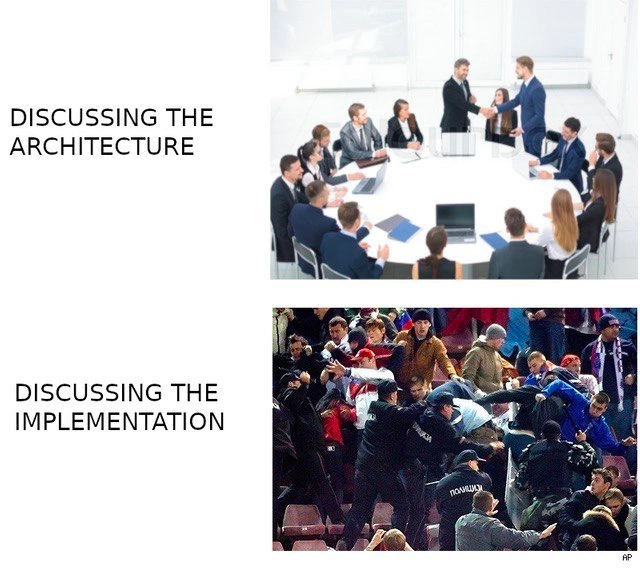
Everyone in a family can happily agree, "Let's order pizza tonight!" — smiles, high-fives, done in ten seconds. Then comes the actual order: pineapple or no pineapple, thin crust or thick, which half gets mushrooms — and suddenly it's chaos and someone's storming off. The top picture is "let's get pizza." The bottom picture is choosing the toppings. The joke is that the big decision was peaceful and the tiny details started the brawl — because the big decision didn't really decide anything yet.
Level 2: Where the Whiteboard Meets the Keyboard
- Architecture is the high-level shape of a system: which big pieces exist (services, databases, queues), how they talk, and what trade-offs you accept. Think city planning — zones and roads, not individual houses.
- Implementation is the actual code: function names, file layout, which library to use, error handling, formatting. Think actually building one house, with three contractors who each insist their way of hanging a door is the only correct one.
- Bikeshedding (the law of triviality): people argue most about the things easiest to understand. Few feel confident debating consensus protocols; everyone has a take on naming a variable.
- Code review: the process where teammates read your changes before merging. It's where implementation opinions collide in writing, with a permanent public record — which is both its great strength and why it occasionally resembles the bottom photo.
If you're new: your first design meeting will feel encouragingly smooth, and your first pull request may attract more comments than the entire design doc did. That's not because your code is bad — it's because code is the first artifact concrete enough for people to truly engage with. Take the heat as engagement, extract the signal, and learn the team's conventions early; most riots are turf wars over conventions nobody wrote down.
Level 3: Consensus Is Cheap at Altitude
The two photographs do all the rhetorical work. "DISCUSSING THE ARCHITECTURE": a pristine stock-photo boardroom, white round table, laptops closed or politely angled, two men shaking hands while everyone applauds. "DISCUSSING THE IMPLEMENTATION": an actual AP press photo of a stadium riot, fists flying, police jackets reading ПОЛИЦИЈА as officers physically separate the participants. The contrast is funny because it inverts where you'd expect the stakes to be — architecture is the expensive, hard-to-reverse stuff! — and yet every senior engineer knows the meme is reporting from the field.
Why does it work this way? Because abstraction is a conflict-avoidance technology. At the architecture level, words like loosely coupled, event-driven, and scalable are agreeable precisely because they're underspecified — everyone in the room is silently mapping them onto their own private, mutually incompatible mental model. The handshake in the top panel is two people agreeing on a sentence while disagreeing on its meaning. Nothing has been decided yet, so there's nothing to fight about. It's the diplomatic communiqué phase of software: warm, vague, photographed for the newsletter.
Implementation is where ambiguity dies, and with it, civility. Someone must now decide which service owns the user table, whether the retry lives in the client or the gateway, what the module is named, whether it's utils or helpers or a war crime. These decisions are concrete enough to be wrong, small enough that everyone feels qualified to have an opinion — the classic bikeshedding dynamic, where a committee waves through the nuclear reactor but fights for hours over the bicycle shed — and personal enough to encode status: whoever's convention wins, wins. Code review is where this gets ritualized; the PR comment thread that starts with "nit:" and ends 47 replies later with someone linking a style guide from 2014 is the bottom panel rendered in Markdown. The organizational truth underneath is uncomfortable: teams often can't litigate the architecture (too abstract, too politically expensive, the staff engineer already blessed it), so all the unspent disagreement drains downhill and detonates over indentation and folder structure. The riot was always going to happen; implementation is just where the doors open.
There's also a survivorship trick in the top panel worth naming: architecture discussions stay pleasant because their failures are deferred. You don't find out the handshake was wrong until eighteen months later, in an incident review, where — conveniently — the conversation is once again about implementation.
Description
A two-panel meme that contrasts the nature of architectural and implementation discussions in software development. The top panel, labeled 'DISCUSSING THE ARCHITECTURE', shows a serene stock photo of business professionals in suits having a calm and orderly meeting around a large white conference table, with two colleagues shaking hands. The bottom panel, labeled 'DISCUSSING THE IMPLEMENTATION', depicts a completely different scene: a chaotic and violent brawl in stadium seating, with numerous people, including what appear to be police officers (one uniform has 'ПОЛИЦИЯ' in Cyrillic), physically clashing. The meme humorously illustrates the common experience where high-level architectural planning is often a smooth, agreeable process, while the subsequent discussions about concrete implementation details devolve into passionate, contentious debates over specifics like library choices, coding standards, and exact methods, revealing the true complexities and strong opinions

Comments
8Comment deleted
The architecture was approved unanimously in 15 minutes. The argument over whether to use a trailing comma in the JSON config is now entering its third hour and security has been called
Architecture slide: “We’ll just add a service mesh.” Implementation meeting: “Great - whose pager owns the mesh that dead-locked itself while hot-rotating mTLS certs at 2 AM?”
Architecture: "We'll use event-driven microservices with CQRS and eventual consistency." Implementation: "So who's writing the 47 compensating sagas when someone's Lambda times out halfway through a distributed transaction?"
Everyone agrees on 'loosely coupled microservices' in the slide deck; the fistfight starts when someone has to decide which service owns the user table
The architecture meeting: 'We'll use microservices with event-driven patterns and CQRS.' Everyone nods sagely. The implementation PR: 47 comments arguing whether to use `getUserById` or `fetchUser`, three engineers threatening to quit over the logger choice, and someone suggesting we rewrite it in Rust. The real architecture was the enemies we made along the way
Architecture meetings are civil because boxes and arrows don’t page you at 3 a.m; implementation becomes Thunderdome the moment you ask who owns retries, idempotency, and schema migrations
Architecture decisions are unanimous; implementation reviews devolve into a byzantine fault‑tolerant consensus algorithm with unbounded retries and zero eventual agreement
Architecture: Whiteboard consensus on microservices. Implementation: Cage match over which monolith to carve first