Skip to content
DevMeme
7253 of 7435
The Rust Evangelist Under Your Bed: Zero-Cost Abstractions
Languages Post #7952, on Apr 28, 2026 in TG

The Rust Evangelist Under Your Bed: Zero-Cost Abstractions

Why is this Languages meme funny?

Level 1: The Salesman Under the Bed

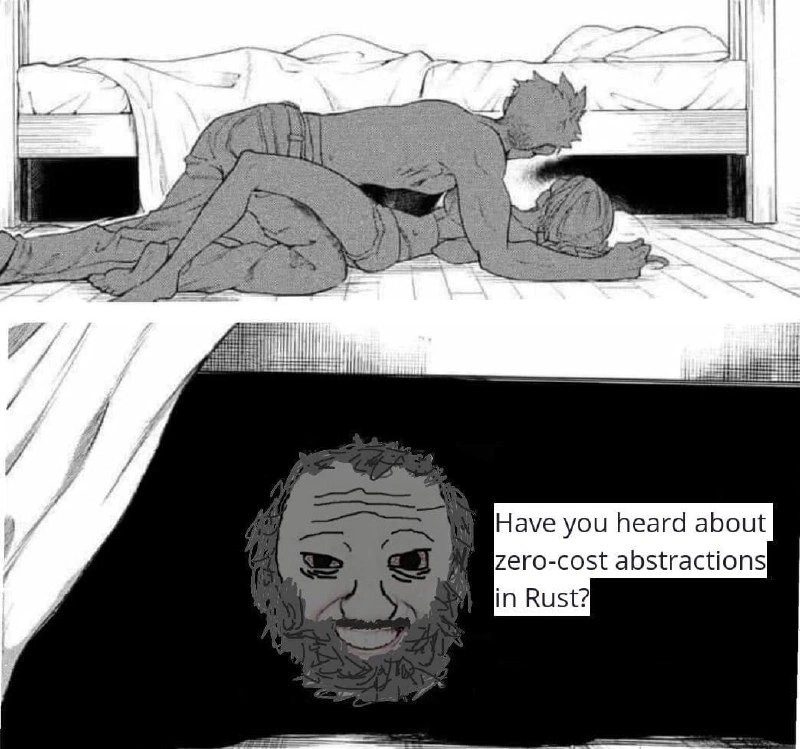
You know the old campfire story about the monster under the bed? This comic replaces the monster with something scarier: a guy who really, really wants to tell you about his favorite thing, at the worst possible moment. A couple is having a private moment, someone peeks under the bed, and instead of glowing eyes there's a smiling bearded face asking, basically, "Got a minute to hear about my favorite tool?" It's funny because everyone knows a person like this — so in love with their hobby that no time or place is off-limits — and the comic just takes that feeling literally: he was under the bed the whole time, waiting.

Level 2: Rust, Borrow Checkers, and Why People Won't Shut Up About It

Rust is a systems programming language competing with C and C++ for performance-critical software. Its headline feature is memory safety: whole categories of crash and security bug (dangling pointers, double frees, data races) are caught before the program ever runs, by a compile-time gatekeeper called the borrow checker that tracks which part of the code owns each piece of data. "Zero-cost abstraction" means Rust's high-level conveniences — generics, iterators, pattern matching — compile into machine code as fast as low-level hand-written code, so you don't trade elegance for speed. The fervor exists because learning Rust is hard (the borrow checker rejects a lot of your early code), and people who climb that wall tend to advocate with convert energy. The wojak face is meme shorthand for an everyman archetype; planting a bearded one under a bed turns "enthusiastic colleague" into "horror movie monster," which is roughly how the fifth unsolicited pitch of the week feels.

Level 3: The Crab That Knocks at 2 AM

The meme's craft is the violation of sanctuary. The top manga panel is maximal intimacy — a couple entangled on the floor beside the bed — and the man's wary glance into the black gap beneath it sets up classic horror grammar. The bottom panel delivers the jump scare: not a demon, but a grinning bearded wojak asking,

"Have you heard about zero-cost abstractions in Rust?"

The phrasing is the punchline's skeleton key: it's the cadence of a doorstep missionary — Have you heard the good news? — and that's precisely the reputation being skewered. The Rust Evangelism Strike Force is the community's self-aware (and detractor-applied) name for the phenomenon: every thread about a C buffer overflow, every CVE writeup, every "what language for my project?" question reliably summons someone suggesting a Rewrite It In Rust. The meme works because the advocacy is technically correct and socially exhausting — the hardest combination to rebut. Rust genuinely does eliminate entire vulnerability classes; the borrow checker genuinely does prevent use-after-free at compile time; and none of that makes it appropriate to bring up here, under the bed, at the most context-inappropriate moment imaginable. The horror-manga framing captures the lived experience of the pitch's targets: it's not that the argument is wrong, it's that you cannot escape it. Every language community has zealots, but Rust's earned this meme genre specifically because its value proposition is moral as well as technical — memory safety framed as responsibility — and moral arguments don't respect context boundaries. The intruder under the bed isn't there to hurt anyone. He's there to help. That's what makes him scary.

Level 4: What the Compiler Actually Optimizes Away

The phrase the bearded intruder whispers from the darkness is a real and rigorous claim, and it's worth taking more seriously than he deserves. Zero-cost abstraction comes from C++ lineage — Bjarne Stroustrup's formulation: what you don't use, you don't pay for; what you do use, you couldn't hand-code any better. Rust operationalizes this through monomorphization: a generic function like fn max<T: Ord>(a: T, b: T) is not dispatched through a runtime lookup; the compiler stamps out a specialized copy per concrete type, which the optimizer then inlines and reduces as if you'd written the type-specific code by hand. Iterator chains — .filter().map().sum() — compile down through LLVM's optimization passes to the same loop a C programmer would write, with bounds checks hoisted or eliminated where provable. Even the famous borrow checker is zero-cost in the strict sense: ownership and lifetimes are compile-time proofs, fully erased from the binary — memory safety without a garbage collector's runtime tax. The honest asterisks: monomorphization trades binary size and compile time for speed (the cost isn't zero, it's moved — to your build farm), and dyn Trait objects reintroduce vtable dispatch when you opt into them. Which makes the meme's framing accidentally precise: the abstraction costs nothing at runtime; the evangelism is paid for at a very different layer of the stack.

Description

A two-panel black-and-white manga edit. Top panel: a couple lies entangled on the floor beside a bed, the man peering warily into the dark gap underneath it. Bottom panel: from the pitch-black space under the bed, a grinning bearded wojak face emerges with a speech bubble asking, "Have you heard about zero-cost abstractions in Rust?" The meme lampoons the Rust community's evangelical reputation - no moment is too private, no context too intimate, for an unsolicited pitch about memory safety, the borrow checker, and abstractions that compile away to nothing

Comments

5
Anonymous ★ Top Pick Zero-cost abstractions, nonzero-cost conversations - the evangelism never gets optimized away
  1. Anonymous ★ Top Pick

    Zero-cost abstractions, nonzero-cost conversations - the evangelism never gets optimized away

  2. @deimossos 2mo

    Nah I've heard about zero cost abstractions in zig

  3. @drbogar 2mo

    What are téri cost abstractions?

  4. @Vlasoov 2mo

    Have you heard for C replacement that still does not have ABI?

  5. @Alechka_Kh 2mo

    i've heard about zero cost abstractions in c++

Use J and K for navigation