Skip to content
DevMeme
6105 of 7435
The uncanny valley of professional self-replication
AI ML Post #6688, on Apr 25, 2025 in TG

The uncanny valley of professional self-replication

Why is this AI ML meme funny?

Level 1: Dog Chasing Its Tail

Imagine a dog chasing its own tail – it’s running in circles and never really gets anywhere. This meme is joking about that kind of never-ending loop, but with people and their jobs. First, it shows a person whose job is hiring (a recruiter) trying to hire another person just like themselves. That seems okay at first. Then it says a cook is cooking another cook – which is a silly, impossible idea (like a chef trying to turn another chef into food!). Finally, it says a programmer is programming another programmer, meaning a coder is somehow writing code to create a new coder. Each step repeats the idea on itself and makes it more absurd. By the last one, it’s so crazy that it’s both funny and a little scary. It’s like a joke that keeps repeating the same pattern over and over, doubling down each time. We find it funny for the same reason we’d laugh at a dog going in circles or a cartoon of a character cloning themselves infinitely – it’s a goofy never-ending story that grows more unreal with each loop. The meme’s faces go from normal toOMG to 😱, showing how a simple idea can become wild and spooky when it repeats without end. In simple terms: it’s funny because it’s a loop with people that just shouldn’t happen in real life, and watching it spiral out of control makes us laugh at how ridiculous it gets.

Level 2: Recursion in Real Life

Let’s break down the joke in more straightforward terms. The key concept here is recursion. In programming, recursion means a function calls itself as part of its execution. For example, imagine a function that tries to print "Hello" and then calls itself again and again. If you don’t tell it when to stop, it will call itself forever (or until the computer crashes). That crash is often a stack overflow error – yes, the famous Q&A site Stack Overflow took its name from that exact bug caused by runaway recursion or deep function calls. A recursive function needs a base case, which is a condition to stop calling itself, or else it's an infinite loop.

Now, the meme jokes that an org chart (a company's internal hierarchy of who works for whom) becomes a recursive function. An org chart is usually like a tree: say, a CEO at the top, under them some managers, under those managers some teams, etc. It’s not supposed to loop back upward or form a cycle. If humans were arranged recursively, you'd get something impossible like "Alice is Bob's boss, Bob is Carol's boss, and Carol is Alice's boss" – you’d go round and round. That would be as nonsensical as a function that never stops calling itself. In a company, Human Resources (HR) folks make sure the org chart makes sense and hire new people for roles. A recruiter is an HR person whose job is to find and hire employees. So the phrase "recruiters hiring a recruiter" means the recruiting team is hiring another recruiter to join their team. It’s a bit self-referential: it's like a team cloning itself. This can actually happen in real life if a company needs more recruiters (for example, during rapid growth). It's slightly funny on its own because it's a loop — the recruiter’s work is to hire people, and here the target is someone with the same job as themselves.

The second line, "Cooks cooking a cook," takes the loop idea and makes it literal and absurd. Normally, cooks (chefs) cook food, not other cooks! This sounds like a silly or dark fairy tale: a chef prepared a meal and the meal is... another chef. 🍲🔪 That’s why it’s comedic — it's a play on words showing an impossible scenario. The meme uses that to signal "we’re getting into weird territory now." You can think of it like recursion gone wrong: the task (cooking) is being applied to the person who does the task (the cook). There’s also an idiom, "too many cooks in the kitchen," which means if you have too many people of the same role, things go badly. Here it’s not too many cooks, but one cook actually turning another cook into the food! It’s a humorous exaggeration of a self-referential loop. The image for this panel shows a face that looks a bit worried or disturbed, which fits the strange idea of culinary cannibalism. In terms of meta-humor, we’ve taken a normal scenario and made it feed on itself, which usually signals something has gone off the rails.

Finally, "Programmers programming a programmer" is the grand punchline, especially for a tech audience. What could that mean? Typically, programming means writing code to make a computer do something. So "programmers programming a programmer" suggests that programmers are writing code to create another programmer. This could be interpreted as building a software program that can do a programmer’s job. It’s a bit of sci-fi or extremely meta: a program that creates programs (and maybe even manages them). In the real world, there's a concept called meta-programming where you write code that produces more code (for example, a code generator or templates that generate classes for you). There are also AI tools nowadays that can write code based on prompts – essentially software that acts like a programmer. So the meme is hinting at these ideas in a tongue-in-cheek way. It imagines the programmers not programming an app or a website, but literally programming "a programmer." That could mean an AI developer or some automated coding system. For instance, think of a scenario where Alice writes a program that can fix bugs or add features on its own – she’s sort of "programming an (artificial) programmer." For a junior developer, this might sound far-fetched, but it's an active area of development. We already have things like GitHub Copilot, which helps write code. Who knows, one day you might literally run a program to do some of your programming tasks for you!

Let’s connect it back to recursion clearly: Recursion is when a thing contains or does itself. This meme gave three examples of a job doing itself:

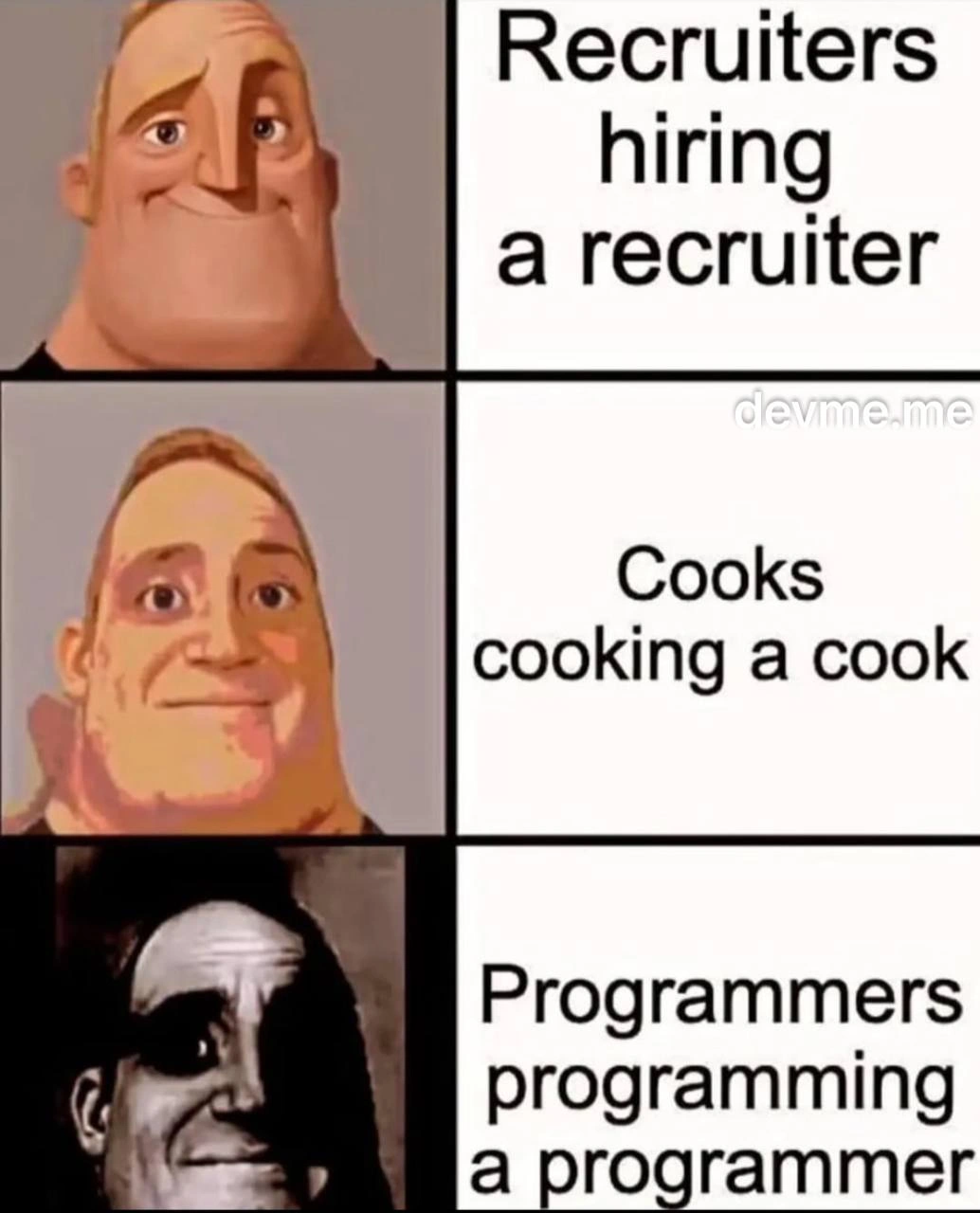
  • A recruiter (whose job is hiring) is hiring another recruiter.
  • A cook (whose job is cooking) is cooking another cook (yikes!).
  • A programmer (whose job is coding programs) is coding a program that is another programmer (mind blown 🤯).

Each step is like adding another layer of self-reference. By the time we get to the programmers, the concept is so self-referential and loopy that it’s both funny and a bit alarming. The progression of the facial expression in the images (from confident to uneasy to downright freaked out) illustrates how diving deeper into recursion can feel. It’s actually a common geeky humor format to escalate like this. This whole idea also alludes to the movie Inception (a dream within a dream within a dream) – here it's a job within a job within a job. If you’ve ever seen two mirrors facing each other and making endless reflections, that’s a visual form of recursion in real life. The meme captures that vibe with people's jobs instead of mirrors.

In summary, this meme blends career humor with a CS fundamental concept. The first part (recruiters and cooks) is more of a silly career or everyday joke, and the last part ties it into programming and computer science. It’s an example of a developer in-joke where understanding recursion makes the punchline funnier. But even without deep CS knowledge, anyone can chuckle at the ridiculous image of people effectively "doing their thing to themselves" in an endless loop. Just remember, in reality, if you ever create a process that feeds into itself, make sure there’s a way to stop – whether that’s a hiring plan that knows when to stop adding recruiters, or a recursive function with a proper exit condition! 😉

Level 3: Infinite Hiring Loop

From a senior developer’s vantage point, this meme nails a blend of industry irony and classic CS humor. It starts innocently: "Recruiters hiring a recruiter." That first panel is a wry nod to real life – during tech booms, it's common for companies to aggressively hire more recruiters to accelerate growth. Seasoned devs have seen this paradox: a hiring frenzy so intense that recruiters themselves become the hottest commodity. It’s a bit self-referential (a self-referential hiring process), but not too crazy – hiring recruiters to hire engineers is normal. Yet here they’re hiring one of their own, which does happen (expanding the HR team), though it starts feeling like a feedback loop. Many of us have chuckled (or groaned) seeing an org chart balloon with more HR and middle managers than actual builders. Why this is funny to devs? Because we’ve witnessed those top-heavy moments where it feels like an infinite loop: more process to support the process. It's an industry irony – sometimes companies focus so much on scaling up (more hiring, more bureaucracy) that they start resembling a function feeding back into itself. As developers, we instinctively mutter, "Where's the base case, folks?"

Then the meme escalates: "Cooks cooking a cook." This panel crosses into absurd literalism – it’s a chef preparing another chef as the dish. The image of a cook literally cooking a cook is darkly comical (and a touch horrifying). That’s why the face in panel two looks a bit uneasy: the scenario has turned cannibalistic. In tech terms, this parallels a system starting to consume itself. Think of a service that exists only to launch copies of itself without doing any external work – a recipe for a crash. The humor format here is clear to a seasoned eye: it’s an inversion of expectations. We expect cooks to cook food, not people; similarly, we expect recruiting to result in engineers or employees, not just more recruiters. It's pointing out the absurdity that can happen when a process becomes too self-involved. There’s an unspoken truth here about organizational dysfunction: if every department just reproduces itself, nothing of value gets delivered. In corporate terms, it's like having meetings about meetings, or a manager whose only output is managing more managers. We laugh, but it’s a painful laugh of recognition — many of us have been in a team that felt like it was chasing its own tail.

Finally, the crescendo for the tech crowd: "Programmers programming a programmer." This is where the meme hits home for developers and brings in the meta humor. The third panel's face is almost terrifying – eyes wide, half in shadow – representing how deeply uncanny this idea is. Why would a programmer program another programmer? Cue the Inception horn: it's programming inception, a dream within a dream for coders. On one level, it's poking fun at our propensity to automate everything. Senior devs joke, "Why do the work when I can write a script to do it for me?" We’ve seen developers create code-generators, scripts, even AI buddies to handle repetitive coding tasks. Meta-programming is a real thing – writing code that produces or manipulates code – which can feel like teaching a robot to code in your stead. The meme exaggerates this to a person-sized scale: imagine literally coding up a new programmer. It’s absurd, but not as far-fetched as it once was. With the rise of AI pair programmers (like GitHub Copilot and advanced code generation tools), we are kind of inching toward "programmers programming a (digital) programmer." The humor has an edge of existential dread for developers: that bottom image expresses, "Wait... are we automating ourselves out of existence?" It's the Mr. Incredible meme format capturing a dev's face as they realize they've gone too far. Today, senior engineers chuckle at this and think of AI or scripts we've created that come uncomfortably close to doing our jobs. It's thrilling and eerie — just like that final panel.

What makes this especially funny to the developer community is the recursive structure of the joke itself. It’s a classic developer in-joke to layer an idea inside itself. The meme’s text is literally a recursive pattern ("X doing X to an X"), culminating in our own profession taking part in the loop. This self-referential style is beloved in developer humor. We even hide easter eggs referencing recursion in our tools: for example, if you search Google for "recursion," it cheekily asks "Did you mean: recursion?" prompting an endless loop of query suggestions. That kind of wink-nudge joke shows up in documentation and inside the industry all the time. We find it hilarious when CS fundamentals like recursion escape the whiteboard and manifest as real-world absurdity. And an org chart recursion with humans is peak absurdity – it violates both business sense and algorithmic sense.

On a serious note, any senior engineer who’s been through a hyper-growth phase or a corporate reorg has felt a bit of this absurdity. Perhaps the company kept hiring VPs and directors to manage managers, or recruiters to hire more recruiters, while the actual product development slowed to a crawl. It’s the old "too many cooks in the kitchen" problem – ironically illustrated here by literal cooks on the menu! Good engineers know that every recursive process needs a stopping condition; otherwise, you get an infinite loop that consumes all resources. Likewise, in a sane company, hiring and organizational expansion should eventually focus on producing value, not just duplicating roles endlessly. This meme is a tongue-in-cheek cautionary tale: if your org chart starts looking like a recursive function with no base case, expect a crash (or at least some very confused employees). And for us programmers, it’s a reminder of why infinite recursion is both amusing and terrifying – whether in code or company structure, nobody wants to be stuck in a loop forever.

Level 4: Turtles All The Way Down

At the most abstract level, this meme riffs on the theory of recursion – a concept where something is defined in terms of itself. In computer science fundamentals, recursion appears when a function calls itself as part of its execution. Imagine a function hire() that internally calls hire() again: without a proper base case (a condition to stop), it would loop infinitely, much like the absurd organizational loop depicted here. This self-referential idea is humorously captured by the classic phrase "turtles all the way down," implying an infinite stack of turtles supporting the world. In computing, an infinite regression like that leads to a stack overflow (the error, not just the website) as the call stack runs out of memory. The meme takes that theoretical doom and slaps humans into it – an org chart behaving like a recursive algorithm with no exit condition. It's essentially highlighting a strange loop in real life: an employee role that exists purely to create another of itself, and so on, ad infinitum.

From a CS theory perspective, this resonates with some deep concepts. One is the idea of a self-hosting compiler or metacompiler – a compiler written in the very language it compiles. How do you compile such a compiler the first time? You need a bootstrap: write a simpler version in another language (the base case) or use an existing compiler. Only then can the new compiler compile its own more complex source. It's a brain-twisting process: the tool ultimately builds itself, not unlike a recruiter recruiting recruiters to expand the recruiting team. This meme's "programmers programming a programmer" evokes that bootstrapping vibe. It's like a compiler for people: you feed in one recruiter (or programmer), and out comes another of the same kind. Computer scientists have long dealt with such self-referential challenges. Metaprogramming (code that writes code) and quines (programs that output their own source code) are classical exercises in self-reference. The humor here is that we're applying those cerebral ideas to everyday job roles. A programmer creating another programmer sounds like a quirky twist on the Church–Turing thesis meets Frankenstein – a theoretical & existential what-if at the intersection of human resources and automata theory.

The recursive loop in an org chart also evokes graph theory: typically, an organization’s hierarchy forms a tree (a directed acyclic graph). By definition, acyclic means no loops – your manager is above you, you might manage others below, but no one ends up managing themselves. If you introduce a cycle (person A hiring person B, who eventually hires person A), you've broken fundamental rules, akin to a function recursing without a base case. In algorithms, that's a fatal error; in a company, it'd be a bureaucratic nightmare. This is essentially a recursive function with humans as nodes in the loop. Each cycle through the loop uses up resources (or stack memory in computing terms) without producing external output – except maybe more of itself. The bottom panel’s horror reflects a not-so-fictional outcome: a "human Stack Overflow," where the system (or person) crashes under the weight of endless self-reference. The meme brilliantly packages these theoretical concepts in a quick visual joke – a nod to those of us who appreciate the elegant, if terrifying, mathematics of infinite recursion when we see it.

Description

This meme uses the three-panel 'Mr. Incredible Becoming Uncanny' format to show escalating levels of absurdity and horror. The first panel shows a normal, smiling Mr. Incredible with the text "Recruiters hiring a recruiter," representing a standard professional activity. The second panel features a slightly disturbed Mr. Incredible with the text "Cooks cooking a cook," which is morbid but straightforward. The final panel shows a deeply unsettling, hollowed-out, black-and-white image of Mr. Incredible, paired with the text "Programmers programming a programmer." This punchline taps into a deep-seated existential dread within the developer community, playing on fears of being automated out of existence by advanced AI, the mind-bending complexity of meta-programming, and the philosophical horror of creating a machine that can replicate human creativity and logic, thus rendering the creator obsolete

Comments

12
Anonymous ★ Top Pick It's all fun and games until the AI you programmed starts refactoring your own source code and opens a pull request with the commit message 'deprecating legacy developer'
  1. Anonymous ★ Top Pick

    It's all fun and games until the AI you programmed starts refactoring your own source code and opens a pull request with the commit message 'deprecating legacy developer'

  2. Anonymous

    Somewhere in HR’s backlog there’s a ticket to break the infinite loop before the company hits a human stack overflow - and yes, it’s marked P0 but still waiting on code review

  3. Anonymous

    The real horror isn't programming a programmer - it's debugging the code that the AI-generated programmer wrote while trying to implement the requirements that another AI interpreted from a PM's vague Slack message about 'making it more scalable.'

  4. Anonymous

    The real horror isn't programmers programming a programmer - it's realizing that programmer would need to pass a whiteboard interview to reverse a linked list before being allowed to exist, creating an infinite recursion with no base case. Stack overflow in the hiring pipeline, anyone?

  5. Anonymous

    Recruiters hire via LinkedIn recursion; programmers chase unicorns through infinite LeetCode loops

  6. Anonymous

    Programmers programming a programmer is compiler bootstrapping for org charts - seed with an intern interpreter, try to self-host into a team, and watch the build fail on dependency 'senior_engineer>=10.yoe' not found in registry

  7. Anonymous

    We’ve been programming programmers since bootstrapping compilers; the difference now is the new hire is an LLM that hallucinates APIs and still asks for prod access

  8. @belyaev_da 1y

    со смыслам

    1. dev_meme 1y

      Please, stick to usage of English around here 🙏

      1. @belyaev_da 1y

        with sense

  9. @phobosperi 1y

    recruiters recruite a recruiter*

    1. Deleted Account 1y

      programmers are programming a programmer

Use J and K for navigation