The Joy of Seeing Legacy Tech Become Trendy Again
Why is this DevCommunities meme funny?
Level 1: Old Is New Again
Imagine your mom or dad finds one of their favorite childhood toys suddenly becoming popular with kids today. They’d probably smile and say, “I remember this!” It’s a happy surprise when something from the past comes back. That’s what’s happening in this picture. An older programmer sees people using old funny pictures (memes) that were popular when they were younger. The big cartoon face with sparkly eyes shows how excited and surprised they feel. It’s like seeing an old friend return. Everyone thought these goofy pictures were gone, but now they’re back and making people laugh all over again. The older programmers feel warm and fuzzy because it reminds them of the “good old days,” and the younger ones think it’s cool and retro. In simple terms: something that used to be cool, then got old, has become cool again – and that makes everybody really happy (and a little nostalgic).
Level 2: Vintage Meme 101
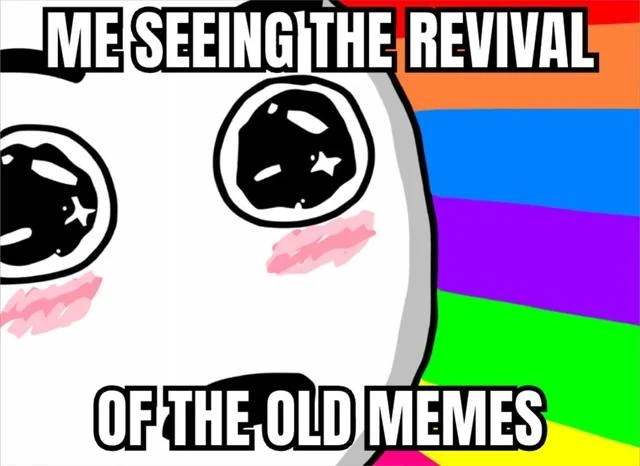
Let’s break down what’s going on for those who didn’t live through the old memes revival firsthand. The image is using a classic meme template from the early 2010s. Back then, memes often had bold white Impact font text at the top and bottom of an image – we call those image macros. The particular picture here is a rage comic face with huge, sparkling eyes and little pink blush marks. In the rage comic era, people drew simple cartoon faces (like "Trollface", "Rage Guy", "Me Gusta", etc.) to convey specific emotions in funny stories. This wide-eyed face with starry pupils usually represents a look of awe or excitement. The background is a brightly colored rainbow burst, which is also a nod to early meme aesthetics (many Advice Animals memes had colorful radial backgrounds for contrast). If you’ve ever seen classics like “Philosoraptor” (a pondering dinosaur on a green background) or “Bad Luck Brian” (a smirking school photo on a multicolor background), you get the idea – that was the style of the time. Those were everywhere in MemeCulture a decade ago, before today’s subtler formats (like funny tweet screenshots or TikTok video memes) took over.
Now, the caption says: “ME SEEING THE REVIVAL OF THE OLD MEMES.” It’s written in that same vintage style, meaning the meme itself looks like one of the old memes it’s talking about. This self-referential twist is what makes it funny. A meme template revival means people are intentionally reusing these “retro” formats (like rage comic faces and Impact text) either to be ironic or just to relive the old days. Think of it like a style from the past coming back into fashion – suddenly everyone’s wearing clothes from the ’90s again and calling it cool. Here, developers are reusing meme styles from the 2010s and having a laugh about it. It creates a nostalgia wave: older folks feel warm and fuzzy seeing something familiar, and younger folks enjoy the old-school vibe (even if they weren’t around for it the first time).
The text also hints that this joke is especially for people who have been coding for a while. It mentions “senior devs” and how they survived jQuery 1.4, SOAP APIs, and SVN. These are basically shout-outs to technologies from about 10–15 years ago that experienced developers remember well (sometimes with a grimace). If you’re newer to programming, here’s a quick intro to those terms:
- jQuery 1.4: jQuery is a JavaScript library that was extremely popular around 2009–2012 for making web pages interactive. Version 1.4 came out in 2010. Before modern frameworks like React or Angular existed, jQuery was what almost everyone used to handle the DOM (the structure of web pages) because it made things like selecting page elements and animations much easier across different browsers. Older devs spent hours writing
$(".dropdown").hide()and felt like heroes of the wild web. - SOAP APIs: SOAP stands for Simple Object Access Protocol. Despite “simple” in the name, SOAP is a rather heavyweight way to send messages between applications (it uses XML for requests and responses). It was widely used in the early 2000s for enterprise web services. Think of it as the predecessor to the now more common RESTful APIs (which typically use JSON). Many senior devs had to wrestle with SOAP’s complex XML schemas and error codes. When REST+JSON services rose to popularity, SOAP started to feel clunky and old – so seeing anything SOAP-related now is like a blast from the past.
- SVN (Subversion): Apache Subversion, usually just called SVN, is a version control system that was extremely common before Git. It’s centralized, meaning there’s one main server that holds the code repository. If two developers edited the same file at the same time, merges could become… messy. A lot of us “survived” SVN by dealing with its quirks (such as the dreaded
.svnfolders it left in every directory). Git, which is distributed and more flexible, took over in the 2010s (thanks in part to GitHub) and pretty much replaced SVN for most teams. Mentioning SVN instantly paints a picture of an earlier era of development.
Bringing up jQuery, SOAP, and SVN all together is like a secret handshake for long-time devs. It signals, “Hey, remember these? If you do, you’ll probably get a kick out of this meme.” TechHistory isn’t just a dry timeline of tools – it’s full of feelings. Maybe you nostalgically recall the thrill of your first jQuery animation working, or the frustration of debugging a SOAP request, or the moment your team migrated from SVN to Git and felt the future arrive. This meme plays on those feelings. The sparkly-eyed excitement in the image captioned “revival of the old memes” is poking fun at how we, as senior devs, react when something we thought was long gone suddenly comes back in style (whether it’s a meme or a programming trend).
To connect the dots to the broader tech trends: Service-Oriented Architecture (SOA) was basically an older generation’s approach to breaking applications into small, interacting parts (services that each did a specific thing). Sound familiar? That’s because it’s very similar to what we now call microservices, just without today’s convenient tools like Docker containers or Kubernetes. Back then, those services often talked to each other via SOAP and XML; today’s microservices prefer lighter methods (like sending JSON over HTTP), but the core idea is a remix of an old idea. That’s why a lot of senior devs smile knowingly when microservices are presented as something revolutionary – we recognize the tune, even if it’s in a new key. Similarly, an AI winter refers to a time in the past when people lost interest in artificial intelligence because it didn’t live up to the hype, and research funding dried up. Now, with powerful machine learning and Large Language Models (LLMs) that can chat or even write code, we’re in a big new AI boom (basically an “AI summer”). The main idea is that what’s old or dormant in tech can return when the conditions are right.
In short, this meme is blending a bit of tech history with current trends in a playful, relatable way. It shows how DeveloperNostalgia can turn into a joke that brings different generations of devs together. If you’ve only been coding for a year or two, the picture might just seem like a goofy cartoon with some excited text. But if you’ve been around longer, you spot the classic style and think, “Whoa, I haven’t seen a meme like this in ages!” That combination of surprise and warm familiarity is exactly the point. The joke works because it reminds us that in technology – just like in fashion or music – what goes around comes around.
Level 3: Meme Renaissance
In the software world, everything old eventually becomes new again – and that applies to both code and comedy. This meme taps into a meme renaissance in developer culture, where decade-old image macros are suddenly trendy once more. Seasoned engineers have been around long enough to see trends cycle. The wide-eyed rage comic face with a rainbow background is a deliberate throwback to early 2010s internet humor. For senior devs who lived through that era, seeing these graphics resurface triggers a powerful wave of DeveloperNostalgia. It’s the kind of GenerationalHumor that lands especially well because it’s an inside joke spanning years: the tools and memes of our past never truly die; they just hibernate until a new generation discovers them.
The humor here comes from recognition and surprise. It’s relatable in a uniquely geeky way – older developers are literally seeing their past return in real time. It’s ironic and self-aware: the meme itself uses an out-of-style format to celebrate that very format’s comeback. In developer communities, this kind of self-referential joke is common. Tech memes thrive on these shared winks to the past. We love to poke fun at how trends we once thought were gone forever suddenly reappear. It’s the same energy as discovering that a “deprecated” framework or a long-dead language is suddenly in vogue again. Everyone cracks a knowing smile because we’ve seen this movie before.
On a deeper level, the meme nods to the cyclical nature of IndustryTrends (especially those driven by hype). In technology, history often repeats itself in new guises. Veteran engineers remember when Service-Oriented Architecture (SOA) was the hot buzzword of the 2000s, promising modular services across an enterprise. Fast forward a decade, and microservices became the shiny new strategy – which, if we’re honest, is SOA wearing cooler sneakers and speaking JSON. The senior folks had a bit of déjà vu: “Haven’t we solved this before?” Similarly, many recall the AI winters of the 1980s and ’90s when artificial intelligence hype crashed hard. Seeing the explosive excitement around modern LLMs in the 2020s (an AI summer, so to speak) feels like watching an old trend reborn with modern GPU power and big data. The specifics differ, but the pattern – fervent excitement, widespread adoption, and sometimes eventual disillusionment – is familiar. This meme cleverly mirrors that pattern in miniature: old meme formats roaring back as new retro-chic content.
Within DevCommunities, such throwbacks highlight the blending of generations. For senior devs, it’s one of those DeveloperInJokes that only truly lands if you’ve “been there, done that.” They’re laughing at the nostalgia and absurdity. Meanwhile, newer developers might only know these rage faces as “cringe old memes” they saw on some dusty internet archive. Now both groups find themselves laughing together at the same image style, albeit for slightly different reasons. The meme works on multiple levels of relatability. It’s like a classic fashion trend returning after 20 years – in the end, these things come full circle. As the saying goes in tech history circles:
"Those who do not remember the past are doomed to reinstall it."
Description
A classic meme format featuring a close-up of a cartoon face with large, black, sparkling anime-style eyes and pink blush marks, expressing overwhelming joy and emotion. The right side of the image has a vibrant, multi-colored rainbow background. The text, in a bold white font with a black outline, is split between the top and bottom of the image, reading: 'ME SEEING THE REVIVAL OF THE OLD MEMES'. This meme captures the intense feeling of positive nostalgia. For experienced developers, this is analogous to seeing a technology or methodology they used years ago, which was considered outdated, suddenly become popular and trendy again, validating their old knowledge and experience in a cyclical tech landscape
Comments
7Comment deleted
It's the same look I give when a junior dev 'discovers' server-side rendering and presents it in a meeting as a revolutionary new performance paradigm
That feeling when the 2010 rage faces return is the same energy as product asking us to ‘modernize’ by containerizing our legacy WebSphere app - nostalgia meets nightmare fuel
Watching memes come back is like watching your company finally migrate off that jQuery app from 2009 - nostalgic, slightly concerning, but somehow still more reliable than whatever we're building now
Senior engineers watching junior devs discover Stack Overflow answers from 2012 and thinking they've found ancient wisdom - meanwhile we're just nostalgic for when our solutions were actually upvoted and not marked as 'deprecated approach, use modern framework X instead.'
Old templates resurfacing on my feed feel like proposing a modular monolith and getting applause from the same team that split us into 37 gRPC services - turns out nostalgia has lower latency than our service mesh
Like unearthing a 2005 sed script that still shreds your modern Python parser - timeless efficiency
Old memes coming back is our industry in one frame: relabel the monolith a “modular microservice mesh,” switch to Impact, write an RFC, and call it modernization