The 'Learn C++ in One Video' Experience
Why is this Learning meme funny?
Level 1: Wait, How Long?!
Imagine your friend tells you, “Hey, I found a single video that will teach you everything about playing the guitar in one go!” You get super excited – just one video and you’ll be a guitar hero! 😃 But when you click play, you see that the video is 24 days long. Yes, not 24 minutes, but 24 days. Suddenly your smile drops: you’d be watching this thing for almost a month straight! That’s exactly what’s happening in this meme. At first, the person is happy because it sounds like learning C++ (a programming language) will be quick and easy. Then he actually looks at how long the “quick” video is and goes 😧 “Oh no… that’s ridiculously long!”. It’s like someone promised you a quick ride, but you ended up on a never-ending road trip. To make it even funnier, the meme shows he tried to speed up the video super-duper fast (30000 times faster!) so he could finish it quickly – which is just a silly, impossible thing to do. The whole joke is an exaggeration to say: sometimes we think something will be easy or fast to learn, but then we discover it’s much more complicated and time-consuming than we thought. It’s that feeling of “Sure, I can handle this… oh wait, this is way bigger than I realized!” played for laughs. In simple terms, the meme is funny because the poor guy thought he’d climb a little hill of learning, and instead he’s looking up at a mountain – and trying to rocket himself up at 30000× speed, which of course, is just crazy! 📚🚀
Level 2: Information Overload
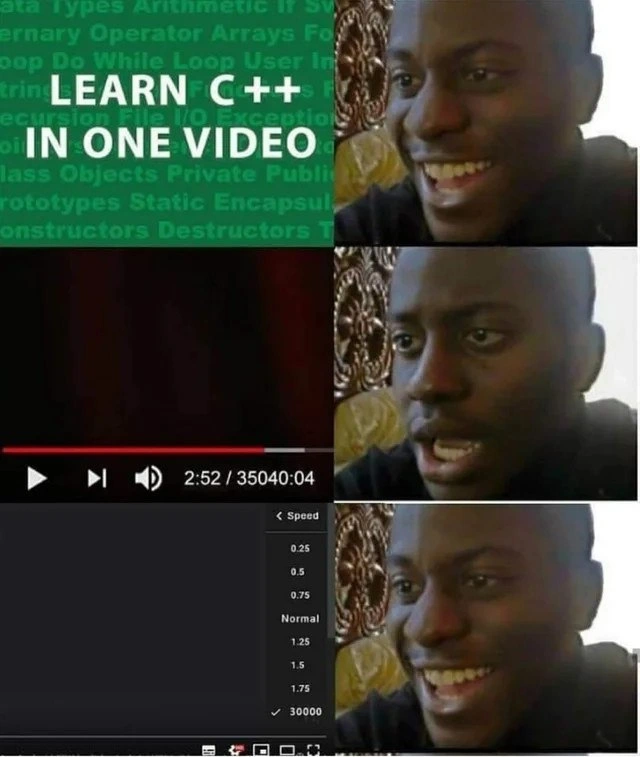
Let’s break down why this meme is funny, especially if you’re new to programming. C++ is a popular programming language, but it’s also famously hard to learn. People often talk about C++ having a steep learning curve, which means it starts off difficult and takes a lot of time and effort before things “click.” It’s not just one or two ideas – C++ has many concepts you need to understand. The meme highlights this by joking about a YouTube video that supposedly covers all of C++ in one go. The left side of the meme looks like a promotional slide with a big promise: “LEARN C++ IN ONE VIDEO.” In the background of that slide, in green, you can see a bunch of C++ topic keywords floating around faintly: things like data types, arithmetic, if/else statements, for loops, arrays, recursion, I/O (input/output), exceptions, classes, objects, private/public (which are access modifiers for class members), static, encapsulation, constructors, destructors, etc. Those are all fundamental topics you’d find in a C++ beginner’s course or tutorial. Essentially, the image is saying “look, we’ll teach you everything – from basic math operations and making decisions in code (if statements) to advanced concepts in object-oriented programming (like what classes are, how to construct objects and destroy them, etc.) – and we’ll do it all in one video.”
Now, at first glance, a newcomer might think, “Great! One video and I’ll know C++!” That’s the reaction of the smiling man in the top-right panel – he represents the viewer’s initial excitement. But then comes the punchline: below that, we see the YouTube progress bar showing 2 minutes 52 seconds out of 35040 minutes and 4 seconds. 😮 In plain terms, 35040 minutes is 584 hours, which is about 24 days of continuous video. Imagine a single video that literally takes you 24 days non-stop to watch from start to finish! That’s obviously not what you expect when someone says “one video.” It’s comically exaggerated to make the point that learning C++ thoroughly is a huge undertaking. The man’s face in the right panels goes from happy to utterly shocked when he realizes how insanely long this supposed “one video” is. If you were in his place, you’d probably react the same way: jaw dropping, eyes wide, thinking “Wait, this will take HOW long?!”.
To add to the humor, the meme shows a snapshot of the YouTube playback Speed menu in the bottom-left corner of the image. Normally, YouTube lets you adjust playback speed – common options are 0.25× (quarter speed, for slow motion), 0.5×, 0.75×, normal 1×, then a bit faster like 1.25×, 1.5×, up to maybe 2× (double speed). People sometimes watch tutorials at 1.5× or 2× to save time (the speaker’s voice sounds funny but you get through the content faster). In the meme’s image, you see those normal options… and then an absurd extra option: 30000 (that’s 30000× speed) with a checkmark next to it. 🤯 This means the viewer has jokingly set the video to play at 30000 times the normal speed. That number is outrageously high – at 30000×, a one-hour video would play back in just about 0.12 seconds! Here, a 24-day (584-hour) video at 30000× would zip by in roughly 1.17 hours. The idea is the poor guy is so desperate to “learn C++ in one sitting” that he’s willing to try anything, even a ludicrous speedup that obviously no human could actually understand. It’s a playful jab at how we sometimes foolishly try to speed through learning without giving ourselves the necessary time to absorb the material. It’s also referencing tech humor around being overloaded with information – something often tagged as DeveloperFrustration or CodingHumor when you feel like you have to cram too much too quickly.
Let’s clarify a few of those C++ terms that were floating on the green slide, since they’re central to what one would have to learn:
- Data Types: These are the different kinds of data you can use in C++ (or most languages) – for example,
intfor integers (numbers without decimals),doublefor floating-point numbers (numbers with decimals),charfor a single character,std::stringfor text strings, etc. C++ is statically typed, meaning you have to specify these types and you can’t mix them arbitrarily. Learning C++ means learning what these types are and how to use them. - Arithmetic and Operators: This refers to doing math and other operations in code (like addition
+, subtraction-, multiplication*, division/, but also things like assignment=or comparison==). - If / Switch (Conditional statements): These are ways for the program to make decisions. An
ifstatement runs certain code only if a condition is true. Aswitchis a multi-way branch – kind of like a menu of possible actions depending on a value. Beginners have to learn the syntax and logic of making decisions in code. - Loops (for, do/while): Loops let you repeat actions. A
forloop might iterate a set number of times (like from 1 to 10), awhileloop runs until a condition is false, and ado...whileloop is a variant that checks the condition at the end of the loop. Mastering loops is key to doing repetitive tasks in programming. - User Input / I/O: “I/O” stands for Input/Output. In C++, this often means using
std::cinto get user input from the console orstd::coutto print output. It also includes reading from and writing to files. A C++ tutorial would show how you can prompt a user for data or read from a file, and then process it. - Strings: Handling text in C++. This includes understanding that strings in C++ can be C-style (character arrays ending in a
\0) or more commonly using thestd::stringclass. Working with text has its own functions and gotchas that learners have to get comfortable with. - Recursion: A programming concept where a function calls itself to solve a problem in smaller pieces. C++ supports recursion, and it’s often taught as part of learning algorithms (like factorial or Fibonacci examples). It’s a slightly mind-bending concept for new programmers, so it’s another bump on the learning curve.
- File I/O: (Likely what “I/O” in the list meant, along with user input) – This covers reading from and writing to files using libraries like
<fstream>. It’s one more thing on the “learn this” list. - Exceptions: C++ has a system for error handling called exceptions (using
try,throw, andcatch). It’s a more advanced topic where you learn how to handle unexpected situations or errors in a controlled way. Newcomers often find exception handling tricky at first because it introduces different control flow. - Classes, Objects, Private/Public, Static, Encapsulation: These all relate to Object-Oriented Programming (OOP) in C++. A class is a blueprint for creating objects (which are like bundles of data and functions that operate on that data). The keywords private and public define access levels for parts of the class – public means any code can use it, private means only the class’s own code can use it (it’s a way to hide details). Encapsulation is the principle of bundling data with methods and restricting access – basically what classes help you do. Static can mean a couple of things, but commonly a static member of a class is something that belongs to the class itself rather than any particular object instance. There’s a lot to unpack in OOP, and C++’s version of it has quirks (like needing to manage memory for objects if you allocate them dynamically).
- Constructors and Destructors: These are special functions in a class. A constructor runs when you create a new object (to initialize it), and a destructor runs when an object is destroyed (to clean up, especially to free resources like memory). C++ doesn’t have automatic garbage collection like some languages, so understanding constructors/destructors is critical for managing resources and avoiding memory leaks.
All those terms show just how much ground a “learn C++” video would have to cover. And believe it or not, there’s even more beyond that in real comprehensive learning (templates, standard library containers, smart pointers, etc.)! So the joke here is that to truly “learn C++,” the video ends up comically long – because otherwise you’d be skipping important topics. It’s highlighting the LearningToCodeJourney in a humorous way: when you start learning programming (especially a tough language like C++), you might underestimate how many concepts you’ll need to absorb. The meme is basically a friend patting you on the back and saying, “Heh, yeah… there’s a lot to learn, isn’t there?” but in a funny, exaggerated manner.
Now, about that wild 30000× speed choice: Obviously, no one can actually listen at 30000× speed – that’s science fiction. Normally, people max out around 2× or maybe 3× if they’re superhuman. So why include it? It’s there to drive home how desperate or absurd it is to try to cram learning C++ into a ridiculously short time. It’s like a cartoonish way to say “I wish I could just upload this knowledge instantly.” If you’ve ever been a student procrastinating until the night before an exam, you might know the feeling of urgently wishing you could speed-read or speed-watch all the material. In developer culture, we joke about how sometimes you feel like you’re drinking from a firehose – too much information blasting at you. Here it’s taken to the extreme: a firehose? How about a tsunami of info at 30000× speed! The checked 30000× option also parodies how tech folks often try to “optimize” their learning. It’s a bit of TechHumor about us being efficiency nerds. We tweak everything – our code, our tools, even YouTube playback – to be faster. But there’s a limit: at some point, speeding up becomes self-defeating, which is exactly what 30000× illustrates with a laugh.
In summary, at this level, the meme is funny because it reveals an absurd reality: you can’t really learn a complicated programming language in one short sitting. Learning takes time, especially something like C++ which has so many pieces to understand. The meme uses extreme exaggeration (a video that lasts 24 days and a 30000× speed button) to poke fun at our wishful thinking. If you’re a beginner, it’s a lighthearted reminder not to be too hard on yourself – if you find C++ overwhelming, that’s normal! Nobody truly masters it overnight or from one video. The journey from eager enthusiasm to wide-eyed shock that the meme’s character shows – that’s a rite of passage in the learning to code journey. You start off thinking “I’ve got this!” and then realize “Wow, there’s a LOT I need to learn.” And that’s okay. The meme just lets us laugh about it. 😄
Level 3: Marathon Not a Sprint
For experienced developers, this meme triggers a knowing laugh. It skewers the classic “Learn X in Y minutes” phenomenon – the clickbait promise that you can master something as intricate as C++ with a quick fix. Anyone who’s wrestled with C++ (or any complex tech) knows learning it is a marathon, not a sprint. The left panel’s bold boast > LEARN C++ IN ONE VIDEO
captures that enticing expectation. How many times have we optimistically clicked on a “Complete Tutorial” video or full-course playlist hoping to speed-run a new language or framework? The right panels then deliver the reality: the smiling man’s face turns to horrified shock as he notices the progress bar reading 2:52 / 35040:04. That’s over 24 days of content! The humor lands because we’ve all been in his shoes, initially excited by a new learning resource… until we realize it’s way more than we bargained for. It’s the classic expectations vs. reality switcheroo. Seasoned devs chuckle because it’s so true: C++ has a notorious LearningCurve – what starts as “Sure, I can pick this up in a weekend” quickly becomes “Oh wow, this is going to take weeks (or months… or years)”.
The enormity of 35040 minutes is absurd on purpose. It lampoons the fact that a language as broad as C++ can’t be distilled without investing serious time. In industry, C++ is known for being both powerful and complicated. It’s the language that gives you low-level control (like managing memory and interacting with hardware) and high-level abstractions (like classes, templates, and the STL), which means there’s a lot to learn. The meme’s green background lists terms like data types, loops, recursion, I/O, exceptions, classes, objects, encapsulation, constructors, destructors. And guess what? Those are just the basics! A seasoned C++ developer knows that after you get through those, you still have pointers and references, dynamic memory (new / delete), smart pointers, templates, the entire Standard Template Library (vectors, algorithms, iterators), concurrency (threads, mutexes), and on and on. Each of those topics can spiral into deep rabbit holes. No wonder a ”one-stop” video would bloat into a 24-day marathon – it’s practically trying to cover everything but the kitchen sink.
From the perspective of a veteran, the desperate resort to 30000× speed in the bottom inset is hilariously relatable. It’s poking fun at our modern developer habit of watching tutorials at 1.5× or 2× speed to save time. We love to optimize everything, even how we learn. But here it’s cranked to a ludicrous extreme: 30000 times normal speed! The checkmark next to that option indicates the viewer’s frantic attempt to consume those 24 days of material as fast as humanly (or rather superhumanly) possible. It’s a perfect hyperbole for developer frustration. We’ve all wished we could just upload knowledge to our brain in seconds, Matrix-style, especially when faced with a daunting task like grokking C++’s intricacies under a deadline. Seeing “30000” as a speed option is a laugh-out-loud moment because it’s so absurd – you can imagine the chipmunk chatter of a 24-day lecture blasted through in a few minutes, an incomprehensible blur. The seasoned take-away: there are no shortcuts. If you try to rush through learning C++ (or anything complex) at too high a speed, you’ll likely retain nothing – much like how code executed 30000× faster might just crash if not designed for it. In C++ terms, that’s like invoking undefined behavior on your brain!
On a more serious note, the meme hints at the reality of mastering C++. Older devs nod because they remember their own journey – the initial zeal, the first confusing compile errors, the segmentation faults that seemingly came out of nowhere, the countless hours debugging memory leaks or const correctness issues. “Learn C++ in one video” sounds as naive as “just fix that one bug in five minutes”. We know that behind that simple marketing phrase lies a world of pain and profundity. C++ has a reputation: it rewards you with control and performance, but it demands that you absorb a lot of knowledge. There’s a shared understanding that becoming proficient in it involves many late nights, trial-and-error, and yes, probably several courses or books – certainly more than a single YouTube video, no matter how lengthy. The meme exaggerates the video length to say “Sure, you can have one video… but be prepared, it might last forever!” – which is exactly what it feels like when you’re slogging through tough documentation or a marathon tutorial series.
To experienced eyes, there’s also an implied wink at how tech education is marketed versus how it really is. The Languages category (C++ here) meets the harsh reality of Learning: you see phrases like “Master C++ in 24 Hours” on book covers or video titles, but fine print always differs. In practice, maybe you can get the syntax basics in a day, but true mastery? That’s a whole different story (more like 24 weeks, if not more!). This meme encapsulates that disconnect perfectly. The humor works because it blends developer humor with a bit of self-deprecation: we’ve all been the guy in the meme, excited to tackle a new skill with a can-do attitude, only to have C++ (or any complex tech) humble us with its vast scope. It’s a comedic reminder that learning to code – especially in C++ – is a journey with no real shortcuts, and attempting to binge it all at once will likely leave you shocked, overwhelmed, and reaching for impossibly high playback speeds in vain.
To put it in code analogy, if learning C++ were a program, it’s not a simple one-liner you can run; it’s a large codebase you need to compile and debug over time. You can’t just #include <Everything> and call learnAll(); in one go without consequences. Here’s a playful snippet echoing that sentiment:
// Trying to absorb a 24-day C++ tutorial at 30000x speed:
try {
watchTutorial("C++_Mega_Course.mp4", /*speed=*/ 30000);
} catch (const BrainOverloadException& e) {
std::cerr << "Error: " << e.what()
<< " 🚫 Too much info, too fast!" << std::endl;
slowDownAndPractice();
}
In real life, of course, there’s no BrainOverloadException – you’ll just know you’ve hit your limit when nothing makes sense anymore. The code is a lighthearted way to say: if you try to cram 24 days of content at once, your “mental compiler” will throw an error! In summary, for the seasoned crowd, the meme is both a satire of quick-fix learning resources and a nod to the complexity of C++. It captures the humbling moment when enthusiasm meets reality – and does so in a way that only those who’ve been down that road will fully appreciate.
Level 4: One Video NP-hard
At the deepest level, this meme exposes the irreducible complexity of C++. In theoretical terms, attempting to compress an entire programming language into a single video runs up against fundamental limits of information density – almost like bumping into a Kolmogorov complexity barrier. C++ isn’t just a simple topic; it’s a multi-paradigm language with a 40-year history, from low-level pointer arithmetic to high-level template metaprogramming that’s practically a language within the language. In fact, C++ templates are Turing-complete at compile time, meaning you can (in theory) compute anything during compilation. That theoretical power comes with astounding depth: every new concept (pointers, memory management, object lifecycles, template specialization, concurrency, etc.) adds layers that intertwine. The result is a knowledge base so large that any “all-in-one” resource inevitably becomes enormous.
The meme’s fictitious 24-day tutorial is a tongue-in-cheek nod to this enormity. It’s as if the video creator tried to achieve the ultimate compression of C++ knowledge and ended up with a 35040-minute runtime – basically the size of a full college course or two. In computer science terms, think of it like trying to reduce an NP-hard problem: you might compress some parts, but the problem’s inherent complexity will manifest somewhere (here it manifests as an absurd video length 😆). No clever editing trick or 30000× playback hack can truly sidestep the cognitive load required. Human learning isn’t infinitely scalable – there’s a throughput limit akin to a brain’s “bandwidth.” Blast lessons at 30000× speed, and it’s like feeding a CPU data faster than its clock can handle: you get buffer overflow of the mind. Just as no amount of micro-optimizations can turn an exponential algorithm into a constant-time one, no single video can magically shortcut the steep learning curve of a language as nuanced as C++.
This leads to a kind of educational time dilation. The meme jokingly proposes bending time (via insane playback speed) to absorb knowledge faster. But from a physics or information-theory perspective, you can’t cheat this – energy (or effort) must be expended proportionate to the information gained. It’s reminiscent of the No Free Lunch theorem: there’s no universally free shortcut to learning everything about C++ (or anything complex). Even the ISO C++ standard documents span thousands of pages of dense specification; compressing that into a “one-click” learning experience is about as feasible as compressing a 10GB dataset into a 1KB file without loss. In short, the meme exaggerates to illuminate a truth: C++’s complexity is a behemoth that resists trivial compression, and any attempt to circumvent that (like a one-video solution) collapses under the weight of reality – or in this case, a 24-day runtime.
Description
A three-panel meme using the 'Smiling and then Concerned Black Guy' format. In the first panel, the man is smiling, reacting to a YouTube video thumbnail that promises to teach 'LEARN C++ IN ONE VIDEO', with a background of C++ keywords. In the second panel, his smile turns to a look of shock and disbelief as he sees the video's length in the YouTube player: an astronomical '2:52 / 35040:04', meaning the video is over 35,000 hours long. The third panel shows him smiling again, this time looking at the YouTube playback speed settings, where he has selected a ludicrous '30000' times speed. This meme satirizes the overwhelming complexity of the C++ language and the absurdity of 'all-in-one' crash course tutorials. The joke lies in the progression from naive optimism to horrified realization, and finally to a comically impractical 'solution' to consume an impossible amount of information

Comments
7Comment deleted
That's one way to pipe a firehose of information directly to /dev/null
The 35,040-minute “Learn C++” video tracks: 23 days for the templates to finish instantiating, the remainder for the instructor to chase down the one bit of UB that slipped past the sanitizers
Still shorter than the time it takes to explain to management why we can't just "sprinkle some AI" on our 20-year-old C++ codebase that nobody fully understands anymore
Ah yes, the classic 'Learn C++ in One Video' - technically true if that one video is 4 years long and covers everything from pointer arithmetic to template metaprogramming. But don't worry, just crank the playback speed to 30000x and you'll master RAII, move semantics, and the entire STL during your lunch break. Side effects may include undefined behavior in your understanding of undefined behavior, and a newfound appreciation for why Rust exists
Promised C++ in one video, delivered 58 hours of destructor debates - because RAII rants never go out of scope
“Learn C++ in one video” at 35040:04 - finally a realistic timeline once you include RAII, templates, and the linker; set it to 30,000x and you’ve implemented management’s “C++ expert by Monday” plan
“Learn C++ in one video” - 35,040:04 long with a 30,000x speed option; just enough to cover value categories, SFINAE, the memory model, allocator semantics, and the part where three build systems argue over one ABI