Skip to content
DevMeme
940 of 7435
Scrum Masters vs. Devs: A Picture of Happiness
Agile Post #1063, on Feb 27, 2020 in TG

Scrum Masters vs. Devs: A Picture of Happiness

Why is this Agile meme funny?

Level 1: Forced Family Photo

Imagine your mom wants a perfect family picture for the holiday card. She’s grinning ear to ear, hugging you tight, and saying, “Come on, smile! We need to show Grandma how happy we are!” You, on the other hand, maybe just had a long day and really don’t feel like smiling big. But you still put on an awkward grin because, well, Mom insists. In the end, the photo shows a beaming mom and a stiff, uncomfortable you. It’s kind of funny because anyone who sees the picture can tell you don’t actually want to be in it, even though you’re technically “smiling.” That’s exactly the joke here: the Scrum Master is like the mom forcing a happy photo, and the developer is like the kid giving a half-hearted smile. The Scrum Master wants to show the world a “look how happy our team is!” picture, while the developer is just politely going along with it. We laugh because we’ve all been in that situation – when someone makes you pretend everything is wonderful for a picture or a moment, even if you’re feeling just “meh” inside. It’s a silly, shared human experience: being told to “say cheese!” when you really don’t want to.

Level 2: Stand-up Smiles

Let’s break this down in simpler terms. In Agile software development (particularly a framework called Scrum), a Scrum Master is like the team’s facilitator or coach. Their job is to help the team work together smoothly, run meetings, and remove any roadblocks that are slowing the developers down. They don’t boss people around in theory – instead, they’re meant to serve the team and improve process. Developers (Devs) are the programmers who actually write the code and build the product. Now, Scrum includes a few regular rituals (often called ceremonies or meetings) to keep everyone in sync. One of these is the daily stand-up (or daily Scrum), where each team member quickly says what they did yesterday, what they’ll do today, and if they have any blockers (problems needing help). It’s supposed to be a short, honest status update within the team. There are also Sprint Reviews and Sprint Retrospectives at the end of a cycle where the team reflects on how to improve. All these practices fall under “Agile” – which is an approach that values flexibility, collaboration, and customer feedback, as opposed to older rigid plans (like the heavyweight Waterfall method).

Now, where does happiness come in? Some companies and Scrum Masters like to keep an eye on “team morale” or team happiness. This can be a good thing – unhappy developers might mean something’s wrong (unrealistic deadlines, poor communication, etc.). But the joke here is about forcing a show of happiness. The meme literally shows the Scrum Master character holding up a phone with a photo of her hugging the developer tightly, announcing how happy they look “as a couple.” That’s a pretty odd thing to do in real life, right? It’s exaggerating what sometimes happens figuratively: a Scrum Master might try to demonstrate that “Our team is super happy and getting along great!” by, say, posting a smiling team selfie on Slack or reporting in a meeting that “Everyone is 100% committed and loving the project.” Meanwhile, the developers might actually be uncomfortable, tired, or annoyed – but they oblige awkwardly. In the workplace, this could mean they smile for the group picture, or nod and give a thumbs-up in the meeting, even if they have reservations internally.

This dynamic can be awkward for developers. Imagine you’re a junior dev in your first job: every morning in the stand-up meeting you’re expected to sound positive. Even if the code you wrote yesterday completely broke and you’re stressed, you might feel pressure to say “Yesterday went well, no blockers!” because everyone else seems to be saying upbeat things. That’s how a stand-up can turn into status_reporting theater – where instead of honestly discussing issues, people just report “all good here!” to avoid any negative vibe. A Scrum Master with the right approach will encourage honesty (“It’s okay to say you’re stuck or things aren’t perfect”), but a misguided Scrum Master might only want to hear good news or see smiling faces. So developers learn to just go with the flow and fake enthusiasm so the meeting ends faster and no one gets uneasy.

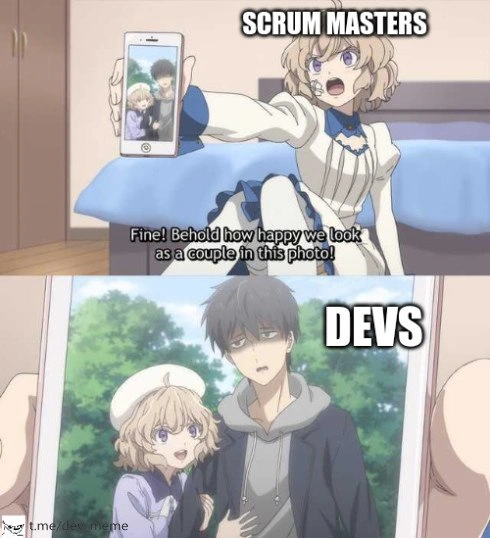
The meme labels the characters to make it clear: SCRUM MASTERS on the girl taking the selfie, and DEVS on the reluctantly hugged guy. It’s using an anime reaction meme format – taking a scene from an anime (Japanese animation) and repurposing it to convey a tech joke. Anime often has exaggerated emotional visuals, which works great here: the Scrum Master looks over-the-top excited, and the Dev looks “please help me” deadpan. Even their body language (her grabbing him in a hug, him standing stiffly) is a funny parallel to a pushy manager and a resigned engineer. This is a form of standup_ceremony_satire because it’s specifically poking fun at the daily stand-up or similar Scrum rituals where everyone’s supposed to be on the same happy page. It’s also highlighting scrum_master_overreach – that means the Scrum Master is overstepping their normal role, caring more about appearances (like a fake happy photo) than the substance (whether the team truly feels okay or not).

For a newcomer to Agile, it might help to know: Agile’s core idea is to value individuals and interactions over strict processes. Ironically, in some environments it flips – the process (ceremonies, reports, “looking Agile”) starts to overshadow honest interactions. So if you ever find yourself in a team where the Scrum Master is constantly saying things like “Alright team, big smiles, we need to show management how united we are!” and you feel a bit uncomfortable, that’s basically what this meme is depicting. It’s like when a teacher in school cares more about the class looking well-behaved when the principal walks by than whether the students are actually learning. The AgileHumor here comes from recognizing that contrast. Developers often joke about hating endless meetings – especially ones that feel performative. We put tags like Meetings and AgilePainPoints on this meme because it captures exactly that pain point: too much emphasis on ceremony can frustrate developers who just want to focus on real problems.

Another term you might see is “forced fun” or “mandatory fun”. Tech teams sometimes use this term to describe company events or team-building exercises that everyone is supposed to enjoy (or at least pretend to). In the meme, the “team happiness photo” is like mandatory fun distilled into one image. The Scrum Master is effectively saying “Come on, show how much you love the team!” and the Dev is like “...sure (if you say so).” Young developers experiencing their first corporate hackathon or off-site party might relate: ever had a manager urge you to participate in a goofy icebreaker game when you’d rather be debugging your code? It’s that feeling. You go along with a smile, but it’s not exactly coming from the heart.

In summary, the meme is using a funny cartoon to highlight a real communication issue in some Agile teams: presentation vs. reality. The Scrum Master (in theory) should be asking “What do you need? What problems can I help remove?” rather than “Say cheese for the team photo!” But when they focus on showing off how smooth and happy the team is, developers can feel like they’re just props in a show. If you’re new to this environment, don’t worry – not all Scrum Masters are like this! The good ones make you feel supported, not awkward. But the meme definitely hits on a common joke: the battle between devs who are a bit introverted or focused on code, and Scrum Masters who are extroverted cheerleaders for the process. Both want the project to succeed, but they sometimes clash in style. This meme has the tags scrum_vs_devs_meme and communication because it’s showing exactly that clash in communication styles and priorities.

Level 3: Agile Optics Over Reality

In this anime-style meme, an overzealous Scrum Master (the excited blonde character) holds up a phone showing a selfie of herself clinging to a deadpan gray-haired Developer. The top caption shouts "SCRUM MASTERS," and the bottom caption labels the disinterested guy as "DEVS." The Scrum Master’s speech bubble even proclaims, “Fine! Behold how happy we look as a couple in this photo!” — as if team happiness were something you could stage for the camera. This scenario is painfully familiar to seasoned developers: it satirizes the performative side of Agile ceremonies, where maintaining optics of a “happy, cohesive team” can take priority over addressing real issues. The humor (and cringy truth) comes from the disconnect between appearances and reality. Just like the uncomfortable anime "boyfriend," developers often feel forced to play along with morale theater.

Why is this funny to experienced devs? It’s a pointed jab at Agile ceremony optics. Many of us have lived through Sprint demos or daily stand-up meetings that felt more like photo-ops than productive check-ins. The Scrum Master in the meme is essentially saying, “Look, everyone, how great our team is doing!” while the dev’s expression says, “I’m here because I have to be.” This echoes real life: managers or Scrum Masters sometimes push team members to smile in retrospectives, celebrate “achievements” on cue, or fill out happiness surveys with only positive feedback. It’s a form of Scrum theater – going through cheerful motions so higher-ups see a "healthy Agile team". Seasoned devs recognize this as a cargo cult agile symptom: following rituals and making things look good on the surface, without actually improving the underlying process or product. The meme captures that absurd feeling when a Scrum Master is more concerned with a status report-friendly narrative (“We’re one big happy family!”) than with the code on fire or the Jira backlog growing by the minute.

This scrum_master_overreach resonates because it’s a common anti-pattern. Agile frameworks like Scrum were intended to empower teams to adapt and communicate honestly. Yet, in practice, a rigid or overbearing Scrum Master can turn these ceremonies into performative checkboxes. For example, instead of a frank discussion in stand-ups about blockers and technical debt, teams end up giving polished mini status reports to satisfy the Scrum Master or project manager listening in. (If you’ve ever caught yourself saying “No blockers, everything’s fine” while thinking “Except the production bug I was up until 2 AM fixing”, you know the drill.) The standup_ceremony_satire here is strong: the daily stand-up was meant to be for the team’s benefit, but pathological cases turn it into a stage where devs perform happiness and progress for someone else’s approval.

On a deeper level, this meme pokes at the communication gap between dev teams and Agile coaches. The Scrum Master character is presumably trying to do their job — fostering teamwork and positivity — but going about it in the shallowest way possible. It’s forced_happiness: scheduling yet another “fun” meeting or insisting on a peppy team photo when what devs really crave is uninterrupted time to solve problems (or candid acknowledgment of the problems). There’s an implicit criticism of how some organizations measure success. Rather than looking at code quality, reasonable deadlines, or developer burnout, they might latch onto vanity metrics like “team engagement” or cheerful meeting snapshots. It’s like a twisted KPI where the goal is a smiling team picture posted on Confluence, instead of a well-architected release.

Everyone in software has heard the phrase “If it isn’t in Jira, it didn’t happen.” Here it’s more like “If the team isn’t smiling, the sprint didn’t happen.” The satire works because we’ve seen real versions of this. Think of a Sprint Review meeting where the team is urged to only showcase successes and skip over any messes, to keep stakeholders impressed. Or a team-building offsite where the itinerary is packed with forced fun, and a group photo with fake grins ends up in the company newsletter captioned “Our Awesome Dev Team!” Meanwhile, the devs in that photo might be grumbling in private Slack channels about how behind the project is or how the new microservice isn’t scaling. The meme’s “happy couple” facade is a perfect metaphor for this kind of disconnect. The Scrum Master is effectively saying, “We make such a great team, right?” while the dev’s face (and every developer viewing the meme) says, “This is awkward and not the full story.”

In true DeveloperFrustration fashion, the image highlights the tension between AgileHumor and agile reality. The categories (Agile, Meetings, Communication) are all at play here. Agile meetings are supposed to improve communication, but when a Scrum Master obsesses over status_reporting and positivity, it can have the opposite effect: developers communicate less honestly. Why? Because when every stand-up or retrospective feels like a performance review or a PR photo shoot, devs learn to mask their true feelings to avoid rocking the boat. The result: a disconnect between reported team health (“Look how happy we are!”) and actual team health (quiet quitting or weekend bug-fixing misery). The meme exaggerates it with the anime trope of a girl flamboyantly hugging an apathetic guy, which is a humorous way to depict how one-sided that enthusiasm can be.

From an organizational perspective, this scenario persists because of incentive structures. Scrum Masters (or Agile coaches) might be under pressure to demonstrate that their team is engaged and the Agile process is yielding a positive culture. So they might genuinely believe posting a smiling selfie with the team or pushing for constant upbeat vibes will fulfill that. Developers, on the other hand, often operate under different incentives: shipping reliable code, meeting deadlines, and not getting paged at 3 AM. When crunch time hits or technical debt looms, devs can feel resentment towards the “soft” side of Agile that interrupts work without tangible benefit. Yet, they comply — just like the dev in the meme awkwardly posing for the photo — because saying “no” to a Scrum Master’s request to play along might brand them as not a “team player.” This is classic AgilePainPoints: the very framework meant to help teams self-organize can, in misapplication, create new tensions and DeveloperFrustration.

By portraying the Scrum Master and Dev as a happy couple, the meme also hints at how some Scrum Masters try to buddy up with the team in superficial ways. Picture a Scrum Master who’s not coding alongside the developers, but suddenly during Sprint Retro they’re patting everyone on the back, saying “We did great! We’re so awesome!” and snapping a photo. It feels as contrived as a forced couple selfie. The devs might be thinking, “Sure, we’re smiling, but did you notice half the sprint tasks got rolled over?” The comedic irony is that the Scrum Master is proudly showing off a relationship bond that the other side (the devs) isn’t truly feeling at that moment. This dissonance — between staged ‘team happiness’ and genuine sentiment — is where the meme gets its bite.

Ultimately, the meme lands because it’s too real for anyone who’s been in an Agile environment gone slightly awry. It’s a reminder that good Agile practice is about trust and transparency, whereas bad Agile practice is about appearances and ceremony for their own sake. As a battle-weary developer, you chuckle (or maybe cringe) seeing this exaggerated “happy Scrum couple” because it rings true. You’ve had that exact DEVS facial expression when a well-meaning Scrum Master insists on a goofy team selfie after a grueling sprint. Inside, you’re thinking: We might look cheerful in that JPEG, but oh boy, production is a dumpster fire. This meme perfectly contrasts the Agile idealism (Scrum Master’s excited grin) with the developer reality (exhausted, indifferent stare) — a clash that fuels so much of our internal tech humor.

Description

Two-panel anime meme from the series 'Kyokou Suiri' (In/Spectre). The top panel has the text 'SCRUM MASTERS' over an anime girl with blonde, curly hair in a frilly dress. She is angrily holding up a phone and the subtitle reads, 'Fine! Behold how happy we look as a couple in this photo!'. The bottom panel is a close-up of the phone's screen, showing the photo itself. In the photo, the girl is smiling happily, while the boy next to her, with dark messy hair and a grey hoodie, looks completely drained, with dark circles under his eyes. The text 'DEVS' is superimposed over the boy. The meme humorously illustrates the profound disconnect between the perception of project health by Scrum Masters, who often focus on the successful completion of ceremonies and metrics, and the actual state of the developers, who can be overworked and burnt out by the process. It's a sharp critique of 'Agile theater,' where adherence to process is prioritized over the team's well-being and sustainable pace. A watermark for 't.me/dev_meme' is visible in the bottom-left corner
Comments

7
Anonymous ★ Top Pick The Scrum Master reports 'Velocity is high and morale is great!' The dev's commit history just says 'fix: typo' at 2 AM. The photo captures that delta perfectly
  1. Anonymous ★ Top Pick

    The Scrum Master reports 'Velocity is high and morale is great!' The dev's commit history just says 'fix: typo' at 2 AM. The photo captures that delta perfectly

  2. Anonymous

    Another successful sprint: 34 story points burned, one meticulously staged “happy team” selfie for the exec deck, and exactly zero reduction in the monolith that’s older than our first Jira ticket

  3. Anonymous

    The only retrospective action item that actually gets implemented is the Scrum Master adding more ceremonies to 'improve team cohesion' - because nothing says 'happy couple' like a fourth daily standup variant and mandatory fun Fridays

  4. Anonymous

    This perfectly captures the Agile industrial complex: Scrum Masters enthusiastically showcasing 'high-performing team culture' with velocity charts and happiness metrics, while the devs are just trying to survive another sprint planning session that could have been an async Slack thread. The real story points are in the developers' eyes - that's where you'll find the technical debt of forced collaboration ceremonies

  5. Anonymous

    Scrum Master: “Look how happy we look as a couple!” Devs: “We prefer loose coupling and high cohesion - stop trying to prove it with a green JIRA filter.”

  6. Anonymous

    Agile theater in 4k: the Scrum Master manufactures a happy-team selfie for the exec demo while the devs' morale metric stays NaN

  7. Anonymous

    Scrum Masters velocity: smiles per sprint. Devs: tech debt per retrospective

Use J and K for navigation