Deciphering My Own Ancient Code
Why is this CodeQuality meme funny?
Level 1: Lost in My Own Mess
Imagine you built a super complicated LEGO castle without following any instructions or making any notes for yourself. You were just sticking pieces together in a crazy, fun way and eventually made something that kind of worked. Now, a few weeks later, your teacher or friend asks you to add a new room to this castle, or maybe fix something that’s weird about it. You pick up the castle and... you have absolutely no idea how you put it together in the first place. There are secret rooms, tangled tunnels of bricks, and you even find a door that leads to nowhere. You’re staring at it thinking, “What on earth was I trying to do here?!”
That’s exactly what’s happening in this meme. The “spaghetti code” is like that messy LEGO castle — it’s all tangled and confusing. And no comments is like having no instruction manual or notes. The developer is basically in the same spot as you with the castle: they made a big mess (their code), and now even they can’t understand it. It’s funny in a facepalming way because you’d expect the creator to know what’s going on, but nope! They’re as lost as anyone else. It’s like writing a secret message in a unique language you invented, thinking you’ll remember it, but when you look at it later, it just looks like gibberish even to you. The meme makes us laugh because we’ve all felt confused by something we ourselves did. It’s a reminder: if you don’t keep things tidy and leave yourself notes (whether building with LEGO or writing code), you might end up baffled by your own creation, scratching your head and thinking, “I created this monster, and now I can’t tame it!”
Level 2: Spaghetti Code Hangover
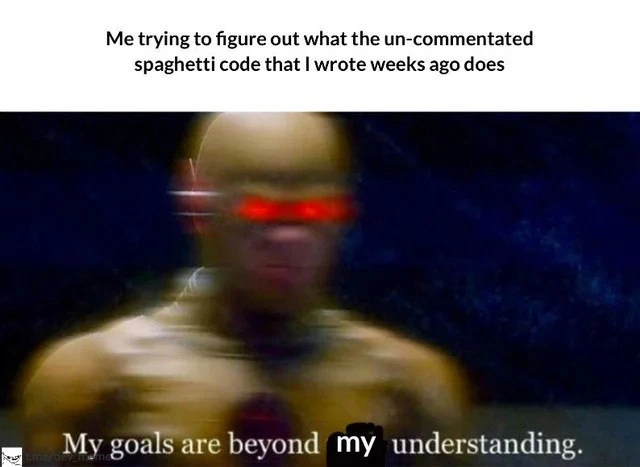
Let’s break down what’s happening in this meme in simpler, junior-friendly terms. The person in the meme (the “Me”) is a developer who wrote some code a few weeks ago. Now they revisit that code and can’t figure out how it works at all. The text at the top basically says: “Me trying to figure out what the un-commented spaghetti code that I wrote weeks ago does.” That phrase is describing the situation:
- Un-commented code: Code that has no comments. In programming, comments are lines that programmers write for humans, not for the computer. For example, in many languages, you might see something like
// calculate the totalor/* this part sorts the list */above a piece of code. Those are comments. They explain, in plain language, what the code is supposed to do or any important details. Here, the code has none of those explanations. “Un-commented” means the original developer (who is the same person now trying to read it) didn’t write any notes or explanations in the code. It’s like a book with no chapter titles or a recipe with no instructions – just raw steps and you have to guess why each step is there. - Spaghetti code: This is a funny term developers use to describe code that is very messy and tangled. Why spaghetti? Imagine a bowl of spaghetti pasta — a heap of long noodles all tangled up. If I asked you to follow one noodle from one end to the other, it would be difficult because it’s all intertwined in a confusing way. Spaghetti code is the same idea but with the flow of the program. It might jump around unpredictably, functions call each other in confusing ways, there’s no clear start or end, and overall it’s hard to follow the “thread” of execution. This often happens when code is written hastily or without a clear structure. For a newcomer or even the original coder coming back later, reading spaghetti code is like trying to untangle a big knot — frustrating and time-consuming.
- Code from weeks ago: This highlights a common experience — even if you yourself wrote the code, if enough time passes (a few weeks, in this case), you might forget the details. Code is very exact and sometimes complex. Unless it was written cleanly or documented, you can’t rely on memory alone to understand it after some time. The meme exaggerates this by suggesting the code is so confusing that its own author is now totally lost.
Now, the bottom part of the meme shows a super-villain with red glowing eyes and blurred motion (he’s sort of shaking with intensity). This villain is actually a character known as the Reverse-Flash from the superhero TV show “The Flash.” In the original scene, he says, “My goals are beyond your understanding,” as a way to taunt the hero (basically saying “you can’t possibly understand what I’m trying to achieve”). The meme creator altered the subtitle to say “My goals are beyond my understanding.” By replacing “your” with “my,” the meaning changes completely and becomes a joke. It now reads like the villain (or the coder’s own code) is saying it doesn't even understand itself!
In context:
- “My goals” refers to what the code was meant to do — the purpose or the task the code was trying to accomplish (the feature or outcome the programmer had in mind).
- “beyond my understanding” implies that the goals/purpose of this code are not understandable even to the person who set those goals. In other words, “I don’t even understand what I was trying to do here.” That’s the punchline: the developer is looking at their old code and honestly has no clue what the logic means anymore. It’s like the code has become an alien artifact.
The humor and the slight pain behind this scenario come from a few key software engineering concepts:
- Code Maintainability: This means how easy it is for someone (often a future developer, who could be future-you or another team member) to read, use, and modify the code. High maintainability comes from clear structure, good naming, and documentation (like comments). Low maintainability — as in this meme — happens when the code is written without these things. Spaghetti code with no comments is basically low maintainability code. It’s very hard to maintain or update because understanding it is a big challenge. New developers learn quickly that writing code isn’t just about making the computer do something; it’s also about making the code understandable for humans who might work on it later.
- Debugging / Troubleshooting: This is the process of figuring out why code isn’t working as expected or simply understanding what it’s doing step by step. When the meme says “me trying to figure out what the code does,” it’s essentially describing a debugging session where the developer is reading through the code, possibly running it step by step, trying to make sense of it. Now, debugging normal code can be straightforward if the code is clear. But debugging spaghetti code without comments is like solving a mystery with no clues. The motion-blur on the villain with red eyes perfectly captures the frantic feeling of debugging under pressure: your eyes might dart across many files or many lines, you might be scrolling quickly (hence the “blur”), and the red eyes could symbolize both strain (tired red eyes from staring at the screen) and a bit of panic or frustration.
- Technical Debt: This is a term that compares writing quick, messy code to taking on debt (like a loan) in real life. If you rush and don’t do things properly (like not commenting or not structuring the code well), you “borrow” some convenience now, but you’ll “pay for it” later when that haste causes problems. The “interest” on technical debt is the extra time and effort you have to spend later due to early shortcuts. In our meme scenario, not commenting the code and writing it sloppily was taking on technical debt. Now, weeks later, the interest is due — the developer must invest a bunch of time and brainpower to understand what they themselves wrote. If they had taken a little more time to write clear code or add comments back then (avoiding some debt), they would have “paid” a bit then, but saved a lot of trouble now.
- Refactoring: This means improving the internal structure of code without changing what it actually does. When faced with spaghetti code, a common task is to refactor it — break it into smaller functions, give variables meaningful names, add comments, maybe even rewrite portions for clarity. The meme implies that the code probably needs refactoring, but doing that is going to be painful (RefactoringPain is real!). Why painful? Because you have to first understand the messy code to safely change it. It’s like needing to untangle a knot before you can straighten the rope. Many junior devs first encounter refactoring when they realize their initial code works but is very hard to read or extend. This meme is a comical reminder of why refactoring and writing clean code matters.
- Past self vs Future self: There’s a bit of a psychological inside joke here. Developers often joke that their past self (the person they were when they wrote the code) either sabotages or helps their future self (the person reading the code later). If past-you wrote good documentation and clean code, future-you is grateful. If past-you was lazy or rushed, future-you suffers. Here, future-self (the developer now) is basically shaking their fist at past-self (the developer a few weeks ago) saying “Why have you done this to me?!” The meme literally personifies this by using a villain image — it’s like the past version of the coder turned into an evil villain who created a diabolical piece of code. And the present version of the coder is the victim-hero who’s stuck dealing with it. This split-self scenario is very common in coding. It teaches a valuable lesson: when writing code, think about the poor soul (even if it’s yourself later on) who will have to read and understand it.
To put it simply, this meme is a funny warning. CodeComments and clear structure are important! The developer in the meme is basically saying, “I have no idea what I was thinking when I wrote this.” It’s both humorous and a tiny bit tragic for a dev because we’ve all had that moment of DeveloperRegret. The meme resonates with readers who are programmers because they likely have been in that exact situation: staring at their own code with a mix of confusion and self-directed annoyance.
The combination of the dramatic villain image with the text makes the situation over-the-top in a laughable way. It’s an exaggeration of the feeling:
- The red glowing eyes = me, the developer, getting angry at my computer screen (or at myself).
- The blurred figure = the chaotic state of my brain as I try to race through the code, or how the code feels like it’s moving too fast to pin down.
- The quote “My goals are beyond my understanding” = a fancy, meme-able way to say “I do not understand what I was trying to do here, even though I’m the one who wrote it.”
In summary, for a junior developer or someone new to these ideas: Always document and organize your code. If you don’t, you might literally forget why you wrote something or how it works. Then you’ll end up like the person in the meme: bewildered by your own work, as if confronting an unpredictable villain. Writing good comments, choosing clear variable and function names, and structuring your program logically are all ways to avoid this fate. Because trust me, nothing is more awkward in coding than debugging your own code and muttering, “what was I thinking?!” 😅
Level 3: Reverse-Engineering Myself
This meme hits home for every seasoned developer who’s returned to their own cryptic code and thought, “Who wrote this nonsense?!” only to realize — horror of horrors — it was them. The top caption sets the scene: me, the developer, desperately trying to figure out the un-commented spaghetti code I wrote weeks ago. The image below dramatizes this internal crisis with a motion-blurred super-villain (the DC Reverse-Flash) glaring with menacing red eyes. The bottom subtitle reads, “My goals are beyond my understanding,” with the word “my” pasted in. It’s a perfectly dark comic twist: the code’s purpose (the “goals” of past-me) is now literally beyond my understanding. The visual of a villainous speedster with glowing eyes represents the frantic confusion and dread you feel when confronted by your own unfathomable creation. It’s as if your past self were an evil genius who laid a fiendish trap only you would fall into later.
On a technical level, this meme skewers the classic spaghetti code nightmare. Spaghetti code refers to code with a tangled, ad-hoc control flow — imagine a bowl of spaghetti where each noodle (logic path) weaves around unpredictably. There’s no clear structure, just a mess of loops, jumps, and interdependencies. Combine that with zero code comments (explanatory notes in the source that could guide a reader), and you have a perfect storm of CodeMaintainability disaster. The humor here is painfully relatable: most developers have written something quickly (often late at night or under deadline pressure) and thought, “I’ll remember how this works.” Weeks or months later, reading that same code feels like deciphering someone else’s bizarre work. The meme’s punchline — “My goals are beyond my understanding” — is basically present-me admitting defeat in the face of past-me’s convoluted logic.
Why is this so funny (and traumatic)? Because it’s true. The TechnicalDebt metaphor in software is no joke: writing quick-and-dirty code without documentation is like swiping a credit card – you “buy” some speed or convenience at the cost of future headaches (interest payments in debugging time). Here, the debt has come due. The developer’s goals from weeks ago (the code’s intended function) did get achieved back then (the code probably ran), but now the reasoning is lost. It’s one thing to inherit a monstrosity from someone else, but realizing you yourself built this labyrinth is a whole new level of DeveloperRegret. The meme taps into that self-deprecating humor: we are often our own worst enemies. As a bitter joke in programming circles goes, “Always code as if the guy who ends up maintaining your code will be a violent psychopath who knows where you live.” In reality, that poor soul maintaining your code is often your own future self. 😅 Here I am, essentially haunted by my past self’s laziness or haste.
From an experienced developer’s perspective, several deeper patterns are being referenced. The phrase “un-commented spaghetti code” is practically a horror-story trope in software engineering. It hints at multiple anti-patterns:
- Lack of documentation: No inline comments, no README, nothing to translate the author’s intent. It’s a code_documentation_failure where the code isn’t self-explanatory and there’s no external guide. This breaks one of the cardinal rules of maintainable code: code should be written for humans to read it, not just for machines to execute.
- High complexity and tangled logic: Functions doing too many things, deeply nested loops, unpredictable jumps — all of which increase the cognitive load needed to understand the program. We measure this with metrics like cyclomatic complexity (how many independent paths exist through the code). Spaghetti code tends to have sky-high complexity, meaning even the original author can’t easily trace what’s happening. It’s like a maze with no exits clearly marked.
- Technical debt and quick fixes: This kind of code often results from rushing or patching one thing after another. Maybe I thought, “I just need this to work right now,” and left a trail of
TODOcomments (if even that) promising to clean up later. Later never came. Each shortcut accumulates into a TechDebt pile. Now, debugging or extending this code is expensive — akin to paying interest on that debt with additional pain and time. - Past vs Future self disconnect: There’s an implicit joke about future_self_vs_past_self. Past-me was so sure of themselves that they didn’t leave hints. Future-me (now present) approaches the code like a bewildered archaeologist, trying to decipher an artifact. It’s practically a time-travel paradox: I wish I could go back in time and yell at past-me to add a few comments or refactor that mess. The Reverse-Flash imagery playfully reinforces this temporal self-conflict (Reverse-Flash in comics literally travels back in time to mess with The Flash — here past-me has “messed with” present-me).
- Big ball of mud: If this spaghetti mess grows beyond a single snippet, it can turn into a “Big Ball of Mud” architecture – a term for an entire codebase that lacks clear structure or modularity. This meme captures that feeling on a micro scale: even a small piece of code can feel like a big ball of mud when it’s inscrutable. In industry history, we moved from unstructured programming (lots of GOTOs – the original spaghetti code) to structured programming and higher-level abstractions precisely to avoid these situations. But even in modern code (yes, even with fancy OOP or functional paradigms), you can create spaghetti by poor planning. The ghost of GOTO can manifest as tangled function calls or deeply nested conditionals that produce the same confusion.
The blurred, red-eyed villain visual also conveys the Debugging_Troubleshooting chaos that ensues. When debugging, you often step through code trying to follow the program’s “story.” In a well-commented, well-structured code, the story is like a clear novel. In spaghetti code, it’s like reading a shredded book where pages are out of order. The blur effect in the meme feels like the developer’s eyes scanning back and forth through code files at high speed, heart racing, as they attempt to piece together clues. The glowing red eyes? That’s the mix of anger (at oneself) and sheer panic when a production bug arises in this code and you’re the one who has to fix it. (The meme doesn’t explicitly mention production, but every experienced dev knows that uncommented code has a tendency to blow up at the worst times — Friday 5 PM deploys, anyone?). It’s a self-inflicted on-call horror.
Ultimately, the meme is funny because it’s cathartic. We laugh to keep from crying at our own mistakes. It’s a form of DeveloperHumor and DeveloperSelfDeprecation: we’ve all been the dummy who thought our code was “straightforward enough” without documentation. The subtitle “My goals are beyond my understanding” could be every programmer’s motto on a bad day. It’s essentially admitting, “I have no clue what Past-Me was trying to achieve or why they did it this way.” The choice of a grandiose villain quote makes it ironic and over-the-top, which highlights how ridiculous the situation is — I’ve become a perplexed hero facing an inscrutable villain plot, except I’m both the hero and the villain in this story. The refactoringpain is real: untangling such a mess often means painstakingly rewriting code, adding comments after the fact, or drawing flowcharts on a whiteboard just to map out what’s happening. A senior engineer reading this meme might chuckle and wince simultaneously, recalling war stories of self_debugging sessions where they spent an afternoon reverse-engineering their own 6-month-old commit.
In short, the meme humorously encapsulates a hard truth of software development: writing code is often easier than reading code, especially if the code was written with little care for the poor soul who has to read it later. And when that poor soul is you — well, you’ve only yourself to blame… and perhaps to laugh at. After enough of these encounters, you can bet this developer (and all of us) will think twice before saying, “I’ll document it later.” Consider those red glowing eyes a warning from Future-You: comment your code and avoid the spaghetti trap, or you’ll end up battling your own understanding.
Description
A meme that humorously depicts a developer's struggle with their own past work. The top caption reads, 'Me trying to figure out what the un-commentated spaghetti code that I wrote weeks ago does'. The image below is a blurry, motion-effect shot of the DC Comics villain Reverse-Flash from 'The Flash' TV series, with his eyes glowing an intense red. The subtitled quote at the bottom, originally 'My goals are beyond your understanding,' has been cleverly edited to say, 'My goals are beyond my understanding.' The word 'your' is visibly whited out and replaced with 'my'. This alteration perfectly captures the feeling of a developer looking back at their own poorly documented, convoluted code and having no idea what their past self was trying to achieve. It’s a relatable commentary on the importance of writing clean, commented code, as even the original author can quickly lose context and find their own work incomprehensible
Comments
7Comment deleted
The six stages of debugging your own old code: 1. This is genius. 2. This is okay. 3. This is... not great. 4. What was I thinking? 5. `git blame`. 6. Oh, right. Me
Fired up git blame on my old, uncommented helper module - every line just said “you.” Congrats, Past-Me: you accidentally shipped Schrödinger’s microservice - it both works in prod and is unknowable until you look at it, at which point it collapses and takes the whole cluster with it
The real 10x developer writes code so optimized that even they can't understand it after the caffeine wears off - it's like pair programming with a hostile time-traveling version of yourself who speaks only in abstract syntax trees
The real tragedy isn't that you wrote spaghetti code without comments - it's that you somehow convinced yourself at the time that the logic was so elegant and self-evident that future-you would instantly grasp the nested ternary operators and side-effect-laden function chains. Spoiler: future-you now suspects past-you was either a genius or having a stroke, and the git blame offers no clarity, only shame
Debugging your own spaghetti code: reverse-engineering an artifact from a slightly less caffeinated version of yourself
After a quick bout of temporal debugging, git blame prints my name 42 times and the commit title "WIP: quick hack - explain later."
Revisiting my un-commented spaghetti from last quarter: implicit globals, four singletons, and a DIY event bus - basically a distributed system; my understanding is only eventually consistent