Learn to Code So You Can Finally Understand Programmer Memes Everywhere
Why is this DevCommunities meme funny?
Level 1: Joining the Club
Imagine all your friends are part of a secret club where they share funny jokes in a language only they understand. They’re all laughing at something, and you’re sitting there confused. You’d probably want to learn that language just so you can be in on the joke, right? That’s exactly what this meme is saying about programming. Learning to code is like getting a special decoder ring for a big worldwide clubhouse of programmers. They have tons of inside jokes on the internet (on sites like Twitter and Reddit) that seem gibberish until you know how to code. Once you do, the “gibberish” starts to make sense and it’s hilarious! In simple terms, the meme is joking that one of the best reasons to learn programming is so you can laugh along with all the other programmers. It’s funny because it’s a little bit true: being able to share a laugh makes you feel like part of the group. Everyone likes to belong — and in the programmer group, the password to get in on the jokes is understanding code. So, learning to code lets you join the fun.
Level 2: Decoding Dev Humor
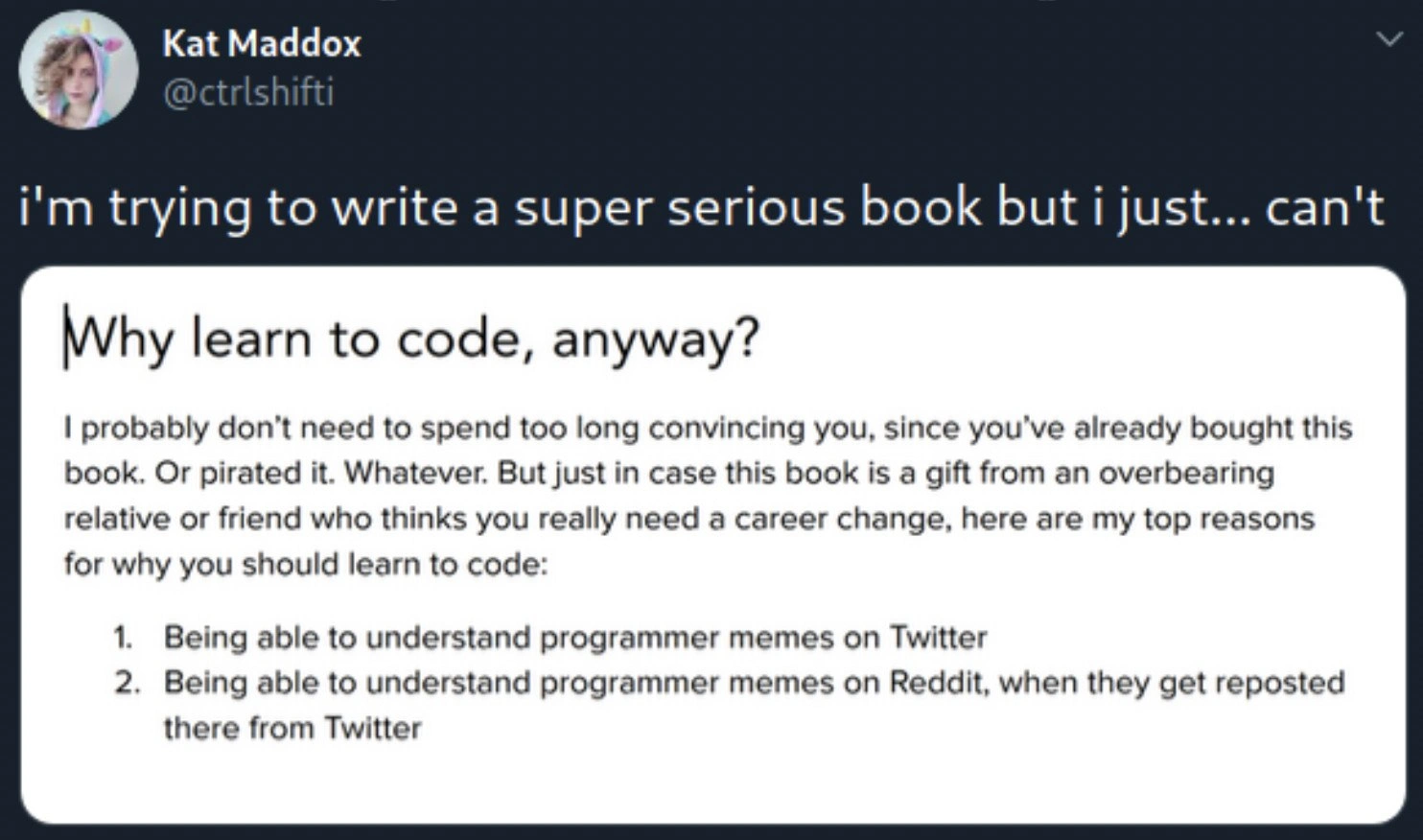
So what exactly is going on here? The meme shows a fake page from a coding book listing reasons to learn programming, and both reasons are basically “to understand programmer memes on the internet.” This is a lighthearted take on DeveloperMotivation. Usually, when someone asks why learn to code, the answers are things like to build websites or apps, to get a good job in tech, to automate tasks, etc. But this joke flips it: it says you should learn coding just to get all the funny DeveloperHumor you see on Twitter and Reddit. It’s implying that programmer memes (the jokes, images, and posts that programmers share) are such a big part of the culture that they alone are worth the effort of learning to code. That’s a playful exaggeration, of course! Let’s break down some of the terms and references to make sure everything’s clear:
Programmer memes: These are inside jokes in the form of images or text that only people with coding knowledge find funny. For example, a meme might show the classic Spider-Man pointing at Spider-Man image with a caption about two identical bugs in your code. If you’ve written code, you know the joke is about how two mistakes can look different but are actually the same. If you haven’t coded, you might not get why it’s funny. Programmer memes often reference things like specific programming languages (like Python vs. Java jokes), common bugs (null pointer errors), or tools and habits (like using Stack Overflow for every solution). They’re basically the inside jokes of the DeveloperCommunity.
Twitter dev community: Twitter isn’t just celebrities and news — there’s a whole subculture of developers on Twitter (sometimes called DevTwitter) who share quick TechHumor and tips. Tweets are short (used to be 140 characters, now 280), so dev jokes there are usually snappy one-liners or a funny screenshot. In the meme image, the top part is literally a Twitter post by Kat Maddox (@ctrlshifti). She’s presumably an author or coder joking about her attempt to write seriously. Many devs follow each other on Twitter to stay connected. A lot of popular programmer jokes or references spread rapidly on Twitter because it’s easy to retweet and go viral within the tech crowd. For someone new to coding, stumbling onto “programmer Twitter” might feel like walking into a room where everyone’s speaking in code-related punchlines. Learning to code helps you understand those references.
Reddit threads (reposted from Twitter): Reddit is a big forum of communities, and one popular subreddit is r/ProgrammerHumor, dedicated entirely to developer jokes and memes. What the meme’s fake book page says is basically: “Reason 1: so you can get the jokes on Twitter. Reason 2: so you can get the same jokes on Reddit when people post them there.” This references a common pattern: often a funny tweet by a developer will be screenshot and shared on Reddit for a wider audience. Reddit has threaded comments, so people might discuss or add their own spin in the comments. If you’re learning to code, you’ll likely end up on Reddit at some point (communities like r/learnprogramming for help, or r/developers for discussions). Being able to laugh at the reposted jokes on Reddit means you truly get it. In short, Reddit and Twitter are two key DevCommunities where coder humor circulates.
MemeCulture in dev: “Meme culture” just means the habit of sharing memes (funny images/text that get remixed and passed around) is strong among developers. Why? Because coding can be frustrating or tedious, and humor is a way to cope and bond. There are recurring jokes — for instance, jokes about Git (“I have no idea what I’m doing” dog with a keyboard whenever merging code goes wrong), or jokes about Stack Overflow (copy-pasting code from the internet instead of writing it yourself). Over time, a newcomer starts recognizing these patterns. Becoming meme-literate in programming is almost like learning a dialect of the programming world. This meme itself is joking that gaining this meme literacy is the best payoff for learning to code!
LearningToCodeJourney & social_motivation_for_coding: Most people learn to code through a mix of interest, necessity, and sometimes social environment. “Social motivation” means you’re motivated by the people around it. Maybe your friends are all developers, or you want to join an online group of cool indie game makers, so you learn to code to belong. In this case, the social motivator is understanding and participating in humor on social platforms. It’s as if the meme is saying “All the cool kids (programmers) are laughing at these jokes. Don’t you want to be in on it?” In reality, very few would go through the entire effort of learning programming just for jokes, but it highlights how fun and welcoming the community vibe can be. When you’re new, getting a programmer joke for the first time feels like a milestone — like you’ve unlocked an achievement and truly joined the tribe. For example, the first time you actually laugh at a joke about “off-by-one errors” (a common mistake where a loop goes one step too far or not far enough), it means you’ve probably wrestled with that bug yourself. That shared hardship turned humor is a rite of passage.
Overbearing relative gifting this book: The excerpt text mentions the scenario where maybe this book was a present from someone who really wants you to switch careers into tech. This is a humorous nod to a real situation: tech is seen as a lucrative, stable field, so many of us have had a well-meaning parent or friend say, “You should learn programming!” Perhaps they even buy you a “Learn Python” book out of the blue. The author jokingly acknowledges that and says, “okay, if you’re reading this only because someone else thinks you should, here’s why you might actually want to do it” — cue the funny reasons. It’s a bit of meta_motivation: turning the serious career change pitch into a comical cultural pitch.
Book writing struggle and tone: Kat Maddox’s tweet confesses she’s trying to write a serious book but can’t help being goofy. Many technical authors try to inject personality and humor into their writing to keep readers engaged (Learning doesn’t have to be boring!). The style in the image – casual language, even saying “Whatever.” – breaks the formal tone you’d expect in an educational book. This contrast is intentionally funny. For a newcomer, it’s important to realize that the programming world often mixes learning with laughter. From YouTube tutorials that include programming jokes, to documentation with Easter eggs, this field has a playful side. The meme itself is like an Easter egg page you might wish to find in a dry programming manual, to give you a chuckle.
By explaining all this, you can see why the meme resonates with developers. It’s essentially saying: the coding community is like a big club with its own humor. If you learn to code, you don’t just gain a skill, you gain a whole bunch of new friends who laugh at the same weird things. That idea is both absurd and endearing, which is why it makes for great TechHumor. Now, even if you’re new to coding, you know that “programmer meme literacy” is a funny way to describe fitting in with the coder crowd online. And who knows, maybe that is on your list of reasons to keep going on your coding journey – being able to finally chuckle at those Twitter jokes instead of feeling left out!
Level 3: Meme-Driven Motivation
At first glance, this meme masquerades as a page from a programming book asking “Why learn to code, anyway?” The punchline is that the top (and apparently only) reasons given are all about understanding programmer memes on Twitter and Reddit. This is a clever in-joke for those deep in developer communities: it satirically reduces the vast LearningToCodeJourney to a single social goal – meme literacy. For an experienced engineer, the humor lands because it flips the expected motivation for coding (building software, solving problems, landing a great job) into a meta motivation (being in on the jokes). It’s poking fun at how central MemeCulture has become in the daily life of coders. The author of the faux-book page, Kat Maddox, even prefaces with a tongue-in-cheek tone (“you’ve already bought this book. Or pirated it. Whatever.”), immediately signaling to veteran tech readers that this text isn’t your typical dry career advice. In fact, the casual nod to pirating technical books is itself a sly wink at developer culture, where sharing knowledge (sometimes via a free PDF or two) is common.
The core joke is that the only listed reasons to code are understanding memes on Twitter and on Reddit (specifically Reddit reposts of Twitter memes). Notice how both list items are nearly identical. This mirrors a truth of the online dev world: much of TechHumor originates on Twitter (short witty posts by developers with @handles) and then migrates to Reddit threads (like r/ProgrammerHumor) for broader discussion. The meme’s format exaggerates how vital these inside jokes are — enough to appear as the sole inspiration in a “super serious” coding book. For seasoned developers, this exaggeration is funny because it’s almost plausible: we’ve all seen junior devs dive into learning a new language or framework because they saw a hilarious meme or tweet about it. It’s a send-up of DeveloperMotivation in the age of social media, where a well-timed joke about NullPointerException or a DevOps disaster gets more engagement than a serious technical post. DevCommunity insiders understand that being able to laugh at things like “0-indexing vs 1-indexing” or “it’s always DNS” means you’ve endured those headaches yourself. In other words, understanding the humor proves you’ve earned your stripes.
Beyond the punchline, there’s a layer of truth highlighting how social_motivation_for_coding can supplement traditional reasons. Memes have become a kind of cultural glue for those in software development. A senior engineer knows that sharing a laugh over a deploy-on-Friday joke can break the ice with colleagues and create camaraderie across teams. This meme gets traction because it celebrates that tribal knowledge: only by learning to code (and experiencing the trials of debugging, deployments, and stack traces) will you truly appreciate why those quirky cartoons and tweet screenshots are funny. It’s effectively saying, “Welcome to the club — the memes will make sense once you’re one of us.”
What’s also relatable for seasoned coders is the book_writing_struggle mentioned in the tweet above the image: “I’m trying to write a super serious book but I just… can’t.” This hints that the author (presumably writing a beginner coding book) keeps drifting into humor. That’s a familiar scenario in tech circles — even official conference talks and programming books sprinkle in jokes about syntax or Reddit threads to keep things lively. Experienced devs know that pure seriousness in tech writing is hard when the culture itself is brimming with wit and sarcasm. The meme’s faux-book page is likely what happens when a tech author’s inner DeveloperHumor goblin takes over. The result is meta_motivation comedy: encouraging someone to code, not for the usual lofty reasons, but to gain programmer_meme_literacy and finally chuckle along with the rest of us on Slack, Twitter, or Reddit. It’s funny because it rings true — the DeveloperCommunity does bond over these inside jokes daily, sometimes more fiercely than over actual code quality or algorithms. In summary, the meme resonates with senior engineers by blending truth and absurdity: yes, our craft has serious rewards, but let’s be honest, being able to laugh at that latest “JavaScript framework of the week” meme is a reward in itself!
Description
The image is a screenshot of a dark-theme Twitter post. At the top, a user (profile photo blurred) named “Kat Maddox @ctrlshifti” writes in lowercase: “i’m trying to write a super serious book but i just… can’t”. Below, a white rounded-corner inset shows a fake book page titled in large bold serif text: “Why learn to code, anyway?”. A paragraph follows: “I probably don’t need to spend too long convincing you, since you’ve already bought this book. Or pirated it. Whatever. But just in case this book is a gift from an overbearing relative or friend who thinks you really need a career change, here are my top reasons for why you should learn to code:”. An ordered list gives only two reasons: “1. Being able to understand programmer memes on Twitter 2. Being able to understand programmer memes on Reddit, when they get reposted there from Twitter”. Visually it mimics a tech book excerpt, but the content satirically states that decoding online developer memes is the sole motivation for learning programming, highlighting the centrality of Twitter and Reddit in dev culture. The humor resonates with experienced engineers who know how community jokes and meme literacy form a shared technical subculture
Comments
17Comment deleted
I spent a decade mastering Paxos so the cluster would survive network splits, but it turns out the real payoff is recognizing the same “CAP theorem starter pack” meme as it hops from Twitter to Reddit to the company Slack
After 20 years in tech, I can confirm that understanding memes is indeed the primary ROI of learning to code - the actual programming is just a side effect we tolerate to maintain our Stack Overflow reputation and justify our mechanical keyboard collection
Honest curriculum design: by chapter 3 you can parse JSON, by chapter 5 you can parse why the JSON meme was funnier before Reddit cropped the watermark
The real reason senior engineers learn new languages isn't for performance gains or type safety - it's so they can finally understand the memes in that framework's Discord server. After 20 years, you realize the documentation was just a gateway drug to the shitposting
After two decades of APIs, the only integration that never breaks is the Twitter->Reddit repost pipeline: source=png, sink=png, ETL=clipboard, consistency=eventual, schema='sarcasm'
The ultimate distributed trace: debugging meme consistency across Twitter-Reddit partitions requires production-level code literacy
Why learn to code? So you can recognize that Twitter-to-Reddit meme reposts are just an eventually consistent, at-least-once delivery pipeline with no dedupe and unbounded retries
3. Understand programmer memes in dev_meme when they get reposted there from reddit Comment deleted
4. Realize that the direction is reverse and memes go *from* reddit *to* twitter Comment deleted
5. Realize that both steal from each other and are adamant that the other steals from them. Comment deleted
stahp Comment deleted
Circular dependency Comment deleted
We need the technology to treeshake the memes Comment deleted
6. Realize that memes are part of public domain and nobody steals them Comment deleted
7. Realizing that indexes start with 0... Comment deleted
to be honest, I love it when a book has some actual humour in it Comment deleted
True Comment deleted