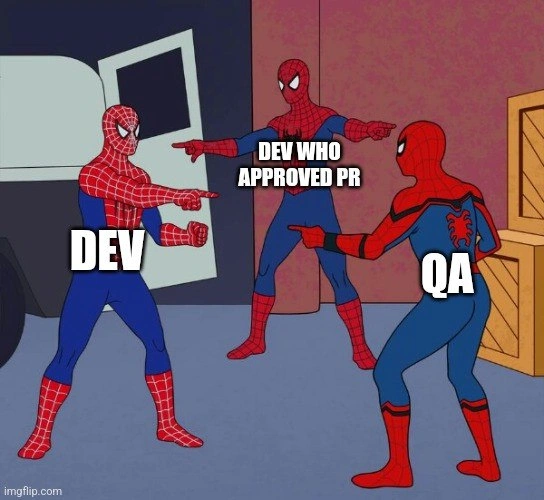
When a production bug arises, dev, reviewer, and QA play Spider-Man blame
Why is this CodeReviews meme funny?
Level 1: Pointing Fingers
Imagine three kids in a room who just found that a big cookie is missing from the cookie jar. Crumbs are everywhere. When a parent walks in and asks “What happened?”, all three kids immediately point at each other and shout, “They did it!” No one wants to be the one who’s responsible for the missing cookie, so each child tries to blame someone else. It’s a funny sight because obviously someone ate the cookie (maybe all of them had a part in it!), but instead of admitting the mistake or fixing it (like cleaning up the crumbs), they’re frozen in a triangle pointing fingers. That’s exactly what this Spider-Man meme is showing, but with a software bug: something went wrong, and instead of fixing it together, each person is just saying “Not me, it’s their fault!” The image makes us laugh because we know none of the finger-pointing actually solves the problem — it’s a silly standoff, like a cartoon scene, and it reminds us of how people can act when they’re trying to avoid getting in trouble.
Level 2: Who Signed Off?
If you’re newer to development, let’s break down what’s happening. In a typical software team, a developer (Dev) writes code for a new feature or fix and then creates a Pull Request (PR). A pull request is basically a proposal to merge their code changes into the main codebase (using version control systems like GitHub or GitLab). Another developer reviews this PR — reading through the code changes, adding comments, suggesting improvements. When they’re satisfied, they “approve” the PR, which means they give the green light to merge the code. In the meme, the middle Spider-Man labeled “DEV WHO APPROVED PR” represents that peer reviewer, essentially another dev who said “Looks good to me” on the code.
After code is merged, it often goes through QA (Quality Assurance). The QA engineer or team tests the new changes in a staging environment (or sometimes in production if it’s a live test), trying to catch any bugs (mistakes or defects) that the developer might have missed. QA folks are trained to think of edge cases and ensure the software meets the requirements and doesn’t break existing functionality. Only after QA signs off, the update is deployed to production for real users.
Now, a production bug is a bug that somehow made it past all those safeguards and is now causing trouble in the live system. This is a big deal because real customers or systems are affected. When that happens, there’s understandably a lot of pressure to fix it quickly — but also a question: “How did this get through? Who was responsible for missing it?” That’s where the blame game begins, which is exactly what the Spider-Man pointing meme is showing in a funny way.
In the image, all three characters are Spider-Man because they’re all essentially equal parts of the development cycle. But each one has a label:
- DEV – the developer who originally wrote the code.
- DEV WHO APPROVED PR – the colleague who reviewed and approved the code change (the code reviewer).
- QA – the quality assurance engineer who tested the change before release.
They’re all pointing at each other, which represents each role saying “It’s not my fault, it’s your fault.” It’s a scene of mutual blame. For example:
- The developer might argue, “I only wrote the code. The reviewer approved it, so they should have caught any issue. And QA tested it, so how am I to blame if it passed tests?”
- The code reviewer might say, “I did review it, but it’s ultimately the author’s code. Plus QA didn’t find any problems either, so the bug must have been something they missed in testing.”
- The QA engineer could respond, “Hey, I tested the feature based on the information I had. If the developer introduced a bug and the reviewer didn’t spot it, it’s not fair to pin it all on QA!”
This blame exchange is common enough that it’s a bit of a trope in DeveloperHumor circles. It highlights DeveloperPainPoints around communication and responsibility. Instead of calmly working together to fix the bug and improve the process, each role gets defensive. It’s essentially everyone asking, “Who signed off on this bad code?” and trying to make sure the answer isn’t “me.”
Technically, all three had a chance to catch the bug:
- The Dev could have written more tests or double-checked their work (maybe they did, but the tests didn’t cover the failing scenario).
- The Reviewer could have reviewed more thoroughly or even pulled the branch to run the code and see if anything was off (though not all reviewers go that far, especially under time pressure).
- The QA could have included that scenario in their testing, or communicated more questions if something was unclear.
But software is complex, and mistakes happen despite these safeguards. That’s why in healthy team practices, the focus is on fixing the issue and preventing future bugs, rather than on personal blame. Yet, as this meme jokes, teams under stress can forget that. The Spider-Man meme is popular in tech because it visually captures a communication failure: three teammates stuck in a loop of mutual blame rather than solving the problem. It’s funny to developers because we recognize the absurdity — we know we should work together, but stress and confusion in the moment can lead to everyone just pointing fingers, literally like cartoon characters. The warehouse background and the identical Spider-Man costumes exaggerate how silly the situation is: they’re all on the same side (same costume, same team) in the same environment, but losing sight of the shared goal.
So, the meme is essentially a lighthearted jab at what happens when a bug sneaks into production. Instead of calmly debugging, the devs and QA end up in a standoff: Who wrote the bug? Who missed it in code review? Who failed to test properly? It’s a reminder that in software development, playing the “blame game” is a common pitfall. And if you’re a junior dev, it’s both a cautionary tale (don’t let this toxic cycle happen!) and a bit of comfort — because if even Spider-Man ends up in these situations, you’re not alone when you witness a blame showdown in your first big project bug. The real lesson is that it’s more productive to communicate and collaborate (How do we fix this and ensure it doesn’t happen again?) than to emulate Spider-Man and point at your peers.
Level 3: Mutually Assured Finger-Pointing
In the aftermath of a production bug, the blame game unfolds like a well-rehearsed play. The meme’s Spider-Man standoff is a perfect illustration of the blame triangle in software teams: the original developer (Dev), the peer who approved the Pull Request (code reviewer), and the QA engineer are all visibly identical (just like the Spider-Men) and each is adamant the fault lies with the others. This scenario is painfully familiar to senior engineers — it’s a cultural anti-pattern where every role involved in the code review and QA process deflects responsibility. The humor comes from the exaggerated clarity of the pointing fingers: in real incidents the blame is often more passive-aggressive or couched in politeness, but here the meme strips it down to its raw, cartoonish essence. Each Spider-Man has the same powers (or in this case, access to the codebase), yet they’re acting like distinct entities at odds.
From a high-level perspective, this is highlighting a breakdown in what should be a collaborative safety net for software quality. Ideally, pull request reviews, continuous integration tests, and QA testing cycles act together to catch bugs before code hits production. When a defect still slips through all these layers, it’s often due to a systemic issue: maybe the code reviewer was rushing and did a rubber-stamp approval, or lacked domain knowledge to spot the error. Perhaps the QA team had incomplete test cases or misunderstood the feature’s acceptance criteria. The developer might have assumed “someone else will catch it if it’s wrong,” leading to less self-scrutiny. In a sense, each Spider-Man here represents an interface in the development process where accountability can be lost. A veteran engineer will recognize the pattern: a bug in prod triggers an immediate mutual_blame_loop, where everyone points elsewhere instead of examining the process that allowed the bug to escape.
There’s an ironic twist in using Spider-Man for this meme. All three characters are the same person (visually clones), which underscores the absurdity: in reality, Dev, Reviewer, and QA are all on the same team, working toward the same goal of high-quality software. The blame exchange is essentially Spider-Man pointing at himself in a mirror from an outside perspective. This speaks to deeper issues of team culture: shared responsibility versus siloed thinking. Seasoned devs have sat through post-mortems where managers demand to know “Who approved this? Who signed off on this release?” The meme captures that moment of defensive reflex:
- The Dev might say, “It passed my unit tests and peer review, so QA must have missed it.”
- The Reviewer retorts, “I trusted the code and the tests, QA should have caught this in staging.”
- The QA fires back, “I tested the requirements given; if the code had an edge-case bug, the dev and reviewer overlooked it first!”
It’s a circular firing squad where everyone has a point (literally and figuratively), yet nobody wins. 😅 Experienced engineers know that this is as productive as three Spider-Men pointing in circles. Instead of a blameless post-mortem focused on the root cause, here we see the classic defensive posture. The meme hits home because it exaggerates a real DeveloperCulture problem: when facing production_bug_fallout, some teams default to finger-pointing rather than collaboration. It’s darkly humorous to those who’ve been in the war room at 3 AM, watching people spend more energy assigning blame than debugging the bug.
On a technical note, this blame standoff hints at a failure in the DevOps idea of shared ownership. Modern practices encourage treating a bug as “our bug” that all roles collectively missed, prompting improvements in the process (like better automated tests or clearer code review checklists). But in many organizations, remnants of older siloed workflows persist. Historically, developers threw code “over the wall” to QA, and if something broke in production, it was a volley of “not it!” across departments. The meme’s scenario updates that trope to the newer pull request era: now the “Dev who approved PR” (a fellow developer acting as reviewer) joins the fray along with QA. It’s a three-way standoff of mutual accountability evasion. The absurdity and familiarity of this tableau draws a knowing chuckle from senior engineers: we laugh so we don’t cry, because we’ve all seen how unproductive and toxic the blame game can be. The meme starkly reminds us that a production bug is usually a team failure, not an individual one — but in the heat of the moment, everyone’s inner Spider-Man prefers to point at someone else.
Description
Classic Spider-Man pointing meme: three identical cartoon Spider-Man characters in a warehouse backdrop of dull reds and greys, each standing in a triangle and pointing accusingly at the others. Overlaid white bold text labels the left character "DEV", the center character "DEV WHO APPROVED PR", and the right character "QA". Wooden crates and a partially open loading-bay door fill the scene while flat comic colors emphasize the identical costumes. The meme humorously depicts the post-deployment blame cycle in which the original developer, the peer who merged the pull request, and the quality-assurance engineer each deny responsibility for a defect that slipped through code review and testing, highlighting real-world tensions in code-review workflows and QA processes
Comments
14Comment deleted
Our RCA went full Paxos - no consensus on the fix, but the blame got safely replicated to three identical nodes
The best part about this scenario is everyone's git blame output mysteriously shows commits from 'Former Employee' who left six months ago, and the PR was approved with a single '👍' emoji at 4:59 PM on a Friday
The PR said 'LGTM' - and to be fair, it did look good; nobody claimed it was read
The real bug here is the circular dependency in the blame graph. Classic O(n²) finger-pointing complexity where n is the number of people who touched the code. In a truly mature engineering culture, this would resolve to a blameless postmortem - but let's be honest, we've all been at least one of these Spider-Men when that critical bug makes it past three layers of 'LGTM' and straight into production on a Friday afternoon
LGTM is not a test; it’s our distributed blame protocol
In our org, responsibility uses eventual consistency - DEV, reviewer, and QA all converge on pointing at each other while the bug serves traffic
Classic Byzantine Generals: four nodes, zero consensus on who shipped the bug
Nope. Dev should always be mostly responsible. Comment deleted
You sound like an irresponsible QA Comment deleted
Nice try. But no, I'm a shitty dev. Comment deleted
The most responsibility should be on the one who actually broke something, not on the one supposed to control that. Comment deleted
I don't think so. QA is literally getting paid to do that. Comment deleted
I agree but the QA cannot possibly think what you were thinking when you wrote that code Comment deleted
Depends whether it's "doesn't implement feature correctly" bad or "breaks unrelated things across whole project" bad. Comment deleted