Skip to content
DevMeme
1234 of 7435
The Myth of the 'Quick Data Pull'
Databases Post #1378, on Apr 24, 2020 in TG

The Myth of the 'Quick Data Pull'

Why is this Databases meme funny?

Level 1: The Messy Toy Box

Imagine you have a big toy box where you’ve tossed all your toys over time. Now, your friend comes along and says, “Hey, can you quickly find that one special action figure for me?” They think your toy box is super organized – like maybe you have a special section or a magic label for that toy – so it should just take a second. But in reality, your toy box is a jumble of Lego pieces, dolls, cars, and crayons all mixed together. To find that one action figure, you’re going to have to dig and dig, pulling out lots of other stuff along the way. It’s definitely not a one-second job. You might even have to dump the whole box out on the floor to search through everything! 😅 The meme is funny for the same reason: the person asking for data believes it’s as easy as pulling a book from a neat shelf, but the developer knows the data is like that messy toy box. What looks simple from the outside actually takes a lot of time and effort behind the scenes. The joke is basically the developer saying, “Sure, I’ll just grab that for you from the perfectly organized imaginary shelf it’s on,” when in truth, they know they’ll be on their hands and knees digging through a chaotic pile of information.

Level 2: Imaginary Table, Real Work

Let’s break down what’s happening in this scenario in more straightforward terms. A stakeholder (like a manager, client, or someone from another team who needs information) says, "Can you just quickly pull this data for me?" They make it sound easy, as if grabbing data is like pulling a file from a cabinet. The developer responds (at least in the meme) by writing an SQL query for a make-believe table called some_ideal_clean_and_pristine.table_that_you_think_exists. This response is not something you’d actually say out loud in a meeting, of course – it's a joking way to highlight a problem. The developer is essentially thinking: “Sure, I’ll just query that perfect table you imagine we have.”

First, a quick primer on SQL: it stands for Structured Query Language, and it's the standard language for interacting with relational databases. When you want to retrieve information from a database, you write a query. The query shown in the meme uses the syntax SELECT * FROM <table_name>;. In SQL, SELECT is the keyword to fetch data, and the * means "all columns". So SELECT * literally means “select everything.” The part after FROM specifies the table you want to get the data from. For example, if you have a table named customers, you might do:

SELECT * 
FROM customers;

to get all the customer data. Here, however, the table name is a gag: some_ideal_clean_and_pristine.table_that_you_think_exists. In many database systems, we organize tables into schemas or namespaces, which is why there’s a dot in the name. It’s like saying <schema>.<table>. So the schema is humorously called some_ideal_clean_and_pristine (implying a collection of perfectly clean data), and the table is named table_that_you_think_exists (implying this is the table the stakeholder probably believes is out there). No real database has tables with names that on-the-nose (at least, one would hope not!). The developer is making up a ridiculously specific name to get the point across: this table is a fantasy.

Why would the stakeholder think such a table exists? Often non-technical folks assume that data is neatly stored and labeled. If they need, say, the total sales for last month, they might imagine there’s simply a table called “sales_last_month” or some single place where all that info lives, ready for querying. This is rarely the case. Data in real organizations can be messy. It might be split between multiple tables like orders, customers, and order_items, or even across different systems. There might be one database for online sales, another for store sales, and an Excel sheet floating around with some manual adjustments. Part of a Data Engineer’s job (and by extension, any developer tasked with data requests) is to gather and combine these sources into something useful. When a request is ad-hoc (meaning a one-time, unplanned request, often urgent), the engineer doesn’t have a pre-built solution and has to do extra work to get the answer.

Let’s clarify some terms and why this “quick data pull” isn’t actually quick:

  • Ad-hoc data request: This means someone is asking for data on the fly, outside the regular reports or dashboards. It’s not something that was prepared beforehand. For the developer, this often triggers a bunch of manual steps: figuring out where the data is, writing new queries or scripts, and double-checking the results.

  • Stakeholder pressure: Notice the word "quickly" in the request. Stakeholders often add that, implying they need it ASAP. This can put pressure on developers, because saying "This will take time" might not be what the stakeholder wants to hear. The developer in the meme feels that pressure and answers with a bit of sarcasm hidden in an SQL query.

  • Requirements ambiguity: The stakeholder just says "pull this data" without much detail. To a developer, that’s super vague. Which data exactly do you need? For what time period? In what format? Do you want raw records or a summary? When stakeholders are not specific, it can lead to multiple back-and-forth clarifications. In the joke, SELECT * symbolizes this vagueness – if you don’t tell us what you want, we might as well grab everything. Of course, grabbing everything is inefficient and potentially overwhelming (imagine returning millions of rows when maybe only a total number was needed).

  • "Imaginary pristine table": In a perfect scenario, all data relevant to the stakeholder’s question would indeed live in one clean, well-structured table. Pristine means spotless or perfectly clean – so in data terms, that would mean no missing values, consistent formats, correct calculations, and up-to-date records. The meme is pointing out that such perfection is a fairy tale. Real data tables often require cleaning (removing or correcting bad data), and you might need to write JOINs to combine multiple tables to get a complete answer. A JOIN in SQL is how you merge rows from two or more tables based on a related column (like joining an orders table with a customers table by a customer ID). For example, if you needed customer names with their orders, you might do:

    SELECT customers.name, orders.order_date, orders.total_amount
    FROM customers
    JOIN orders ON orders.customer_id = customers.id
    WHERE orders.order_date >= '2020-03-01';
    

    This is a realistic query that shows you often must pull data from several places and filter it (here by date) to answer what seems like a simple question. There is no one command that just says “give me the important data now” without knowing the specifics.

  • Select * anti-pattern: While using SELECT * is quick and fine for exploration, in professional settings it's considered an anti-pattern to use it in permanent code or reports. Why? Because it can retrieve a lot of unnecessary data. It might slow down your query or burden the database, especially if the table has many columns or rows. It also makes the query less clear – you’re not documenting which pieces of data you actually care about. If someone adds a new column to the table later (say a column called new_notes), SELECT * will start pulling that too, possibly breaking your application or altering your results without you realizing. Typically, good practice is to explicitly list the needed columns, like SELECT name, order_date, total_amount FROM orders;. The meme intentionally uses SELECT * to keep the query generic and to emphasize the assumption that "we'll just get everything". It’s poking at the idea that the stakeholder hasn’t specified what they want, so might as well grab all columns from this mythical table.

  • DataEngineering reality: In real life, fulfilling this kind of request might involve a lot more than a single query. A data engineer or developer might have to:

    • Locate which tables (or files, or services) hold the relevant information. There’s often no table literally named what the business question is – you have to know where to look.
    • Write multiple queries or an ETL (Extract, Transform, Load) script to extract the data, transform it (join tables, clean up values, calculate new fields), and then maybe load it into a report or send back as a file.
    • Clean the data: e.g., handle missing entries, filter out test records, reconcile different date formats, etc. "Clean and pristine" data is as rare as a phoenix. Usually, you spend significant time just scrubbing the raw data to make sure it's accurate and consistent before you hand it over.
    • Verify the results: cross-check that the numbers make sense or that you understood the request correctly. There’s nothing worse than confidently delivering data quickly, only to find out it answered the wrong question due to a misunderstanding.

    All these steps mean that a “quick” data pull can easily take hours or even days, depending on complexity and how well the data infrastructure is set up. If a company has a robust data warehouse with well-defined schemas and up-to-date tables for commonly asked questions, then things can go faster. But many times, data engineers are still building those single source-of-truth tables (or they simply don’t exist for the particular question asked). So developers end up doing one-off queries and analyses under time pressure. That gap between how fast people want data and how fast we can actually deliver it is the data_latency_reality. Data isn’t always instantly accessible or current. Sometimes the data you need was last updated a week ago, or it’s still being processed.

In summary, this meme humorously educates us about StakeholderExpectations versus reality. The stakeholder expects an immediate answer from an ideally organized database. The developer knows the truth: the data is likely entangled across many parts of the system, and pulling it “quickly” is a challenge. It’s a bit like someone asking a chef to whip up a gourmet meal from scratch in five minutes – sure, the chef could if all the ingredients were prepped and the kitchen was perfectly organized (the “ideal pristine” scenario), but in a normal kitchen you’d be running around chopping and mixing – it definitely takes longer than they think. The SQL query in the meme is the developer’s lighthearted way of saying, “If only it were that simple.”

Level 3: SELECT * FROM Reality

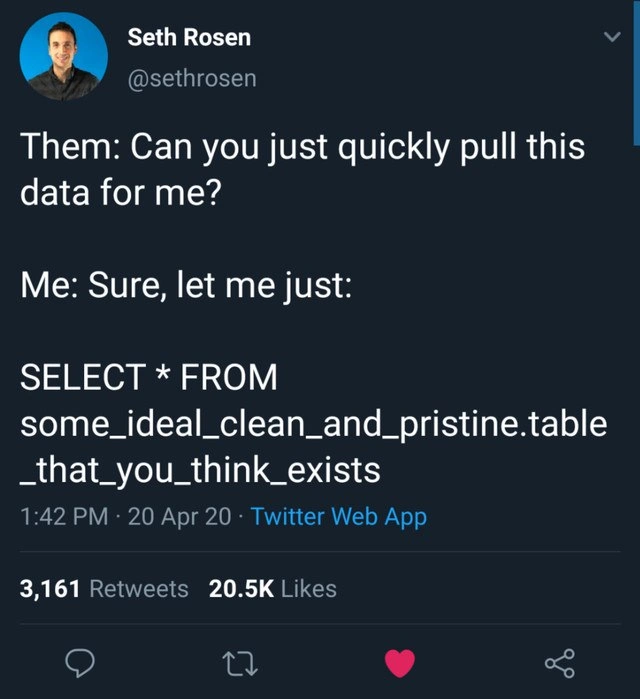
Them: Can you just quickly pull this data for me?
Me: Sure, let me just:

SELECT * 
FROM some_ideal_clean_and_pristine.table_that_you_think_exists;

This meme captures a classic clash between stakeholder expectations and developer reality. The stakeholder innocently assumes that all the needed data is sitting in one pristine table, neatly organized and ready to query. The developer responds with a tongue-in-cheek SQL query to an obviously imaginary table – named some_ideal_clean_and_pristine.table_that_you_think_exists – highlighting how fanciful that assumption is. The humor comes from the absurd level of perfection implied by that table name. It's as if the developer is saying, "Sure, I'll just run this magical query on that perfect database table you believe we have." In other words, "I'll get right on that, right after I find the unicorn stable in our server room." 🦄

Experienced developers immediately recognize the pain behind the joke. SELECT * is SQL shorthand for "give me everything," and here it’s used sarcastically. In a perfect world, you really could SELECT * from a single source-of-truth table and get exactly what the stakeholder wants. But in reality, such a one-stop, clean data table almost never exists. Instead, data is spread across multiple tables (or even systems), full of inconsistencies, missing fields, and historical quirks. By crafting the query as SELECT * FROM some_ideal_clean_and_pristine.table_that_you_think_exists, the developer reflects every data engineer’s daydream: a utopian schema where someone already did all the hard work of cleaning and integrating the data. The suffix _that_you_think_exists is the final wink — it emphasizes that this table exists only in the stakeholder’s imagination. MisalignedExpectations is the understatement of the year here.

The tweet also hides a bit of insider wit: naming the table in lowercase with underscores is exactly how actual tables are named in many databases. It looks plausible, which makes it even funnier to those in the know. We see a fully qualified name with a dot (some_ideal_clean_and_pristine.table_that_you_think_exists), mimicking a real schema and table. Any seasoned SQL user chuckles because they've wished for tables with names like perfectly_clean_data or all_the_answers at some point when under pressure. The developer-author knows that no such table will be found – the query would just throw an error in real life (ERROR: relation "some_ideal_clean_and_pristine.table_that_you_think_exists" does not exist). The humor is a coping mechanism: rather than scream into the void about messy data, we make a snarky SQL joke.

Why is this so relatable? In countless companies, a boss or client asks for an urgent number or report: "Just quickly pull the data, it should be easy, right?" Meanwhile, the developers or data engineers are thinking of the hours of data wrangling ahead. Maybe the data lives in five different tables with cryptic names, with foreign keys that almost join properly (except when they don’t). Perhaps the data wasn't even being tracked until last week, or it’s sitting in a data lake as raw logs that need parsing. The stakeholder doesn’t see any of that complexity – to them, the data is "in the computer" and a database query is as simple as typing a sentence. This meme perfectly lampoons that naiveté. It’s a gentle roast of non-technical folks who assume databases are like Google: you just type a question and instantly get the exact answer.

From a senior developer perspective, there’s also an implied critique of processes (or the lack thereof). Why isn't there an easy way to get this data? Often because of technical debt, siloed systems, or the fact that the request is super specific and nobody anticipated it. Many organizations lack a single “source of truth” database table for all metrics – and maintaining one is hard. Data engineers toil to build pipelines that transform raw, messy data into clean tables, but they can’t pre-build a table for every ad-hoc question that might pop up. So when a high-level stakeholder comes with an impromptu request, developers have to drop everything to cobble together JOINs and aggregate queries, or export data to Excel and manually clean it. It’s rarely the quick one-liner the stakeholder envisioned. The meme’s popularity (thousands of retweets and likes) shows just how many in the tech community have been on the receiving end of these "quick data pull" asks.

There’s a touch of irony in the SQL syntax itself. Using SELECT * in production is generally considered a select_star_antipattern – it's usually better to specify the exact columns you need. But here the developer intentionally writes SELECT * to signify "I'll just dump everything you think you want." It subtly pokes fun at the vagueness of the request. The stakeholder hasn’t told us which data, which columns, what filters or date range – nothing. Just “this data.” So the developer mockingly prepares to grab all the things from the mythical perfect table. It’s a playful way of saying, "You haven’t given me details, so I suppose you expect literally everything is ready and waiting." In reality, a request like this would trigger a back-and-forth of clarifications: What timeframe are you interested in? Which users? What do you mean by 'data'? The meme sidesteps all that by naming the fantasy table in a way that encapsulates the stakeholder’s unsaid assumption: the data is already organized for them.

One can almost hear the weary sarcasm in the developer’s voice: “Sure, I’ll just run this one simple query…” as they crack their knuckles and prepare for a late night of SQL sorcery. The humor masks a deeper truth about StakeholderPressure: often the people asking for data don’t realize they might be kicking off a mini-project. The developer’s fake compliance in the tweet ("Sure, let me just…") is something many of us do in real life with a forced smile, before diving into the actual hard work. It’s either that or give a lecture on why the data isn’t readily available – and who has time for that when the clock is ticking? The path of least resistance (and maximum comedic relief later) is to nod, say “on it!”, and then mutter to yourself while sifting through databases that resemble a digital junk drawer.

Ultimately, the meme is funny because it sits at the intersection of tech and workplace comedy. It highlights the requirements ambiguity that plagues many projects: the request sounds simple, but it’s actually not well-defined or trivial at all. It’s a mini-story of miscommunication: the stakeholder imagines a straightforward task, the developer perceives a complicated hunt. That contrast fuels the joke. DataEngineering veterans laugh (perhaps a bit bitterly) because they've spent days building what someone thought would be a five-minute query. The meme gives a nod to those behind-the-scenes heroes: for once, we get to openly acknowledge how ridiculous "just pull this data" can be. And we do it with that universal developer dialect – a snippet of code – because sometimes a fake query speaks louder than a thousand status updates.

Description

A screenshot of a tweet from user Seth Rosen. The tweet humorously contrasts a common non-technical request with the reality of data engineering. It reads: 'Them: Can you just quickly pull this data for me? Me: Sure, let me just: SELECT * FROM some_ideal_clean_and_pristine.table_that_you_think_exists'. The joke lies in the fictional SQL table name, which perfectly captures the stakeholder's naive assumption that data is always clean, organized, and easily accessible. For developers and data engineers, this is a deeply relatable jab at the hidden complexity behind seemingly simple data requests. The reality is that data is often messy, distributed across multiple systems, and requires significant effort to query and clean, making a 'quick pull' a rare luxury

Comments

7
Anonymous ★ Top Pick The only thing 'quick' about the data pull is how quickly you discover the 'single source of truth' is spread across three microservices, a legacy monolith, and an intern's abandoned CSV file
  1. Anonymous ★ Top Pick

    The only thing 'quick' about the data pull is how quickly you discover the 'single source of truth' is spread across three microservices, a legacy monolith, and an intern's abandoned CSV file

  2. Anonymous

    Absolutely - let me just choose which definition of “customer” you prefer: the one in the OLTP shard, the OLAP cube, the Kafka compacted topic, or the Google Sheet helpfully named DO_NOT_USE_FINAL

  3. Anonymous

    After 15 years of explaining why we can't 'just join the customer table with the revenue table,' I've started billing by the number of times I have to explain that our 47 different definitions of 'customer' across 12 legacy systems don't magically reconcile themselves just because someone drew a box labeled 'Data Lake' on a PowerPoint slide

  4. Anonymous

    Ah yes, the mythical 'some_ideal_clean_and_pristine.table_that_you_think_exists' - right next to 'production.data_with_no_nulls' and 'analytics.perfectly_normalized_schema'. In reality, you'll be joining seventeen tables with inconsistent naming conventions, filtering out duplicates from that ETL job that ran twice last Tuesday, and explaining why the 'quick pull' requires three days of data archaeology and a PhD in deciphering legacy column names like 'field_x_temp_final_v2_ACTUAL'

  5. Anonymous

    Every “quick pull” assumes a single, clean 3NF table; in reality I’m spelunking through SCD2 dimensions, CDC streams, and an orders_final_final_use_this_one view that explodes the moment you SELECT *

  6. Anonymous

    Stakeholder's 'quick SELECT *' = data archaeologist's 3-day schema expedition through 15 years of 'pristine' evolution

  7. Anonymous

    Quick data pull? Sure - I’ll just SELECT * FROM the single source of truth, a view over a view over a CSV in S3 named revenue_final_final_v2.csv

Use J and K for navigation