Professional Dynamics: Medicine vs. Software Development
Why is this QA meme funny?
Level 1: Cat and Mouse
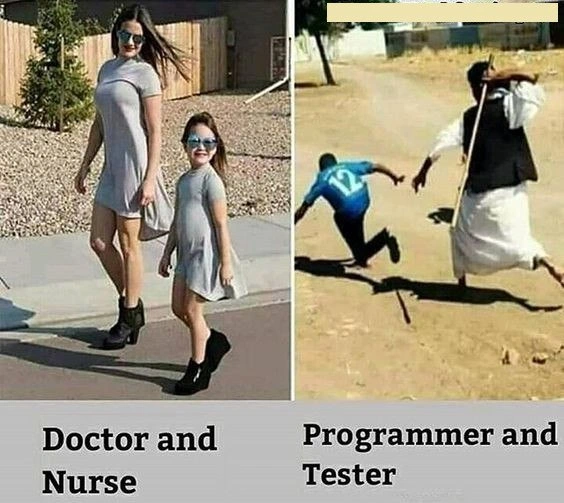
Imagine two people who are supposed to be working together on something, like two friends cleaning up a classroom. If they get along and everything is going well, they’ll walk side by side, calmly doing their job – just like the doctor and nurse in the left picture, who look peaceful and in sync. Now imagine one friend accidentally makes a big mess – say, knocks over a bucket of paint – and then tries to run away so they don’t get in trouble or have to clean it. The other friend (or maybe a teacher) sees the mess and gets angry, chasing after the person who caused it, possibly waving a broom or a rag, yelling “Come back here and fix this!” That’s exactly the kind of situation the right picture is showing, but in the world of computers. The “programmer” is like the kid who made the mess (they wrote a computer program that has a mistake, which we call a bug), and the “tester” is like the upset friend or teacher chasing them (their job is to find the mistakes and get them fixed). It’s a bit like a game of cat and mouse, where the cat (tester) is determined to catch the mouse (programmer) that scurried off after making a mess. It’s funny because normally you’d expect people on the same team to calmly help each other (like the doctor and nurse do), but here we see one team member running away and the other trying to catch them to make them do their job. It’s an exaggerated, silly way to show that sometimes when we make mistakes, we might feel like running off, and the person who finds the mistake has to run after us to get it fixed.
Level 2: Fix It or Flee
Let’s break this down in simpler terms. In the world of software, a programmer (developer) is the person who writes the code to build an application or system. A tester, often part of a Quality Assurance (QA) team, is the person who checks that this software actually works as expected. Testers try to find bugs – which are mistakes or errors in the code that make the software behave in unexpected or wrong ways. When a tester finds a bug, they report it so the developer can fix it. Sounds straightforward, right? Both people ultimately want the software to be good. But as this meme humorously shows, it doesn’t always feel like a gentle, cooperative process; it can feel like a wild chase!
On the left side of the meme, labeled "Doctor and Nurse", the two medical professionals are walking side by side, matching steps and even outfits. This represents teamwork and harmony. It’s implying that in healthcare, a doctor and a nurse work together calmly with a shared purpose (taking care of patients). There’s an understanding and immediate collaboration – if something goes wrong with a patient, the doctor isn’t running away from the nurse; they handle it together.
Now compare that to the right side, labeled "Programmer and Tester". Here we see the programmer (the person in the blue jersey) literally running for it, while the tester (in white clothing) is chasing after them brandishing a long stick. The text suggests the tester is furious. This scene is a comical exaggeration of how a software tester might react upon finding a serious bug: instead of a calm discussion, it’s portrayed as the tester going on a rampage to make the developer fix their mistakes. In reality, a tester isn’t going to hit a programmer with a stick – but they might bombard them with bug tickets, urgent emails, or angry Slack messages when a critical issue is discovered, especially late in the development cycle. The meme plays on that feeling of urgency and panic.
If you’re a junior developer (or new to working with QA), here’s what typically happens: You write some code and it seems to work for you. Then you hand it over to QA for testing. The testers start using the software in all sorts of ways – ways you maybe didn’t anticipate – trying to see if it breaks. If they find a problem (say clicking a certain button causes a crash, or entering a certain type of data yields the wrong result), they will log it as a bug report. This often goes into a tracking system (like Jira or GitHub issues) with details of what’s wrong. When a bug is filed, you, the developer, are expected to fix it.
Now, if the bug is minor, it’s usually a polite request: "Hey, there’s a typo on this page" or "The layout looks off on mobile screens, could you take a look?". But if the bug is major – for example, the entire app crashes when a user tries a common action – then there’s a sense of urgency and sometimes stress. Testers (and your project manager) will be on your case to get it resolved quickly because a critical bug can delay a release or affect lots of users. This is when the situation can feel tense. A new developer might be surprised at how much pressure comes when something is broken. The developer frustration here comes from a mix of embarrassment ("How did I miss that?") and stress ("I need to fix this ASAP!"), while the tester’s frustration is from seeing the software fail and knowing it could have been avoided or needs immediate attention. The meme dramatically casts the tester as angry and chasing because from the dev’s perspective, a very insistent tester chasing you down for a fix can feel threatening (even if in reality it’s just stern emails or constant reminders).
Let’s connect this to everyday office life in dev teams: Have you ever heard developers and QA testers jokingly refer to each other as adversaries? It’s pretty common in TestingHumor circles to tease that “testers break everything” or “developers never do it right the first time.” Of course, it’s all in good fun (usually); both roles are essential and on the same side in truth. But the reason these jokes exist is because of those moments of tension. For example, imagine you thought you finished a task and you’re feeling proud, ready to deliver, when suddenly QA finds a big flaw. You might let out a groan because it means more work and possibly looking bad for missing it. The QA, meanwhile, might be thinking, “How did they not catch this?!” Now, instead of a calm handshake and cooperation (like the doctor/nurse), it’s a bit of a standoff: the tester pushes the bug report your way, and you might instinctively get defensive or try to avoid the issue momentarily. The meme dramatizes that instinct to avoid the bug fix – the programmer fleeing.
In many modern teams, they try to avoid this adversarial vibe. Practices like Test-Driven Development (TDD) (where developers write tests themselves as they code) and Continuous Integration (where code is tested automatically whenever it’s changed) help catch bugs earlier, so testers and developers are more partners than rivals. Additionally, Agile teams often have developers and QA working closely every day, sometimes even swapping roles or at least understanding each other’s work. But even with all that, the fundamental truth remains: when a tester finds a serious bug, it’s the developer who has to drop everything and fix it. That dynamic inherently has a bit of push-and-pull: one person is essentially saying “there’s a problem you caused,” and the other has to acknowledge and resolve it. It’s easy to see how feelings can flare up (even if just jokingly).
So, “Fix it or flee” encapsulates the developer’s choice in that comical moment: either fix the bug now or run (which of course is not a real option, but it can feel like you want to run away!). The meme resonates with anyone who’s been in software development because we’ve all had that moment of wanting to hide when a tester finds a nasty bug in something we wrote. And we’ve seen testers who won’t let up until the issue is addressed (rightly so – that’s their job). The chase scene is just a funny exaggeration of the bug-hunting drama that plays out in tech teams everywhere. In short, if you’ve ever been part of a dev/QA team, this image perfectly captures those bug-related confrontations in a single, hilarious snapshot. Both sides can laugh at it because it’s a shared love-hate experience: frustrating in the moment, but funny when you look back on it (or when you see it turned into a meme like this!).
Level 3: When Testers Attack
In software development, the programmer vs tester relationship can sometimes feel like a high-stakes chase scene. This meme exaggerates that dynamic by showing a tester literally hunting down a developer over bugs in the code. On the left, we see a doctor and nurse walking in perfect sync – a calm, cooperative duo. On the right, it’s chaos: a panicked programmer (blue jersey #17) sprinting away, pursued by a furious tester wielding a stick. It’s an absurd visual metaphor for an all-too-familiar scenario in software Testing and QA: when a critical bug is discovered, the developer often feels hounded by the tester to fix it immediately.
Why is this funny to those in tech? It plays on the adversarial_testing_dynamic that sometimes arises between development and QA teams. In an ideal world, devs and testers work together smoothly (like doctors and nurses in sync, focusing on the patient/software quality). But in reality, especially under tight deadlines or in old-school processes, their interaction can turn into a blame game or a frantic BugFix showdown. The mismatch of expectations is stark: developers may think a feature is “good enough” or that a bug is minor, while testers see any defect as a showstopper that must be corrected. This misalignment can make a simple bug report feel like an angry chase. Experienced engineers know this dance well – it’s practically a rite of passage in DeveloperHumor circles to joke about being “hunted” by QA after deploying buggy code. The humor comes from exaggerating the truth: testers don’t actually attack programmers with sticks (of course!), but their bug reports and test cases can hit just as hard when you’re on the receiving end.
Let’s break down the scenario and why it resonates with so many developers:
- Different goals, same product: Developers are under pressure to ship new features and updates quickly, while testers are tasked with ensuring the software has zero bugs and meets quality standards. This often sets up a speed vs quality tug-of-war. The dev wants to move fast; the tester wants to be thorough. When a bug pops up, it’s like lighting a fuse on this long-standing tension, igniting that chase depicted in the meme.
- “Works on my machine” vs reality: A classic point of friction. A developer might protest that the code works on my machine, implying the tester is overreacting or the environment is to blame. Testers, on the other hand, simulate real users – they’ll reply, “Well, it doesn’t work on the test machine (or in production)!” This disconnect can make the developer feel cornered. The meme takes that feeling and dials it up to 11: the dev isn’t just cornered, they are running for their life (figuratively) from the relentless tester who found the flaw.
- Organizational silo effect: In some companies (especially with older Waterfall-style workflows), development and QA are separate teams. This separation can breed an us-vs-them mentality. Rather than doctors and nurses who train together and operate as a unified team, devs and testers might only interact when something’s wrong. By the time a tester raises a bug, the developer might already be onto a new task and sees the tester as an antagonist dragging them backward. The meme’s second panel — a tester chasing a dev in open terrain — humorously captures that silo-induced confrontation: they’re clearly not on the same calm walk anymore!
Everyone who’s been through a grueling release or a heated bug triage meeting can relate. Picture a real-life scenario: it’s late Friday afternoon, the team is about to push a release, and suddenly QA discovers a critical bug (let’s say, the app crashes whenever a user’s name is blank). The tester flags it as a showstopper. The developer, who thought they were done for the week, now has a fire to put out. You can imagine the exchange:
Tester: “The login page is crashing on blank input – this is a P0 bug! We can’t release until it’s fixed.”
Developer: "It worked on my machine, are you sure it’s a bug?”
Tester: “Yes, 100% reproducible. I’m literally seeing it fail. We need a fix now.”
Developer: “Okay, okay… I’ll fix it. Just… put down the stick.”
Of course, the tester doesn’t have a real stick, but that urgent tone can feel like a whack over the head for the developer who thought everything was fine. The meme takes this common drama and visualizes it as a literal chase scene. It’s an exaggeration that elicits a knowing laugh: we’ve all been that dev internally yelling “uh oh!” and wanting to escape when a tester finds a big bug in our code, and we’ve all seen testers doggedly track an issue until it’s resolved (though usually with emails and JIRA tickets, not wooden sticks!).
From a high-level perspective, this also pokes fun at how software QA process is sometimes viewed compared to other professions. In medicine, a doctor and nurse share a mission seamlessly – any issue with a patient, they address together immediately. In tech, devs and testers technically share the mission of a quality product, but deadlines, human nature, and organizational structure can pit them against each other. The result is a bit of corporate dysfunction humor: instead of calmly walking together to solve a problem, we get a comical bug-fueled pursuit. It’s a tongue-in-cheek reminder that despite all our agile methodologies and DevOps culture preaching collaboration, old habits (and inter-team tensions) die hard. A bug in production? It’s every dev for themselves, and the testers are coming! 🏃💨
To sum up the deeper insight: this meme lands because it captures the DeveloperFrustration and mild panic of being accountable for bugs (BugsInSoftware can be embarrassing and stressful), while also highlighting TestingHumor – the tester’s almost righteous fury in insisting things be fixed. It’s funny because it’s true enough: in the tech world, a serious defect really can make it feel like “fix it now or face the wrath of QA.” Or in meme terms: fix it, or flee!
# Pseudocode illustration of the meme's logic:
if bug_found:
# Uh oh, a bug was discovered in the software
programmer.run(stamina="panicked") # Developer tries to escape accountability
tester.chase(weapon="bug_report") # Tester relentlessly pursues with the bug report (the "stick")
else:
# No issues found, all is calm
doctor.walk(alongside=nurse, pace="calm") # Doctor & nurse scenario: smooth cooperation
Description
A two-panel comparison meme contrasting professional relationships. The left panel shows a woman and a young girl walking side-by-side in matching grey dresses, looking stylish and cooperative. The caption below reads 'Doctor and Nurse'. The right panel displays a chaotic scene where one man, holding a large stick, is aggressively chasing another man who is running away in a dirt field. The caption below this image reads 'Programmer and Tester'. The humor is derived from the stark contrast, portraying the doctor-nurse relationship as harmonious and collaborative, while depicting the programmer-tester relationship as an adversarial and violent conflict. This plays on the classic stereotype within software development where testers, upon finding bugs, are seen as the enemy by programmers who must then fix them
Comments
7Comment deleted
In a healthy DevOps culture, the programmer and tester are the pair on the left. In the picture on the right, they're still negotiating the definition of 'done'
Doctors do rounds; testers do rage-sprints - nothing boosts a dev’s velocity like a Sev-1 they swore “can’t happen because Kafka guarantees exactly-once.”
The real chase begins when the tester finds a critical bug five minutes before the Friday deployment, and suddenly the developer discovers seventeen urgent reasons why it's actually a feature working as designed
The eternal dance: developers insisting 'it works on my machine' while testers gleefully document seventeen edge cases that crash the entire system. The relationship is adversarial by design - one builds castles in the sand, the other brings the tide. But here's the truth senior engineers know: the best products emerge from this creative tension. A tester who doesn't challenge you isn't doing their job, and a developer who can't handle bug reports hasn't shipped enough production code. The meme captures the surface conflict, but underneath lies a symbiotic relationship where both roles push each other toward excellence - even if it occasionally requires a metaphorical stick
Doctors collaborate seamlessly; testers ensure survival of the fittest code via primal pursuit
Adversarial QA is the distributed-systems version of strong consistency - you only get it when someone sprints after you with a stick the moment you say “works on my machine.”
Seen here: the original “stake”-holder sprint review after you closed a P0 as “can’t reproduce” on your laptop