The Ostrich Algorithm: A Bug's Life
Why is this Bugs meme funny?
Level 1: Hoping It Goes Away
Imagine you're in school and your teacher almost never gives pop quizzes – maybe just once in a whole year. Because it's so rare, you decide not to study extra or worry about a surprise test at all. You're basically thinking, "Eh, it's probably not gonna happen, so why prepare?" If a pop quiz does happen that one time, you'll just deal with it then (you might take a bad grade, or quickly cram at the last second). This is just like what's happening with the bug in the meme. The programmer had a small problem in the code that only shows up super rarely, so they chose to ignore it and hope it never comes up. In other words, they stuck their head in the sand and pretended there was no problem, just like an ostrich in the old saying. It's funny because instead of fixing the bug in a fancy way, the programmer basically said, "No problem here!" and carried on, crossing their fingers that the bug stays hidden.
Level 2: Ostrich Algorithm 101
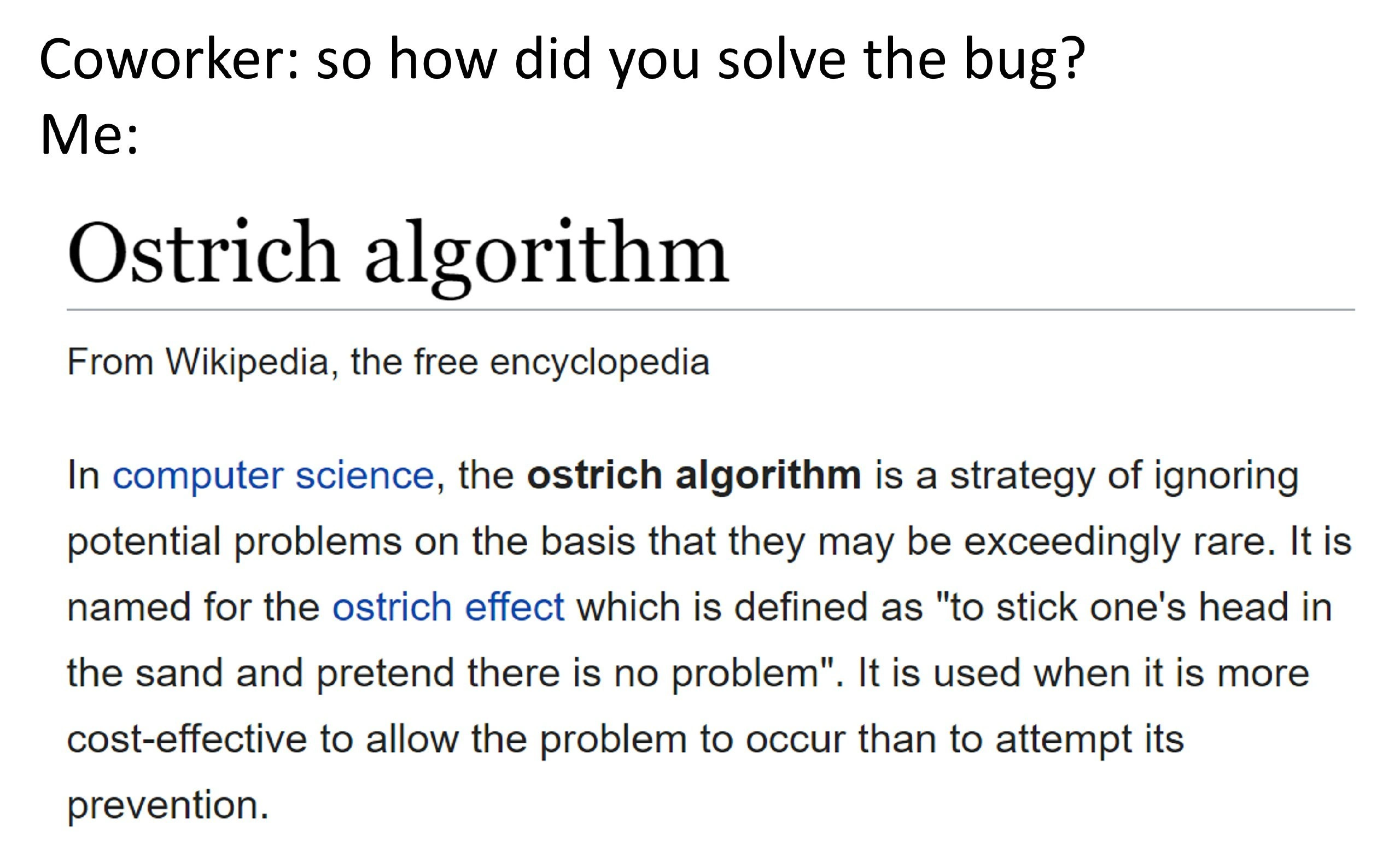
Let's break down what's happening in this meme for a less-experienced developer. First off, a bug in software is an error or flaw that makes a program behave in a way it shouldn't. "Fixing a bug" usually means finding the cause of the error in the code and correcting it so the issue goes away. In the meme, a coworker asks, "So how did you solve the bug?" — expecting a normal explanation like "I found a missing semicolon" or "I fixed a logic mistake."
Instead, the reply is just a screenshot of a Wikipedia article titled Ostrich algorithm. This is a real term in computer science. The article snippet in the image explains that the ostrich algorithm is basically a strategy of ignoring a problem because it happens so rarely. It's named after the idea of an ostrich burying its head in the sand to avoid seeing danger (even though ostriches don't literally do that, it's a common saying). The text from Wikipedia even says it plainly: sometimes it's "more cost-effective to allow the problem to occur than to attempt its prevention." In simple terms, it might be cheaper (in time or effort) to just let a rare bug happen once in a while than to spend lots of time coding a fix for it.
So the developer in the meme is cheekily admitting that their "fix" for the bug was to do nothing at all! They're telling their coworker: this bug was so rare or hard to deal with that I decided to pretend it isn't there. It's a humorous way to say "I ignored the bug and hoped for the best."
Why would anyone do that? In real development, teams sometimes face bugs that occur very infrequently or only under extremely peculiar conditions. If a bug only happens once in a million times, and if it doesn't cause serious damage, a team might decide to leave it alone, especially if trying to fix it could introduce worse problems or delay the project. This is what we call a cost vs. risk trade-off: weighing the effort and risk of a fix against the likelihood and impact of the bug. For example, imagine a tiny glitch that only one user out of millions ever encounters. The engineers might log it as a "known issue" and not actively fix it in the code, because the chance of it happening is so low and the cost (or risk) of changing the code is high.
The term "ostrich algorithm" is often brought up as a tongue-in-cheek reference in such cases. It's even mentioned in some operating systems textbooks when discussing things like deadlocks (a type of bug where two processes get stuck waiting on each other forever). One way to handle deadlocks is to write complex prevention code or detection mechanisms, but an easier (ostrich) way is to do nothing and assume deadlocks won't happen often. In the same spirit, our developer basically applied the ostrich approach to a software bug. They ignored the rare bug, essentially sticking their head in the sand, and called that the solution.
The humor here is pretty straightforward once you know the term. The coworker expected a real fix, but the developer's answer is just "I used the Ostrich algorithm" — meaning I literally ignored the bug. It's a mix of honesty and irony. Even as a junior dev, you'll likely encounter moments where you have to decide whether a bug is worth fixing or if it's so minor and unlikely that you leave it be for now. This meme highlights that awkward but real aspect of debugging: sometimes, doing nothing is the chosen solution (and it can even sound smart when you give it a fancy name!).
Level 3: Bug? What Bug?
At a senior developer level, this meme strikes a chord because it's painfully relatable. The coworker asks, "How did you solve the bug?" expecting to hear about some clever fix or a heroic debugging tale. Instead, our mischievous developer responds by effectively saying, "I solved it by not actually solving it" – backing it up with a Wikipedia entry for the Ostrich algorithm. It's the ultimate cheeky answer: pretend the bug doesn't exist, because it happens so rarely.
Why is this funny (and familiar) to seasoned engineers? Because many of us have been in exactly that situation. Perhaps you spent days chasing an elusive glitch – a classic heisenbug that vanishes when you try to inspect it (often caused by freak timing in concurrent code) – only to find it occurs so infrequently that the team eventually throws up their hands and says, "You know what, let's just ship it and hope for the best." In a bug tracker, such an issue might even get marked as "WONTFIX" or "Deferred", which is the official way of saying: "Yep, we know about it, but we're not gonna tackle it." This is where the cost vs. risk trade-off comes in. If a bug only surfaces once in a million runs and has minimal impact, spending weeks redesigning code (or risking new bugs by fixing it) just isn't worth it. It’s like an unwritten rule in software: sometimes "if it ain't broke 99.999% of the time, don't fix it." In tongue-in-cheek pseudo-code, that philosophy might look like:
if (bug.frequency < VERY_RARE_THRESHOLD) {
// Ostrich algorithm: bug is so rare, just ignore it
console.log("Ignoring the rare bug, carrying on...");
} else {
fixBugProperly(); // handle it if it starts happening often
}
Teams actually apply this mentality in real life. They might leave a log message or an alert for when the rare bug happens, but otherwise they leave it be. It's essentially a calculated gamble: acknowledge the bug, keep an eye on it, but don't invest tons of effort unless it becomes a real problem.
Another reason this meme gets a knowing laugh is the sheer honesty of the dev’s answer. Not everyone would admit to their boss or colleague, "I basically did nothing to fix that bug." But here the developer does it with a straight face and a Wikipedia citation in hand – as if to say, "See? I'm not being lazy, this is a recognized strategy!" That self-awareness is golden. It turns a potentially embarrassing admission into a nerdy joke. We all share those experiences in debugging & troubleshooting where, after exhausting every solution, the pragmatic choice is to do nothing and hope for the best. It's an inside joke among developers: sometimes the smartest move is to not poke a sleeping bug.
Of course, every veteran coder knows this approach can be a double-edged sword. Murphy's Law lurks in the background: that one-in-a-million bug has a knack for resurfacing at the worst possible moment (say, during a live demo or on launch day). We've felt that pang of dread when an ignored issue suddenly strikes at 3 AM in production. Yet, there's also a guilty relief when a bug you decided to ignore never actually comes back. It's like you gambled and won. This meme perfectly captures that risky little dance. It highlights the mix of anxiety and optimism in a dev’s life: the moment when you choose to live with a bug and just cross your fingers. And when someone asks "Did you fix it?", you half-jokingly reply, "Sure, I applied the Ostrich algorithm!"
Level 4: Head-in-Sand Heuristics
In advanced system theory, there's actually an official tongue-in-cheek strategy known in computer science as the Ostrich algorithm. The term comes from the concurrency folklore of operating systems design. When faced with complex issues like deadlocks (where multiple processes or threads wait forever on each other), one can either invest heavy compute overhead to prevent or detect these bugs, or simply bury one’s head in the sand and ignore them entirely. That's right — there's literally a textbook strategy that says: if a problem is incredibly rare, do nothing and let it be!
Consider classical OS theory: Edsger Dijkstra’s famous Banker's algorithm can carefully avoid deadlocks by analyzing resource allocation state, but it’s complicated and slow. Another method is to run a deadlock detection routine periodically, scanning wait-for graphs to break any circular waits (a bit like solving a resource puzzle repeatedly). These approaches guarantee a safer system but at the cost of additional complexity and performance overhead on every operation.
Enter the Ostrich algorithm: it says skip all that overhead. Assume deadlocks (or whatever rare bug) won't happen often, and just proceed normally. If a deadlock does occur once in a blue moon, well, you might simply log it, maybe automatically reboot or have an admin manually intervene. This is essentially an algorithmic embodiment of a cost vs. risk trade-off. Formally speaking, if the expected cost (probability × impact) of a bug manifesting is smaller than the cost of constantly guarding against it, then ignoring the bug is ironically the optimal strategy.
Real-world systems do employ this logic. Many general-purpose operating systems and databases operate under an implicit Ostrich policy: they don’t actively prevent every theoretical concurrency issue because the overhead isn’t worth the benefit in the common case. It's the computing equivalent of not installing an expensive fail-safe for a scenario that statistically almost never happens. The humor (and insight) here is that the developer in the meme is openly admitting their "fix" was to apply this head-in-the-sand heuristic — a playful reminder that sometimes, doing nothing is actually a recognized (if controversial) solution in software engineering theory.
Description
A two-part meme. The top text reads "Coworker: so how did you solve the bug? Me:". Below this is a screenshot of a Wikipedia article titled "Ostrich algorithm". The article text defines the algorithm as "a strategy of ignoring potential problems on the basis that they may be exceedingly rare... It is used when it is more cost-effective to allow the problem to occur than to attempt its prevention." The joke lies in applying a formal computer science term to the common, and sometimes necessary, practice of deliberately not fixing a bug. For experienced developers, this is a humorous take on the pragmatic, and often unglamorous, reality of software maintenance, where triaging issues and managing technical debt sometimes means choosing to let rare bugs persist rather than expending significant resources to fix them
Comments
10Comment deleted
Our official policy for handling Heisenbugs is the Ostrich Algorithm, but we call it 'non-deterministic feature deferral' to make it sound more expensive
Deployed an enterprise-grade Ostrich Algorithm: wrapped the one-in-a-million deadlock in a try/catch that just bumps a Prometheus counter nobody alerts on - instant compliance, zero effort
After 20 years in the industry, you realize the ostrich algorithm is just a fancy name for 'mark it as won't fix' with a probability analysis attached - except now you can cite Wikipedia when the postmortem committee asks why you didn't handle that one-in-a-million race condition that took down production on Black Friday
Ah yes, the ostrich algorithm - a time-honored approach in production systems where the MTBF is just high enough that you'll have moved to a different team before the incident occurs. It's the architectural pattern that pairs beautifully with 'works on my machine' and 'we'll fix it in the next sprint.' Senior engineers recognize this as the unspoken foundation of many legacy systems: not technical debt, but technical willful ignorance - where the cost of the fix exceeds the probability-weighted cost of failure, at least until it becomes someone else's pager duty
How’d I fix it? Ostrich algorithm: rebranded the bug as acceptable risk, let the error budget pay for it, and tweaked the SLO until it stopped paging
Ostrich algorithm: where ignoring tail latencies beats O(n) Heisenbug hunts with provably better asymptotics
Implemented the Ostrich pattern: proved the bug’s probability fits our SLO’s error budget, reclassified it as accepted risk, and shipped - finance calls it cost optimization, SRE calls it Tuesday
aka "If i ignore it, maybe it will go away" Comment deleted
This is the ALARP principle - 'As Low As Reasonably Practicable' in risk-management context. One just stop putting in more resources when it's not worth to do so Comment deleted
UUIDs Comment deleted