Skip to content
DevMeme
5733 of 7435
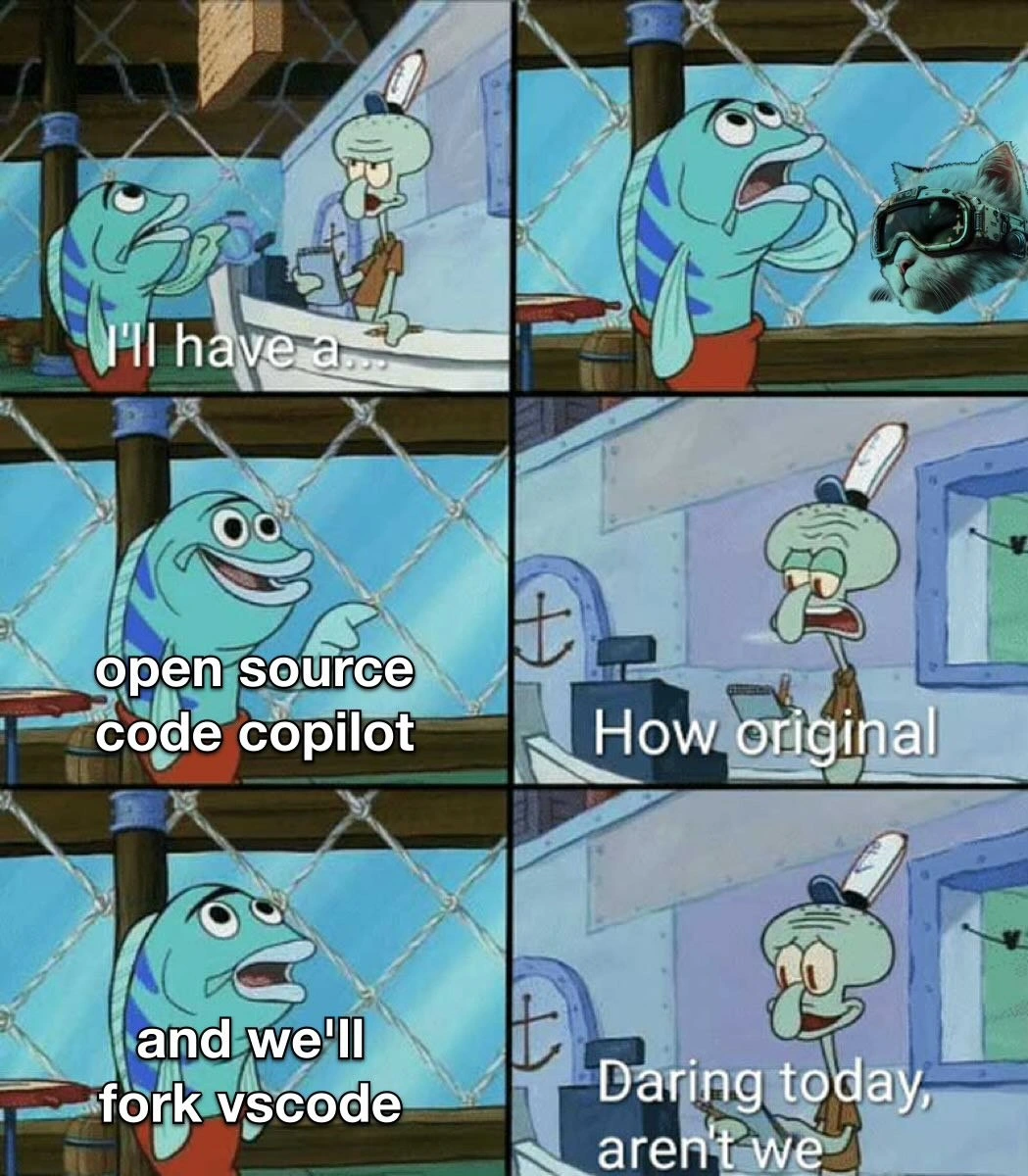
The standard issue AI startup meal
IndustryTrends Hype Post #6286, on Sep 30, 2024 in TG

The standard issue AI startup meal

Why is this IndustryTrends Hype meme funny?

Level 1: Fancy Wrapper, Same Burger

Imagine you go to a burger shop and say, “I’d like the exact same burger everyone always gets, but put it in a different box and maybe add a tiny extra pickle.” Then you grin like you’ve just invented a daring new dish. The cashier, who sells this burger all day every day, just looks at you and says sarcastically, “Wow, how original.”

That’s the joke of this meme. One person thinks they’re ordering something bold and new, but really it’s the same old thing with a small twist. The cashier (Squidward, in the SpongeBob scene) has seen it a million times, and he can’t even pretend to be impressed. His response – “Daring today, aren’t we” – means “Oh, you think you’re being so bold, huh?” in the most deadpan, eye-rolling way.

In simpler terms, the meme is laughing at someone who copies an idea and acts like it’s unique. It’s funny because we’ve all seen people do that — whether it’s a kid copying a friend’s project and calling it new, or just ordering the usual burger with one extra topping and feeling creative. The experienced folks instantly recognize it and react with playful sarcasm. The emotional core here is the gap between how special the person thinks their idea is and how ordinary it actually is. The seasoned cashier isn’t fooled, and that contrast is what makes us chuckle.

Level 2: Recipe for a Clone

Let’s break down the tech ingredients in this comedic order, assuming you’re new to these terms:

  • GitHub Copilot: This is like a coder’s sidekick built by GitHub and OpenAI. It uses AI (specifically a large language model) to suggest code as you write. For example, you start typing a function, and Copilot might finish the whole function for you. It’s a bit like auto-complete on steroids. However, GitHub Copilot is a paid, closed-source service (you can’t see its code or run it yourself without paying).

  • Open source code Copilot: This refers to any Copilot-like tool that is open source. “Open source” means the code for the tool (and often the AI model itself) is freely available for everyone to view, modify, and use. So an open-source Copilot aims to do the same job (AI-assisted code completion) but without proprietary restrictions. Developers like this because it can be free, customizable, and you can host it yourself. There have been many such projects lately trying to mimic Copilot’s abilities using open-source AI models. Essentially, these are copilot_alternatives created by the community.

  • LLM (Large Language Model): This is the brains behind these AI code assistants. It’s a type of AI model trained on tons of text. In our case, that text includes a lot of source code. So the model learns patterns in code. When you use a tool like Copilot, the LLM is what actually reads the code you’ve written and predicts what code should come next. Think of it as a very advanced autocomplete that has learned from millions of GitHub repositories. An open_source_llm_tool would be something like Code LLaMA or GPT-J – models open to the public that can generate code.

  • VS Code (Visual Studio Code): A very popular code editor/IDE from Microsoft. Importantly, VS Code’s source code is open source (anyone can view and copy it), though the official release from Microsoft includes some proprietary bits. Developers love VS Code because it’s lightweight, extensible (lots of plugins!), and free. You can write extensions to add features, like new languages support or even AI assistants.

  • Forking VSCode: To “fork” in software means to copy the source code of a project and start your own version (a new “branch” of the project, but separate from the original). So, forking VSCode means someone takes the VS Code codebase and builds their own editor out of it. Why do that? Maybe to include custom features by default, or to change branding, or remove something (like the telemetry/tracking Microsoft’s version has). In this meme, “we’ll fork VSCode” implies “we’ll make our own customized VS Code editor.” It’s not an original move because many people have done it. (For example, VSCodium is a well-known fork of VS Code that simply removes telemetry and Microsoft’s branding.) Forks usually still look and act like VS Code, just with a slight twist.

Now, what’s being ridiculed here is the trend of combining those ingredients. The “order” is basically: “Give me an open-source AI coding assistant, and put it inside a custom VS Code editor.” This has become a trend — numerous projects are doing exactly that. They take an open source LLM that can generate code (the Copilot-like part) and then either make a VS Code extension or straight up fork VS Code and bundle the AI in it. The claim is often that this is new and exciting for developers (DeveloperExperience_DX hype), because you get AI help while coding, all free and open.

For a newer developer, that might sound awesome. “Cool, an AI can help me code, and I don’t even have to pay for Copilot!” And indeed, these tools can be useful. But the meme is highlighting how formulaic this innovation has become. It’s like everyone is following the same recipe:

  1. Take the popular thing (Copilot-style AI code completion).
  2. Make it open source (so you can say, “Look, no corporate strings attached!”).
  3. Package it with a trendy editor (VS Code, because that’s what everyone uses).

Each step here is fairly straightforward in concept:

  • There are open source AI models readily available, so step 1 is picking one (no need to invent your own AI from scratch).
  • Making something open source is often just a choice to share the code and not charge money.
  • VS Code being open source means step 3 is as easy as copying its code and adding your AI into it.

So, to an experienced person, a project that does all this isn’t pioneering new technology, it’s more like connecting the dots that are already there. It will improve developer experience for some (because not everyone could use the paid Copilot), but it’s not a huge leap in capability. It’s more like bringing an existing idea to a wider audience or different audience.

The SpongeBob meme format (fish customer and Squidward cashier) is used to convey that message in a snappy way. The fish (customer) is the excited developer or startup founder, placing the “order” for this project idea. Squidward, the cashier, represents seasoned engineers reacting. His line “How original” is pure dry sarcasm — he’s saying the idea isn’t original at all. Then “Daring today, aren’t we” doubles down on that sarcasm, implying that the person thinks they’re being bold or daring with this idea, but really they’re not taking any risk or doing anything new.

The daring_today_quote has become an internet shorthand to mock people who act like something very common is actually a brave choice. For example, someone might post a picture of them having the same coffee order as always and caption it “Daring today, aren’t we.” Here, it’s applied to tech: forking VS Code and making an open Copilot is portrayed as a very safe, bandwagon move, not daring at all.

And about that little cat with goggles in the corner of one panel – that’s just meme silliness. It’s there to add a random dash of humor. There’s no technical meaning; it’s not some secret AI cat project or anything. 🤷 It’s common in meme culture to throw in a quirky sticker or image (especially cats, because the internet loves cats) to make the image more eclectic and fun. So the cat is basically saying, “This whole situation is a bit absurd, and we’re in on the joke.”

In summary, this meme is explaining in a joking manner that creating an open-source AI coding assistant and packaging it in a VS Code fork is a trend that’s become almost cliché. If you’re new, you now know:

  • What an AI code assistant (Copilot or its clones) is.
  • Why people fork VS Code (to tweak it or bundle new stuff).
  • And that doing both has become a common trend – so common that it’s now being made fun of.

Level 3: Originality Not Included

This meme delivers a hearty IndustryTrends_Hype roast, Spongebob-style. The scene: a fish at the Krusty Krab (our enthusiastic developer or startup founder) proudly places an order. What’s on the menu today?

Fish: “I’ll have a… open source code copilot… and we’ll fork VSCode.”
Squidward (the jaded engineer at the register, barely raising an eyebrow): “How original.”
(pause)
Squidward: “Daring today, aren’t we.” (delivered with peak sarcasm)

In plain terms, the customer is asking for the hot new combo special in the dev world: an open-source AI code assistant and a customized VSCode to go with it. Squidward’s deadpan reply drips with “seen this a million times” cynicism. The humor hits home for anyone watching the current AI tool explosion — it feels like every week someone announces “Yet Another Copilot, now open source!” or “We made our own VSCode-based AI editor!” Veteran developers (Squidward) respond with a fatigued “How original.”

Why is this funny? Because it’s too real. The meme pokes fun at a gold rush of copilot_alternatives that all look eerily alike. GitHub Copilot blew everyone’s mind by auto-completing code with AI, and in its wake came a stampede:

  • Companies big and small scrambling to release their own AITools for code. (Hello, Amazon CodeWhisperer and friends.)
  • Open-source enthusiasts hacking together their versions using open_source_llm_tools like Code LLaMA, GPT-J, or StarCoder.
  • Countless extensions promising “AI-powered autocompletion”. Many are literally named like “Something-Copilot” to ride the coattails.

And of course, to package these goodies, what better vehicle than VSCode? VS Code is the world’s most popular code editor (an IDE-lite really), and it’s OpenSource. Its source is on GitHub, free for anyone to fork (copy) and modify. So what do these “daring” projects do? They grab VS Code’s codebase, integrate their AI assistant, slap on a new logo (maybe a cat with goggles? 😼), and ta-da: “We built a whole new AI coding IDE!”

From the seasoned dev perspective, this is innovation karaoke. They’re just singing Microsoft’s tune with a different cover band. We’ve seen this pattern before: a big breakthrough hits (Docker, Angular, you name it), and suddenly every team is releasing a “new” twist that’s often just minor variation. Here the twist is “but ours is open source!” and “we bundled it in an editor for you.” Nice perks, sure, but hardly daring or original when dozens of folks are doing the exact same thing simultaneously.

Consider the ingredients of this meme’s order:

  • “Open source code copilot” – a code completion AI that’s open source. In 2024, that means plugging in a pre-trained open model. Nothing wrong with that (freedom, transparency, yay), but doing it now is following the trend, not starting it.
  • “We’ll fork VSCode” – Instead of just making an extension, they fork the entire editor. Forking an editor is the tech equivalent of copy-pasting someone else’s app and adding one feature. It’s allowed (thanks to open source licenses) and sometimes useful, but it’s definitely not groundbreaking. Seasoned devs know there are countless VS Code variants out there (VS Code without Microsoft telemetry – been done; VS Code in a browser – done; custom VS Code for XYZ – done). Forking VSCode is so common that “How original” practically lampshades it.

Squidward’s second line, “Daring today, aren’t we,” underscores the sarcasm. These projects paint themselves as bold mavericks challenging Big Tech’s Copilot, but in reality they’re taking a safe, predictable route. It’s like everyone in class turning in the same project but with their name written in a different color. As a grizzled engineer, you’re not exactly applauding the creativity.

Let’s be clear: it’s not that open-source Copilots or VSCode forks are bad ideas. In fact, many developers appreciate them. It’s about the hype and lack of originality. Each new announcement markets itself like the wheel was just reinvented – “A revolutionary developer experience (DeveloperExperience_DX) awaits! We integrated CodeGeneration AI into your IDE!” – and seasoned folks are thinking, “Yep, just like the 10 other ones this month.” The meme captures that collective eye-roll.

To illustrate how formulaic this trend has become, here’s essentially the cookie-cutter recipe every such project follows, in pseudo-code form:

// Pseudo-code for the "new AI coding tool" formula:
const model = loadOpenSourceLLM("CodeLlama-13B");  // 1. Use an open AI model trained on code
const editor = forkRepo("microsoft/vscode");      // 2. Fork VSCode's source to make your own editor
integrateAI(model, editor);                       // 3. Integrate the AI as a code completion feature
releaseProduct(editor, "SuperOpenCopilot");       // 4. Ship it with a fancy name and hype it up

:point_up: Voilà! The same basic dish, served on a different plate. If this feels a bit “copy-paste”, that’s because it is. The meme’s blue fish character is essentially every dev team following the above script, and Squidward is the rest of us forced to taste-test yet another forked IDE with the same AI filling. His face says, “I’ve chewed this flavor before.”

Even the random cat sticker with cyber goggles in the meme’s corner adds to the absurdity. It’s like the meme creator is parodying how these projects might throw in a mascot or quirky branding to seem unique. (Tech meme pro-tip: slapping a cool cat or unicorn on something is a sure sign we’re not taking it too seriously.) The absurd cat doesn’t relate to Copilots or VSCode at all — it’s just there to amplify the “this is ridiculous” vibe.

In meme-culture context, the spongebob_squidward_meme_format is a popular choice for calling out unoriginal ideas. The template comes from a SpongeBob episode scene where Squidward’s sarcasm is front and center. Anytime someone on the internet says or does something cliché, you’ll see Squidward behind that cashier counter, monotone saying “How original.” It’s the perfect reaction image for copycat behavior. By using that exact “how original” reaction and the “Daring today” quote, the meme creator ties this developer trend to a well-known punchline. Even without deep tech knowledge, you can tell the joke: “This new idea isn’t new at all, and it’s laughable that they think it is.”

So, at Level 3, the takeaway is: the meme is a light-hearted swipe at the AIHype train. It reminds us that not every “new” idea in tech is truly novel — many are iterations or repackagings of someone else’s work. The seasoned dev community can spot a bandwagon a mile away. When they see “open source Copilot inside a VSCode fork” for the umpteenth time, they channel their inner Squidward. Originality not included, indeed.

Level 4: Attention All Copycats

At the cutting edge, all these AIAssistants are built on the same underlying tech: the Transformer architecture that powers large language models. In academic terms, GitHub Copilot and its open-source clones are just massive sequence predictors, churning out code by statistically guessing the next token. They use LLMs (Large Language Models) trained on huge swaths of code from GitHub and Stack Overflow. The open-source ones often repurpose open-weight models (where the neural network’s weights are public) like Meta’s Code LLaMA or the StarCoder model. Under the hood, it’s the same science: an attention-based network scanning your code context and predicting what comes next with uncanny fluency.

The irony? By 2024, the Transformer blueprint is old news in AI research. The seminal paper “Attention is All You Need” came out in 2017 – practically eons ago in ML time. The code generation twist (fine-tuning on source code) was pioneered by OpenAI’s Codex and others a few years back. So when yet another project spins up “an open-source Copilot,” they’re following a well-trodden path. There’s no novel machine-learning theory here – it’s tweaking hyperparameters and riding on OpenSource model checkpoints that anyone can download. All these clones inevitably produce similar results because they’re constrained by the same fundamentals: the distribution of code in their training data and the limits of next-token prediction. It’s like a bunch of students copying the same solution manual – of course the answers look alike.

From a systems perspective, integrating a LLM into an editor isn’t groundbreaking research, it’s engineering glue. The heavy lifting (natural language <-> code modeling) was solved by the model’s creators; the clone makers just wrap it in a new IDE. In fact, many open-source Copilot alternatives sacrifice model size or quality to run locally. A state-of-the-art model like GPT-4 (behind the real Copilot) is largely closed-off, so the open clones use smaller open models (maybe 7B or 13B parameters instead of 175B) to make it feasible for developers to self-host. They compress weights, quantize them to 4-bit, and offload to GPUs – clever tricks, but again, well-known in the AI_ML community. The result? The assistant can run on your machine, but might be dumber or slower than the original. In theory it’s an achievement of democratization (yay open source!), but technically it’s incremental, not revolutionary. We’re basically watching the reference implementation get repeated ad nauseam, which makes veteran engineers go: “We get it, you read the same papers and used the same model checkpoints – welcome to last year.”

Description

A six-panel meme using the 'Daring Today, Aren't We?' format from the Spongebob Squarepants cartoon, featuring a blue fish customer and a cynical Squidward as the cashier. In the first panel, the fish begins to order, saying, 'I'll have a...'. The second panel shows the fish looking up, with a photoshopped image of a cat wearing VR or tech goggles, symbolizing a 'visionary' tech idea. In the third panel, the fish confidently orders an 'open source code copilot'. Squidward replies with a deadpan 'How original' in the fourth panel. The fish continues in the fifth panel, adding, 'and we'll fork vscode'. This prompts Squidward's final, sarcastic remark in the sixth panel: 'Daring today, aren't we'. The meme humorously criticizes the current trend in the tech industry where numerous startups are being created with what is perceived as a very unoriginal formula: creating an open-source alternative to GitHub Copilot and basing it on a fork of the popular VSCode editor. For senior developers, this represents a tiresome lack of innovation and a low-effort approach to building a new product
Comments

7
Anonymous ★ Top Pick Their roadmap is just the VSCode release notes from two months ago and a ChatGPT Plus subscription
  1. Anonymous ★ Top Pick

    Their roadmap is just the VSCode release notes from two months ago and a ChatGPT Plus subscription

  2. Anonymous

    Because nothing screams innovation like gluing a recycled GPT-J endpoint onto a telemetry-stripped VSCode fork - wake me when someone forks away the electron memory leaks

  3. Anonymous

    Another startup promising to revolutionize development by wrapping OpenAI's API in a VSCode fork with a different color theme and calling it innovation - just what we needed after the last 47 identical pitches this quarter

  4. Anonymous

    Ah yes, another VSCode fork with AI autocomplete - because what the ecosystem really needed was the 47th Electron-based editor that consumes 4GB of RAM to suggest 'console.log'. At least when we forked Vim, we had the decency to start a decades-long holy war about it. Now we just npm install our way to 'innovation' and call it a day. But hey, your README probably has really nice badges, and that's what counts in 2024, right?

  5. Anonymous

    Every “open-source Copilot” pitch I see is Code‑OSS with a sidebar that proxies LSP to a closed LLM - open-core so thin the MIT license can read the EULA through it

  6. Anonymous

    Modern playbook: fork VSCode, wire a chat sidebar to $OPENAI_API_KEY, call it a platform - the only distributed system you shipped is the pricing page

  7. Anonymous

    Squidward nailed it - true daring is forking VSCode, swapping the logo, and charging enterprise support for 'custom DX'

Use J and K for navigation