Startup hype gets fact-checked by open source reality
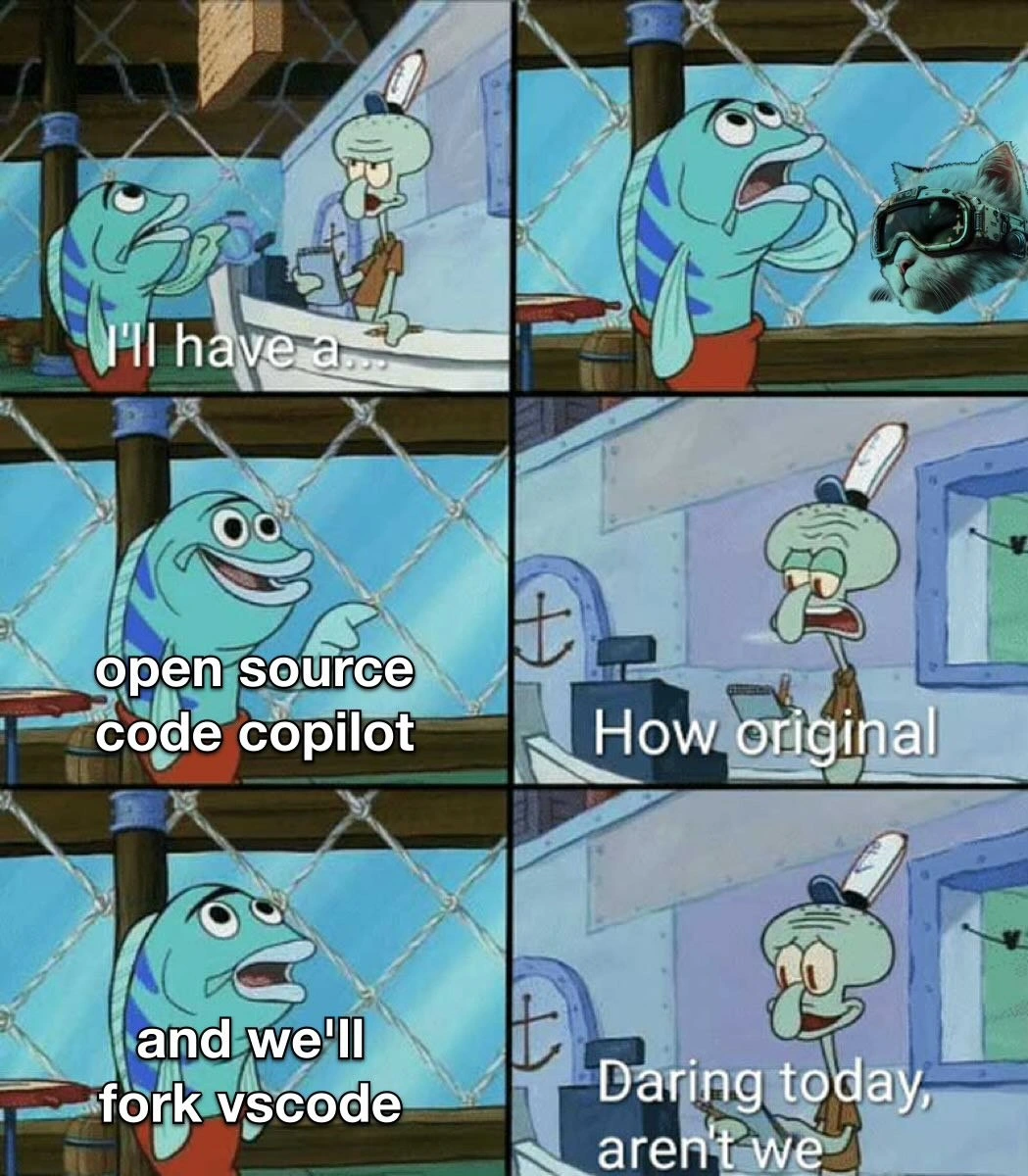
Why is this OpenSource meme funny?
Level 1: Copying Homework
Imagine you’re in school and your friend Alice spent a lot of time writing a really cool story. It’s so good that she shares it with everyone. Now, you need a story for the school contest, and instead of writing your own, you take Alice’s story, change the names of the characters, and claim it as your story. You even stand on stage and proudly say, “Look at the amazing story I wrote!” This might fool some people for a moment, but anyone who has read Alice’s story will recognize it. In this meme’s case, a person took someone else’s coding project (like Alice’s story, but with computer code) and just changed the name on it. They told everyone it was their new creation, hoping to win praise and maybe prizes (in real life, investment money or support). But the community (like the classmates who knew Alice’s story) quickly pointed out the truth. They essentially said, “Hey, that project is just Alice’s project with a new name!” Getting caught like that is embarrassing. The funny part is how obvious it was – it’s as if they copied homework and only erased the original name. The lesson: don’t be a copycat. In any community, whether at school or among programmers, if you copy someone’s work and pretend it’s yours, people will eventually find out and call you out on it.
Level 2: Find, Replace, Launch
Let’s break down the scenario in simpler technical terms. This is about an open-source project being copied and rebranded. Open source means the original code (in this case, a project called Continue.dev) is publicly available for anyone to see, use, and modify under certain conditions. On platforms like GitHub, developers often “fork” a repository – essentially making their own copy of someone else’s code – either to contribute changes or to build something new on top of it. Here, PearAI is supposed to be that “new” project built by two founders. But instead of writing fresh code, they forked Continue.dev’s codebase and did a mass find-and-replace to change the name “Continue” to “PearAI” everywhere in the code and documentation. In programming, doing a global find-and-replace (for instance, using a tool like sed or an IDE’s Replace All feature) can quickly swap out words. It looks like they swapped the product’s identity without significantly altering its functionality.
Why is this a big deal? Well, in OpenSourceCulture, there’s an expectation of honesty and giving credit. It’s common (and totally okay) to build on top of open source – that’s the whole idea – but you’re generally expected to acknowledge the original project or contribute back improvements. If you don’t, and especially if you try to pass the work off as entirely your own, you’ll upset both the original creators and the developer community. It feels like plagiarism – similar to copying someone’s code or homework. There are also licenses attached to open-source projects (like MIT, Apache, GPL, etc.) that legally outline what you must do if you reuse the code. For example, many licenses require preserving the original copyright notice or license text. So if PearAI’s founders removed references to Continue.dev entirely, they might be skirting those rules. It falls into a gray area: maybe legally permissible if they left the license file intact, but certainly bad form ethically to not prominently credit the source.
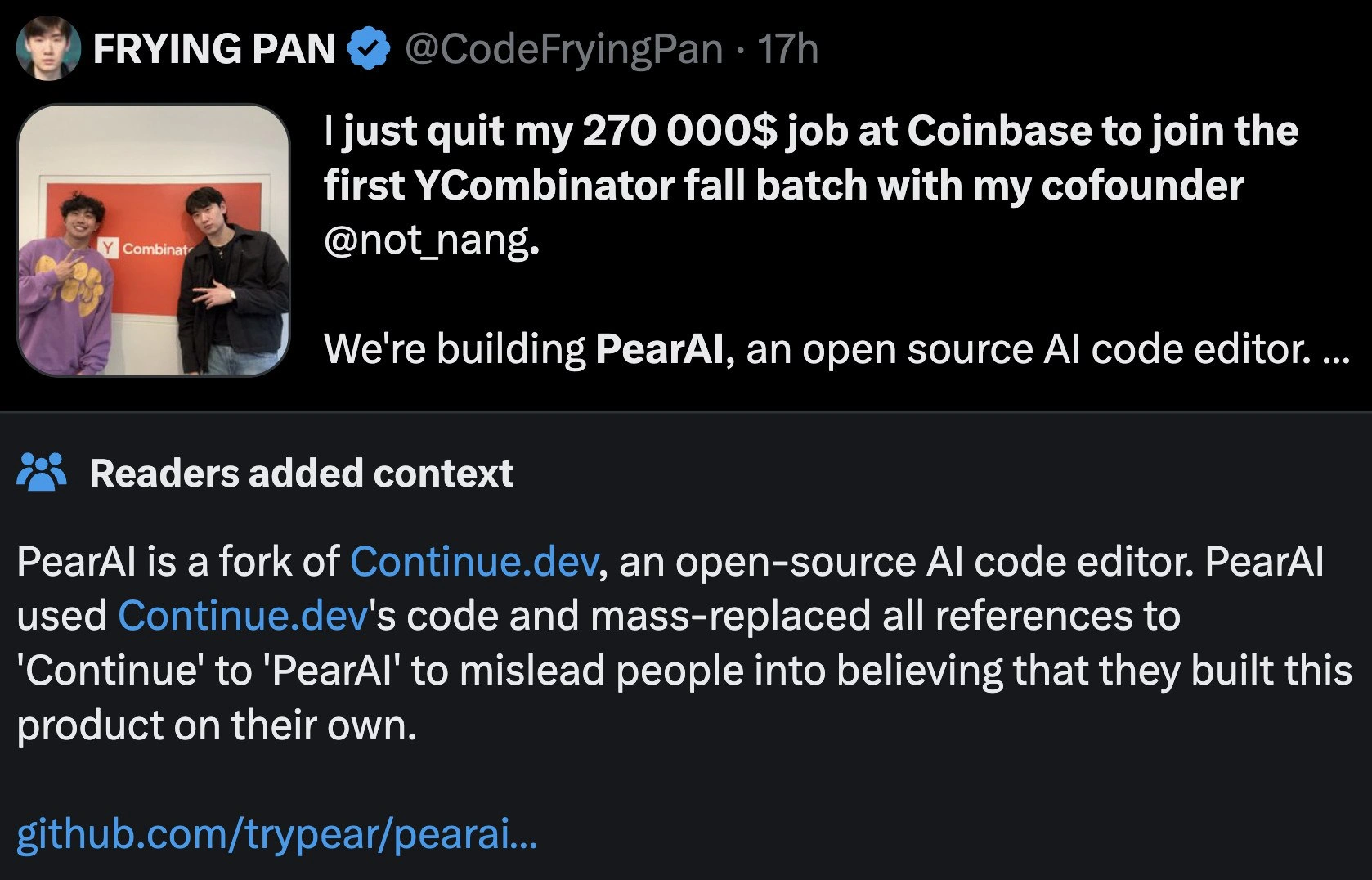
Now, Y Combinator (YC) is a famous startup accelerator – getting accepted is a big deal for founders, often generating hype around their product. The tweet’s author emphasized that he quit a high-paying job (270k salary is huge!) to pursue this startup. That’s meant to sound inspiring and show confidence. StartupCulture on social media often involves these dramatic announcements to build in public and get support. However, the twist here is that a Community Note (a feature on X/Twitter where readers can add context to potentially misleading posts) immediately highlighted the truth: PearAI is actually just Continue.dev in disguise. That community note is effectively the tech community saying, “Hold on, this isn’t original work.” TechTwitter audiences, especially developers, appreciate these context notes because they value transparency. The community note even included a link to the GitHub repo (trypear/pearai) showing the fork, which is concrete evidence.
From a junior developer’s perspective, there are some key lessons: (1) Version Control history and open repositories make it hard to hide code origins. If you simply copy code, other devs can compare and spot it quickly. (2) If you admire an open-source project enough to base your startup on it, it’s often better to join forces or contribute to that project, or at least be upfront that you used it, instead of just swapping names. (3) Search-and-replace rebranding is a very shallow change – it doesn’t magically turn someone else’s work into your own original creation. Just like you can’t take a popular app, change the logo, and truly call it yours, the same goes for code. Engineers who have been around a bit will quickly recognize the functionality or even specific code patterns from popular libraries or projects. And finally, (4) the developer community communicates – through Twitter, GitHub, forums – so trying to quietly clone something and take credit is likely to backfire. In short, be respectful with open source: use it, contribute, but don’t just rebrand it and pretend you invented it.
Level 3: The $270K Fork Fiasco
This meme captures a modern open-source fiasco colliding with startup hype. A developer boasts on Tech Twitter about quitting a $270,000 Coinbase job to join Y Combinator’s new batch with PearAI, pitched as “an open source AI code editor” they’re building. Seasoned engineers immediately smell something off: the pitch is a bit too familiar. Sure enough, a Twitter Community Note (the crowd-sourced fact-check feature) drops the hammer, revealing PearAI is just a fork of an existing OSS project, Continue.dev. In other words, our intrepid “founders” seemingly did little more than run a global search-and-replace on someone else’s codebase – swapping every Continue to PearAI – and then claimed they built a revolutionary product. It’s a brutal call-out of a fork-and-rebrand ploy, and it highlights a cautionary tale in developer communities: if your startup’s code is basically a copy-paste, the open-source community will notice.
At an experienced level, the humor (and horror) lies in how brazenly this violates open-source etiquette. Open source software is built on trust and credit; you can reuse code (licenses permitting), but implying false originality is a cardinal sin in DevCommunities. Here, the founders chased AI hype – slapping buzzwords on an existing code editor integrated with AI – but provided essentially zero original contribution. The community note effectively says “We see you, and we see that git clone in your recent history.” It’s the developer equivalent of catching someone turning in a colleague’s project with the title changed. Experienced devs chuckle (or cringe) because they’ve seen this pattern before: ambitious startup founders taking an OSS shortcut and hoping no one checks the commit log. The juxtaposition of a flashy announcement (“I’m building the next big thing!”) with a factual footnote (“…actually, it’s somebody else’s thing with a new name”) is equal parts comedy and schadenfreude.
Why is this so relatable for senior engineers? For one, it underscores the enduring gap between StartupCulture optimism and engineering reality. It’s ridiculously easy to create a “new” product by forking a repo – trivial enough to be done with a one-liner script:
# The hypothetical PearAI origin story in commands
git clone https://github.com/continuedev/continue.git pearai
cd pearai
# Replace all mentions of 'Continue' with 'PearAI'
find . -type f -exec sed -i 's/Continue/PearAI/g' {} +
echo "🚀 Initial commit: Renamed Continue.dev to PearAI" | git commit -F -
With a few commands, VersionControl history is rewritten and the startup can claim a “product.” The meme’s punchline is that this cheap search_and_replace_rebranding didn’t fool the community. In an era of rampant AIHype, VCs and accelerators like YC might be eager to fund anything labeled “AI” – but engineers on GitHub are quick to scrutinize claims. The Readers added context note is essentially the dev community performing an impromptu code review on the founders’ credibility. It calls out the OSS license gray area: yes, PearAI’s team may have legally used Continue.dev’s code (depending on the license, e.g. MIT would allow forking with attribution), but the way they presented it misleads people into thinking it’s original work. That’s a huge faux pas in OpenSourceCulture.
There’s also an undercurrent of irony that seasoned devs appreciate. The founder’s tweet tries to flex both StartupCulture clout (“joining YC’s first fall batch!”) and personal risk (“quit my $270K job, wow!”). It’s a classic Tech Twitter stunt: dramatize the leap of faith to get buzz. But that narrative falls flat when the “innovation” is just a code plagiarism. The community note basically turns the hype inside out: You left a cushy job to push someone else’s project under a new logo? The whole situation becomes a dark comedy about incentives – a reminder that in the gold rush for AI startups, some folks will literally start their résumés with git clone. And as any battle-scarred coder knows, rebranding an OSS project without added value is a losing strategy long-term; you’ll face backlash from developers and probably have a hard time justifying your “startup” once everyone knows it’s a thin copy. In short, this meme hits on multiple industry in-jokes: the ease of spinning up a “new” product from open source, the ever-increasing AI_ML venture hype, and the watchdog nature of the developer community that doesn’t let dubious claims slide. It’s equal parts infuriating and satisfying – infuriating that it happened, satisfying that the community called it out in real time.
Description
A screenshot of a tweet from a user named 'FRYING PAN' (@CodeFryingPan). The tweet proudly announces: 'I just quit my 270 000$ job at Coinbase to join the first YCombinator fall batch with my cofounder... We're building PearAI, an open source AI code editor.' The post includes a photo of two young men standing in front of an orange wall with the 'Y Combinator' logo. Below this celebratory announcement is a prominent 'Readers added context' box, a feature from the social media platform X (formerly Twitter). This community note provides a critical fact-check, stating: 'PearAI is a fork of Continue.dev, an open-source AI code editor. PearAI used Continue.dev's code and mass-replaced all references to 'Continue' to 'PearAI' to mislead people into believing that they built this product on their own.' The technical and cultural context of this meme is the public exposure of deceptive practices within the startup and open-source communities. It highlights the clash between founder hype and the developer community's valuation of transparency and originality. For senior engineers, the humor lies in the schadenfreude of seeing a low-effort, rebranded project being called out so publicly and efficiently
Comments
7Comment deleted
They ran a global find-and-replace on the codebase, but forgot to do the same on their business ethics. The community was happy to push a patch for that
Innovation level: `git clone continue.dev && sed -i 's/Continue/PearAI/g' -R` - proof that a one-liner can still raise a seed round
Leaving $270k to build a startup where your main innovation is mastering sed 's/Continue/PearAI/g' - truly disrupting the find-and-replace industry
Ah yes, the classic 'git fork && sed s/Continue/PearAI/g' startup strategy - because nothing says 'innovative founder' quite like a global find-replace operation. At least when we copy-paste from Stack Overflow, we have the decency to change the variable names AND understand what the code does. This is what happens when someone mistakes 'move fast and break things' for 'move fast and ctrl+H things.' The real tragedy? Giving up $270K/year at Coinbase to speedrun getting roasted by the entire open-source community. Even junior devs know you can't just rebrand someone's MIT-licensed repo and call it a day - that's not disruption, that's just... 'git blame' waiting to happen
YC loves scrappy builders, but when your MVP is “git clone; sed -i s/Continue/PearAI/g,” the only thing you’ve disrupted is the attribution line in LICENSE
Modern startup stack: git fork && sed -i 's/Continue/PearAI/g' && apply_to_YC - too bad Community Notes basically runs git blame on your marketing
Forking Continue.dev into PearAI: the ultimate low-effort refactor - change the name, drop the Coinbase comp, and deploy to seed round production