EU AI Regulation vs. US AI Dominance
Why is this AI ML meme funny?
Level 1: Rules vs Fun
Imagine you have two groups of kids trying to deal with a new crazy toy. One kid stands off to the side with a big rulebook they wrote, proudly saying, “My rules for playing with this toy are the absolute best!” That’s all they keep talking about – how great and safe their rules are. Now, the other kids? They’re on the playground actually playing with the toy, laughing and having a blast, inventing new games with it as they go along. They’re not really listening to the kid with the rulebook – they’re too busy having fun. The first kid feels a bit proud and maybe confused: he’s like, “If only they knew how awesome my rules are…” But the others are just enjoying the toy in the moment.
In this simple story, the rule-making kid is like the EU (Europe) bragging about having the best guidelines for AI, and the playing kids are like the US companies enthusiastically building and using AI. The funny (and a little sad) part is the rule-maker is left out of the game while patting himself on the back, and the players are carrying on, unaware that there even are “amazing rules” being touted. It’s a lighthearted way to show that sometimes, having the fanciest rules doesn’t matter much if everyone else is busy playing without them. The joke is basically about being proud of rules versus just diving in and doing the thing, with each side completely ignoring the other.
Level 2: Policy vs Party
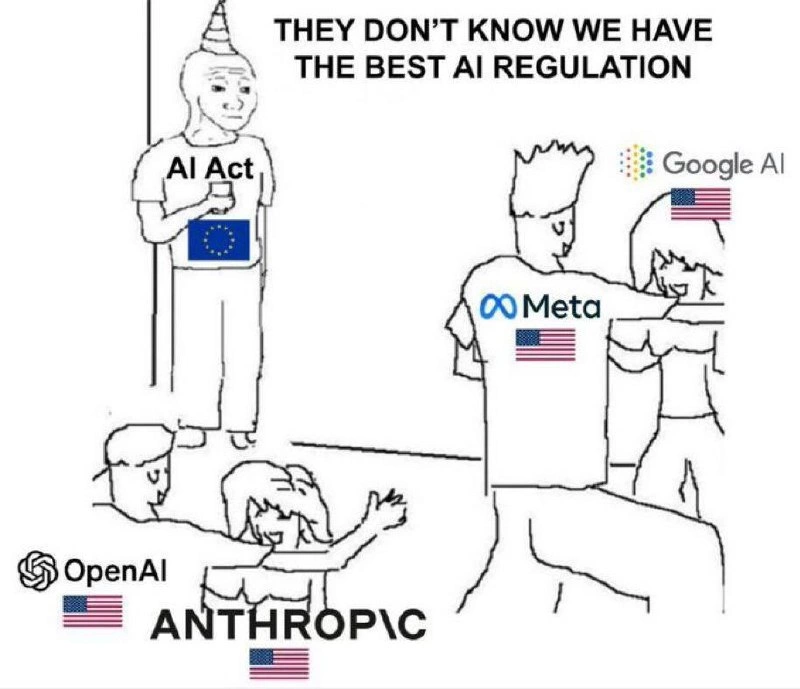
This meme shows a contrast between making rules and making progress in the AI world, using a simple party scenario. On the left side, we have a lonely character representing the EU AI Act – a major European Union proposal to regulate AI. He’s illustrated wearing an EU flag logo and a shirt that says “AI Act,” holding a drink but not joining the dancing. Above his head is the caption: “THEY DON’T KNOW WE HAVE THE BEST AI REGULATION.” This is a thought he has at the party, indicating he’s proud of the strict AI rules he brings, even though no one else seems aware or interested. Being a wallflower at a party means he’s standing off to the side, not part of the fun – a bit isolated and maybe a touch smug about his own importance.
On the right side, we see a bunch of stick-figures dancing and having fun. These are labeled with logos and names of big American tech players in AI: Google AI, Meta, OpenAI, and Anthropic. Each of these figures has a little American flag on them, showing they’re from the USA. They’re drawn as happy partygoers, mingling and dancing together, completely oblivious to the EU regulator on the side. In other words, they don’t even notice the EU guy or his proud thought about regulation – they’re too busy with their own thing.
So, what’s going on here? It’s a humorous take on the difference between how Europe and the United States are approaching Artificial Intelligence (AI). The EU AI Act (the lonely figure) is essentially a big set of proposed rules from the European Union that aims to govern AI technology. Think of it as Europe saying, “We need to set some ground rules and safety standards for this AI stuff!” It covers things like: ensuring AI doesn’t discriminate, requiring transparency (for example, telling people when they’re interacting with an AI and not a human), and even banning some AI uses that are considered too dangerous (like a social credit scoring system, etc.). Europe is known for these kind of strict tech regulations – you might recall how the EU’s GDPR law brought us all those cookie consent pop-ups and stronger data privacy rights a few years back. The AI Act is similar in spirit: it’s Europe flexing its regulatory muscle to protect users and guide ethical AI development. That’s why in the meme the EU character believes they have “the best AI regulation” – it’s a point of pride that their rulebook for AI is very comprehensive and strong on ethics.
On the other hand, the dancing figures with names like Google, Meta, OpenAI, Anthropic represent the fast-moving AI industry, largely led by American companies. Each of those names is a major player in developing AI models:
- Google AI – Google’s branch that works on artificial intelligence (Google has done a lot, from smart assistants to self-driving car AI, and they own DeepMind, which famously created AlphaGo and other advanced AI systems).
- Meta – That’s the company behind Facebook, Instagram, etc. Meta has a big AI research division too; for instance, they’ve released AI language models named LLaMA and do a lot of work on AI that powers social media and VR.
- OpenAI – A research lab/startup known for creating ChatGPT and GPT-4, which kicked off the recent AI chatbot craze. They’re all about pushing AI capabilities (with backing from Microsoft).
- Anthropic – A newer AI company focused on building AI in a safer manner (they’re behind an AI assistant named Claude). They were founded by former OpenAI folks and emphasize AI safety, but they’re still building advanced models like the others.
All these are marked with U.S. flags because they’re primarily U.S.-based companies or labs. In the meme, they’re shown partying – which symbolizes them actively developing and deploying AI systems, basically having a good time innovating and releasing new things. They “keep dancing” means they continue their work (releasing new AI models, improving their tech) without being overly concerned at that moment about regulations like the EU’s. They might not even know or care that the EU is busy making strict laws because they’re focused on the technological race.
The humor comes from this mismatch of focus:
- The EU side (left) is all about compliance and regulation. He’s like, “We’ve done something great – we wrote the best rules to keep AI in check!” This is a bit of a prideful or bureaucratic mindset: measuring success by how strong your rules are.
- The US tech side (right) is all about innovation and action. They measure success by “What cool AI did we build or ship this month?” They’re just enjoying the boom in AI technology, dancing away and collaborating, like it’s a big exciting party of progress.
The meme format “They don’t know X” typically jokes about a person who thinks they have a secret or something impressive, while others around them are completely unaware. Here the EU person’s secret or impressive thing is “the best AI regulation”, but obviously the dancing tech companies aren’t looking his way or asking about it at all. It pokes fun at the possibility that the EU regulator is a bit out-of-touch in that setting – bragging about something that the others at the party (the AI companies) aren’t interested in at the moment. It’s like someone at a music festival bragging that they have the best earplugs; the crowd might technically benefit from that, but they’re all too busy enjoying the music to care about earplugs right then.
In simpler terms, the meme is highlighting a real-world observation: Europe tends to emphasize rules and safety in AI, while America tends to emphasize speed and innovation. This is why we see a “trans-Atlantic gap.” The phrase “flexes regulation” in the title suggests that the EU is showing off its regulatory strength (flexing, like showing your muscles), as if it’s proud and maybe a bit boastful about how it can control AI with laws. Meanwhile, “US models keep dancing” implies American AI models (or the companies making them) keep advancing and being deployed without missing a beat, as if no one tapped them on the shoulder to slow down.
To a junior developer or someone new to this topic, here are some key points to know to appreciate the meme:
- AI Regulation (EU AI Act): This is Europe’s big plan to regulate AI. It’s a law under development (as of 2024) that will classify AI systems by risk (unacceptable risk, high risk, limited risk, minimal risk) and impose requirements like transparency, fairness, and accountability, especially on higher-risk AI (like AI used in medical devices or hiring decisions). The meme portrays it as a person because it’s easier to joke about a person at a party than a bunch of legal text. The EU often takes a proactive regulatory stance – meaning they try to set up rules early to prevent problems (this is sometimes called the “precautionary principle”: better safe than sorry).
- AI Companies (Google, Meta, OpenAI, Anthropic): These represent where a lot of ground-breaking AI work is happening. For example, OpenAI’s ChatGPT is something a lot of people actually used, and it wasn’t heavily regulated when it came out – it was just released to the public and iterated on. Google and Meta are integrating AI into many products (like Google’s search or Facebook’s content systems) and releasing research. Anthropic, while smaller, is specifically concerned with AI being safer, but they’re also actively making AI. These companies operate in a competitive, fast-paced environment, particularly in the U.S. where – at the time of this meme – there wasn’t a comprehensive AI law equivalent to the EU’s Act. The U.S. government had issued some AI guidelines and ethics frameworks, but largely it’s been self-regulation by companies. This fosters quick development – sometimes summed up as “move fast and break things” (an old Silicon Valley motto, meaning it’s okay to deploy something that might not be perfect or might cause disruptions, and then fix it as you go).
- Data Privacy and GDPR: Mentioned in the tags is GDPR, the EU’s famous data privacy regulation. It’s relevant because it shows the EU’s track record: they passed GDPR to protect personal data, and it had a huge impact globally. So the EU likely sees the AI Act as the next GDPR – a way to lead the world in tech policy. For a junior dev, think of all those “Accept Cookies” banners or those emails about privacy policy updates – that’s because of GDPR. Companies had to comply or face heavy fines. Now with AI, the EU might enforce things like requiring AI systems to explain their decisions or to register in a database if they’re high risk. It’s a big compliance effort.
- Compliance vs. Delivery: This is a general theme. Compliance means following all the rules and regulations. It involves paperwork, tests, checks – e.g., if you release an AI system in Europe under the AI Act, you might have to provide documentation on its training data, do risk assessments, etc. Delivery (or deployment) means actually shipping the product or feature to users. The meme contrasts compliance pride (being proud of having all the paperwork in order) with shipping pride (being proud of getting something working into users’ hands).
The meme isn’t saying one side is right or wrong outright – it’s more laughing at the disconnect. The EU regulator character is like that one person at a party who values something very differently than everyone around him. He’s standing there with his drink, feeling satisfied that he has the best rules, but he’s totally missing out on the fun (the AI innovations and collaborations). The others aren’t necessarily mocking him; they just aren’t tuned into that wavelength at all. They’re in a different mode – think of it as “policy mode” vs “engineering mode.” In tech companies, you sometimes see this: the legal/compliance team versus the engineering/product team. The compliance folks might celebrate a passed audit or a new certification, while the engineers celebrate a successful launch or a new feature deployed. Both are important achievements, but each team is kind of partying in its own corner, so to speak. Here, the EU is one corner (regulatory achievement) and the US companies are the other (technical achievement).
For someone not deeply technical, another analogy: It’s like an adult at a youth party proudly saying “I brought the best safety handbook for this party!” while the teenagers are dancing to the latest music. The adult’s intention might be good (keep everyone safe), but bragging about a handbook isn’t what makes a party fun, and the teens are just excited about the moment. Similarly, the EU bringing a “handbook” (regulation) to the AI party gets a bit of a cold shoulder because the excitement is all about the new AI “music” playing.
In summary, the meme is a playful jab at the lag between tech innovation and law-making. The EU (European Union) is depicted as being a bit self-congratulatory about having strict AI rules ready. The US AI companies are depicted as charging ahead, busy creating and using AI with little regard to those rules (at least for now). It reflects a real-world scenario around 2023-2024: the EU preparing to enforce AI regulations, while companies like OpenAI, Google, and others rapidly push AI products out globally, setting the pace of change. Anyone working in or around AI can attest that regulation often trails innovation – and when it catches up, the innovators might already be onto the next thing (or dancing to the next song, as the meme would put it). The comedic element lies in that image of one side thinking “we nailed it with our rules!” and the other side not even hearing that statement over the sound of their own party.
Level 3: Regulatory Wallflower
In this meme, the European Union’s AI Act is personified as that lonely guy at the party proudly thinking, “They don’t know we have the best AI regulation.” On the other side of the room, the party is in full swing: caricatures of Google AI, Meta, OpenAI, and Anthropic (each draped in American flags) are dancing cheerfully, utterly indifferent to the wallflower’s boast. This juxtaposition is instantly recognizable to experienced tech folks as a satire of the current trans-Atlantic tech landscape: Europe is busy patting itself on the back for its meticulous AI governance, while the US-based AI giants are busy shipping new models and innovations at breakneck speed, seemingly oblivious to (or unconcerned with) Europe’s new rules.
Why is this funny to an industry insider? It’s the classic mismatch of priorities and pace. The EU regulator character is exhibiting compliance pride—he’s proud of having crafted a robust legal framework (perhaps akin to a developer feeling smug about comprehensive documentation or an extensive suite of unit tests). But he’s a wallflower because that achievement, however worthy, is being completely ignored by the cool kids on the dance floor who are showing off actual results. Google, Meta, OpenAI, Anthropic – these names represent real AI products and breakthroughs (think ChatGPT from OpenAI, or Meta’s recently open-sourced large language model Llama 2). They’re “dancing” in the sense that they are reveling in the rapidly advancing AI boom – releasing cutting-edge models, demoing new AI features, and grabbing headlines. Meanwhile, the EU’s achievement is a stack of policy documents and regulatory provisions – important, sure, but not exactly the life of the party. It’s as if a project manager shows up to a hackathon after weeks of writing a 100-page requirement spec, while the developers from another team are already presenting a cool working prototype. The spec-writer stands aside thinking, “If only they appreciate how perfect my plan is,” but everyone’s too busy gawking at the functioning demo.
This meme nails a shared tech industry sentiment: the gap between policy-making and product-building. In software terms, the EU’s approach is like a waterfall model – gather all requirements (ethics, safety, compliance), create the ultimate plan (the AI Act), and declare success in having the plan. The US approach, embodied by these AI companies, is more agile or even move-fast-and-break-things: build something first (a powerful AI model), push it out to users, then iterate and maybe deal with regulations or fixes later. The humor (and the headache for those who’ve lived it) comes from seeing someone celebrate the process while others celebrate outcomes. It’s a gentle jab at the EU’s tendency to prioritize governance and regulation in emerging tech, contrasted with the American tech sector’s bias toward innovation and deployment.
There’s also an implied commentary on speed vs. scrutiny. The EU AI Act has been years in the making – drafting through committees in Brussels, debates about ethics, risk categories, compliance procedures, GDPR-style protections for AI, etc. It’s a slow grind by design, aiming to proactively address issues like bias, transparency, and safety before AI systems cause widespread harm. Meanwhile, in those same years, US companies (and their research labs) have pumped out ever-larger AI models. Think of the leap from GPT-2 to GPT-4, or the explosion of AI products integrated into search engines, productivity tools, and social media – all happening with minimal regulatory interference. By the time the EU AI Act is finalized (it’s likely being finalized around 2024–2025), the landscape of AI will have already shifted (new model architectures, new players, new societal impacts). It’s the classic policy lag: legislation is chasing a target that never stands still. Seasoned engineers have seen this pattern in many forms. It’s why the meme gets that knowing chuckle – it captures how reality outpaces rule-making.
Another layer to this joke is the “they don’t know” format, a classic meme template often used to depict someone who feels they possess a special insight or achievement that others are oblivious to. Here the EU figure’s thought bubble – “They don’t know we have the best AI regulation” – drips with ironic smugness. The comedy is that the partygoers genuinely don’t care about that claim. This mirrors a real-world sentiment: AI labs and companies often push forward globally, sometimes paying lip service to regulators, but mostly focusing on outdoing each other in model performance. The EU may claim moral high ground (best regulation = we’re doing the responsible thing!), but at the end of the day, if the actual AI action (the exciting research, the product releases, the big leaps) is happening elsewhere, that claim doesn’t earn much admiration at the “party” where tech progress is celebrated. It’s as if the EU is awarding itself a trophy that no one else at the competition acknowledges, because they’re too busy racing ahead.
For those of us in the developer and tech community, this scenario is painfully relatable. Consider a big enterprise scenario: a compliance department lead proudly announces “We’ve complied with all ISO standards and passed all audits with flying colors!” while the product teams are firefighting scaling issues or rolling out features to beat a competitor. Both sides are important, but only one typically gets the spotlight and excitement. The compliance folks often feel underappreciated (just like our EU wallflower), and the product folks often feel the compliance is a party pooper slowing them down – until something goes wrong, at which point everyone suddenly pays attention to those rules. The meme taps into that unspoken tension: the necessary but unloved work of regulation versus the flashy, coveted work of innovation. It’s essentially compliance vs. delivery. Developers with a few years under their belt have likely sat through mandatory regulatory training (security, privacy, etc.) thinking, “Okay, but I have code to ship…” That’s the same energy as the dancing AI companies nodding politely (or not at all) to the EU’s grand regulatory achievement.
Historically, the EU has flexed its regulatory muscles successfully. A famous example is GDPR (General Data Protection Regulation), referenced by the tags. When GDPR came into effect in 2018, it was the strictest data privacy law the tech world had seen. Many of us remember the scramble it caused: companies large and small had to add cookie consent banners, update privacy policies, and give users ways to download or delete their data. The EU is clearly proud of that legacy – they truly shifted global norms on privacy (websites worldwide changed behavior to comply). So the EU AI Act is like the sequel: a sweeping law to set global standards for AI ethics, data usage, and user protection. And the EU believes (not without reason) that they’re leading the world in responsible AI governance. In their view, having “the best AI regulation” is akin to having the moral high ground, much like they felt with privacy. That’s why our wallflower is smirking with pride. He assumes that eventually everyone will realize how great these rules are – perhaps even that the dancing AI companies should be impressed, if they only knew.
But here’s the rub that makes the meme zing: in the fast-paced AI race, innovation often outshines regulation. The US companies have the flags on their backs for a reason: the likes of Google, Meta, OpenAI, and Anthropic represent the epicenter of AI breakthroughs. They’re backed by Silicon Valley-esque risk-taking culture and hefty investment. Google’s deep learning research (think DeepMind and Google Brain) has produced world-leading AI systems (AlphaGo, anyone?). Meta has poured resources into AI research and even open-sourced large models that the global community uses. OpenAI’s ChatGPT practically defined the generative AI craze in late 2022, bringing AI to millions of regular users. Anthropic, while smaller, was founded by former OpenAI folks and focuses on AI safety but by building AI (their model Claude competes with ChatGPT). These organizations iterate quickly – new model improvements roll out in weeks or months, not years. They publish papers, release APIs, gather massive user feedback, and improve again. It’s an energetic dance of progress, and it’s happening largely in the US (and a few other hotspots), not in EU headquarters. So from the perspective of those companies, a regulation like the EU AI Act is somewhat peripheral noise for now. They might comply if they have to (when selling in Europe), or lobby to shape it, but it’s not what drives their day-to-day excitement. They’re more occupied with one-upping each other’s model capabilities (who’s got the bigger model? the better training data? the new cool demo?). Thus, in the meme, they’re “dancing and socializing” – absorbed in their own world – giving zero attention to the wallflower’s internal boast.
This dynamic has a hint of truth that industry veterans smirk at: The EU often ends up regulating technology that was largely developed elsewhere. There’s an inside joke that “if you can’t innovate, regulate.” 😏 It’s harsh, and not entirely fair (Europe does innovate, just differently), but the meme leans into that stereotype. Europe’s contributions to the current AI wave are less visible to the public – there’s no European ChatGPT equivalent making waves (European tech companies are more in automotive, fintech, etc., and a lot of AI research talent in Europe often ends up working for the likes of Google or DeepMind in London, which, notably, is now an American-owned lab). So the EU takes on a role somewhat like the world’s tech referee. They might not have star players on the field, but they do have the whistle and rulebook. In the meme’s party terms, the EU isn’t dancing to the hottest new track; he’s the chaperone checking that the music’s volume and content are appropriate. The humorous undertone is, of course, that at this moment the chaperone is mostly being ignored while the party rages on.
For a senior developer or engineer, there’s also the recognition of organizational psychology here. Big tech companies in the US often talk about wanting “smart regulation” but tend to resist heavy-handed rules. There’s an ongoing debate: how to ensure AI is safe and ethical without strangling innovation. The meme caricatures the EU as over-eager to regulate and the US as over-eager to push boundaries. Both have pitfalls that experienced folks know well. Too much unchecked AI innovation and you get potential disasters (misinformation, bias incidents, privacy breaches – we’ve seen early examples of all). Too heavy a regulatory hand too early, and you might smother beneficial innovation or drive it elsewhere (developers routing around jurisdictions that make their life hard – like some companies geo-blocked EU users rather than deal with GDPR at first). The tag “us_vs_eu_innovation” captures this clash. The US side of the meme could be seen as chanting “AI hype!” and “ship it now!” – an echo of the AIHypeVsReality trend where everyone’s launching something AI-powered whether it’s ready or not. The EU side is countering with “AI ethics” and “not so fast!”, reflecting AIEthicsConcerns and AISafetyResearch focus – things that tend to temper hype with reality checks.
Another wink to those in the know is the EU figure’s claim of “best AI regulation”. That phrase itself is satirical because regulation isn’t something typically rated like a product – it’s not like saying “best smartphone” or “best algorithm”. Claiming best regulation is inherently a bit funny, suggesting a sort of self-congratulatory stance. It implies “our rules are superior” as if regulation is a competition. Tech folks might recall how EU officials often speak about GDPR as a gold standard and likely see the AI Act the same way. The meme paints that attitude as slightly out-of-touch at a party where the conversation is about the latest AI model’s cool new trick. It’s a humor born from contrast: one side speaks in legalistic terms, the other in technological feats. Imagine a DJ battle where one DJ shows off a complex legal document and the other drops a new beat that gets everyone dancing – the crowd’s going to vibe with the beat, not the document.
In summary, this meme resonates on multiple levels with experienced tech professionals: it highlights the cultural divide between European regulators and Silicon Valley-style innovators, it jokes about the timing mismatch (regulators still polishing their rulebook while industry has moved on to the next big thing), and it captures that familiar workplace scenario of the rule-maker versus the do-ers. The “wallflower” EU AI Act isn’t wrong to seek control (many in tech agree some regulation is needed for AI’s societal impacts), but the meme humorously points out that bragging about rules means little if the party (the industry) is paying no attention. The real influence comes when the music stops and the lights come on – i.e., when regulations actually hit and those companies must scramble to comply or face fines. But at this moment captured by the meme, we’re in the free-wheeling early dance of AI innovation, and the EU’s just a guy with a party hat full of policies, waiting for someone to listen. It’s funny, a bit bittersweet, and very much of the moment in the AI world.
Level 4: Compliance Complexity Theory
At the most theoretical level, this meme hints at the fundamental tension between AI’s technical complexity and regulatory oversight. The European Union’s AI Act as depicted isn’t just a buzzkill at the party—it’s trying to impose formal rules on technologies that are notoriously hard to pin down with rules. Advanced topics in AI safety research and algorithmic ethics come into play here. The EU’s boast of having the “best AI regulation” belies the inherent unpredictability of large AI models and the unsolved challenges in aligning them with human values. In computer science terms, it’s like trying to write a formal specification for an algorithm that is still evolving in real-time. Under the hood of this joke, we see echoes of computational complexity—not of algorithms solving puzzles, but of regulators trying to solve the puzzle of AI governance. It’s almost as if the EU believes there’s a deterministic, rules-based approach to control AI, while the actual AI models behave more like chaotic systems or black-box functions.
From a rigorous perspective, ensuring AI adheres to ethical and safety constraints is a multidimensional optimization problem with no easy solution. In fact, the meme’s humor masks several deep technical conundrums that even experts grapple with:
Fairness Paradox: AI fairness is a well-known unsolvable tri-lemma. Different mathematical definitions of fairness (
equal opportunity,demographic parity, etc.) often conflict. Regulators might demand “no bias” in AI, but theoretically, an algorithm cannot simultaneously optimize all fairness criteria for all groups. It’s akin to an NP-hard problem in social values: there’s no single optimal solution that satisfies every constraint. So while the EU might mandate “ethical AI”, defining and proving an AI system is fair can be as hard as formal verification of a complex program – sometimes provably impossible given trade-offs (much like the no-free-lunch theorem in ML).Black-Box Transparency: Modern AI models (like deep neural networks with billions of parameters) are largely opaque. They’re often described as “black boxes” because even their creators can’t fully explain how a specific decision is made internally. The EU AI Act aspires to require explainability and transparency (a user’s right to know why an AI decision happened). This is reminiscent of the “right to explanation” that EU’s GDPR tried to enforce for algorithms. But from a technical standpoint, cracking open a deep learning model to give a human-readable explanation is a frontier of research (Explainable AI or XAI). Regulators can demand it, but scientists are still figuring out how to do it reliably. It’s a bit like asking for a detailed blueprint of a brain’s thought process – a noble request, but extremely complex. There’s an almost ironic loop here: the more powerful and state-of-the-art an AI model (like GPT-4 or Meta’s Llama series), the less interpretable it tends to be. So the “best AI regulation” might set ideal goals that current machine learning theory doesn’t have methods to fully achieve.
The Alignment Problem: Ensuring an AI system always follows human-intended goals and values – known as the AI alignment problem – is a cutting-edge theoretical challenge. The meme quietly touches on this: the EU’s regulatory stance assumes AI behavior can be bounded by compliance checklists. But AI models, especially general ones, have emergent behaviors that are hard to predict. Even their creators often discover new capabilities or quirks after deployment (for example, a large language model suddenly demonstrating a surprising ability to solve a kind of puzzle it wasn’t explicitly trained for). Aligning such a model with human ethics is not just a policy question; it’s an open research question involving everything from reinforcement learning algorithms to formal logic and even philosophy. In theoretical terms, it’s reminiscent of trying to prove properties about an algorithm that can learn and change – a moving target. There’s no static theorem that guarantees a powerful AI won’t produce unexpected or undesirable outputs (short of essentially solving the Halting Problem for AI behavior, which is impossible). This is why AI safety research is a field of its own: figuring out how to mathematically define and verify “safe” behavior for AI. The EU can mandate that AI models be “safe”, but making that concrete involves complex frameworks (like adversarial robustness tests, interpretability methods, bounding the model’s output distribution to avoid extreme harmful cases, etc.). It’s a bit like the difference between passing a law that says “weather must be predictable” versus actually computing chaotic weather patterns – one is straightforward on paper, the other defies easy computation.
In essence, the meme’s scenario encapsulates a high-level truth: writing laws for AI is easy; engineering AI to always obey those laws is hard. The EU’s regulatory confidence bumps up against the scientific reality that large AI systems are stochastic, non-deterministic, and often inscrutable. The trans-Atlantic disconnect here isn’t just cultural or economic – it’s rooted in the complexity of AI itself. Europe is brandishing a rulebook for what they see as a controllable system, while the system (AI models) behaves more like a wild dance of algorithms that no one fully controls. The “wallflower” in the corner thinks he has tamed the dance with the best guidelines, but from a theoretical viewpoint, the dance might not be fully tameable in the first place. This irony – between formal regulatory intent and the informal, emergent nature of AI tech – is what makes the meme resonate on a deep level with AI researchers and seasoned engineers. They know that when it comes to advanced AI, compliance itself is a complex algorithm to implement.
Description
This image uses the 'They Don't Know' / 'Loner at a Party' Wojak meme format to comment on the global AI landscape. A sad-looking character with a party hat, representing the EU's 'AI Act' (with an EU flag on their shirt), stands alone in a corner thinking, 'THEY DON'T KNOW WE HAVE THE BEST AI REGULATION.' Meanwhile, other figures representing major US-based AI companies - Google AI, Meta, OpenAI, and Anthropic, each with an American flag - are happily socializing and dominating the party. The meme satirizes the perception that while the European Union is focused on creating comprehensive (and potentially restrictive) regulations, the major innovation and market leadership in AI is happening in the United States, where companies are moving fast and are largely unconcerned with the EU's regulatory efforts
Comments
56Comment deleted
The EU AI Act is like a meticulously crafted RFC for a protocol that the rest of the world has already implemented via UDP and is now scaling to a billion users
Meanwhile, the architects in Brussels are finalizing Article 42 - just in time for GPT-10 to self-refactor around it
The EU's AI Act is like implementing strict type checking in production while everyone else is still shipping with 'any' - technically superior, practically ignored, and wondering why nobody wants to come to their strongly-typed party
The EU's AI Act is like implementing comprehensive type safety and formal verification while the US companies are already shipping to production with 'move fast and break things' - except they're breaking societal norms at scale with models trained on the entire internet. Sure, Europe has the most elegant regulatory framework, but by the time it's fully enforced, GPT-7 will probably be writing its own compliance documentation and Meta will have pivoted to their third metaverse iteration. It's the eternal tension: one side optimizing for correctness and safety guarantees, the other for velocity and market dominance - and somehow both are convinced they're winning
The EU shipped an interface contract; the US shipped four breaking changes before ratification - time to write a cross‑Atlantic compliance adapter
The EU shipped a 400-page contract‑first spec for AI; US labs implemented the endpoint months ago and lawyers now maintain the adapter class called “Responsible AI.”
EU AI Act: Where high-risk models need more paperwork than parameters
I don't really think this has to do with regulations A few companies in the EU exist like Mistral and Flux no problem but most VC that is required to start these companies is in the US Comment deleted
Regulations help new companies not existing and vc won't invest in something that first has to invest millions in "regulatory compliance" while established companies can just budget that. In EU we don't have democracy, we have bureaucracy. Comment deleted
If you think that without AI Act we would have companies comparable to Meta, OpenAI and Anthropic, you are truly delusional Comment deleted
If you think Ai Act helps such companies to emerge then you're the delusional one. Comment deleted
I don't think either of these things ahaha Comment deleted
It's interesting how we come to different conclusions from the same premises. Yes, regulations prevent AI companies from just flooding the market, but why is that a bad thing? You don't argue like that about companies during medical research, because a mistake can cost so much; with the speed AI is being developed at, the risk is just as high, for a multitude of reasons Comment deleted
Because regulations of AI only limits EU AI companies, while China and US will leave EU biting the dust. It is literal shot in the leg. Comment deleted
Would you argue that taking a no-nuclear-arms stand is the wrong thing to do for a country, as some other countries have nuclear weapons? Comment deleted
Of course it is wrong. Look at Ukraine. And nobody will take this stance after Ukraine. Taking a no-nuclear-arms stand, as some other countries have nuclear weapons is literally suicide as practice shows. Comment deleted
I can't help but notice this will go horribly either way Comment deleted
did it went horribly for Pakistan, India, China? Everybody who oficially implemented nukes after USSR and US never got invaded. Comment deleted
"Officially"? Do you understand how little that means? Comment deleted
they didn't got invaded or even got risks of invasion, so it means a lot Comment deleted
No, you don't get it. No one cares about "official" rules, whatever those are. Iran can threaten anyone however they like Comment deleted
I didn't said that somebody cares. I said that this is what happening. Name one country who become target of starting the war by other country while having official nuclear weapons. Comment deleted
The difference is in core values and philosophical roots of ones line of thought. The division is hard to bridge. Like for example: classical liberals will advocate for rights of individual, while communists will argue that individual rights limit freedom and only collective well being of whole commune is far more important than any individual. There's no bridge between those. Comment deleted
We could not now how it would went, but Budapest memorandum was a mistakes, and Russian invasion marked the end of denuclearization. Everybody knows that Ukraine fucked up there, it's a common knowledge now. We do know that countries with official nukes are living in peace. Comment deleted
You are saying that forfeiting arms or being poorly armed country will lead criminals to shoot/stab people there and Russia will come invading for no fucking reason? I doubt that this is how mutually assured destruction works in real world Comment deleted
This is literally how it works, if Ukraine would not give up nukes Russia would not invaded, that's how mutually assured destruction works in real world. Also Russia having them is why there is so much restrictions on Ukraine. Comment deleted
Слава Україні! Comment deleted
please use english in this chat or add translate below Comment deleted
tr(ua->en) Glory to Ukraine Comment deleted
Glory to Ukraine ^^ Comment deleted
Similar to tech giants in general Comment deleted
Ai act will be worldwide Comment deleted
AI Act is a total BS from the very beginning. Just read about "unacceptable risk" Comment deleted
No it will not be worldwide. Why would it? Comment deleted
It's already Used in International disputs Comment deleted
Just let it take over already. Wouldn't world be a better place with meatbags as mere servants to the big machine? Works out in sci-fi, good enough to me. (Don't take me seriously, I'm drunk) Comment deleted
As only one alternative Comment deleted
Or between people arguing for "gun control" as if that will somehow prevent crimes, while time and time again it is shown that if guns are prohibited only criminals have guns. And even if all the guns magically disappeared there still be criminals killing people with whatever equipment Comment deleted
‘No Way To Prevent This,’ Says Only Nation Where This Regularly Happens Comment deleted
[insert crime statistics highlighting race of the offender] Comment deleted
Also: UK has no gun violence... only peaceful stabbings :) Comment deleted
This just a lie. https://en.wikipedia.org/wiki/List_of_countries_by_firearm-related_homicide_rates the biggest firearm-related homicide rates per capita is in the countries where guns highly regulated Comment deleted
I can't fact-check that? All European countries have lower homicide rates per capita than US Comment deleted
US is located near Mexica, not near Europe. Gun violence in Brazil and Mexica x10 from US. BTW in Canada guns are also easy to get. Nearly 22% of Canadian households had at least one firearm. But homicide rates are same as in EU. Comment deleted
Everything EU regulates eventually turns to shit. Hope for the best, prepare for the worst Comment deleted
Well current AI is already shit so nothing will change Comment deleted
Apple AI and gpt with voice isnt coming to eu because of these regulations saying human like voice AI is forbidden Comment deleted
*except for usb-c enforcement (thank god somebody has the balls to finally do that, even cheap chinese electronics started adopting usb-c times faster) Comment deleted
Well, Apple's USB-c is shit. Comment deleted
2.0 in 2024 lmao. Comment deleted
Any usb-c is usb-c, they just call it thunderbolt whatever Comment deleted
Thunderbolt is on Macs, they didn't need regulations to force it there. I am talking about iPhones with 2.0 speeds. Comment deleted
Except it fucked over a bunch of small projects, USB-C isn't nearly as unvirsal as people think and now they'll just waste some money developing chips to pair your phone to your USB cable or some shit because it's Apple Comment deleted
You can blame apple but come on, developing projects with micro-usb or whatever is cringy in 2024, usb-c chips cost 30 cents per item and that's not even a bulk price, the regulation is about having a single cable for everything and it's convenient imo Comment deleted
the issue with EU regulations is that for every good thing they do they propose (and sometimes approve) five shitty regulations Comment deleted
On topic of AI and code Comment deleted