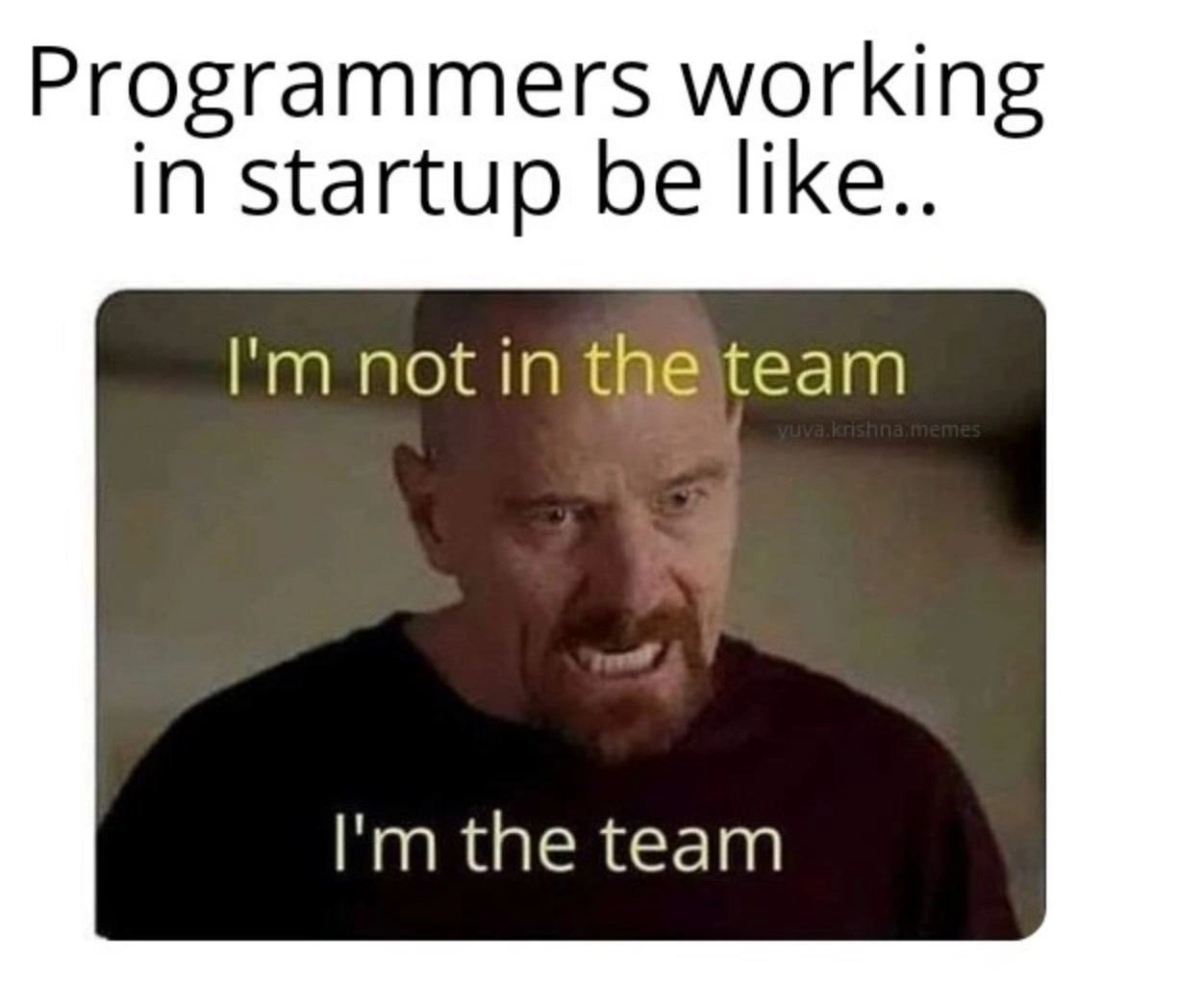
Startup Dev Life: I'm Not in the Team, I Am the Team
Why is this Startup meme funny?
Level 1: Team of One
Imagine you have a school project where you’re supposed to work in a group, but none of your classmates show up to help. You end up doing the whole project all by yourself. When it’s time to present, the teacher asks, “Where’s the rest of your team?” and you just shrug and say, “I’m not in the team, I’m the team.” It sounds kind of funny, right? You’re basically telling the teacher that you alone did everything that a whole team was supposed to do.
This meme is joking about that kind of situation, but in a workplace setting. It’s like a sports game where one player has to play every position — goalie, defender, and striker all at once. The picture in the meme shows a intense-looking man proudly saying he is the team. The humor comes from how over-the-top that is. Normally, being a team means you have a bunch of people working together. But here, it’s just one very busy person doing it all. It’s both impressive and a little silly. Impressive because, wow, that person is juggling a lot! Silly (and relatable) because we all know a “team meeting” with just one person talking to themselves isn’t really a team at all. So the meme makes us laugh at the idea of a lone programmer in a startup wearing every hat, proudly declaring they don’t just belong to the team — they are the entire team. It’s a funny way to show how in some situations (like small startups or school projects) one person ends up doing everything, for better or worse.
Level 2: Wearing Many Hats
This meme shows a scenario that might feel extreme but is actually pretty common in startup culture. Imagine a small new company with only a handful of people. If you’re the only engineer hired, then the entire tech team is literally just you. The image (featuring a scowling character from Breaking Bad) has the caption "I'm not in the team, I'm the team." That’s the lone developer basically saying: “There is no team besides me.” It humorously highlights how at a startup one programmer often has to do the work of an entire department. Why? Because early-stage startups have limited resources and can usually pay only one tech person — so that person ends up doing everything.
In a larger company, roles are specialized: you’d have front-end developers, back-end developers, designers, testers, and DevOps engineers all working together. In a tiny startup, one person might have to fill all those roles at once. In practical terms, the only engineer at a startup finds themselves:
- Writing the user interface and web pages (the front-end that users see and interact with).
- Building the server logic and database queries (the back-end behind the scenes that powers the app).
- Managing infrastructure, deployments, and environments (that’s the DevOps part — setting up servers, cloud services, and making sure the app runs smoothly in production).
- Testing the software and fixing bugs (there might not be a separate QA tester, so the developer has to double-check their own work).
- Handling on-call duties for outages (if the website or app breaks in the middle of the night, there's no dedicated support team — you are the support).
- Even participating in business meetings or customer support when technical input is needed (since you’re the only technical voice in the company, you end up explaining tech issues to everyone, from marketing to the CEO).
They call this "wearing many hats" because one person is doing jobs that would normally be spread out among multiple people — as if you're wearing the engineer hat, the tester hat, the ops hat, etc., swapping between them constantly. It can be exciting because you get to learn a bit of everything, but it’s also challenging. You have to switch contexts all the time (one minute fixing a UI bug, the next minute tracking down a server error), which can be tiring and difficult to do efficiently.
Let’s unpack a few terms and tags related to this meme. Startup life often implies a fast-paced environment with long hours and unpredictable tasks, especially for engineers. The tag bus_factor_one is a warning concept: the "bus factor" asks how many people on the team can get hit by a bus before the project is in serious trouble. It’s morbid humor for how much knowledge is concentrated in each person. A bus factor of 1 means only one person knows critical parts of the system. If that person were unavailable (whether due to leaving, illness, or, yes, getting hit by a bus), the project might grind to a halt because no one else knows what they know. In our scenario, the lone engineer is that single point of knowledge. It’s not ideal to have a bus factor of one, but in a small startup it happens because there’s simply no one else to share the knowledge with initially.
The meme also hints at “full stack or bust.” A full-stack developer is someone who can work on both the front-end and back-end (the “full stack” of technologies). In a startup, being full-stack isn’t just a nice-to-have – it’s often a requirement. “Full stack or bust” means if you can’t handle the entire range of tasks (from database all the way up to user interface), the startup won’t succeed (bust meaning failure). There’s no separate specialist to cover an area you can’t do, so the lone dev must at least try to do it all. It’s a bit of a sink-or-swim situation for a developer: you either pick up a broad skill set quickly, or the project stalls. This can supercharge one's developer productivity in the sense that you grow a lot of skills, but it’s also overwhelming because no one can be an expert at everything at once.
And then there’s DevOps – a combination of “Development” and “Operations.” DevOps typically involves tasks like deploying code, configuring servers, managing cloud infrastructure, and ensuring the application stays up and running. In bigger companies, you might have a dedicated DevOps team or site reliability engineers. In a startup with one engineer, "DevOps" is just another item on your to-do list. We sometimes joke about solo_devops, meaning the lone developer has to handle all the ops work solo: setting up continuous integration, managing Docker containers, debugging production issues – all without backup. It’s a lot for one person to handle, and definitely not a nine-to-five gig. If an alert goes off in the middle of the night indicating the server is down, the only engineer is the one who has to jump out of bed to fix it (that’s the 3 AM production fix the description mentions). Being "on call" 24/7 is tough, because you’re constantly aware that if anything breaks, you’re the default (and only) fixer.
So what makes this funny to developers? It’s the exaggeration and recognition of a truth. The meme uses a dramatic TV character (the image of a determined, bald Walter White from Breaking Bad) to represent the lone programmer saying “I’m the team.” It’s humorous because in normal situations, no single person would ever call themselves an entire team — teams are, by definition, groups. But in an early-stage startup, the lone engineer really is the whole group when it comes to coding. The joke hits home for developers who have experienced this kind of startup culture. They find it relatable: maybe they’ve been the only developer at a new company, or had to take on way more responsibilities than a single job usually entails. There’s a sense of proud self-reliance (“I built and run everything myself!”) mixed with the absurdity of it (“This is crazy, nobody should have to handle all of this alone!”).
From a junior developer’s perspective, this scenario is both a warning and an adventure. On one hand, you get to touch every part of the project and learn a ton — your developer reality becomes a crash course in front-end, back-end, and DevOps all at once. On the other hand, it can be stressful and lonely. There’s no senior engineer to mentor you directly on the team because, well, you are the team. Every success is yours, but so is every mistake. The meme’s phrase “I’m the team” nails that feeling in a tongue-in-cheek way. It’s the lone dev saying with a sort of comedic bravado: “Yup, it’s just me here, doing everything. Wish me luck!” Everyone in the startup knows it, and we’re laughing because it’s true and a little crazy. This is the StartupLife in a nutshell: great responsibility, great learning opportunity, and maybe a few great big headaches along the way.
Level 3: Single Point of Failure
Senior developers immediately recognize the dark humor here: at a tiny startup, a lone engineer isn't just on the team — they are the team. The caption "I'm not in the team; I'm the team" riffs off a famous Breaking Bad quote to dramatize the situation. In the show, Walter White declares "I'm not in danger, Skyler. I am the danger." — likewise, this meme's engineer proudly asserts they’re not merely part of a group, they are the group. It's a boast with a grim edge, especially to anyone who’s been that solo coder carrying an entire project on their back.
Being the only engineer means you end up wearing many hats by necessity. In a given day, our hero might be:
- Frontend developer in the morning, debugging UI issues and tweaking CSS,
- Backend engineer by afternoon, designing APIs and wrestling with database queries,
- DevOps by evening, provisioning cloud servers, writing CI/CD scripts, and running deployments, and
- the on-call sysadmin overnight, jolting awake at 3 AM to fix whatever just caught fire in production.
In other words, it's full-stack or bust. Absolutely everything technical falls on one pair of shoulders. There’s no database expert down the hall or QA team to catch bugs — if the site goes down, guess who gets the call? When a feature needs building, there’s no one else coming to help. This bus_factor_one scenario (only one person holds all the critical knowledge) is thrilling in its autonomy but terrifying in its fragility. There’s zero redundancy. If our solo dev gets sick, goes on vacation (as if!), or — heaven forbid — quits, the entire codebase is left without a caretaker. It's the human equivalent of a single point of failure in system architecture: one node goes down and the whole system (or startup) is in jeopardy.
For veteran engineers, the meme triggers a mix of laughter and PTSD. They recall those "team" meetings where you’re essentially talking to yourself, or explaining technical blockers to a non-coder CEO who just nods blankly. Working in a vacuum means Git version control holds no mysteries because every commit is yours. You want a code review? Better find a rubber duck to talk to, because there are no colleagues to sign off on your PR. git blame has only one name in the margin (yours), for better or worse. At least merge conflicts are easy when you're the only one merging — but on the flip side, every bug is your bug. Deploy breaks at midnight? Look in the mirror, there’s the culprit and the fixer, all-in-one.
$ whoami
the_team
That snippet above is a tongue-in-cheek way of saying the lone dev practically is the system. In reality, early-stage startups often adopt an "everything-as-a-service" philosophy to cope: use external APIs and cloud platforms for as much as possible. The idea is to lighten the load on the solo engineer — use Firebase for auth, Stripe for payments, AWS for hosting, etc. But integrating all those services becomes yet another hat to wear. The lone developer ends up orchestrating a bunch of third-party tools like a one-person integration team, which can be just as overwhelming. It's a classic startup paradox: move fast with one brilliant generalist, but risk that everything hinges on one brain. This is essentially Conway's Law in action — the product’s structure mirrors the one-person organization. Often you get a simple monolith app (one giant codebase that does everything) because that's easiest for a single mind to handle. Occasionally, an overzealous solo dev might try microservices or fancy architectures, but then they're juggling multiple codebases alone, which is its own special kind of madness.
What makes the meme funny is also what makes it painful: the absurd StartupLife reality that one person is deploying, debugging, and delivering like a whole squad. It's a bit of self-deprecating humor among seasoned devs — we laugh because we've been there, pulling hero hours and secretly praying nothing blows up. Startup culture sometimes even glorifies this scenario, spinning tales of the mythical 10x engineer who can do the work of ten people. Sure, being the sole coder can feel empowering (no bureaucracy, no blockers — you push code straight to prod, for better or worse). But the flip side is the crushing responsibility and inevitable burnout lurking around the corner. There’s no one to share the on-call rotation, no second set of eyes to spot a bad commit, no backup at all. The meme captures that bravado of "I got this, I can do everything!" while hinting at the underlying truth: this is not sustainable. It’s both badass and terrifying when an entire company’s tech rests on one person. Experienced developers find it hilarious in that oh-no-I-recognize-this way. We’ve lived that relatable developer experience where you’re frantically fixing a production bug thinking, “If I go down, this ship goes down with me.” The humor comes from recognizing the bus-factor-of-1 absurdity and the unspoken hope that the “team of one” can keep all the plates spinning... at least until the next funding round to hire help.
Description
A meme humorously depicting the all-encompassing role of a developer in a startup. The image is captioned at the top with 'Programmers working in startup be like..'. It features an intense, close-up screenshot of Walter White from the TV series 'Breaking Bad,' looking directly at the viewer with a fierce expression. The text overlaid on the image is split into two parts. The top line says, 'I'm not in the team,' and the bottom line declares, 'I'm the team.' The joke satirizes the common startup reality where a single engineer often handles frontend, backend, DevOps, QA, and sometimes even product decisions, effectively being a one-person department. This contrasts sharply with specialized roles in larger corporations. A watermark for 'yuva.krishna.memes' is visible in the upper right portion of the image

Comments
12Comment deleted
My job title is 'Senior Software Engineer,' but my AWS bill and PagerDuty alerts just refer to me as 'root'
Daily stand-up: "Yesterday I coded, QA’d, deployed, fixed prod, and scheduled PTO - any blockers?"
The moment you realize your startup's entire CI/CD pipeline is just you pushing directly to main because there's literally no one else to review your PRs, and your disaster recovery plan is hoping you don't get sick during a production incident
At a startup, 'cross-functional team' means you're the frontend dev in the morning, backend architect at lunch, DevOps engineer in the afternoon, DBA before dinner, and on-call SRE at 3 AM. The daily standup is just you talking to yourself in the mirror, and merge conflicts are resolved by whoever wins the argument with your past self. At least code reviews are fast - you already know what that idiot was thinking when they wrote it
Seed-stage org chart is a Makefile where the default target is 'me' and every dependency (dev, ops, QA, support) is .PHONY
Our seed-stage RACI has my name in every column; the on-call rotation is just a mirror
Startup org chart: a single node with infinite self-referential edges - scaling via recursion
And then "Say my title!" Comment deleted
Me rn Comment deleted
One man army Comment deleted
Now we're in business Comment deleted
not a team, I am the whole department. Comment deleted