The Keyboard Throne
Why is this Hardware meme funny?
Level 1: Too Many Buttons
This is funny because it is like a person who loves remote controls so much that they build a chair out of them. It shows someone taking a useful tool way too far: keyboards are great for typing, but terrible for sitting.
Level 2: Shortcut Furniture
Emacs is a powerful, highly customizable text editor that many programmers use for writing code, managing files, running commands, and building personal workflows. It is known for heavy use of keyboard shortcuts, meaning users can do many things without touching a mouse.
The image turns that reputation into a visual pun. The chair is covered with keyboards, so it looks like the person sitting there is surrounded by input devices from every direction. A keyboard is normally for typing; here, keyboards are used like cushions, armrests, and decoration. That mismatch is the joke.
For newer developers, this connects to an early career discovery: programmers can care intensely about tools. Some people prefer Vim, some prefer Emacs, some use VS Code, some customize terminal setups, and some spend a surprising amount of time making sure one shortcut saves three seconds. Those choices can genuinely improve speed and comfort, but they can also become personality traits.
The ergonomics part matters too. Ergonomics is about designing tools and workspaces so humans can use them comfortably and safely. A chair made from hard keyboards is the opposite of ergonomic. It looks like a throne for someone who won the editor war and lost the back-pain war.
Level 3: Chorded Throne
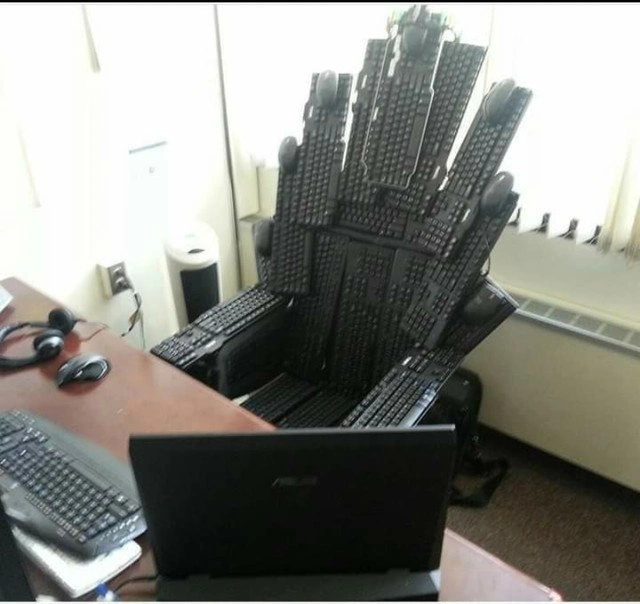
The image shows an office chair transformed into a jagged throne of black keyboards. They cover the back, arms, and seat area, with more keyboards and desk hardware visible nearby. There is no overlaid text in the image, so the caption has to do the last bit of targeting:
Emacs user's chair for sale!
That caption is doing serious work. Emacs is famous not just as a text editor, but as a whole culture of keyboard-driven control. Its users often navigate, edit, search, split windows, run commands, and customize workflows through key combinations like Ctrl, Meta, and multi-step command sequences. So a chair made of keyboards becomes a physical exaggeration of the stereotype: the Emacs user is not merely using keybindings; they are enthroned by them, supported by them, possibly injured by them.
The humor is partly about DeveloperTooling as identity. Keyboards are ordinary input devices, but in programmer culture they become tribal artifacts. Mechanical switches, split layouts, Vim versus Emacs navigation, custom keycaps, ergonomic boards, macro layers, and shortcut muscle memory all become signals of how someone works. The picture takes that quiet obsession and makes it architectural. If your daily workflow is built around commands from the keyboard, why not make the whole office chair out of keyboards? Finally, a workstation that accepts input from your elbows.
There is also a nasty little Ergonomics joke buried in the construction. Developers spend years optimizing editor shortcuts to reduce keystrokes, then sit for eight hours in positions that would make a physical therapist stare into the middle distance. This chair is the perfect monument to misplaced optimization: maximum input surface, minimum lumbar support. It supports every keybinding except the one that prevents wrist pain.
At a senior level, the meme also pokes at how tooling choices accumulate into lifestyle. An editor is supposed to be a means to write code, but mature development environments become personal operating systems. People build snippets, macros, lints, shells, REPLs, project navigation, test runners, and note systems into the same tool until switching editors feels less like changing software and more like moving house. That is why editor jokes are rarely just about editors. They are about workflows becoming identities, and identities becoming furniture.
The surrounding desk reinforces the office-culture absurdity. This is not a polished product render; it looks like a real workspace where spare peripherals have been assembled into a cursed ergonomic statement. The result is funny because it is both obviously unusable and emotionally plausible. Every team has at least one person who treats keyboard shortcuts like a sacred oral tradition and could probably justify this chair as "low-latency."
Description
The image shows an office workspace where a chair has been covered or constructed with many black computer keyboards arranged across the back, arms, and seat. A laptop or monitor sits in the foreground, with additional keyboards, a mouse, headphones, and office furniture visible around the desk; there is no overlaid text. The visual gag turns the developer’s primary input device into a throne-like seat, suggesting either keyboard obsession or a monument built from retired peripherals. It works as tech humor because keyboards are both ordinary tools and identity markers for developers, especially when preferences and shortcuts become part of the culture.
Comments
5Comment deleted
It supports every keybinding except lumbar support.
Throne of thousand keyboards Comment deleted
Keyboard Throne Comment deleted
Keycifer's throne Comment deleted
game of keyboarones Comment deleted