The Inevitable Crash of a Project Manager's No-Code Dream
Why is this Management PMs meme funny?
Level 1: Shortcuts Backfire
Imagine you have a toy building kit that promises you can make anything without any hard work. Excitedly, you use it to build a fancy toy house by snapping pieces together – no glue or tools needed. Everything is going great until you try to add a special turret on the roof, but the kit doesn’t have any piece for that. Uh-oh! You absolutely need this turret to make your dream house, but there’s just no way to do it with the pieces you have. You feel disappointed and a bit silly. Now you realize you might have to take the house apart and start over using regular building blocks or tools to get it exactly right.
Meanwhile, your older siblings or friends are watching. They’ve built lots of these houses before. They kind of knew this would happen because that super easy kit was limited in what it could do. They’re smiling a bit (not too loudly – they don’t want to be mean). One friend says, “Should we go help fix it?” and the other laughs, “In a minute… let them figure out why the quick way didn’t work first.” They’re not being cruel; they just want you to learn from the mistake for a moment. After a little while, they do come over to help you rebuild it properly.
In the end, you learn that sometimes if something is too easy to be true, it might not do everything you need. Taking a shortcut felt good at first, but it caused a bigger delay later. The funny part of the story is everyone saw the little disaster coming except you – and now you know too. It’s a lighthearted lesson: doing it the right way may be harder, but it saves you from sitting on the floor in defeat later!
Level 2: Drag-&-Drop Dilemma
Let’s break down what’s happening in simpler terms. The key idea here is a no-code platform – that’s a software tool which lets you create applications through a visual interface instead of writing code. Imagine software like building blocks: you pick features from menus, draw flowcharts for logic, and voilà, you have an app. Examples include things like website builders that let you design pages by dragging items, or app makers where you configure rules with dropdowns. It’s all very friendly for non-programmers. In our comic, the project manager used such a platform to build his entire project. A project manager (PM) is usually the person organizing tasks and timelines, not necessarily coding. Here the PM decided, “I don’t need the devs, I’ll do it myself with this no-code tool!” At first, it probably went great – he could make forms, pages, basic features really quickly. That’s why no-code is so appealing: you can get a simple prototype up faster than if you hand-wrote all the code.
The trouble appears when the PM discovers a core feature that can’t be done with his tool. This is the “unavoidable edge-case reality check” mentioned in the title. An edge-case is a scenario or requirement that’s not common or was not planned for. No-code platforms have predefined capabilities – think of them like a set menu at a restaurant. You can order what’s on the menu, but if you request something custom that’s not listed, the kitchen can’t make it. In tech terms, the PM hit a feature_gap: something important is missing that the project absolutely needs. For example, maybe the app needed to do a very specific kind of calculation or connect to another system in a unique way, and the no-code software just doesn’t provide that option.
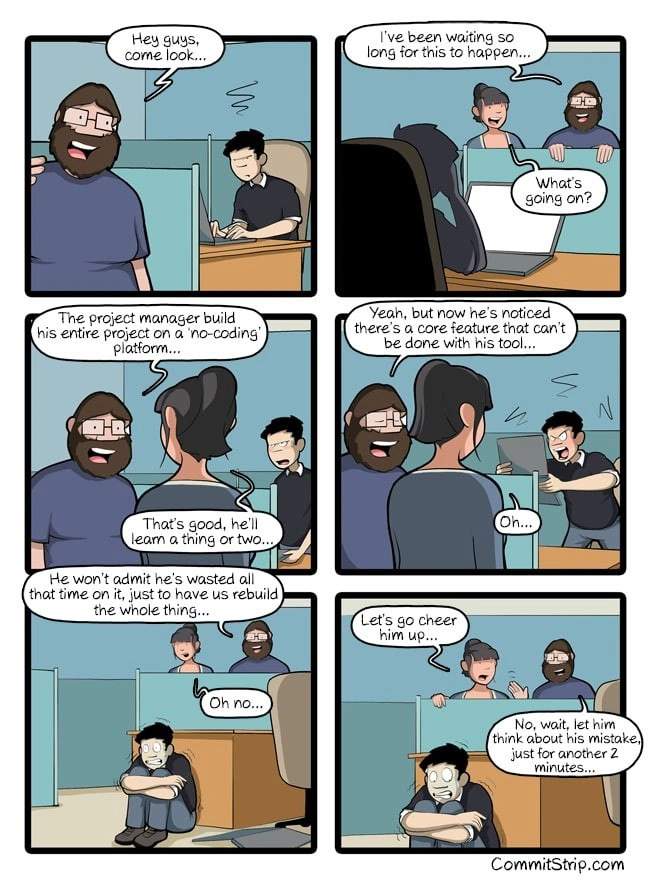
Now the PM is in a bind. He’s invested a lot of time building the project in this platform, but that missing piece is a showstopper. He can’t launch the product without that core feature. The comic shows him literally sitting on the floor, arms around his knees, looking distraught – a pretty relatable image of despair in tech when you realize you’ve made a big mistake. The developers watching from the side understand exactly what’s happened. They even joke, “he’ll learn a thing or two…” because they’ve likely seen this before. Often, when people use a quick tool or low-code approach to bypass the development team, they eventually discover limitations the hard way.
The devs say they’ll have to rebuild the whole thing. That means the work done on the no-code platform might be thrown away or remain only as a rough prototype. To implement that missing feature (and probably to ensure the app can grow in the future), the team will write the code manually in a proper programming language. Starting over like this is costly in time and effort – essentially, the project took a detour. We call this kind of extra work technical debt. Technical debt is a term for the concept of “doing something quick and dirty now, and paying for it later.” Just like financial debt, you save time up front (like borrowing money) but you incur a debt that must be paid with interest (extra work later on). Here, the PM’s quick no-code solution saved time initially, but the “interest” is having to redo everything and maybe even more work to integrate it properly.
The last bit of humor: the devs aren’t immediately rushing to console him. One says, “Let’s go cheer him up…” but the other goes, “No, wait, let him think about his mistake, just for another 2 minutes.” That’s a playful jab. It shows they feel a little sorry for him, but also want the lesson to sink in – a bit of friendly teasing. In a workplace, this might translate to giving someone a moment to realize where they went wrong before coming in with a solution. It’s like when a kid messes up after not listening, and the parents exchange a knowing look like, “we won’t say I told you so, but we kind of did.” The comic is poking fun at both the PM for being overconfident with a trendy solution and the devs for having that “we expected this” reaction. In the end, it’s a humorous reminder: in software projects, shortcuts and buzzwords can’t replace proper planning and collaboration with engineers. If you try, you might end up back at square one, having learned a lesson the hard way.
Level 3: The Inevitable Rewrite
This comic hits home for senior developers because it’s a scenario we’ve watched play out in real life over and over. A well-meaning project manager (PM), hyped by the latest IndustryTrends_Hype (in this case the "no-code" buzzword), decides to build an entire project on a LowCodePlatforms solution without involving the dev team. At first, it’s all success stories and demos – “Look, I built our app without writing a single line of code!” The dev team smiles politely, but inside, the experienced folks are already raising an eyebrow. Why? Because they anticipate the hidden complexity gap. There’s always that one core feature or weird edge-case the glossy marketing brochure didn’t cover. It might be an integration with an internal system, a custom business rule, a performance requirement, or just something that the no-code tool was never designed to do. And when that day comes, the whole castle built on drag-and-drop turns into a pumpkin.
The humor here is equal parts schadenfreude_observation and a cautionary tale. We see the PM curled up on the floor, devastated – he’s realizing that weeks or months of work have hit a wall. The devs whisper “I’ve been waiting so long for this to happen…” not out of cruelty, but that dark humor born from dealing with pm_overreach before. They knew this day was coming the moment they heard “entire project on a no-code platform.” It’s the Inevitable Rewrite: now the team will likely have to rebuild the whole thing from scratch using actual code. In other words, the prototype has outgrown its drag-and-drop sandbox. All that time spent? It’s become TechnicalDebt – an experiment that must be paid off with extra work.
Why didn’t the PM just let the devs build it properly in the first place? Often it’s pressure to deliver fast, or belief in the hype that ”anyone can be a developer with the right tool.” It’s a classic EngineeringTradeoffs dilemma: the PM traded upfront speed for future pain. The comic nails the awkwardness: the PM doesn’t want to admit the approach failed ("he won’t admit he’s wasted all that time"). Meanwhile, the developers have a mix of sympathy and “told you so.” One dev even suggests they let him stew for a few minutes to absorb the lesson. This is a tongue-in-cheek reflection of real dev-team dynamics – a senior engineer might quip “let the manager sweat it out” when a risky shortcut collapses. They will ultimately help (“Let’s go cheer him up…”) because the goal is to get the project back on track. But you can bet that after this reality check, the PM will think twice before jumping on the next Buzzwords bandwagon without consulting his engineers. The meme brilliantly captures that little moment of vindication for the devs: the hype met reality, and reality won. It’s a gentle poke at management optimism, reminding everyone that unscalable_prototype quick-fixes often lead straight to a rebuild_from_scratch detour.
Level 4: No Silver Bullet
In software engineering there's a classic lesson: no single tool can magically eliminate complexity. In 1986, Fred Brooks famously wrote "No Silver Bullet" to argue that there's no easy cure for the inherent complexity in software. No-code platforms promise that anyone can build an app with drag-and-drop ease. They're like a specialized domain-specific language hidden behind a pretty GUI. But here's the catch seasoned engineers recognize: if a tool is simple enough for anyone to use, it usually can’t express every edge-case or complex rule out-of-the-box. To handle those, you’d need the full power of a general-purpose programming language (which no-code tries to abstract away). This situation is a textbook case of essential complexity versus accidental complexity. The essential complexity is the real-world business logic that must be handled (that "core feature" the PM needs). The no-code platform reduced some accidental complexity (writing boilerplate code, setting up infrastructure) – great – but it can’t magically solve the hard unique problem. If it tried, it would basically have to become a full programming environment itself! In theoretical terms, most no-code tools are not fully Turing complete (or if they are, using them for complex logic becomes absurdly convoluted). That means there are problems they just can’t compute or scenarios they never anticipated. The hidden joke: the project manager treated the no-code tool as a silver bullet, only to slam into the logical limits of what that tool can do. Seasoned devs have seen this pattern since the era of 4GLs and UML code generators – every decade a new “no-code” promise emerges, and every time, reality (and Gödel’s completeness, if you will) bites back. In short, you can’t escape complexity; you can only move it around. Here the PM tried to move it away from code, but it showed up as a feature gap that no flowchart could fill, proving there’s no free ride in computation.
Description
A six-panel comic from 'CommitStrip' depicting a classic office scenario where developers observe a project manager's failed experiment. The story unfolds as a group of developers watch their project manager, who has built an entire project on a 'no-coding' platform, hit a wall. He discovers a core feature cannot be implemented with his chosen tool. The developers, who had anticipated this outcome, watch with a sense of schadenfreude as the manager's initial confidence dissolves into frustration, ending with him hiding under his desk in despair. The final panel delivers the punchline, with one developer suggesting they let him 'think about his mistake' for a couple of minutes before intervening. This comic strip satirizes the frequent underestimation of software complexity by non-technical managers and the often-overstated capabilities of no-code/low-code platforms. For senior developers, it's a painfully familiar story of their technical advice being ignored in favor of a 'magic bullet' solution, which ultimately leads to wasted time and an inevitable, rushed request for the engineering team to rebuild the project correctly
Comments
8Comment deleted
No-code platforms are great until you need a 'for' loop. Then you discover the real price of that subscription is the engineering team's sanity during the inevitable rewrite
Nothing says ‘career growth’ like rewriting a WYSIWYG MVP into real code because the platform’s ‘Add Critical Feature’ button is still in beta
The PM just discovered the difference between "no-code" and "no-clue" - turns out the platform's exit strategy was our entry point all along
No-code platforms get you 80% of the way instantly; the remaining 20% is where you discover the platform, your budget, and your dignity all have the same hard limit
The classic no-code platform journey: starts with 'Look, I built it in a weekend!' and ends with 'So about that custom authentication with OAuth2, SAML federation, and our legacy LDAP integration...' Nothing teaches the value of proper technical evaluation quite like discovering your drag-and-drop solution can't handle the one feature that's actually in the requirements doc. At least he'll have a compelling case study for the next 'Why We Don't Let PMs Choose The Tech Stack' presentation
No-code: PMs' fast path from 'shipped in a week' to 'devs, rewrite in two months' - the ultimate tech debt accelerator
Every 'no-code MVP' is just a time-delayed RFC for a rewrite with interest compounded daily
Build vs buy rule: if the platform can’t model your core invariant, you didn’t buy a solution - you rented a constraint with a mandatory rewrite clause