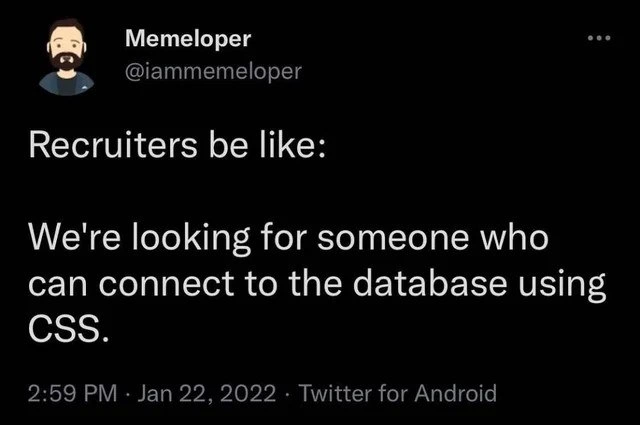
When Recruiters Write Technically Impossible Job Descriptions
Why is this Career HR meme funny?
Level 1: Fixing Plumbing with Paint
Imagine you’re building a house. You have a painter who makes the walls and rooms look nice with colors (that’s like CSS making a webpage pretty). Then you have a plumber who connects the water pipes so that water flows into the house (that’s like a database providing data to an application). Now picture a project manager who doesn’t know much about construction saying, “We need someone who can connect the water pipes using paint.” 😅 It sounds silly, right? Paint is great for decorating, but it can’t connect pipes! The request makes no sense because it mixes up two completely different jobs. That’s exactly why the line “connect to the database using CSS” is funny to developers. It’s as if someone asked to solve a plumbing problem with a painting tool. Everyone who knows a bit about the tasks can see it’s an impossible mix-up. The humor comes from that obvious mix-up — it makes us laugh and shake our heads, because we all know paint doesn’t fix pipes, and CSS doesn’t fetch data. It’s a goofy way of showing how sometimes people not familiar with the work can ask for things that just don’t fit together, and we find it funny because it’s so absurd.
Level 2: Front-End vs Back-End
Let’s break down why “connect to the database using CSS” is pure gibberish from a technical standpoint. In modern software, we often talk about the tech stack as having different layers or tiers, each with its own tools and purpose. Two fundamental layers are the front-end and the back-end:
Front-End (Client Side): This is the part of the software that runs in the user’s browser or on their device. It’s all about presentation and user interaction. HTML defines the content and structure of a webpage, CSS (Cascading Style Sheets) defines the look and feel (layout, colors, fonts, etc.), and JavaScript adds interactivity and dynamic behavior. Front-end is basically what you see and click. For example, CSS can style a button to be blue and rounded, but CSS by itself doesn’t know anything about databases or data storage. It’s like the interior decor of a house – it can change the paint and furniture, but it doesn’t affect the plumbing.
Back-End (Server Side): This is the behind-the-scenes part that users don’t directly see. It’s responsible for the application’s logic, data processing, and communication with the database. The back-end is typically written in languages like Python, Java, C#, JavaScript (Node.js), etc., and uses database query languages like SQL to fetch or update data. Connecting to a database means using credentials, drivers, and queries to retrieve information – none of which CSS can do. The database (e.g., MySQL, PostgreSQL, MongoDB) is where data is stored, and only back-end code or database management tools talk to it. Think of the back-end as the plumbing and electrical wiring of the house – it makes sure water flows and lights turn on, but it’s all hidden behind the walls.
To visualize the separation, here’s a simple view of a typical web application stack:
| Layer | Technologies | Role in the Stack |
|---|---|---|
| User Interface | HTML, CSS, JavaScript | Presentation – layout, style, and UX |
| Application Logic | Python, Java, Node.js etc. | Processing – server-side logic, data handling |
| Database | MySQL, PostgreSQL, MongoDB, etc. | Data Storage – persisting and retrieving data |
CSS lives in the User Interface layer. Its job is to cascade styles and make things look consistent and nice on the webpage. A database connection, on the other hand, happens in the Application Logic layer, often executed on a server. For instance, if we want to display a list of users on a website, the typical flow is:
- Back-end code connects to the database and runs a query (e.g., “SELECT name FROM Users” in SQL) to get the data.
- The back-end then sends this data to the front-end (maybe as HTML or JSON).
- The front-end displays it, and CSS can be used to style how that list of names looks on the page (font size, color, spacing, etc.).
At no point is CSS itself querying the database. CSS doesn’t have the capability to talk to a database server or run queries. It’s not a programming language; it’s a style sheet language. By design, CSS is sandboxed to the browser for security and simplicity – imagine if any website’s CSS could directly query databases, it would be chaos and a huge security risk! The meme’s joke implies doing step 1 with a tool that’s only meant for step 3, which is technically impossible.
For someone starting out (maybe a junior developer or a student), hearing “connect to the database using CSS” might be momentarily confusing or make you second-guess your knowledge: “Did I miss a feature of CSS that involves databases? Is there some CSS function for data?” Rest assured, you didn’t miss anything – it’s the recruiter who is confused, not you. This kind of line shows up when non-technical folks throw around terms without knowing their specifics. It’s a classic example of RequirementsAmbiguity: the job requirement is so mixed-up that it becomes meaningless.
Early in your career, you might encounter job postings like this and feel developer frustration because the requirements seem all over the place. One minute it asks for a web designer’s skillset (HTML/CSS), the next it wants a database guru. Of course, many roles do expect a bit of both (that would be a full-stack developer, someone who handles both front-end and back-end), but even then, the tasks and tools are distinct. A full-stack dev will write SQL queries or use ORMs for the database part and write CSS for the UI part – but they would never use CSS to execute the SQL queries!
The humor here also makes the point that sometimes recruiters don’t communicate clearly with the engineering team when drafting the job description. Perhaps the company does need someone with both front-end and back-end skills. However, a technically accurate posting would say something like “Looking for a developer proficient in CSS for front-end styling and SQL for database interactions.” When that gets mushed into “using CSS to connect to the database,” it becomes a communication mishap. Developers (even those early in their career) recognize that as a red flag — it tells us the person hiring doesn’t quite understand the role, which can be a bit worrying. But instead of getting mad, the community often jokes about it, as this meme does, turning that confusion into a bit of shared CareerHumor. It’s a way to bond over the silly stuff we see in the tech hiring process.
Level 3: Buzzword Bingo
In the world of tech recruiting, this meme nails a classic case of buzzword salad—mixing unrelated technologies as if they were interchangeable. The tweet mocks recruiters who rattle off requirements without understanding the architectural layers of a tech stack. Here, a recruiter says: “We need someone who can connect to the database using CSS.” Seasoned developers immediately smirk at the absurdity: CSS (Cascading Style Sheets) is a language for styling web pages (making things look pretty in a browser), whereas connecting to a database is a backend operation (retrieving or storing data on a server). It’s as nonsensical as asking a chef to boil water using a paintbrush. This kind of request violates the fundamental separation of concerns in software design. Frontend and backend serve very different purposes, and merging them in one sentence like this reveals a profound communication breakdown.
Why is it funny? Because every experienced dev has seen job postings or received recruiter messages that feel just like this—mashing together jargon from multiple domains in impossible ways. It’s a satire of Misaligned Expectations in hiring. The recruiter likely copy-pasted skills from several roles into one Frankenstein description, expecting a mythical “full-stack” unicorn. The result is a requirement that ignores how technology actually works. Frontend vs. backend confusion is a well-known trope: you might hear about positions demanding “10+ years experience in Kubernetes, React, Swift, and COBOL” all at once, or a role combining UI/UX design with low-level kernel programming. These mixes sound hilariously ambiguous to insiders. The meme resonates especially with senior developers who’ve endured interviews where the interviewer asked questions that made no sense for the role. It’s humor built on shared trauma: everyone remembers that one recruiter email asking for the impossible (like “proficient in Python frameworks such as Django, Flask, and Excel” – yes, really).
Behind the laughter is a real industry pattern. Non-technical HR staff sometimes don’t fully grasp the tech stack and end up with jumbled requirements. The phrase “connect to the database using CSS” is a perfect comedic exaggeration of this gap. It implies the recruiter has no idea that CSS lives purely in the browser and can’t even talk to a database. For a developer, this conjures an image of someone trying to write an SQL query in a .css file – an utterly futile exercise:
/* Trying to connect to a database in CSS (just for laughs) */
#data-table {
connection-string: "Server=myDB;UID=admin;PWD=secret"; /* 😜 Not a real CSS property */
query: "SELECT * FROM users;"; /* 🚫 This will do nothing */
content: attr(data-results); /* Imaginary data injection */
}
Of course, no browser or system would ever execute a database query from a CSS file! This code is a joke – as impossible as it looks – highlighting the absurdity of the request. The humor lands because developers have felt this frustration: The recruiter either mixed up terminology or assumed all tech is magic fairy dust that one language can do anything. It pokes fun at the “jack of all trades” job descriptions that treat highly specialized skills as plug-and-play buzzwords. In reality, a well-structured system has clear layers (UI, backend logic, database), and professionals specialize. The tweet underscores how clueless it sounds when someone ignores those boundaries. It’s a gentle roast of the recruiting process, and a nod to every dev who has had to politely explain, “Actually, CSS doesn’t do that…” while suppressing a facepalm. In short, the meme is funny because it’s painfully relatable: a depiction of technical ignorance that we’ve all encountered, wrapped in a one-liner that makes the absurdity obvious to any experienced engineer.
Description
A screenshot of a tweet from the user 'Memeloper' (@iammemeloper) on a black background. The tweet text reads: 'Recruiters be like: We're looking for someone who can connect to the database using CSS.' This meme humorously exaggerates the technical misunderstandings that can occur when non-technical recruiters try to hire for highly technical software development roles. The joke lies in the absurdity of the request: CSS (Cascading Style Sheets) is a language used for styling the visual presentation of web pages, while connecting to a database is a backend function handled by languages like Python, Java, or SQL. For experienced developers, this is a deeply relatable jab at the often-frustrating experience of dealing with recruiters who rely on buzzwords without understanding their meaning, leading to nonsensical job requirements

Comments
33Comment deleted
The job also required 10 years of experience in Kubernetes, a PhD in centering divs, and the ability to perform schema migrations with only `:hover` pseudo-classes
Next week they’ll want someone who can left-pad a Kafka topic with HTML
The same recruiter who rejected my CSS-based ORM is now asking why our database queries don't have proper media queries for mobile optimization
To be fair, with enough attribute selectors and a keylogging stylesheet, CSS exfiltrating your database isn't a joke - it's a CVE
Ah yes, CSS database connectivity - right after we finish implementing our MongoDB queries in HTML and writing our authentication logic in JPEG. This perfectly captures the moment when a recruiter's LinkedIn keyword search becomes a job requirement, resulting in positions that ask for 10 years of experience in technologies that are 3 years old, or in this case, expecting a styling language to handle data persistence. It's the technical equivalent of asking a painter to perform surgery because they both work with 'bodies' - a category error so fundamental it reveals a complete absence of domain knowledge in the hiring pipeline
Recruiters' full-stack dream: CSS selectors querying tables, because who needs SQL when you can just style your JOINs?
If the JD expects database connections via CSS, prepare for an architecture where presentation, transport, and persistence collapse into one box labeled ‘web’ - the only thing that scales is the confusion
Connecting to a DB with CSS is the layered-architecture equivalent of asking DNS to render your React app
counter strike: source Comment deleted
so you can visit tge database in 3d Comment deleted
afaik css can do 3d Comment deleted
havent seen 2D counter strike Comment deleted
there is no "potato pc" edition of it Comment deleted
of course, garrys mod is a great example, also contagion and left4dead Comment deleted
I don't know if you're joking anymore 😅 Comment deleted
break tables with he erase data with flash increment int with bullets Comment deleted
he? Comment deleted
Hierarchy Exception grenade Comment deleted
https://css-tricks.com/roman-empire-made-pure-css-connect-4-possible/ Comment deleted
Please use Rus- English in this chat --- add a translation Comment deleted
Oh, sorry. I mean it would be funny if the subject turns out to be technically possible. Because modern CSS has expressions and they may be Turing complete. Comment deleted
https://stackoverflow.com/questions/2497146/is-css-turing-complete They say it is Comment deleted
Turing completeness doesn't mean it has interfaces necessary for DB connection Comment deleted
yes, sure, Just a way of saying that CSS might have something. Comment deleted
It has lots of pain and misery for us. Comment deleted
It means you can emulate a computer with any db tools in it Comment deleted
Thank you, captain. Emulating DB inside the CSS is a task better left untouched LOL Comment deleted
You won't need to emulate entire db though, only db access Comment deleted
No that doesn't count. I want at least SQL99 DB in my CSS! Comment deleted
if JS in IE6 can do it, then you can do it in CSS (IE6 ver.) Comment deleted
(based on stackoverflow answer to question "is css turing complete") Comment deleted
But can we? Comment deleted
"Remote code execution via stack overflow in CSS engine" to the rescue! Comment deleted