Skip to content
DevMeme
4822 of 7435
Extreme Programming: Expectation Skydives, Reality Pair-Programs at the Kitchen Table
Agile Post #5282, on Jun 29, 2023 in TG

Extreme Programming: Expectation Skydives, Reality Pair-Programs at the Kitchen Table

Why is this Agile meme funny?

Level 1: Not Actually Skydiving

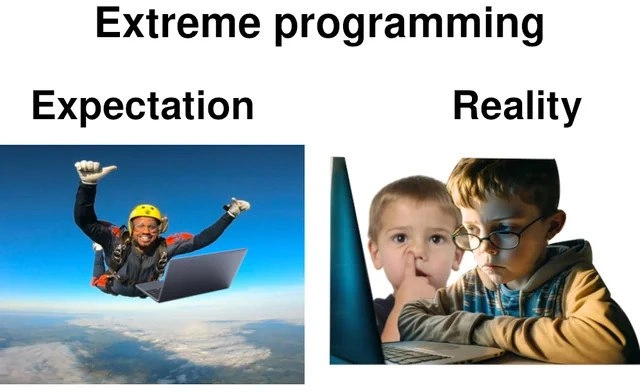
Imagine your teacher says the class is doing “extreme homework.” You might picture yourself doing math problems while skydiving or riding a roller coaster – something wild and crazy. That’s the expectation the big exciting word “extreme” creates. But in reality, “extreme homework” just means you and a friend sit together at the kitchen table, working on the assignment very carefully and helping each other. Nothing explosive or dangerous – just two people with pencils and books, figuring things out together. That’s exactly what this meme is joking about. The title “Extreme Programming” sounds like you’ll be coding in some crazy, action-packed way (like the guy jumping out of a plane with a laptop in the meme’s first picture). But really, it just means two people writing code side by side on one computer (like the two kids in the second picture). It’s funny because the word “extreme” makes us expect an adventure, but the truth is it’s just normal teamwork. The humor comes from that surprise: something that sounds super intense turns out to be totally everyday and friendly.

Level 2: Extreme Name, Simple Practice

Extreme Programming (XP) is actually a straightforward Agile methodology, despite the dramatic name. In the world of software development, “Agile” refers to approaches that emphasize flexibility, quick iteration, and close teamwork. XP is one of the early Agile methods (born around 1999) that focuses on improving the developer experience by encouraging developers to work together closely and catch issues early. The name “extreme” comes from taking common good practices and doing them more frequently or intensely. For example, in XP teams practice Test-Driven Development (TDD) – writing tests before writing the code itself – which is a more extreme way to ensure quality. They also do continuous integration, meaning they merge and test code changes many times a day instead of once in a blue moon. Perhaps the most famous XP practice seen in the meme is pair programming: two programmers share one computer and work on the same code together. One person types (the driver) while the other reviews each line in real-time (the navigator), and they swap often. It’s like having a permanent buddy system for coding. This might feel intense for a newbie (someone’s watching you code every minute!), but it’s definitely not the kind of “extreme” that involves parachutes or action-movie stunts.

The meme uses the popular “expectation vs. reality” format to playfully exaggerate this contrast. On the “Expectation” side, we see a skydiving coder – a person literally programming on a laptop while free-falling through the sky. This visual jokes that hearing “Extreme Programming” for the first time might make you imagine some daredevil coding scenario. It’s riffing on the word “extreme” as if it meant extreme sports. On the “Reality” side, instead of adrenaline junkies, we see two kids huddled indoors around a single laptop – clearly pair programming in a very ordinary setting (possibly their kitchen table). They look focused, one maybe pointing or guiding, the other typing – a spot-on depiction of how XP really looks in practice. The humor here is that Extreme Programming as an Agile methodology is actually kind of quiet and methodical. It’s about writing better code through constant collaboration, not about coding under extreme physical conditions. In fact, the goal of XP is to reduce the need for heroic, last-second efforts by catching bugs early and sharing knowledge constantly. So, the meme is an Agile parody: it teases how a fancy Agile term can sound thrilling or intense, but what you actually do day-to-day is pretty tame – like two people sharing a keyboard, likely fueled by coffee and logic, not adrenaline. For a junior developer or someone new to Agile, the takeaway is that “Extreme Programming” isn’t a literal thrill ride; it’s just an enthusiastic name for a teamwork-heavy, quality-focused way to build software. The joke lands because once you know this, the image of a skydiving programmer seems delightfully ridiculous, and the image of two kids coding seems endearingly true to life.

Level 3: Adrenaline vs Collaboration

Extreme Programming (XP) might sound like coding on the edge – the meme’s left panel makes that literal with a skydiving coder tapping away mid-freefall. It’s an absurd visual gag: “extreme” taken at face value. But seasoned engineers know this is classic industry satire. In real life, Extreme Programming is an Agile methodology, not an extreme sport. The right panel’s two kids pair programming at a kitchen table is hilariously closer to the truth. The meme plays on that expectation vs. reality contrast: the marketing hype of “Extreme Programming” conjures X-Games-level coding thrills, while the day-to-day reality is a calm, cooperative coding session – arguably extreme only in its focus. It’s a relatable inside joke in developer culture, highlighting how Agile buzzwords can promise the extreme but deliver the ordinary. Seasoned devs chuckle because they’ve lived this gap every sprint: grand promises of Agile transformation that turn out to be just regular team work. The humor taps into our collective memory of tech trends that had edgy names (“Radical Paradigm Shift!” 🚀) yet boiled down to time-tested practices. We’ve all seen how developer experience (DX) often involves navigating hype versus reality, and this meme nails that perfectly.

Dig a bit deeper and the joke gets even richer. The name Extreme Programming was coined in the late ’90s by Kent Beck to mean “take good software practices to the extreme,” not “do crazy stunts while coding.” The idea was to crank up the dial on proven techniques: if code reviews are good, do them continuously (that’s what pair programming is – constant code review); if testing catches bugs, write tests before the code (hello, TDD); if frequent integration prevents integration hell, integrate code multiple times a day. XP basically turns the amps up to 11 on best practices. So in a sense, the methodology is extreme – but it’s an extreme commitment to discipline and collaboration, not an adrenaline rush. The meme riffs on this double meaning. Seasoned developers appreciate the irony: the most “extreme” aspect of XP is resolving a merge conflict or debating a variable name with your pair, not leaping out of a plane with a laptop. In fact, one might say the only free-fall in Agile Extreme Programming is the drop in drama during releases – since all that steady testing and refactoring means fewer last-minute plunges into chaos. The meme’s Agile humor lands because it reminds us that behind flashy terms, real software engineering is often pretty down-to-earth. It’s a gentle poke at Agile marketing: Extreme Programming may sound hardcore, but its reality is two people, one keyboard, and a lot of steady, sometimes even pedestrian, teamwork. After all, the biggest adrenaline spike on an XP team is more likely from too much coffee or a late-breaking bug, not a mid-air coding session.

Description

The meme is split into two columns under the bold heading “Extreme programming.” Beneath the sub-heading “Expectation,” a skydiver in full gear free-falls thousands of feet above the clouds while typing on an open laptop - an absurdly literal take on ‘extreme.’ Under the sub-heading “Reality,” two young children huddle around a laptop indoors, clearly illustrating pair programming in a far less adrenaline-filled setting. The juxtaposition pokes fun at how the Agile practice of Extreme Programming (XP) sounds intense but usually boils down to quiet, everyday collaboration. It underscores the perennial gap between marketing hype and the pedestrian truths senior engineers live every sprint

Comments

9
Anonymous ★ Top Pick Twenty-five iterations in, we discovered the only ‘extreme’ part of XP is how many coffee refills your pair requests before the build finally turns green
  1. Anonymous ★ Top Pick

    Twenty-five iterations in, we discovered the only ‘extreme’ part of XP is how many coffee refills your pair requests before the build finally turns green

  2. Anonymous

    After 20 years in the industry, I've learned that 'Extreme Programming' is less about coding while base jumping and more about the extreme patience required when your pair programming partner insists on explaining why your perfectly functional solution needs to be refactored to match their favorite design pattern from that Medium article they read last week

  3. Anonymous

    Extreme Programming: where 'extreme' refers to the number of hours you'll spend explaining to management why two developers sharing one keyboard is actually more efficient than having them work separately, not the adrenaline rush of deploying to production on a Friday afternoon

  4. Anonymous

    XP expectation: commit from 30,000 feet; XP reality: two seniors bikeshedding a method name while the CI flips red→green and a single keyboard limits horizontal scaling

  5. Anonymous

    XP isn’t skydiving - it’s two people sharing one keyboard while CI nags; the only free fall is velocity when pairing without tests

  6. Anonymous

    XP: Expect terminal velocity commits; get playground-velocity refactoring with a side of finger-painting tests

  7. Deleted Account 3y

    Extreme code?

  8. @mrr_cat 2y

    Out of memory

  9. @mrr_cat 2y

    Stack overflow

Use J and K for navigation