Skip to content
DevMeme
7063 of 7435
The Myth of Consensual Software Development: Vibe Coder Edition
AI ML Post #7744, on Feb 22, 2026 in TG

The Myth of Consensual Software Development: Vibe Coder Edition

Why is this AI ML meme funny?

Level 1: The Treehouse Vote

Imagine three kids share a treehouse. Two of them vote to turn it into a candy store — one gets to eat candy all day, the other collects the money. The third kid, who actually built the treehouse, yells "I don't agree!" from the ground... because the first thing the other two did was take away his ladder. The meme is funny in a wincing way: everyone says the decision was made together, but the only person voting "no" is the one who already lost everything, and his vote was never going to count.

Level 2: Who's Who in This Bed

A few terms doing the heavy lifting here. Vibe coding means building software primarily by describing what you want to an AI assistant and accepting its output with minimal line-by-line review — fast for prototypes, risky for anything that must survive contact with production. Shareholders and investors are the people a public company's leadership legally and culturally prioritizes; when AI tools promise the same output with fewer salaries, cutting engineering jobs becomes the obvious move from their seat. Tech layoffs are the result: the "unemployed dev" isn't fired for bad work, but because the spreadsheet says a smaller team plus LLM subscriptions costs less than he does.

The faces matter too. The objector is the Anthony Fantano template face (a music reviewer whose exaggerated reaction images became meme currency), here recast as the voice nobody invited to the meeting. The imgflip.com watermark tells you this was assembled in a free online meme generator — fittingly low-effort tooling for a meme about low-effort tooling. If you're early in your career, the lesson hiding in the joke: the decisions that most affect your job are made in rooms you're not in, and "alignment" on a team often means the people with power already agreed.

Level 3: Stakeholder Alignment, Minus One Stakeholder

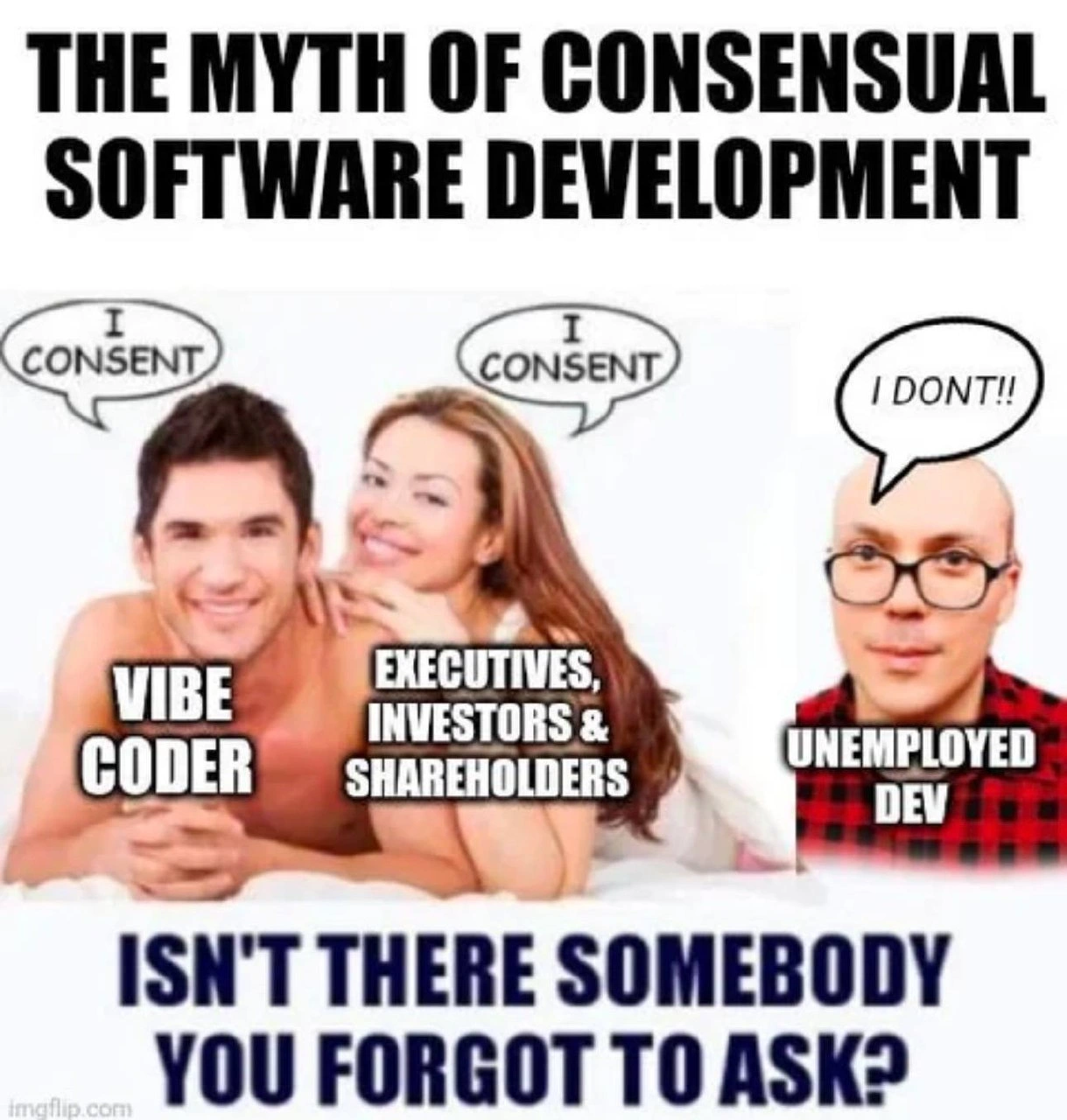
The genius of this template swap is that it weaponizes the original "Isn't there somebody you forgot to ask?" format — a meme built to mock people who insert themselves into other adults' consensual arrangements — and inverts its moral polarity. Here, the blissful couple in bed, labeled "VIBE CODER" and "EXECUTIVES, INVESTORS & SHAREHOLDERS," both chirping I CONSENT, really are in a mutually beneficial arrangement: one ships features by prompting an LLM and accepting whatever compiles, the other watches headcount costs drop and margins inflate. The bald, bespectacled objector in the red flannel shouting "I DONT!!" is labeled "UNEMPLOYED DEV" — and unlike the original meme's busybody, he has an entirely legitimate grievance. He just has no leverage.

That's the dark joke experienced engineers recognize immediately: in the AI-era restructuring of software labor, the people most affected by the decision are precisely the ones structurally excluded from making it. Vibe coding — Andrej Karpathy's term for development where you "fully give in to the vibes" and let the model write everything — created a genuine, if uneasy, coalition. Developers who embraced it got 5x output metrics on their performance reviews. Executives got a narrative for analysts: smaller teams, same velocity, shareholder value delivered. Both parties consent enthusiastically because both are paid for the appearance of productivity in the current quarter.

The displaced engineer's objection isn't Luddism, either — it's usually the most technically grounded voice in the room. He's the one who knows that LLM-generated code optimizes for plausibility, not correctness; that the review burden doesn't vanish, it just gets deferred until the vibe-coded service falls over at 3 AM and nobody on the remaining skeleton crew understands the codebase because nobody actually wrote it. The meme's headline, "THE MYTH OF CONSENSUAL SOFTWARE DEVELOPMENT," lands because consent in corporate decision-making was always a polite fiction: RFC processes, "we value your feedback" surveys, and town halls exist downstream of decisions already made in board decks. The incentive structure guarantees the outcome — when the people who approve the budget and the people who get the productivity credit agree, the dissenter's role is, at best, to be thanked for his service in the layoff email.

There's also a quietly brutal observation about who ends up in each role. The vibe coder and the unemployed dev are often the same skill tier — sometimes the same person, six months apart. Adapting to the tooling isn't purely meritocratic; it's timing, team placement, and whether your particular specialty (say, careful systems programming) was legible to management as "AI-augmentable" or "AI-replaceable."

Description

A parody of the classic 'Isn't there somebody you forgot to ask?' meme, headlined 'THE MYTH OF CONSENSUAL SOFTWARE DEVELOPMENT.' A smiling stock-photo couple in bed - the man labeled 'VIBE CODER' and the woman labeled 'EXECUTIVES, INVESTORS & SHAREHOLDERS' - both say 'I CONSENT' in speech bubbles. To the right, a bald bespectacled man in a red flannel shirt (the Anthony Fantano template face) labeled 'UNEMPLOYED DEV' shouts 'I DONT!!' Bottom caption: 'ISN'T THERE SOMEBODY YOU FORGOT TO ASK?' with an imgflip.com watermark. The meme skewers the AI-era alignment between developers happily vibe-coding with LLMs and the executives profiting from it, while the displaced engineers whose jobs evaporate get no say

Comments

8
Anonymous ★ Top Pick Stakeholder alignment achieved: the vibe coder ships, the shareholders cheer, and the only dissenting voice has been moved to a read-only role in the org chart
  1. Anonymous ★ Top Pick

    Stakeholder alignment achieved: the vibe coder ships, the shareholders cheer, and the only dissenting voice has been moved to a read-only role in the org chart

  2. @b7sum 4mo

    are all employims vibecoders

  3. @nwordtech 4mo

    Do vibe coders consent or do they get raped by the shareholders? Don't answer that. A rhetorical question

    1. @npcman 4mo

      Yes

    2. @kingJohnM 4mo

      The only difference between the AI bubble and a pyramid scam is geometry.

  4. @NickNirus 4mo

    why is unemployed dev represented by Anthony Fantano

    1. @SamsonovAnton 4mo

      Which one should be it?

  5. @Agent1378 4mo

    Software cucking

Use J and K for navigation