Skip to content
DevMeme
3619 of 7435
It's Not Personal Info, It's Just 'Meta Data'!
DataPrivacy Post #3957, on Nov 23, 2021 in TG

It's Not Personal Info, It's Just 'Meta Data'!

Why is this DataPrivacy meme funny?

Level 1: Same Stuff, New Name

Imagine you catch your sibling snooping in your diary, and they grin and say, “I’m not reading your secrets, I’m just checking the meta-diary data!” 😉 Clearly, they’re just playing with words – it’s the same naughty behavior with a silly new label. This meme is funny for the very same reason. A big company known for using your personal information decided to call itself “Meta,” and the joke is that now they might start calling your personal info “Meta Data” as if that makes it okay. It’s like a child trying to rename a bad habit to avoid trouble – everyone can see through it and that’s why we laugh.

Level 2: Personal vs “Meta Data”

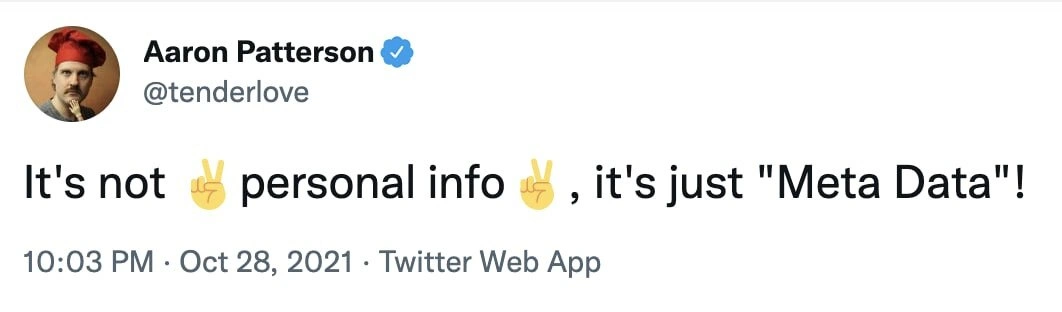
Let’s break down the joke in simpler terms. In late 2021, the company Facebook changed its name to Meta. On the same day, a programmer named Aaron Patterson tweeted the line: “It’s not ‘personal info’, it’s just ‘Meta Data’!” surrounded by little ✌️ peace-sign emojis (used like air quotes for sarcasm). Why is this funny to tech folks? Well, it’s a play on words and a comment on DataPrivacy.

First, understand the terms: personal info usually means any data that can identify you as a person – things like your name, address, birthday, or email. In tech and legal lingo, this is often called PII (Personally Identifiable Information). Companies like social networks gather a lot of this info about users. Metadata, on the other hand, means "data about data." It describes other data without being the main content. For example, when you take a photo, the image is the main data, and the date/time it was taken or the camera model are the photo’s metadata. Or if you send a message, the message text is the data, while the metadata might be what time it was sent or who the receiver was.

Now, here’s the catch: Companies sometimes try to reassure people by saying, “We’re not looking at your personal stuff, just the metadata.” Government agencies have said similar things about surveillance (collecting phone call metadata instead of recording conversations). It sounds less invasive, right? But in truth, metadata can reveal a lot about you – sometimes even more than the content itself. If a service knows all the metadata of your phone calls (who you called, when, how long), they can sketch a pretty accurate picture of your relationships and routine without ever hearing a word you said. So calling it “just metadata” is often a way to downplay real privacy intrusions.

In the tweet, when he says “It’s not personal info, it’s just ‘Meta Data’,” he’s humorously implying that now that Facebook’s company name is Meta, they might start calling your personal information by a new name: “Meta Data.” It’s a pun: Meta (the company) + data. It also riffs on the idea that if you stick the word “meta” in front, it might sound like a technical detail rather than private user data. The sarcasm is heavy – those peace-sign/air-quote emojis around personal info show he doesn’t truly believe it’s something minor. The joke highlights a bit of privacy marketing spin: using euphemisms or rebranding to make something worrying (like companies tracking your data) seem harmless or routine.

For someone newer to tech, think of it this way: Facebook’s new name led to lots of “Meta” jokes. Developers immediately thought about metadata (a common tech term) and how it conveniently contains the word Meta. This tweet cleverly combines that with an ongoing concern: companies collecting user data and then downplaying the extent of what they gather. Essentially, it’s saying: “Hey, don’t worry, we’re not misusing your personal info… we’ve just renamed it!” – which obviously doesn’t make anything better. It’s a bit of lighthearted PrivacyHumor that also critiques how companies handle privacy. Even if you didn’t know all the background, the structure “It’s not X, it’s just Y!” is recognizable as a joking way to re-label something – in this case making fun of Meta (the company) for how it might label your info. Developers find it funny because it’s absurd and a little too on-the-nose about real industry behavior.

Level 3: The Orwellian Rebrand

This meme brilliantly captures a piece of industry satire: the old corporate habit of solving PR problems with rebranding and doublespeak. The tweet came out on the same day Facebook announced its new name, Meta. By saying “It’s not ✌️personal info✌️, it’s just ‘Meta Data’!” the author (developer Aaron Patterson, known for his tongue-in-cheek humor) pokes fun at the idea that a mere name change could sanitize Facebook’s ongoing privacy concerns. It’s a nod to Orwellian doublespeak – like a tech giant playing word games to downplay something sketchy. Seasoned developers immediately recognize the pattern here: when under scrutiny, companies often reach for euphemisms. We’ve seen bugs called “undocumented features,” ads called “personalized content,” and invasive tracking described as “anonymous telemetry.” So hearing personal info might now be called “Meta Data” fits right into that playbook of polite re-labeling.

Facebook (Facebook Meta) had been embroiled in privacy issues for years – from the Cambridge Analytica scandal to constant debates over user tracking and data sharing. By October 2021, the company was eager for a fresh start (or at least a distraction) and rebranded to “Meta” to highlight a new focus on the metaverse. Engineers and privacy advocates, however, weren’t so easily convinced. The tweet’s sarcasm says: Sure, change your name to Meta, and while you’re at it, just pretend all that sensitive user data is innocently called “Meta Data.” The use of the ✌️ peace sign emoji around “personal info” mimics air quotes, signaling that term is supposedly no big deal. It’s a subtle eye-roll in textual form. The quotations around "Meta Data" further drive home the irony – it’s not a legitimate technical category here, just a cheeky reference to Meta’s new branding.

For veteran developers, the humor lands because it’s so true to life. We’ve sat through meetings where legal or marketing teams insist on reframing how we describe things: “We’re not selling user data, we’re sharing insights.” 🙄 This meme distills that experience into one zinger. It highlights the disconnect between what companies say and what they do. The rebrand to Meta might aim to distance the company from past controversies, but we all know the trove of personal information and metadata that drives their ads isn’t going anywhere. By riffing on the word “Meta”, the tweet reminds us that no matter the corporate name on the door, the data inside is still personal. The laughter (tinged with cynicism) comes from recognizing this age-old tactic: fix the language, pretend the problem is solved. In reality, the code and databases under the hood haven’t changed a bit, and experienced devs find both comfort and frustration in collectively acknowledging that fact with a joke.

Level 4: Metadata Misdirection

On a theoretical level, renaming personal data as metadata is pure semantic sleight-of-hand. In information theory terms, even so-called metadata carries significant entropy about an individual. For example, the metadata of your online activity – like communication logs or location tags – can be analyzed using graph theory to map out your social network or daily patterns. This is the basis of traffic analysis: extracting sensitive insights from metadata alone. Academic research has shown that even “anonymized” datasets can often be de-anonymized with enough metadata cross-correlation (the mosaic effect in privacy). In other words, data about your data can be just as revealing as the data itself.

From a privacy-engineering perspective, calling something "just metadata" doesn’t magically strip away its identifying power. Modern privacy laws like GDPR implicitly recognize this by protecting any information linked to an identifiable person – including device IDs or location logs that companies once tried to classify as “just technical data.” The tweet’s joke digs at this concept: a company might euphemistically label your personal info as “Meta Data” (capital M, as in the new corporate name) in hopes that it sounds harmless. But fundamental principles of data privacy and security don’t bend to marketing. Renaming the bucket holding personal information won’t change the fact that the information content – and the risk of misuse – remains the same. It’s a bit like trying to bypass the laws of math or physics with wordplay: the underlying set of data points and their ability to identify you are unchanged. In short, the meme hints at a truth well-known in theoretical and practical security circles: metadata is data, no matter what you call it, and no rebranding can obfuscate its implications.

Description

This image is a screenshot of a tweet from the well-known developer Aaron Patterson (@tenderlove). The tweet, posted on October 28, 2021, reads: 'It's not ✌️ personal info ✌️, it's just "Meta Data"!'. The text is punctuated by two peace sign emojis, which add a layer of sarcasm and dismissiveness. This post humorously critiques a common talking point in the tech industry where companies downplay the significance of the user data they collect by labeling it as 'metadata.' The joke resonates with experienced engineers who are aware that metadata, when aggregated, can be extremely revealing and often de-anonymized, effectively becoming personal information. It's a sharp commentary on corporate doublespeak, the erosion of user privacy, and the ethical gray areas developers often have to navigate when implementing tracking and analytics

Comments

10
Anonymous ★ Top Pick We call it 'metadata' until the GDPR audit. Then it becomes 'anonymized, non-attributable event stream signals' that just happen to join perfectly to the user table
  1. Anonymous ★ Top Pick

    We call it 'metadata' until the GDPR audit. Then it becomes 'anonymized, non-attributable event stream signals' that just happen to join perfectly to the user table

  2. Anonymous

    Privacy review tip: just dump the entire users table into a JSONB column called meta_data - once the schema disappears, apparently so does the regulation

  3. Anonymous

    After 20 years in tech, I've learned that 'metadata' is just personal data wearing a fake mustache and glasses at the privacy compliance meeting - and somehow legal still falls for it every time

  4. Anonymous

    Ah yes, the classic enterprise defense: 'We don't collect *personal* data, just metadata!' - which is like saying 'We don't read your diary, we just track when you write in it, how long each entry is, who you mention, your emotional patterns, and cross-reference it with everyone else's diaries.' Any architect who's built a data warehouse knows that metadata is often *more* valuable than the raw data itself - it's structured, queryable, and reveals behavioral patterns that users would never explicitly share. The real kicker? This tweet dropped right around Facebook's rebrand to Meta, making the 'Meta Data' pun either brilliantly timed or cosmically ironic

  5. Anonymous

    Privacy lawyers pitching metadata as non-PII, then it headlines your browser tab like a bad View Source habit

  6. Anonymous

    It’s not personal info, it’s just metadata - aka the join table that reconstructs your life in one query

  7. Anonymous

    Your ‘anonymized’ logs with timestamp, IP, UA, referrer, and device_id hash aren’t metadata - they’re a surrogate primary key with a marketing-friendly label

  8. ẞonny 4y

    Lol

  9. @Alienatick 4y

    It's just Meta!!

  10. @ZgGPuo8dZef58K6hxxGVj3Z2 4y

    Lol

Use J and K for navigation