
The Horror of API Design Shortcuts: Serializing JSON into a String Field
Why is this TechDebt meme funny?
Level 1: Quick Fix, Big Mess
Imagine you’re supposed to clean your room, and instead of putting each toy in its proper place and each book on the shelf, you grab everything and shove it into a closet, then slam the door shut. You come out smiling, "Look, the room is clean!" On the surface it looks tidy because the mess is hidden, but nothing is really organized. The next time you need your favorite toy, you’ll have to open that closet and — whoosh — everything spills out in a chaotic heap. You might break something or spend a long time finding what you want. That’s exactly what’s happening in this meme. The developer didn’t want to take the time to properly organize the data (by making a new API or changing the database structure), so they just hid all the new information in one place that was already there (stuffing it into a JSON string in an existing field). It solved the problem right now, but everyone knows it’s going to be a big headache later when someone finally has to unpack that closet of data. Bart’s wide-eyed, horrified face is like a parent walking in, seeing the "clean" room, and instantly realizing that all the junk is just jammed out of sight. It’s funny because we all know that kind of shortcut only makes more trouble later – eventually you have to open that closet door, and then uh-oh, here comes the mess!
Level 2: Hiding Data in Plain Sight
At a simpler level, this meme is pointing out a lazy workaround in software design using common tech concepts. In the scene, one developer (Homer) is excited because he thinks he found an easy solution. He says they don't need to design a new API anymore. An API (Application Programming Interface) is basically a defined way for different software pieces to communicate – for example, a web service that sends data in a format both sides agree on. Normally, if you have new information to send or store, you might create a new API endpoint or add a new field in your database with the right data type. But instead, Homer has taken a shortcut: he "serialized the object to JSON" and is putting it into an existing string field in the database. Bart’s alarmed reaction shows that this isn't as clever as it sounds.
Let's unpack the jargon:
- JSON (JavaScript Object Notation) is a popular text-based format for representing data. It looks like
{"key": "value", "anotherKey": 123}– kind of like a dictionary or object written as a string. It's commonly used for APIs and config files because it's easy for both humans and computers to read and write. "Serializing an object to JSON" means taking a bunch of data (like a user profile with name, age, preferences, etc.) and converting it into that JSON string format so it can be easily stored or sent over a network. Think of it as flattening a complex thing into a neat package of text. - A VARCHAR field (short for "variable character") in a database is a column type meant for text. For example, a
VARCHAR(255)can hold up to 255 characters of text. Databases use columns like this for things like names, addresses, or any short text. It's just a container for strings, and crucially, the database doesn't know or care what the string means – it could be a word, a sentence, a random sequence of characters, whatever, as long as it fits the length.
Now, what Homer is doing is taking a whole structured object (which might contain multiple pieces of information) and converting it into one big JSON string. Then he's stuffing that string into an existing text field in the database. Why use an existing field? Possibly because he doesn't want to create a new field or a new API for it. Maybe there's already a column like notes or misc that isn't heavily used, and he figures, "Hey, we can just put our JSON there!" It's like using a drawer that's already in the room, dumping new stuff into it, instead of bringing in a new cabinet.
At first glance, this might seem harmless or even smart:
- No new API endpoint to write or document.
- No database changes (which means no migrations or coordination with a DBA team).
- Just use what's there in a creative way. The data gets from point A to point B, mission accomplished.
However, Bart’s terrified face tells us there's a catch. This approach is basically creating technical debt, which is a term for when you take a quick-and-dirty shortcut in code that you'll likely have to pay for later with extra work (like taking a loan that you'll repay with interest). It’s considered a bad practice because it makes life easier now at the cost of making it harder in the future. Here's why stuffing JSON into a single string is problematic even if it works today:
- Lack of Clarity: Other developers won't immediately know what's going on. If someone new looks at the database, they'll see a column (say,
misc) and some gobbledygook JSON string in it. They might not realize, "Oh, this string actually contains a whole object with multiple data fields." The contract between systems (what data is expected where) becomes hidden. Usually, an API or a database schema is self-documenting – you add a field, name itnew_settingor something, and everyone can see that field and understand its purpose. Here, the important data is hiding in plain sight. Without tribal knowledge (i.e. someone telling you, "By the way, that field has JSON in it that means X, Y, Z"), you'd be lost. - No Enforcement of Structure: Normally, if you want to store an integer or date, you make a field of that specific type. The database then enforces that the data you put there matches the type (so you can't put "hello" into a number field, for example). JSON in a text field has no such safeguards. The database isn't checking that your text is valid JSON or that it follows any format. It's like the Wild West for that piece of data. You could accidentally save a blank string or a cut-off fragment of JSON, and nothing would scream at you until later when maybe the application tries to read it and crashes.
- Hard to Query: Say we have user data stored as JSON in that field, and the JSON has a key
"verified": truefor users who verified their email. Now someone asks, "Can we get a list of all verified users?" With a normal database design, you'd have a columnverifiedand you’d just run a query:SELECT * FROM users WHERE verified = true;Easy. But if that info is buried in a JSON text inside amiscfield, you can't do that out of the box. You'd have to fetch every user's JSON blob and then use your programming language to parse each one to check if"verified": trueinside it. That's super inefficient. Some modern databases let you query JSON if the column type is JSON and indexed properly, but if it's just a plain text field, the database doesn’t understand the contents. - Risks with Size and Format: Remember that
VARCHAR(255)limit? If the JSON string is longer than the field allows, the database might truncate it (cut it off) or throw an error. If it truncates without you noticing, you end up with invalid JSON or missing data. This is like trying to shove too many clothes into a suitcase — anything that doesn't fit either gets left out or causes the suitcase to burst open. Also, if someone later on changes the structure of that JSON (adds new keys or changes the data format inside), there's no versioning or compatibility check. One part of the code might produce JSON one way, another part expects it another way, and suddenly they don't agree. With a real API or schema change, you'd usually coordinate that or version it properly. - Maintenance Headache: Down the line, if the team decides to do it properly, they have to read each JSON from that field and split it back out into normal fields or a new service. That's a non-trivial task. If any of those JSON entries are malformed or different, the migration script could fail or require special casing. It's like realizing all your receipts for a year were thrown into one box, and now at tax time you have to sort them out one by one — tedious and error-prone.
In the context of API Development and Web Services, what Homer did violates APIDesignBestPractices. Good API design would mean explicitly adding the new data to the contract (for example, adding a new JSON field in the API response, or versioning the API if it's a big change) so that everyone knows about it. Similarly for databases, good design means altering the schema in a controlled way (like adding a new column or using a proper JSON column type) when you have new data to store. That way, your data format and storage are transparent and maintainable.
Bart’s reaction is basically the experienced developer in the room realizing that this "short-term win" will likely create long-term pain. It’s the facepalm moment of "Oh no, we're going to regret this later." The humor comes from recognizing this all-too-common scenario. If you're a newer developer, you might not have seen this yet, but stick around long enough and you'll encounter something similar — it might not be JSON in a string, but some hack that was done to save time and ended up making things confusing. The meme is a lighthearted warning: just because you can do something in code doesn't mean it's a good idea. Quick fixes often become big messes.
So in simpler terms: the meme shows a dev avoiding proper cleanup by hiding stuff in a place it doesn't belong. It gets the job done today, but it's setting up a trap for tomorrow. Everyone finds it funny because we've either made that mistake ourselves or have had to clean up after someone who did. The lesson is to prefer clear, clean design (even if it's a bit more work), rather than sneaky shortcuts that turn into technical debt. Good design up front saves a lot of pain down the road!
Level 3: When JSON Attacks
This meme highlights a classic tech debt horror story lurking behind a seemingly clever hack. In the first panel, Homer Simpson proudly declares an end to designing any new interface: "We don't have to come up with a new API anymore." This sets the stage for the anti-pattern being celebrated— instead of properly extending an API or updating a database schema, they've chosen to smuggle structured data through an unstructured side door. The second panel reveals the punchline: "I serialized the object to JSON and we're setting it on an existing string field." In other words, rather than adding a new endpoint or a new database column with proper typing, someone marshaled an entire object into a JSON string and crammed it into a VARCHAR text field that was never meant for it. No new API, no database migration, problem solved! What could possibly go wrong? (Cue senior engineers collectively facepalming.)
Why is this scenario so painfully funny to experienced developers? Because we've all seen how this story ends. Stuffing JSON into a VARCHAR field is a prime example of schema evasion – a form of lazy API design that sidesteps doing things the right way and trades short-term convenience for long-term chaos. It's basically taking the easy road straight into a minefield of maintainability problems. To illustrate, imagine stumbling upon code like this during a review or, worse, at 3 AM while debugging production issues:
# Pseudocode illustrating the hack:
serialized_data = json.dumps(my_object)
database.execute("UPDATE Users SET misc_field = %s WHERE id = %s", (serialized_data, user_id))
# 'misc_field' is a VARCHAR(255) originally meant for a simple note or label.
# We're now repurposing it to store an entire JSON blob. Yikes.
This snippet shows a developer turning a structured my_object into a blob of JSON text and then sneaking it into an unrelated text column (often literally named something like misc or data). The API contract in this approach becomes implicit and brittle: any code that reads this must magically know to parse JSON out of that field. Nothing in the database schema or API documentation will tell you that misc_field secretly holds a JSON object – it's an opaque contract, a secret handshake only the original coder knows about. Bart’s horrified wide-eyed stare is basically every senior engineer’s reaction upon discovering such a surprise in a codebase.
From a code quality standpoint, this "solution" is a ticking time bomb that violates fundamental software design principles. Let's break down some of the carnage it can cause:
- Loss of Structure & Validation: By shoehorning data into a plain string, you forfeit any schema validation. The database has no idea that the text is supposed to be JSON with a certain shape. You could accidentally store malformed JSON or wrong data and the DB would gladly accept it. You only discover something’s wrong much later when an application tries to parse that string and chokes on a missing curly brace. In a proper design, the schema (or API) would enforce rules (e.g. an integer is an integer, a date is a date), but here all bets are off.
- Querying Nightmare: Need to search for or report on some piece of info inside that JSON blob? Good luck. The database sees just a blob of text, so a normal
SELECTquery can't easily filter or join on the contents. Without special JSON functions or indexing (which you'd only have if this were a dedicated JSON column type, not a plainVARCHAR), you'd have to pull every record into application memory and parse the JSON one by one. It's like sealing your data in an envelope and then wondering why the mail sorter can’t read it. This makes analytics or even simple lookups painfully inefficient. - Hidden Coupling: This approach creates tight coupling between systems in the worst way. The producer and consumer of this data now rely on a hidden schema—the structure of that JSON string—without any explicit agreement. If someone changes the JSON format (adds a new field, changes a key name, etc.) and doesn’t update every place that reads it, things will break mysteriously. Proper API development practices (like versioning and clear contracts) are thrown out the window, so integrations become fragile. It's a recipe for "Works on my machine" bugs, because one service might silently depend on a field that another team didn't even know was being used.
- Migration & Maintenance Hell: Fast forward a few months. The JSON blob inevitably grows with more data crammed in (since once this backdoor exists, others will use it to shove in additional stuff). Eventually, management decides to do it right: "We need to report on X from that data" or "Let's move this to a proper schema/API." Now you're faced with parsing and migrating potentially thousands of JSON-packed records. Every quirk or inconsistency in those blobs (and there will be inconsistencies, since there were no rules or validations) becomes a potential failure during migration. Writing a one-time script to extract all those JSON fields and split them into proper columns is tedious and error-prone. The quick fix saved a day of work early on, but costs weeks of pain later.
- Field Limit Folly: Many string fields (like the notorious default
VARCHAR(255)) have length limits. It's shockingly easy to exceed that with a JSON blob. I've seen "mystery bugs" where half a JSON object was missing because it got silently truncated at 255 characters. The context tagvarchar_255_limitis a wink to that scenario. If the JSON is too long, the database might chop it off or reject it, leading to corrupted or lost data. And the worst part? You might not notice immediately. The data goes in apparently fine, but when you try to read it back, suddenly the JSON is incomplete and you get a parsing error, or some fields just vanish. This is the kind of surprise that leads to panicked late-night troubleshooting.
In short, this approach is the poster child of TechnicalDebt. It's like deciding not to fix a leaky roof properly because putting a bucket underneath is faster. Sure, you won't get rained on today, but eventually that roof is going to collapse, and the cleanup will be far uglier. Here, the "bucket" is that trusty VARCHAR field catching all the JSON drips. Every experienced developer recognizes that uneasy feeling: this hack might work today, but it's accumulating interest that will come due at the worst possible time (likely when you're on call, because Murphy's Law loves to strike at 3 AM).
So why do teams resort to this madness? Often it's pressure and expedience. Maybe there's a tight deadline, and someone exclaims, "We can just piggyback on the existing field and not bother everyone with a big change!" It could also be bureaucracy: perhaps getting a new API endpoint approved or a database schema change involves red tape, multiple meetings, and coordination with other teams. In a crunch, jamming data into a JSON blob feels like a clever shortcut to sidestep all that. Homer's giddy excitement in the meme embodies that false sense of victory: he's effectively saying, "Look, we avoided a bunch of work and it still functions!" But Bart’s wide-eyed terror is the voice of wisdom screaming, "This 'easy fix' is going to make us cry later!" The humor here comes from that contrast – the jubilant ignorance of immediate success versus the sober realization of future pain.
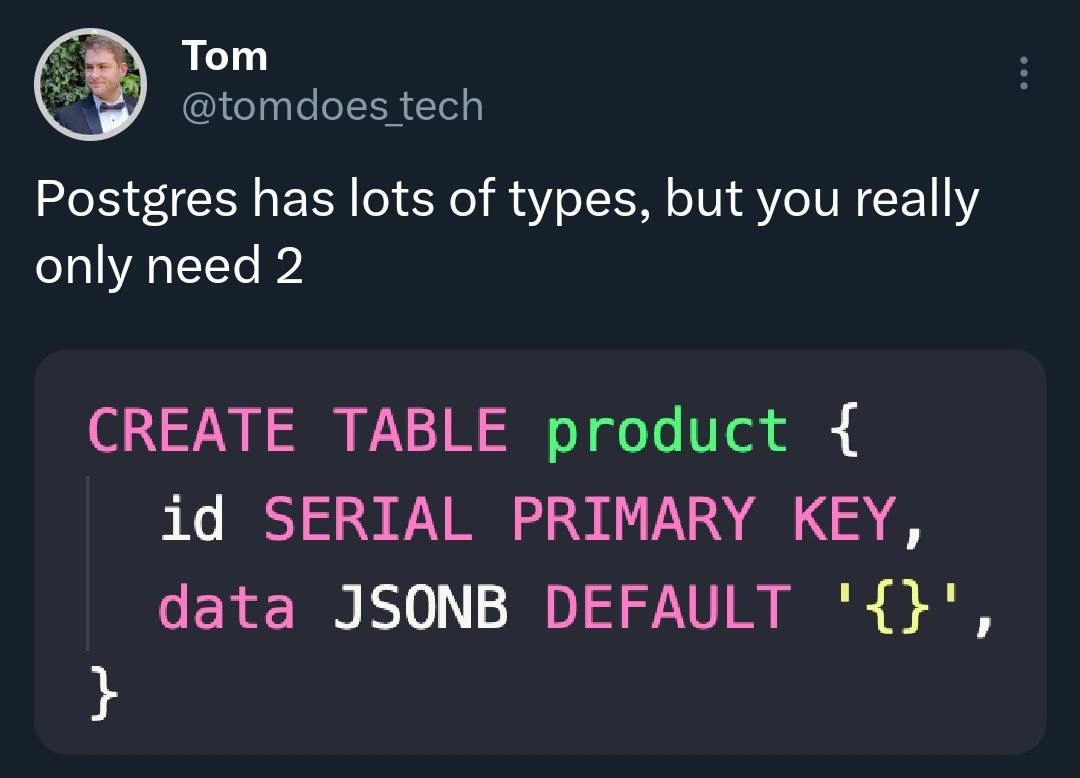
This pattern isn’t new, by the way. It's just the 2020s spin on an old tale. Back in the day, developers pulled similar stunts with XML or even cramming comma-separated lists into single text fields. Every generation of tech has stories of someone trying to bypass proper design. There's a reason we have API design best practices and database normalization rules: they exist because ad-hoc shortcuts like this tend to blow up. Modern relational databases (PostgreSQL, MySQL, etc.) have added native JSON column types with indexing and validation features, acknowledging that semi-structured data has its place. But those tools are meant to be used deliberately, with forethought, not as a last-second hiding spot for data you're too rushed (or lazy) to model properly. Using JSON as part of your design is fine; using JSON to avoid a design is where the trouble starts.
Seasoned developers find this meme equal parts funny and painful because it's so real. It's an IT horror story told in three panels. The bold white text reads like dialogue from a nightmare stand-up meeting: an overeager colleague announcing they've solved a tough problem in one line, and everyone else suddenly feeling a chill. We laugh because we've either done it in our early years or spent long nights untangling the aftermath. The phrase "When the 'solution' is stuffing JSON into a VARCHAR field" is basically shorthand for "we took a shortcut that we'll seriously regret." Bart's face is 100% relatable – it's the look of someone who just realized the codebase has a trapdoor to hell hidden in it.
Ultimately, this meme is a cautionary chuckle for anyone working with APIs and data formats. It reminds us that bad practices can come back to haunt us. Stuffing JSON into a string field instead of doing proper API or schema design is like feeding a Mogwai after midnight – it might seem okay at first, but you're going to get Gremlins. Future-you (or whoever maintains your code) will definitely be saying "D'oh!" when confronted with this bit of "creative" engineering. The lesson: just because something works in the moment doesn't mean it's a good idea. In software, quick fixes often become tomorrow's big headaches.
Description
This is a three-panel meme using a scene from The Simpsons to illustrate a horrifying software development anti-pattern. In the first panel, Homer Simpson happily bursts into a sleeping Bart's room, announcing, 'We don't have to come up with a new API anymore.' In the second panel, Homer leans over Bart aggressively, shaking him awake with the terrifying explanation, 'I serialized the object to JSON and we're setting it on an existing string field.' The final panel is a close-up of Bart screaming in pure terror. The joke is a visceral reaction to a common but terrible coding shortcut. Instead of properly extending an API and database schema with structured fields, the developer has opted to dump unstructured data into a generic text field. This creates massive technical debt, makes the data impossible to query or index efficiently, and effectively hides the data contract inside an opaque string, leading to brittle, hard-to-maintain systems. Bart's scream represents the pain of any experienced engineer who has had to deal with the consequences of such a design
Comments
19Comment deleted
Ah, the generic 'attributes' text field. It starts as a simple JSON blob, evolves into a gzipped and base64-encoded protobuf, and eventually becomes the single point of failure that holds the entire business logic hostage
Sure, just pack the whole microservice contract into one VARCHAR - future-you loves forensic archaeology at 3 a.m
Nothing says 'I've given up on life' quite like discovering your predecessor's 'elegant solution' was to store entire object graphs as stringified JSON in a VARCHAR(MAX) field, complete with nested escaping that would make even Inception jealous - because who needs indexes, type safety, or the ability to query your data when you can just regex your way through production?
Ah yes, the classic 'stringly-typed' API evolution strategy. Why bother with proper versioning, schema migration, or maintaining a coherent type system when you can just JSON.stringify() your way into a maintenance hellscape? Future you will absolutely love debugging why the 'metadata' field sometimes contains a string, sometimes contains stringified JSON, and occasionally contains double-encoded JSON because someone didn't check if it was already serialized. It's like technical debt with compound interest - except the interest rate is measured in developer sanity points per sprint
Backwards compatibility achieved: we moved the entire contract into a VARCHAR; indexing gets added during the postmortem
Schema migration? Nah, just JSON.stringify the 'AI' and pray deserialization survives the next sprint's load test
If your contract is a string field, congratulations - you’ve built a write-only API with infinite backward compatibility and infinite forward regret
sometimes violence is the answer Comment deleted
My last job once put XML into JSON as a string Comment deleted
my current job puts XML in XML attribs as strings Comment deleted
i can still see html in json Comment deleted
WHY TF??!! Comment deleted
BDUI Comment deleted
At least use a jsonb field Comment deleted
My current job store all data structures as json into cassandra str field. And every fucking time we need some field it looks like this json.loads(model.field)[param][index][sub_param] And my suggestion to use normal structs, and automatically serialize/deserialize it before save/after load was rejected Comment deleted
Stringfield Comment deleted
Stringfield C++17 Garand programmer rifle Comment deleted
💀😭😂 Comment deleted
Put escaped json in json💀 Comment deleted