Git Permission Denied: The Anxious Leap from SSH Error to 'Am I Fired?'
Why is this VersionControl meme funny?
Level 1: Locked Out at Work
Imagine you go to school or the office one morning, and when you try to unlock the door with your key or keycard, it suddenly doesn’t work. You’d probably get a jolt of panic thinking, “Wait, am I not allowed in anymore? Did I just get kicked out or fired?” This meme is the tech version of that scenario. In the picture, an engineer is trying to “open” a digital door — pushing code to a workplace’s online code storage — using his special access key (a digital one). But the computer tells him it can’t let him in. That’s just like a door lock refusing to turn. The bottom part shows a cartoon character, Fry, squinting suspiciously and asking, “Have I been fired?” He’s basically voicing the engineer’s sudden fear.
Why is that funny? Because it’s a big reaction to a small clue. The poor developer sees one error message and immediately wonders if he lost his job overnight. It’s an exaggeration of a relatable worry. We’ve all had moments where we get unexpectedly locked out of something important and our mind jumps to the worst possible reason. It’s like if your house key didn’t work and you instantly think, “Did my family kick me out?” In reality, maybe you just have the wrong key or the lock is jammed. In the same way, a lot of the time a “permission denied” computer error just means a minor tech fix is needed. But the meme makes us laugh by showing the over-the-top anxiety that many of us feel but don’t say out loud. The emotional core is feeling suddenly unwelcome and the instant paranoia that comes with it. So, even without knowing the tech details, you get the joke: the guy can’t get in, and he’s hilariously freaking out that he’s been shown the door for real.
Level 2: No Key, No Code
Let’s break down what’s happening in simpler technical terms. Git is a version control tool, which developers use to manage and share code. When you run git push, you’re trying to send your latest code from your local computer up to a remote repository (often hosted on a service like GitHub). Now, GitHub doesn’t just let anyone push code to any repository — you have to prove who you are and that you have permission. One common way devs authenticate with GitHub is via SSH keys. Think of an SSH key like a pair of magic keys: one key is private and stays with you, and the other key is public and you give it to the server (GitHub) in advance. When you attempt a connection, your computer uses the private key to answer a special challenge only that key can answer, and GitHub checks that answer against the matching public key. If it matches, you’re in. If not, you get a failure message.
The error in the meme, Permission denied (publickey), is basically GitHub’s way of saying “I can’t verify you via your key.” It’s a very specific Authentication error indicating that the SSH key authentication failed. Common reasons for this are pretty mundane: maybe you never added your public key to your GitHub account, maybe your SSH agent isn’t running so the key wasn’t actually used, or maybe you’re trying to access a repo you don’t have access to. In everyday development, seeing “Permission denied (publickey)” usually just means you need to fix your SSH setup. But in this meme’s scenario, the context is more dramatic: it suggests that the reason GitHub is denying you is because your access rights were removed overnight — possibly because you’re no longer part of the organization.
Here’s where “off-boarding” comes in. Off-boarding is the formal process when someone leaves a company (whether voluntarily or fired) and the IT team disables their accounts and access. For security, companies often remove a departing employee’s access to code, servers, and internal tools swiftly to prevent any unauthorized actions. So if, unbeknownst to you, your off-boarding was processed (meaning someone clicked the “remove from GitHub org” button for your user account), then GitHub would no longer recognize you as someone who can push to the company’s repositories. The next time you try, you’d see exactly this error. It’s basically saying, “Sorry, you’re not on the guest list for this repo.” In the meme, the developer only finds out about this when seeing the push failure message.
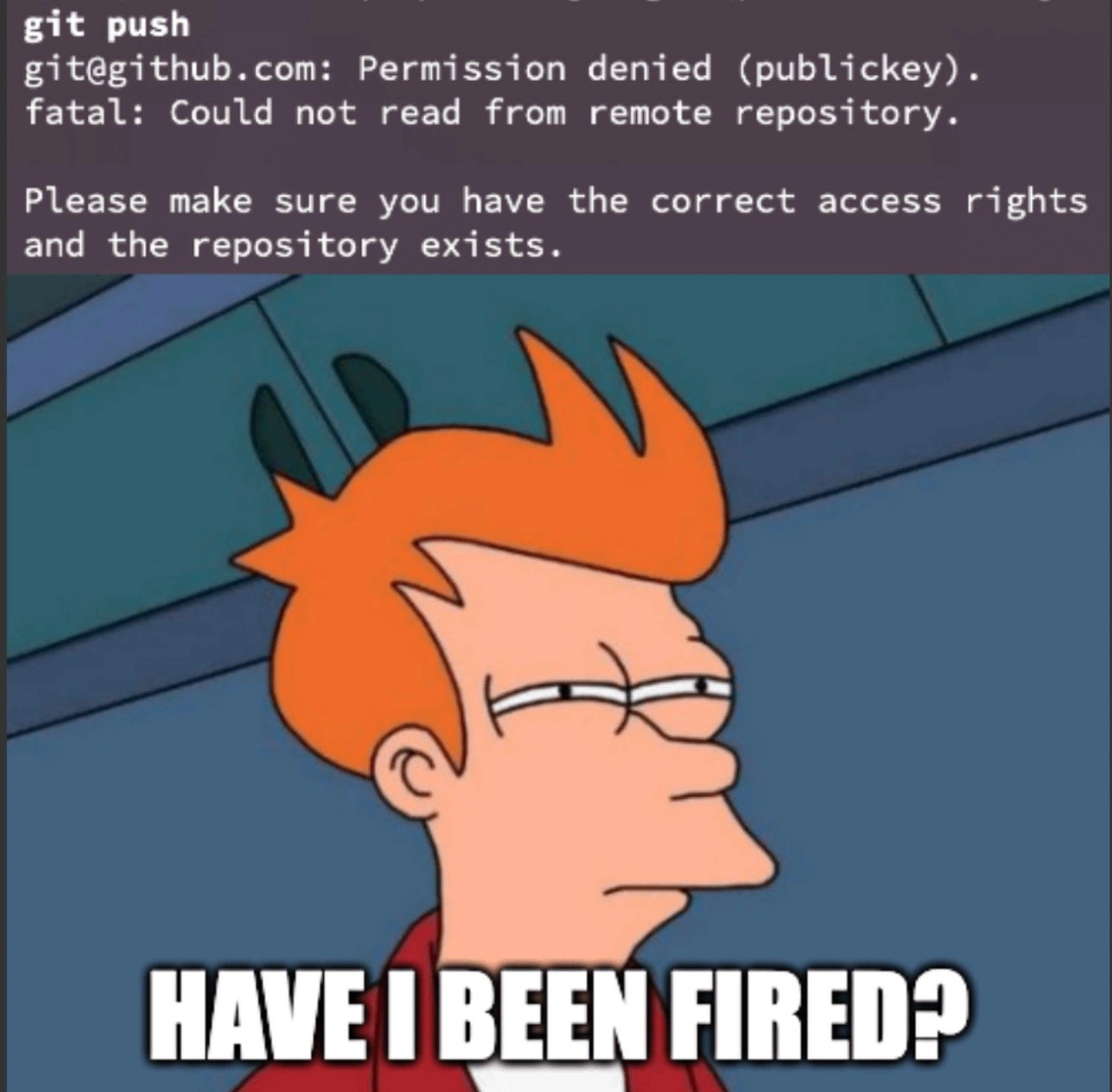
The bottom image of the meme is from Futurama, featuring the character Fry with narrowed eyes. It’s a popular meme format used to express doubt or confusion (“not sure if…”). The text Fry is squinting at says, “HAVE I BEEN FIRED?”. So, putting it together: the top shows a real error from a terminal (git push resulting in a permission denied), and the bottom shows Fry suspiciously wondering if that error means he’s been fired from his job. It’s funny to developers because it captures a real oh crap moment in a lighthearted way. It combines VersionControlHumor (Git and GitHub struggles) with a bit of Security and workplace reality. The tags like permission_denied_publickey and offboarding_anxiety sum it up: it’s the anxious feeling that a cryptic error message might actually be a personal blow. For a newer developer, it’s a lesson that sometimes an error isn’t just a technical glitch — it can hint at a bigger issue. Usually it’s not that dire! But this meme plays on the fear that a simple auth error could mean something as serious as losing your job.
Level 3: Permission Denied Paranoia
For seasoned developers, this scenario triggers an immediate oh no moment. The meme nails a specific flavor of workplace anxiety: you casually run a familiar Git command like git push and suddenly get slapped with [email protected]: Permission denied (publickey). In theory, it’s a mundane error about SSH keys, but in practice, every senior dev’s mind does a quick doom-scroll through possible causes. Did my SSH agent just die? Is GitHub down? Or… has my company login quietly been revoked? That last thought is the gut-drop, and the meme brings it front and center. The top half shows the stark terminal output, the kind we’ve all seen when something’s misconfigured or when access truly is revoked. The bottom half is the classic Futurama Fry image squinting in suspicion, captioned “HAVE I BEEN FIRED?” in bold, anxious text. Seasoned engineers find this hilarious because it’s a RelatableDevExperience: we joke that the first sign of being let go is losing access to version control or Slack. It’s funny because it’s true — plenty of folks have learned they were out of a job only after discovering their keycard or GitHub access stopped working.
This meme’s humor lives in that overlap between technical glitch and corporate reality. Normally, “Permission denied” is just a frustrating Git or SSH configuration issue. But in a company setting, a sudden permissions failure can be the canary in the coal mine of your employment. The phrase “off-boarding ticket was approved overnight” implies an internal IT workflow (likely automated by some DevOps/SRE script). After business hours, someone in IT or HR clicked “deactivate user,” and a cascade began: your accounts and keys were removed from all systems. So come morning, your routine push to the company’s GitHub repository quietly fails. No big red alert, no personal call from the boss — just a cryptic fatal error in your terminal. The absurdity is that the version control system apparently found out you were gone before you did! Engineers with a dark sense of humor (the Cynical Veteran crowd) laugh and wince at this. We’ve seen how companies often prioritize securing resources immediately upon firing someone, sometimes even before that person is told. It’s an uncomfortable truth wrapped in a joke: the code repo rejected you faster than your resignation letter could hit your inbox.
There’s also a shared industry subtext here about GitHub access and SSH keys. The error message suggests “Please make sure you have the correct access rights,” which in a normal situation might prompt you to double-check your key or whether you have permission on the repo. But in the offboarding context, it’s a bit like the system gaslighting you: “Are you sure you should even be here?” It’s simultaneously innocuous and deeply personal. Senior devs appreciate this layered irony. We remember times when a coworker’s push failed because their SSH key was rotated or their account temporarily glitched, and half-jokingly someone quipped: “Maybe you got fired, haha.” This meme takes that jest to its extreme. The combination of the serious console text and Fry’s skeptical face says it all: this isn’t just a lost SSH key, this might be game over. It pokes fun at the paranoia that comes with relying on so many external systems for our daily work—any unexpected denial from those systems suddenly feels like judgement day. And of course, the use of Futurama Fry is the perfect DeveloperHumor touch: he’s the poster child for suspicious “not sure if…” situations. Here he’s not sure if it’s just a tech snafu or if he literally got canned. Any dev who’s been through offboarding_anxiety or watched a colleague mysteriously disappear from the org will smirk at this one, because we’ve all been Fry wondering if that push failure is about to be followed by a meeting invite from HR.
Level 4: Cryptographic Pink Slip
At the deepest technical level, this meme highlights a cryptographic trust failure as a proxy for an employment status update. In Git and GitHub, authentication over SSH relies on public-key cryptography. Your machine holds a private key, and GitHub has the matching public key on file for your user. When you run git push, an SSH handshake occurs: the Git client offers your key’s identifier, the server issues a challenge that only your private key can sign, and then the server verifies that signature using the stored public key. If the public key is missing or not authorized for that repository, the server responds with the dreaded Permission denied (publickey) and terminates the connection. This isn’t a bug or random error—it’s by design. It’s the mathematics of authentication doing its job, ensuring that only someone with a trusted key (i.e., an authorized user) can push code to that remote repository.
Now, how does this relate to off-boarding and getting fired? In a robust security-minded organization (the kind DevOps and SRE teams try to maintain under the banner of SecOps or Zero Trust principles), credentials are invalidated immediately when an employee’s exit is processed. Often there’s an automated pipeline: an HR system triggers an IAM (Identity and Access Management) update, which in turn signals GitHub to revoke the user’s org membership or keys. The result propagates through the system fast — sometimes within minutes or even seconds. The next time that person attempts an SSH connection to GitHub, the public key they present is no longer recognized. From a cryptographic standpoint, it’s as if their digital identity was erased overnight. The security protocols silently enforce the new reality: no key, no access. In essence, the engineer receives a cryptographic pink slip. The protocol doesn’t divulge why (for security, it won’t say “access revoked by HR”), it just refuses to authenticate. It’s a cold, algorithmic confirmation that something about your identity changed. The humor (and horror) of the meme is that the code’s impartial logic ends up delivering very human news: you might not belong here anymore.
This all ties into the Security category: removing access is a fundamental security measure to protect code and infrastructure. Git’s error message is terse but absolutely correct — “Please make sure you have the correct access rights.” In an offboarding scenario, you suddenly don’t have the correct rights, and no amount of debugging your SSH config will fix that. It’s a direct consequence of the systems we’ve engineered: consistent, immediate enforcement of permission changes. While academically satisfying (the integrity of version control access is maintained), it’s also a bit darkly funny. The developer is experiencing a form of protocol-enforced exile. The code repo might as well be an exclusive club with a bouncer who doesn’t give second chances. You present your cryptographic ID at the door and the system checks an authoritative list: if your name’s not on it, sorry, you’re not getting in. In sum, the meme leverages a precise technical mechanism — SSH key authentication failure — as an existential gag. It’s a mashup of VersionControl tech and real-life Security offboarding practices, showing how even the most advanced cryptographic protocols can deliver an experience as blunt as finding out you’re fired via a login failure.
Description
This is a two-part meme that captures a common moment of developer paranoia. The top panel displays a screenshot of a command line interface with a dark background. A `git push` command has been issued, resulting in a classic error message: '[email protected]: Permission denied (publickey). fatal: Could not read from remote repository.' Below this technical error, the bottom panel features the 'Suspicious Fry' meme from the animated show Futurama, where the character Fry squints his eyes with a look of intense suspicion. The caption overlaid on this image reads, 'HAVE I BEEN FIRED?'. The humor stems from the dramatic and relatable escalation from a routine, often easily fixable, SSH key authentication issue to the worst-case conclusion of being terminated from one's job. In many corporate environments, the first sign of termination is the silent revocation of system access, and this meme perfectly plays on that deep-seated anxiety

Comments
9Comment deleted
The five stages of a git permission error: Denial ('It worked yesterday!'), Anger ('Stupid SSH keys!'), Bargaining ('Maybe if I use HTTPS...'), Depression ('I've been fired.'), and Acceptance ('Oh, I'm using the wrong key pair.')
The quickest way to discover your account was de-provisioned: continuous integration? Nah - continuous permission denied
After 20 years in tech, I've learned that SSH key errors are just Git's way of reminding you that your laptop rotation, key management strategy, and employment status all expire at roughly the same time
The real tragedy isn't the permission denial - it's that split second where you genuinely can't tell if your SSH key expired, you forgot to add it to the new machine, IT revoked your access, or you've been quietly terminated and this is how you're finding out. Bonus points if you immediately check Slack to see if you're still in channels before actually running 'ssh-add -l'
At enterprise scale, 'Permission denied (publickey)' is HR’s Okta 401 - when ssh-agent can’t find you, neither can the org
Git push 'permission denied': the pubkey equivalent of HR's 'access revoked' email during reorg season
Senior move: when 'Permission denied (publickey)' screams offboarding, you debug ssh-agent, SSO expiry, and the remote URL before updating LinkedIn
no, you probably just put a / in place of : or vice versa Comment deleted
--force switch needs an update I think. Comment deleted