Skip to content
DevMeme
5762 of 7435
The Database Trolley Problem: Developer Velocity vs. Security Mandates
Databases Post #6316, on Oct 11, 2024 in TG

The Database Trolley Problem: Developer Velocity vs. Security Mandates

Why is this Databases meme funny?

Level 1: Can’t Have It Both Ways

Imagine you have a big jar of cookies at home. There’s a little kid who really wants a cookie – cookies are yummy and the kid gets happy and excited when they can have one. But there’s also a very careful parent who knows that too many cookies can cause a stomachache or cavities (ouch!). The parent is holding the cookie jar lid, kind of like how the person in the picture is holding the lever. Now the kid is begging for cookies because, of course, cookies = fun and getting things done (just like developers feel happy when they can access the data easily). On the other side, the parent is thinking about the dentist (the dentist here is like the security team) who would be very upset if the kid got a bunch of cavities from eating all those cookies. If the parent gives in and hands over a lot of cookies, the kid will be thrilled (yay, cookies!) but later the dentist (and the kid’s teeth) will be in trouble because of the cavities – that’s the “unsafe” choice. If the parent refuses and locks up the cookie jar for safety, the dentist will be happy (no cavities, good job) but the poor kid will be sad and hungry, staring at the jar but not allowed to have a treat – that’s the “no-fun” choice. The parent has to choose one way or the other, and no matter what, someone is upset: either the kid is crying or the dentist is angry.

This is exactly what’s happening in the meme, just with computers. The DBA (think of this person like the parent in charge of the cookies) has to decide whether to give the developers (they’re like the kids who want cookies) more access to the database (cookies) which would make the developers happy because they can do what they want, OR keep things strict to satisfy the security engineers (they’re like the dentist who wants everything safe and healthy). Just like with the cookies, you can’t have it both ways easily: you can’t let the developers have all the freedom and keep security perfectly happy at the same time. One side’s going to be disappointed. The cartoon with the train shows this by having the train track switch – go one way and you “run over” the security side (making security upset), go the other and you “run over” the developer side (making them upset). It’s a funny way to show a tough choice. We laugh at it because we know both sides have a point, and we’ve seen how choosing one over the other can cause drama. In simple terms, the meme is saying: “Should I do the thing that makes my team happy but is a bit risky, or the thing that is safe but will make my team unhappy? Either way, someone’s going to be mad.” If you’ve ever had to choose between fun and safety (like staying up late playing games vs. getting sleep so you’re not tired – another tough choice!), you know the feeling. This joke just takes that feeling and puts it in a workplace with a database, showing how the poor DBA can’t please everyone at once.

Level 2: Lockdown or Letdown

Let’s break down what’s going on in this cartoon in simpler terms, especially if you’re newer to the world of databases and security. The drawing is using the famous “trolley problem” analogy to frame a common IT situation:

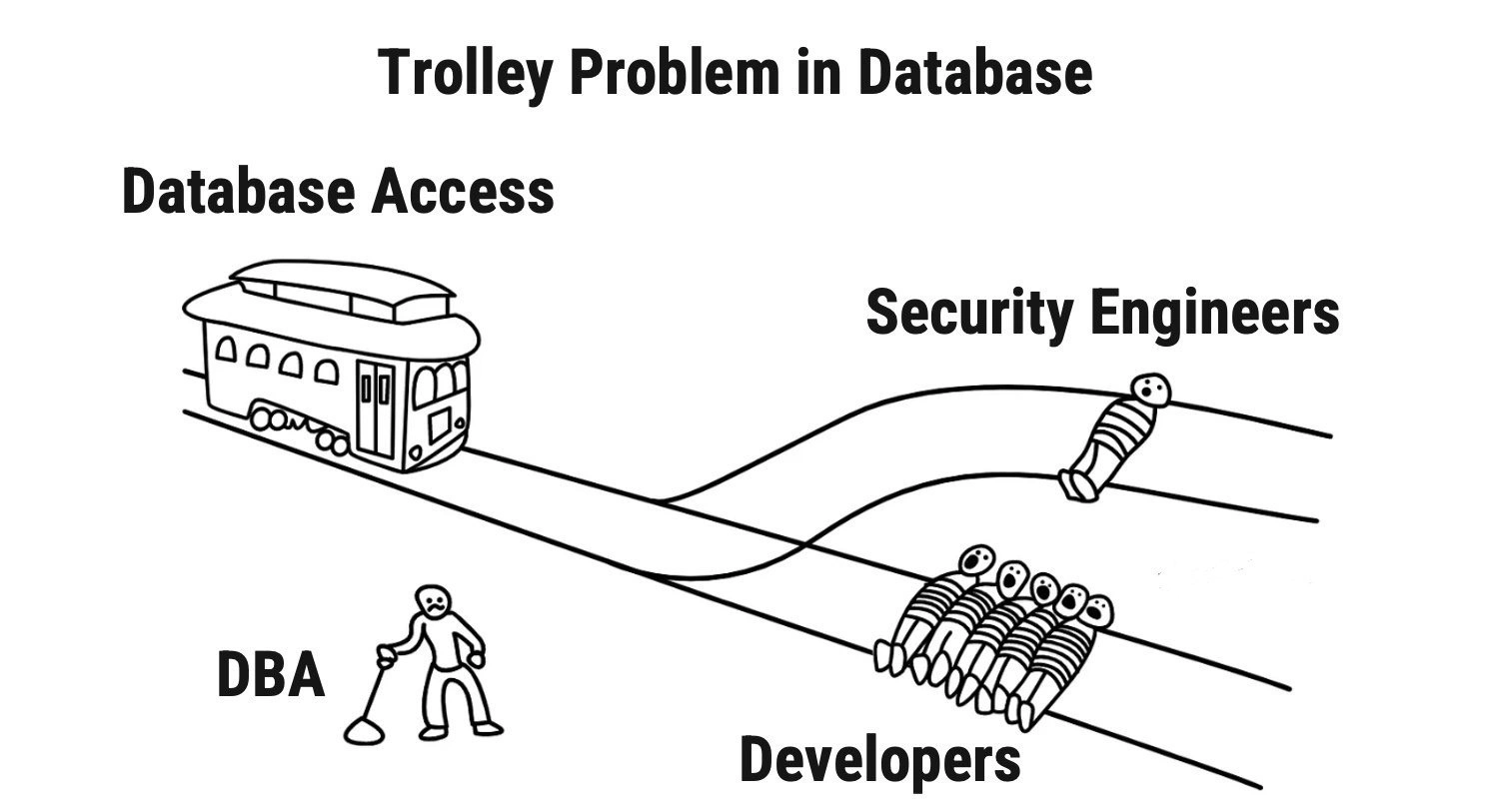
  • Trolley labeled "Database Access": The trolley represents the act of giving people access to a database (specifically the production database). In real life, how much access you grant can dramatically change outcomes, just like the direction of a runaway trolley can drastically change who gets hurt. Think of “Database Access” as the power to run queries or make changes in the live database that the application uses.

  • The DBA (Database Administrator) at the lever: The stick figure by the switch lever is labeled "DBA". A DBA is the person (or team) in charge of maintaining the database systems. This includes tasks like performance tuning, backups, and crucially, controlling who can do what on the database. In many companies, if a developer wants to run a query on the production database or needs special privileges, they have to ask the DBA. Here the DBA is drawn with a very worried expression, because he has to make a tough choice (much like the person in the classic trolley problem who must choose which track the train goes down). The prod-DB lever is a metaphor for the DBA deciding whether to loosen or tighten the database permissions. Everyone around often “holds their breath” during big decisions like this because it can be risky either way.

  • Security Engineers (one person on the upper track): On one track, we see a single stick figure labeled "Security Engineers". This represents the security team’s interests. Security engineers are professionals who establish and enforce rules to keep systems safe from breaches, data leaks, and misuse. In the context of a database, a security engineer’s priority is making sure only the right people (and programs) have the minimum necessary access. They champion things like the principle of least privilege (only give people the access absolutely required to do their job, nothing more) and strict access control mechanisms (for example, using roles and permissions so you can tightly control what each user or role can do in the database). In the cartoon, only one person is on this track, implying maybe that the security team is smaller or a single voice. But even one security concern can carry a lot of weight — hence one person on that track is enough to make the DBA pause. If the DBA decides to give broad database access (i.e., please the developers), that “trolley” might run over this security engineer figure — meaning the security concerns get "run over" or ignored, something a security engineer would consider a disaster (like risking a data breach or violation of policy).

  • Developers (five people on the lower track): On the other track, there are five stick figures labeled "Developers". They represent the developer team’s interests. Developers are the ones writing code for the application, adding features, fixing bugs, and generally needing to work with data. Often developers want or need more access to the production database to do things like run ad-hoc queries, check data, or apply hotfixes. Having easy access can significantly speed up debugging and development – this is part of a good DeveloperExperience_DX (developer experience) because it removes roadblocks from their work. In the cartoon, five people are tied to this track, which humorously shows that more people benefit when access is opened up (since there tend to be many developers needing things). If the DBA keeps the database locked down (to satisfy security), the trolley runs over these five developers – metaphorically meaning their work will be hurt. In real terms, it could mean they’re blocked from getting something done quickly, leading to missed deadlines or prolonged outages while waiting for on-call help. Five developers being "run over" suggests a big impact on productivity or morale if their needs are ignored.

So, the whole image sets up a dilemma: Should the DBA favor the security side or the developer side? In other words, do we keep the database super secure but frustrate the developers, or do we make developers happy by giving them access but upset the security folks? The trolley problem framing shows it as a no-win situation — moving the lever one way saves the developers (letting them work freely) but "kills" security (compromises safety), and moving it the other way saves security (keeps things safe) but "kills" the developers (slows or stops their progress). The meme exaggerates for effect: of course, granting more DB permissions doesn’t literally kill anyone, but in the workplace it can feel like you’re sacrificing one important value for another.

Now, some key terms and concepts to help clarify why this is a common scenario:

  • Production Database (Prod DB): This is the live, real database that the actual application (website, service, etc.) uses in production (i.e., for real users). It contains real customer data or critical information. “Prod” is shorthand for production. Messing with prod is serious because any mistakes there immediately affect real users and possibly revenue. Companies guard the prod database carefully — often only senior engineers or DBAs have direct access to it, precisely to avoid accidental damage or leaks. In contrast, there are typically separate development or staging databases where devs can play around with test data freely without consequences. The issue arises when something needs to be done in production quickly — you can’t just copy the problem to dev environment easily, or the fix must be in the live DB. Then the question is: do we allow a developer into prod DB to handle it?

  • DBA controlling the lever: The reason the DBA holds the lever is because usually, only the DBA (or a small ops team) has full rights on the production database. By design, regular developers might be prevented from doing things like writing or deleting prod data directly. The DBA can grant or deny permissions. For example, a developer might come and say, “I need SELECT permission on the customers table to debug an issue,” and the DBA has the authority to either grant that or say “No, you’ll need to go through some other process.” The lever is symbolic of that authority to switch the state of access.

  • Security vs. Usability (or Security vs. Velocity): This is a classic theme not just in databases, but in all of IT. The more secure/tightly-locked a system is, often the less convenient it is to use. Here usability for developers translates to how easily and quickly they can do what they need (often people say “developer velocity” meaning speed of development). If you give every developer admin access to everything, it’s very usable for them — nothing stands in their way. But it’s not very secure, because one mistake or one compromised account could wreak havoc. On the flip side, if you lock everything down (maybe developers can’t even read the database without a ticket, for instance), then it’s very secure but not usable — developers spend more time waiting or struggling to get info, which slows down work. There’s a constant balancing act between these two goals. The cartoon is literally that balancing act personified by the tracks: one side (security) and the other side (developers’ ease) are at odds.

  • Principle of Least Privilege: This is a key security concept mentioned in the description. It means each user or program should be given the minimum levels of access – or permissions – necessary to perform their duties. For instance, if a developer only needs to read data, they shouldn’t also have delete permissions. Or if an application only needs to write to one table, it shouldn’t have rights to all tables. By limiting access, you reduce the potential damage of any single account or error. In practice, following least privilege means by default a lot of people (developers included) have pretty restricted rights on prod systems. It’s like a “need-to-know” basis for data. Security engineers love this principle because it’s proven to prevent accidents and abuses. Developers, however, often feel it as a handicap when they suddenly do need some permission they don’t have — it can be frustrating to stop and beg for access in the middle of trying to solve a problem. In the meme, giving in to the developers would violate the principle of least privilege (you’d be granting more rights than normal), which is why the security engineer on the track looks distressed.

  • Role-Based Access Control (RBAC): This is a common system for managing who can do what in a database (or any system). Instead of giving every individual a custom set of permissions, you define roles like “Developer”, “DBA”, “SecurityAdmin”, etc., and each role has certain permissions. Then you assign people to roles. For example, the "Developer" role might have permission to run SELECT (read data) on some tables but not to DELETE or ALTER anything. The "DBA" role might have permission to do basically anything (create tables, drop tables, modify data, etc.). RBAC makes it easier to manage because you can adjust a role for many users at once and be sure that, say, all devs have the same restrictions. Now, the conflict arises when a developer, who’s normally in the limited "Developer" role, suddenly asks for something outside that role’s permissions for a special case. The DBA has to decide: do I temporarily bump this person’s role or grant an exception? That’s analogous to pulling the lever in the cartoon. If they do elevate the role, it’s like sending the trolley down the security track (breaking the usual rules designed to protect things). If they refuse, it keeps security intact but sends the trolley down the dev track (work is blocked).

  • "Prod-DB permissions": This phrase just refers to permissions (access rights) on the production database. It might include rights like reading data, writing data, modifying schema, etc. When someone “controls prod-DB permissions”, it means they control who is allowed to do what on the live database. In many organizations, developers have little to no prod-DB permissions by default (maybe just read-only access to certain non-sensitive tables, or often no direct access at all). If developers want to run something in prod, they might have to go through the DBA or an automated system that has privileges. This prevents unapproved changes. The meme’s scenario is basically about whether to relax those permissions for the sake of convenience.

Now, if you’re a junior developer or new to corporate IT, you might be wondering: why such drama over just giving someone access? The reason is that the stakes with production data are extremely high. Real example outcomes of too much access or too little:

  • Too much access scenario (security “dies”): A developer accidentally runs a buggy script that deletes a bunch of customer records (it has happened!). Or someone with access downloads sensitive customer info to their laptop, which then gets stolen or hacked. These are security engineers’ nightmares. They lead to big incidents, maybe even legal trouble if data regulations are violated. This is why security teams sometimes seem overly strict — they are trying to prevent these worst-case scenarios.

  • Too little access scenario (development “dies”): A serious bug is affecting users right now, and a developer knows exactly how to fix the data or needs to investigate the live data, but they’re not allowed in. They file a request, but by the time it’s approved, hours (or days) have passed and users were affected much longer than necessary. Or developers can’t test their changes properly because they’re working with outdated or limited data, causing slower cycles and more bugs slipping through. This frustrates the development team and can hurt the business too, because being slow or down has costs.

This cartoon resonates because teams struggle to find the sweet spot. The captions in the image sum it up: “Trolley Problem in Database” is literally saying this is a moral/operational dilemma. Loosen privileges and the developers will be thrilled (faster deployments, quicker troubleshooting), but the security team will be anxious (since more people could misuse or make mistakes with data). Lock everything down and the security team relaxes (knowing the database is safe from random tampering), but developers get frustrated and delivery velocity is throttled (slowed down). It’s a bit of a running joke in many companies that when developers ask for production access, the default answer from cautious DBAs or security is “No” (sometimes humorously referred to as a “No as a Service” approach). On the other hand, devs often joke about how many hoops they have to jump through just to, say, get a simple SELECT query result in production — like filling tickets, getting 3 manager approvals, and sacrificing a goat (the last one is a joke, of course!) just to see some logs or data.

The meme’s relatability comes from how it exaggerates that daily push-and-pull. If you’re new, don’t worry – you’ll likely see this in action at some point in your career. You might find yourself on the developer side thinking, “Why won’t they just give me access?! It would make this so much easier.” Or if you lean towards security later, you might think, “I can’t just give access like candy; something bad is bound to happen if we start doing that freely.” The drawing frames it in a comedic way, so we can all nod and laugh. The DBA’s face = every person who’s had to mediate between an urgent task and an important rule.

In summary, Level 2 explanation is: this meme is a joke about a DBA deciding who to favor — the developers who want easier database access to do their job quickly, or the security engineers who want to keep the database tightly secured. It visualizes the tough choice as if it were a literal life-and-death trolley track decision. It’s funny to those in tech because it’s a daily balancing act we face: speed and convenience for developers vs. safety and security for the company. And just like in the classic trolley problem, there’s no way to make everyone happy – hence why “everyone holds their breath” when these decisions happen. The stakes are high, whichever way you go, and that absurdity is what we’re laughing at (nervously!).

Level 3: The Least-Privilege Paradox

At the highest level, this meme hilariously captures the Principle of Least Privilege colliding with real-world developer needs. It’s essentially a trolley_problem_meme for IT: the DBA (Database Administrator) is manning a switch that determines who gets "run over" by the consequences of database access decisions. On one track, a lone Security Engineer lies tied up, representing the risk to security if the DBA loosens restrictions. On the other track, five Developers are bound and bracing for impact, representing the hit to development speed if access stays locked down. The DBA’s anguished stick-figure face says it all: no matter which way he pulls the lever, someone is going to be very unhappy. It’s a darkly comic visualization of the classic SecurityVsUsability dilemma—DatabaseSecurity vs. developer agility—a scenario so common that it’s practically RelatableDeveloperExperience folklore at this point. Everyone in the room is holding their breath because they know there’s no perfect outcome; the DBA is stuck choosing the lesser of two evils. This kind of DatabaseHumor lands because it’s rooted in truth: in many organizations, giving developers broad access to the prod database can be as dangerous as a runaway trolley, yet denying access can derail progress like a train screeching to a halt.

From a seasoned engineer’s perspective, the humor comes from how accurately this cartoon distills a painful reality. We’ve all sat in those meetings (or war-room calls) where a developer is begging for elevated prod_db_permissions to fix an urgent issue, while a security/officer or DBA grimly weighs the request like it’s a life-or-death decision. And honestly, it feels that way! Granting that permission might solve the problem in minutes, delighting five developers (and probably a PM or two), but it will give the security team panic attacks about what else those devs might do with unfettered access. On the flip side, upholding strict AccessControlMechanisms (like a read-only policy or a lengthy approval process) keeps the auditors and security folks sleeping soundly, but it risks leaving devs and on-call engineers powerless to respond quickly — possibly turning a minor incident into a protracted outage. It’s a no-win scenario, much like the original trolley problem: can we sacrifice a bit of agility to save security, or sacrifice some security to save agility? The meme format exaggerates it to absurdity by “tying” each group to the tracks, but any senior engineer can attest that it sometimes legitimately feels this dramatic.

This tug-of-war is baked into the architecture of how we manage production data. The DBA vs Devs dynamic often boils down to trust and risk. DBAs (and Security Engineers) are tasked with safeguarding critical data — they apply role_based_access_control policies, limit privileges, and enforce guidelines like “no direct queries on prod” for very good reasons. One rogue DROP TABLE users; run by an overenthusiastic developer with too much access can literally bring the company to its knees. Seasoned DBAs have either witnessed or heard horror stories of a well-meaning dev accidentally deleting or corrupting production data. Those scars run deep; hence the almost reflexive adherence to least privilege principles. In practice, this might mean developers only get a restricted read-only account on the database, or must go through code deployments to affect data rather than manual queries. It’s the safe route — the trolley track where Security Engineers survive unscathed — but it can leave a pile of frustrated devs in its wake, waiting on slow change processes or hunting bugs “in the dark” without adequate data access.

On the other hand, experienced developers know the frustration of strict gatekeeping. Imagine you’re an engineer on-call, scrambling to debug a critical production issue at 2 AM. You discover the problem might be data-related — maybe a particular user record is corrupted, or a quick fix could be applied with an UPDATE statement. But alas, you don’t have permissions to run that query, and the DBA who does is fast asleep (or following change management procedures that take hours). In that moment, the idea of “just give me the damn lever!” is extremely tempting. The meme’s dark humor resonates because we’ve been there: knowing that flipping the switch in favor of the developers (letting the trolley roll over Security’s concerns) would solve the immediate problem and make five devs cheer, but it also means skirting around carefully laid safety measures. It’s a DeveloperHumor staple born from shared experiences — we laugh, albeit with a wince, because we remember the internal conflict of those situations.

The least-privilege paradox is that enforcing strong security often conflicts with optimizing developer productivity. This is sometimes referred to as the Security vs Usability trade-off in system design. The meme personifies that trade-off as two sets of people literally in harm's way. In reality, "harm" translates to things like security breaches or compliance violations versus missed deadlines or prolonged downtime. There’s an irony that both sides ultimately want the best for the product and users: developers want to ship features and fix issues to improve the system, and security wants to protect the system and its data for the users’ sake. Yet their methods can clash in spectacular fashion. The DBA in the middle often acts as the mediator (or the unwilling executioner in the trolley allegory). In many companies, the DBA role is to maintain the database’s health and enforce access policies. They become the human embodiment of the “switch lever” because they literally have root or admin rights that others don’t. Being in that position is hard. The meme’s comedic exaggeration of the DBA sweating over the lever isn’t far off from reality: get it wrong and either you’ve opened Pandora’s box for security nightmares, or you’ve ground development to a halt.

To seasoned eyes, there's also a meta-joke here: the numbers. In the original trolley problem, it’s 1 person vs 5 people. Here we have 1 Security Engineer vs 5 Developers. Often, that reflects reality in tech teams — you might have one security specialist (or a small infosec team) but dozens of developers. The majority is on the dev side, clamoring loudly for fewer roadblocks, while the minority security side, even if smaller in headcount, carries a lot of weight in terms of veto power. It sets up an emotionally familiar scene: a larger group’s loud requests versus a smaller group’s important principles. Any senior engineer who’s tried to push a quick change past a security gatekeeper can relate to feeling like one of those five tied-to-the-tracks developers, just as any lone security specialist or DBA can relate to feeling like it’s them against a crowd. The meme visualizes that tension in a brilliantly simple way.

Let’s not forget the backdrop of role-based access control in databases here. Many organizations implement RBAC such that developers have a limited role (perhaps just read access or very scoped privileges), whereas DBAs have an admin role. Changing those roles or granting exceptions is akin to pulling the lever in favor of devs. A senior engineer chuckles at this cartoon because it’s a scenario they navigate regularly: “Should we grant this developer temporary elevated access to fix the data issue, or do we force everything through a slow, audited process?” It’s a risk assessment each time, and as the meme implies, it often feels like choosing who gets “run over” — agility or security. This is also where the culture of an organization comes into play. Some orgs lean toward trusting developers more (optimizing for speed and relying on good practices to mitigate risk), while others lean toward stringent controls (optimizing for safety and assuming devs might err). Neither extreme is perfect, and the tension between the two is fertile ground for humor.

In classic DevOps fashion, the ideal solution is finding a third option that doesn’t kill anyone on the tracks — e.g., automation or tooling that provides safe, audited access. But the meme wryly suggests that in practice, we often feel stuck with the binary choice. That’s why it resonates: it’s poking fun at the absence of an easy solution. The DBA’s anguished expression is every engineer who’s ever had to decide between two bad options. You can almost hear the DBA thinking, "Why did it have to come to this?" Meanwhile, the developers on the lower track are looking hopeful (or maybe terrified), and the security engineer on the upper track is equally anxious, because each knows the DBA’s decision could ‘throw them under the bus’. It’s a perfect storm of dba_vs_devs conflict wrapped in a simple drawing.

To illustrate how this scenario plays out in real life, consider the actual database commands that might be at stake. For instance, giving in to the developers’ pleas might look like this:

-- Option 1: Make developers happy (but security screams)
GRANT ALL PRIVILEGES ON ProdDB.* TO 'dev_team';

This single SQL command would hand the dev_team full power over the production database (all tables, all actions). It’s like flooring the gas pedal on the trolley toward the Security Engineers on the track. By contrast, the security-conscious route might involve:

-- Option 2: Keep security happy (developers groan)
REVOKE ALL PRIVILEGES ON ProdDB.* FROM 'dev_team';
GRANT SELECT ON ProdDB.public_data TO 'dev_team';  -- read-only access to safe subset

Here we yank back permissions, giving developers maybe just SELECT (read-only) on some safe portion of data. This is the equivalent of steering the trolley away from the security person and unfortunately into the developers, at least from their perspective (since now they can’t modify anything and have to jump through hoops for changes). These snippets are a bit tongue-in-cheek (GRANT ALL PRIVILEGES is a DBA’s nightmare come true), but they reflect the underlying choice: open the gates wide, or keep them barely ajar. In reality, DBAs try to find a balance — e.g., give some privileges or create narrowly scoped roles that allow developers to solve their problem without exposing everything. But striking that balance is tough, and when time is short, it often does feel binary.

Another layer experienced folks appreciate is how the meme highlights organizational incentive misalignment. Developers are typically evaluated on how fast they deliver features or fixes (so more access = less waiting = good for them), whereas security teams are evaluated on keeping incidents and data leaks at zero (so less access = less risk = good for them). The DBA, being responsible for the database, ends up responsible for both uptime/performance (which devs influence) and data safety (which security influences). They’re literally caught in the middle of these competing forces. The cartoon might be simple line art, but any veteran of enterprise tech has felt that squeeze: you’re damned if you do, damned if you don’t. This is why a trolley problem in database form is instantly understandable and funny to us — it’s exaggeration, but only just. We laugh because we cope; it’s cheaper than therapy after the last 5 times we lived this scenario out for real. As the saying goes in security circles, "the most secure system is one with no users" — but then nothing would ever get done. Conversely, an overly open system is a breach waiting to happen. In practice, every day is finding that sweet spot while avoiding the trolley hitting anyone, and this meme nails the absurd pressure of that decision in one frame.

Finally, seasoned readers might recall famous industry stories or internal post-mortems that echo this situation. Ever hear about the engineer who had too much access and accidentally deleted a production database table? Or the time a critical issue went unresolved for hours because no one who could fix it had the right permissions in time? These are the real-life “train wrecks” that give the cartoon its edge. The humor has a bit of gallows laugh to it: we chuckle, but only because we’ve survived those scenarios and earned some scars. In essence, the meme distills a core DeveloperExperience_DX issue — balancing developer autonomy with safe governance — into a morbid little joke. It’s funny, it’s relatable, and it’s a reminder that DatabaseSecurity decisions often carry heavy consequences. As one might quip, “Production access is all fun and games until someone drops the production data.” Here, the DBA is literally holding the game controller and has to decide which outcome is the least catastrophic. That mix of truth and hyperbole is what makes this image pure gold in tech circles.

Developer: "I just need quick access to prod to run one query, I promise I won’t break anything!"
DBA: "...That's what the last guy said."

This cheeky imagined exchange is essentially what the cartoon depicts in philosophical form. The DBA has probably heard that plea a hundred times, and the Security Engineer has probably issued the counter-warning just as often: “One query can kill.” So the DBA stands at the lever, everyone holding their breath, encapsulating in one freeze-frame the dba_vs_devs standoff that so many of us know too well. It’s humorous, it’s tense, and it’s a scenario born out of very real tech-world stakes.

Description

This image presents a classic philosophical dilemma, the Trolley Problem, adapted for a database administration context. It's a simple black-and-white line drawing with the title 'Trolley Problem in Database.' A trolley, labeled 'Database Access,' is heading down a track that will run over a group of five people tied to it, who are labeled 'Developers.' A character labeled 'DBA' (Database Administrator) stands by a lever. If pulled, the lever will switch the trolley to an alternate track where only a single person, labeled 'Security Engineers,' is tied up. The meme humorously illustrates the difficult position DBAs are often in: they must choose between enabling a large number of developers who need broad database access to be productive (the default path) and adhering to the stricter, more restrictive access policies favored by a smaller number of security engineers. The choice is between hindering productivity for the sake of security or enabling productivity at a potential security cost, a classic and perpetual conflict in tech organizations

Comments

11
Anonymous ★ Top Pick The real problem is that the developers have already found an unsecured read replica and are wondering why the DBA is sweating over a lever, while the security engineer is screaming because the trolley is a metaphor for a SELECT * statement without a WHERE clause
  1. Anonymous ★ Top Pick

    The real problem is that the developers have already found an unsecured read replica and are wondering why the DBA is sweating over a lever, while the security engineer is screaming because the trolley is a metaphor for a SELECT * statement without a WHERE clause

  2. Anonymous

    Some call it RBAC; the DBA calls it choosing which Slack channel yells at them after hours

  3. Anonymous

    After 15 years of granting 'temporary' production database access that becomes permanent, you realize the real trolley problem isn't choosing who gets hurt - it's explaining to the CISO why half the company has SELECT * privileges on customer_payment_info because 'they needed it for that one urgent debug session in 2019.'

  4. Anonymous

    The DBA's eternal dilemma: pull the lever and grant prod access, sacrificing the security engineer's carefully crafted least-privilege policies and audit compliance, or leave it and watch six developers spend the next sprint writing Jira tickets explaining why they can't debug that production issue. Either way, you're the villain in someone's postmortem. At least with the trolley problem, the philosopher doesn't have to attend the retrospective

  5. Anonymous

    Trolley dilemma: one DBA or N+1 security reviews per query? Lever pulled - SUPERUSER for all

  6. Anonymous

    Real RBAC is Rail‑Based Access Control: the DBA pulls the lever, dev velocity or compliance gets flattened, and the audit log quietly records break_glass=true

  7. Anonymous

    Flip the lever to a read‑only replica behind a JIT bastion with RBAC and full auditing - when both devs and security complain equally, you’ve finally implemented least privilege

  8. @misesOnWheels 1y

    If he's making problems instead of solving them he's probably not an engineer and his opinion can be discarded

    1. @Infinitelineman 1y

      Can the problem be created in a process of solving another? 🤔

      1. @misesOnWheels 1y

        as long as the one making it also solves it

    2. @chupasaurus 1y

      Ever heard of CAP theorem?)

Use J and K for navigation