Skip to content
DevMeme
1933 of 7435
The Managerial Solution to Delays: More Meetings
Meetings Post #2148, on Oct 14, 2020 in TG

The Managerial Solution to Delays: More Meetings

Why is this Meetings meme funny?

Level 1: Less Talk, More Action

Imagine you have a big school project due soon, and you’re already running late on it. You really need all the time you can get to finish it. Now picture this: your teacher notices you’re behind and decides to hold a long class meeting for three hours to remind everyone what the project is about and why it’s important. During those three hours, you’re just sitting there listening, unable to actually work on your project. Sounds frustrating, doesn’t it? You’re thinking, “If we could skip this talk, I could actually be doing my project!”

That’s exactly the situation in the meme. The boss (like the teacher in our story) is saying, “We’re late, so let’s all stop working and talk about what we need to do.” The workers (like the students) are upset because talking about the work is eating up time they should use to do the work. It’s funny in a silly way because it’s so backward: it’s like pausing a race to remind the runners how to run. The emotion you see—those little squiggles above the characters’ heads—shows they’re annoyed or angry. They know that the big meeting will just make them even later.

In simple terms, the meme is telling a joke about bad planning. It’s saying: sometimes the people in charge do things that don’t make sense, like having a huge meeting when everyone really just needs to buckle down and get the job done. We laugh (or maybe sigh) because we’ve all had moments where someone kept us talking when we really needed to be working. It’s a reminder that often the best way to reach a goal is to spend less time talking about it and more time actually doing it. Less talk, more action!

Level 2: When Meetings Attack

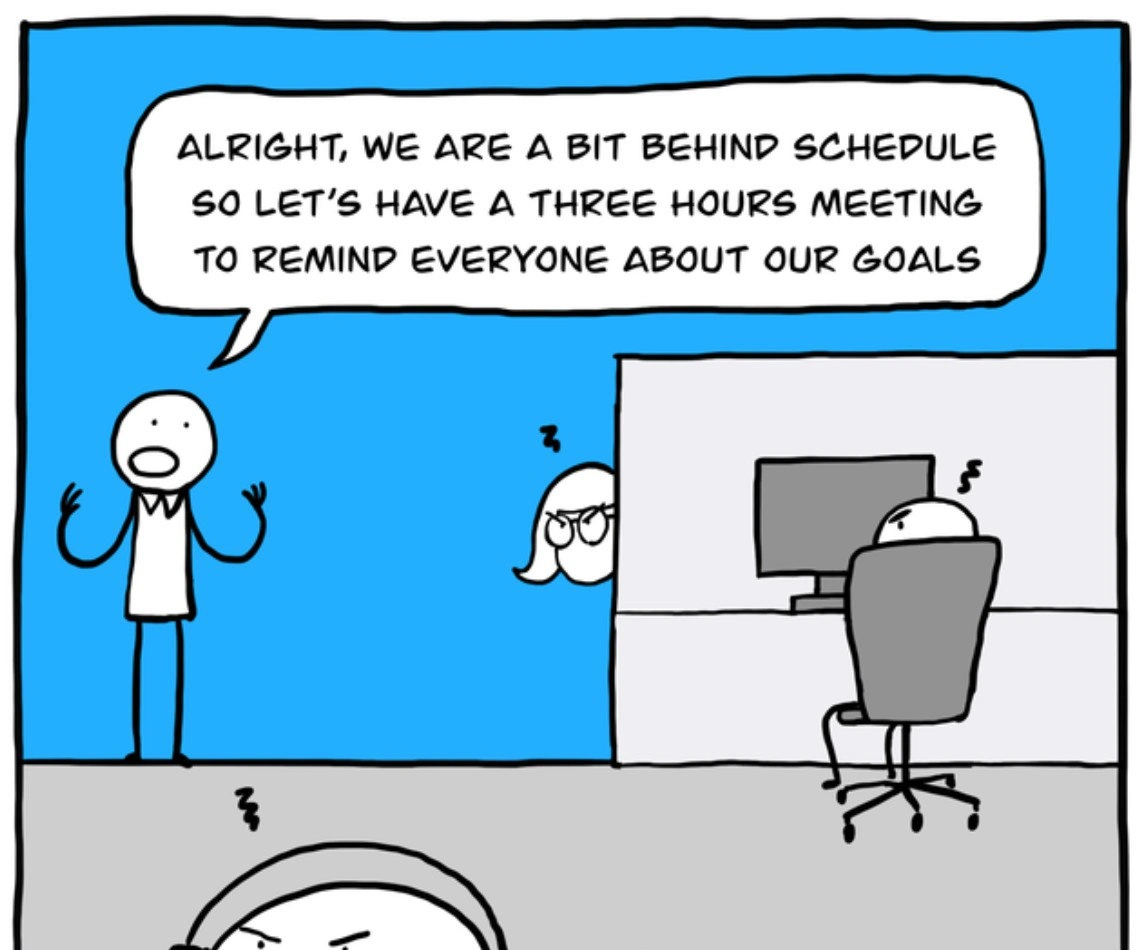
For a newer developer (or someone just starting in a tech company), let’s break down why this meme is funny and all-too-relatable. The scene shows a manager announcing a three-hour meeting because the project is “a bit behind schedule.” That situation itself is the joke: when you’re behind on work, the last thing you want is a long meeting that eats up time you could use to catch up!

First, some key terms here: schedule slippage means a project is falling behind the planned timeline – basically, things are late. A deadline is the date by which work is supposed to be finished. In the meme, the team has a deadline coming, and they’re already late or at risk of being late. Now, how do we normally try to deal with a late project? Ideally by focusing and doing the work faster or cutting scope. However, the manager in this comic chooses a different approach: he schedules a big meeting to remind everyone about our goals. It sounds motivational – make sure the team knows what they’re aiming for – but the developers already know their goals (deliver the features, meet the deadline). What they really need is time to work, not a pep talk.

This highlights something many companies struggle with: meeting culture. That’s when a workplace has a habit of holding lots of meetings, sometimes for every little thing. Some meetings are useful – for example, quick daily stand-ups (short team check-ins common in Scrum/Agile processes) are meant to last just 15 minutes so everyone knows what’s going on. But a three-hour meeting just to restate the project goals? That’s what we’d call a pointless meeting or a time-wasting ceremony. It feels like overkill. In fact, we often joke, “This meeting could have been an email.” That phrase perfectly fits here. The manager could have sent a short summary or email reminder of the goals, taking maybe 5 minutes of everyone’s time. Instead, he’s grabbing 180 minutes from every team member. If 6 people attend, that’s 6 * 3 = 18 hours of total work time gone! You can see why the developers in the cartoon are fuming – their expressions and squiggly lines show developer frustration and annoyance.

Let’s talk about why meetings like this can be harmful to developer productivity. When you’re coding or debugging, you need concentration. Getting “in the zone” or into a flow state is important; that’s when a developer is fully focused and making progress. A long meeting is a big interruption. It’s not just the 3 hours spent sitting in the conference room (or on a Zoom call) – it’s also that after such a meeting, your brain might need time to get back into the groove of coding. This is often called context switching: you switched context from coding mode to meeting/discussion mode, and switching back isn’t instant. Developers often say that after a long meeting, it takes a while to regain their momentum on a task. So, excessive meetings can dramatically cut down actual productive coding time in a day.

The corporate management perspective, however, might be different. A project manager or team lead might genuinely think: “We’re behind schedule because the team has lost sight of the big picture. Let’s gather everyone to re-align on our goals and priorities.” Communication and clear goals are important – nobody would deny that. But there’s a balance. If you over-communicate or keep repeating things we already know, it turns into communication overhead, which means extra communication that doesn’t provide enough value to justify the time spent. Overhead is like extra weight; here it’s the “weight” of the meeting slowing the team down.

In the image description, the developers are drawn literally pulling annoyed faces during the manager’s announcement. One developer is peeking over the cubicle wall with narrowed, angry eyes; another is slouched in the chair with irritation marks above his head. Anyone who’s worked in a dev team can imagine the thoughts in those heads: “Are you kidding me? We need to be coding, not meeting!” This mismatch in thinking is the core of the joke. The manager thinks he’s helping by providing clarity and motivation. The team sees it as the manager ironically making the deadline even harder to meet. It’s a logic fail on the manager’s part – his reasoning is flawed.

There’s also an underlying commentary about CorporateCulture here. In some companies, being in meetings is almost seen as working, especially for managers. Managers spend a lot of their day in meetings (that’s what they do: coordinate, discuss, plan). Meanwhile, developers count on having stretches of no-meeting time to actually get things done. When a manager schedules a big meeting without considering how it affects the makers (developers), it feels disrespectful of their time. Hence, the common frustration you’ll hear in tech circles: too many meetings kill productivity. There are even memes and jokes all over tech forums about MeetingOverload – when your calendar is so full of meetings that you have to work early mornings or late nights to get your real work done. Not fun!

To visualize it: imagine you have an 8-hour workday. You’re already behind on a project, so maybe you needed all 8 hours (or more) of solid work to catch up. Now your boss just took 3 of those hours for a meeting. That leaves only 5 hours to do the work and you might be mentally drained or distracted after the meeting. It’s easy to see how this could push the project even further behind. One developer I know joked: “Being behind schedule because of too much talking, and then responding with even more talking, is like fighting fire with gasoline.” It’s a bit of an exaggeration, but you get the point – it’s counterproductive.

In summary, for a junior developer, the meme is a humorous lesson in workplace reality. It teaches that not all management decisions make sense from a developer’s point of view. It highlights the importance of efficient communication: yes, keep the team aligned on goals, but don’t overdo it. Sometimes the best way to help a late project is to remove distractions and let developers focus, rather than calling yet another long meeting. The laughter (or maybe pained groan) this meme provokes is a way experienced devs communicate: “We’ve all been there. We survived it. And we can all agree it’s ridiculous, right?”

Level 3: The Mythical Meeting Month

Ah yes, the classic solution: a software project is behind schedule, so management’s brilliant idea is to steal three more hours for a meeting. 🤦‍♂️ It’s a scenario every experienced developer recognizes as a manager logic fail. The humor here comes from the absurd contradiction: trying to fix schedule slippage by doing something that guarantees even more slippage. In other words, “we’re late, so let’s pause work and chat about it for half a day.” It’s corporate insanity that’s all too real.

This cartoon panel perfectly skewers meeting culture in many companies. The manager on the left enthusiastically declares, “Alright, we’re a bit behind schedule so let’s have a three hours meeting to remind everyone about our goals.” In his mind, this long status meeting is a strong leadership move to refocus the team. But to the developers on the right, it’s a time-wasting ceremony of the highest order. You can practically hear their inner thoughts: “We know our goals; we just need time to code!” Those squiggly frustration symbols over their heads are the universal developer sign for developer frustration. They’re peeking over cubicle walls and slumping in chairs with the same thought: “This could have been an email, and now we’re losing an afternoon.”

From a veteran engineer’s perspective, this situation is painfully familiar. Under deadline pressure, panicked management often responds by increasing oversight – more meetings, more status check-ins, more “alignment” talks. It’s meant to reassure everyone that the project is under control, but it backfires spectacularly. Why? Because communication overhead is real. Every hour spent in a colossal meeting is an hour not spent actually building, debugging, or delivering features. In fact, if you have 6 developers in a 3-hour meeting, that’s 18 developer-hours lost – over two full workdays of coding gone poof. This is like setting the project’s few remaining hours on fire.🔥

There’s even a famous project management principle this meme evokes: Brooks’ Law from The Mythical Man-Month. Fred Brooks observed that “adding manpower to a late software project makes it later.” Here, instead of adding people, they’ve added a giant meeting, but the effect is similar. The team’s throughput slows down further because now they have to coordinate and discuss rather than produce. It’s all about diminishing returns: beyond a point, throwing more “process” (meetings, status reports, extra check-ins) at a problem just creates more overhead that drags the project down. The manager intends the meeting to boost productivity by reminding everyone of the goals, but in reality every developer already knows the goal (ship the darn project!). What they lack is time, not vision. This pointless meeting is treating the wrong symptom; it’s like prescribing a 3-hour lecture on healthy eating to someone who’s starving – informative, maybe, but they’d rather just have food (or in our case, time to work).

You’ll notice the corporate culture critique underlying the humor. Many organizations have a meeting overload problem: managers operate on a "manager’s schedule" (their day chopped into meeting-sized blocks) while developers operate on a "maker’s schedule" (they need long uninterrupted stretches for deep work like coding). This meme highlights that clash. To a manager, a 3-hour meeting might seem like a necessary block to get everyone “on the same page.” On a calendar it’s just one slot labeled “Reminder Session – 3h”. But to a developer, those 3 hours could have been an entire morning of focused programming – and losing that block is devastating to developer productivity. It’s the difference between actually fixing the late project or just talking about fixing it. The manager’s well-intentioned meeting forces a massive context switch on the team. Imagine a computer CPU that’s trying to finish a task under a deadline, and the operating system suddenly says: “Hold on, let’s context-switch and run a 3-hour low-priority process.” The CPU (developer) now has to save state, swap out of productive mode, sit through the other process (meeting), and then later swap back in and reload everything into cache (their mental model of the code). The overhead of that context switch is huge – lots of lost focus and ramp-up time to get back into coding after the meeting. No wonder those devs in the comic look ready to bang their heads on their desks.

This scenario is also a bit of dark management humor because it satirizes a common management failure mode. Instead of addressing root causes of delay (like unrealistic timelines, insufficient resources, blockers, or scope creep), some managers default to “more communication!” as a solution. It’s project panic mode: “If we’re behind, maybe I haven’t talked about the goals enough!” So they corral everyone for a marathon reminder session. Ironically, this often happens precisely when engineers are crunching hardest – effectively yanking them out of the zone at the worst time. It’s management theater: the boss gets to feel like they took action, but the only tangible outcome is a bunch of slides about goals and a team even further behind. The meme resonates because most seasoned devs have lived through such pointless_meetings and bear the battle scars of schedules slipping further thanks to well-intended but counterproductive “help” from above.

In short, this meme hits on a truth that makes engineers smirk and groan: sometimes the biggest obstacle to meeting a deadline is... meetings. It’s a hilarious and exasperating reminder that meeting culture can undermine the very goals it’s supposed to support. The next time someone proposes a grand three-hour sync to fix a late project, every developer in the room will remember this cartoon and think, “Here we go again…”

Description

A single-panel comic strip featuring simple stick-figure characters in an office environment. On the left, against a bright blue background, a manager-like figure with a collared shirt announces, 'ALRIGHT, WE ARE A BIT BEHIND SCHEDULE SO LET'S HAVE A THREE HOURS MEETING TO REMIND EVERYONE ABOUT OUR GOALS'. To the right, in a grey cubicle area, two employees react with visible frustration. One character with white hair and glasses peeks from behind a wall, looking annoyed with squiggly lines indicating stress. Another is slumped at their desk in front of a computer, also with stress lines. A third employee's angry face is partially visible at the bottom of the frame. The comic satirizes a common and frustrating management anti-pattern where project delays are addressed with long, time-consuming meetings that prevent the team from doing the actual work needed to catch up. For developers, this highlights the critical disconnect between managerial perception and the need for focused, uninterrupted 'maker time' to be productive

Comments

10
Anonymous ★ Top Pick The project is behind schedule, so the manager's solution is a 3-hour meeting. It's the corporate equivalent of trying to fix a memory leak by allocating more RAM
  1. Anonymous ★ Top Pick

    The project is behind schedule, so the manager's solution is a 3-hour meeting. It's the corporate equivalent of trying to fix a memory leak by allocating more RAM

  2. Anonymous

    Nothing accelerates delivery like a three-hour “alignment” meeting - basically a stop-the-world GC for humans scheduled right when your critical-path thread finally warmed up

  3. Anonymous

    After 20 years in tech, I've calculated that every 'quick sync to get back on track' meeting adds exactly π days to the project timeline - irrational, never-ending, and somehow always results in scheduling another meeting to discuss why we're further behind

  4. Anonymous

    The irony here cuts deep: when you're behind schedule, the last thing you need is to context-switch the entire team into a three-hour synchronous meeting. It's like responding to a production outage by scheduling an all-hands retrospective before fixing the issue. Every senior engineer knows that 'reminding everyone about goals' is just management-speak for 'we don't trust you to prioritize correctly,' and the real productivity killer isn't unclear goals - it's the meeting itself. The team's reaction says it all: this is how you turn a schedule slip into a death march, one unnecessary ceremony at a time

  5. Anonymous

    Behind schedule? Perfect - let’s do a three-hour OKR alignment; Little’s Law says when WIP = meetings, throughput ~ 0. It’s Brooks’ Law for calendars

  6. Anonymous

    PM fix for velocity drop: a three-hour sync whose context-switch cost ensures we're lapping negative burndown

  7. Anonymous

    Behind schedule, so they invoked Brooks’s Law for Outlook: add meetings to a late project to make it later

  8. @rrrrrrrrrrrrrrrrrrrrrrrrr_r 5y

    не могу такое не лайкать

    1. @daemon4647 5y

      нужно сразу в рабочий чат постить :D

  9. Deleted Account 5y

    Не, ну ало, митинг на три часа - не продуктивно! То ли дело 12 пятнадцатиминутных стендапов!

Use J and K for navigation