Skip to content
DevMeme
1287 of 7435
A Shared Moment of Code Obfuscation
Compilers Post #1441, on Apr 29, 2020 in TG

A Shared Moment of Code Obfuscation

Why is this Compilers meme funny?

Level 1: Even the Computer is Confused

Imagine you wrote a really complicated secret message to yourself, using a mix of weird abbreviations and drawings. At the time, you thought it was clever, but now you look at it and go, “Huh? What did I even mean here?” You try to get your smart friend (let’s call them the “compiler,” who usually can decode your messages) to read it, and they scratch their head and say, “Sorry, I’ve got no clue either.” That’s exactly what’s happening in this meme. The programmer made a piece of code so messy and tangled that later even they can’t understand it. And the computer program that’s supposed to read the code and turn it into something that runs – even that program is confused! It’s like writing a recipe with such bad handwriting and vague steps that not only do you not know how to cook it again, the chef robot in your kitchen is also shrugging, completely lost. The funny part comes from that shared confusion: both the human and the machine are baffled by this goofy, super-complicated creation. It’s a silly way to remind us that if we make something too confusing, even our own tools and ourselves won’t know what to do with it!

Level 2: Lost in Translation

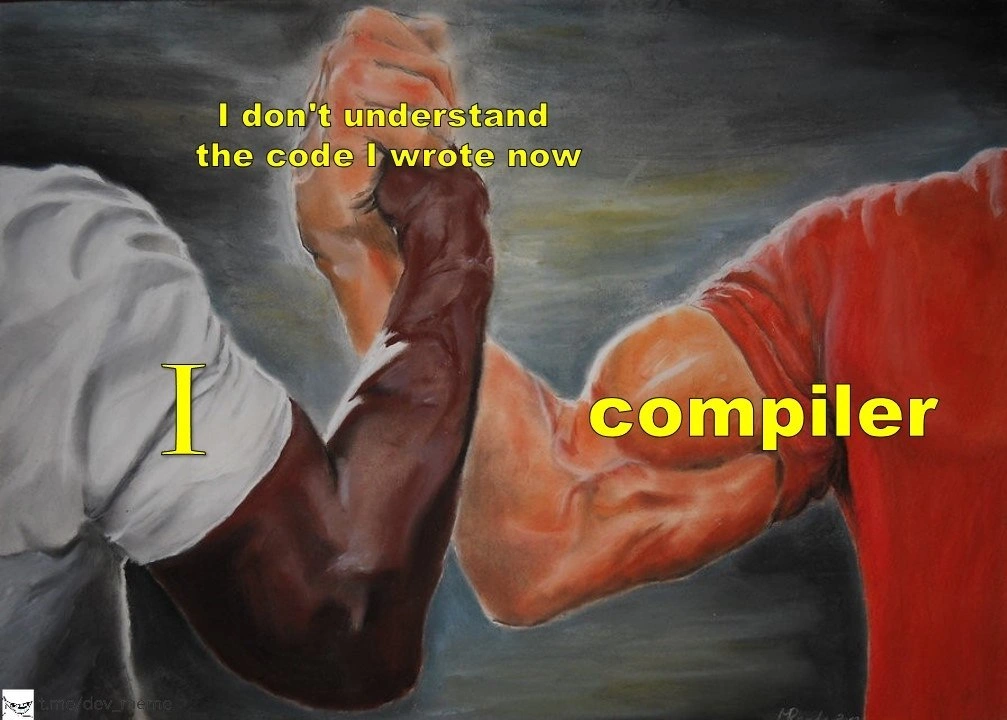
Let’s break down the joke in simpler terms. The image uses the classic Predator handshake meme: two strong arms clasping hands in solidarity. Typically, this format labels each arm as different people or groups, and the joining of hands shows them agreeing on something. In our meme, one arm is labeled “I” (that’s the developer themselves) and the other is labeled “compiler” (the program that turns your code into something the computer can run). Above their handshake is the phrase: “I don’t understand the code I wrote now.” So the picture is saying: both the programmer and the compiler agree that the programmer’s code doesn’t make sense!

Now, why would a compiler “not understand” code? In reality, a compiler has strict rules. It reads your source code, and if you made a mistake (like missing a semicolon, using a variable that wasn’t defined, or any syntax error), the compiler will throw an error message. It might say something like “Syntax error at line 42” or “unexpected token”. These messages can sometimes be hard to decipher, especially for beginners. That’s why we often joke that the compiler is “confused” – because the error text it gives us can feel just as confusing as the code itself. When the meme says the compiler joins me in not understanding my code, it really means the code is so confusing or poorly written that it’s causing lots of compiler errors or warnings. It’s like the compiler is shrugging and saying, “Sorry, I can’t translate this into machine language – I don’t get what you want me to do.”

For the developer’s part (“I don’t understand the code I wrote”), that hits on a common developer humor theme: sometimes we write code that is so complex or rushed that when we come back to it later, even we can’t figure out how it works. This could be because of poor code quality – maybe we didn’t use clear names for things, skipped writing comments, or used a very tricky solution. There’s a term “spaghetti code” which means code with a messy structure, like a bowl of tangled spaghetti noodles. If you’ve ever plugged in a bunch of wires and cables and later found them all knotted up, you know how hard that is to untangle; spaghetti code is the software equivalent. It’s hard to follow the flow of the program because it twists and turns unpredictably. Legacy code (old code that’s been worked on by many people over time) often ends up like this, full of odd quirks that made sense once but no one remembers why now.

The meme is very relatable to developers because many of us have had that experience: you think you wrote a decent piece of code, but when you revisit it, it feels like it was written in another language. You might literally say, “What does this function even do?!” It’s a humbling moment. It teaches the importance of writing maintainable code – code that others (and your future self) can read and understand. That means using meaningful variable and function names, keeping functions short and focused, and maybe adding comments for any “tricky” part of the logic. If we ignore those practices, we accumulate what’s jokingly called technical debt – basically, it’s like taking shortcuts in code that you’ll have to pay back later with extra work. Just like real debt, the more you delay fixing messy code, the more “interest” (problems and confusion) piles up.

So in simpler words, this meme is pointing out: I wrote some really confusing code, and now even the tool that’s supposed to translate it (the compiler) is throwing up its hands. It highlights a bit of self-deprecating humor among developers – we poke fun at ourselves for sometimes being our own worst enemy when it comes to coding. The visual of the handshake makes it funny because it’s as if the programmer and the compiler, who usually interact only through error messages, are suddenly pals bonded by a shared confusion. It’s basically saying, “Look, even the computer doesn’t know what I was trying to do here!” And that’s a gentle reminder (with a laugh) to write cleaner code next time.

Level 3: Spaghetti Alliance

Every seasoned developer has encountered that “what was I thinking?!” moment when reading their own past code. It’s a rite of passage in software development: six months down the line, your own module looks like it was written by an enemy trying to sabotage you. This meme captures that painful hilarity by showing the developer (“I”) and the compiler shaking hands in agreement that the code is utterly confounding. Typically, compilers are these strict, unfeeling enforcers – they’ll reject your code or churn out warnings, but they don’t “agree” or “disagree.” Here we jokingly imagine the compiler joining our side, essentially saying, “Buddy, I got nothing. I don’t understand this nonsense either.” 🤝 It’s the one time you and the compile-time error machine are on the same wavelength. That’s the relatable humor: at least you and the computer both recognize the code is a hot mess!

What kind of code leads to this unholy pact of confusion? Think spaghetti code: a tangled mass of logic with no clear structure – jumps and loops all over, functions calling each other in circles, variables named x or data everywhere, and maybe a few dark magic macro hacks sprinkled in. It’s the sort of code that CodeQuality evangelists have nightmares about. Perhaps it started innocent, but over time requirements changed and quick-fixes piled up (hello, TechnicalDebt 👋). Deadlines were tight, you told yourself “I’ll refactor later,” and later never came. Now you’re staring at a beast with a dozen levels of nested if statements and you honestly can’t trace the logic anymore without a flowchart and three cups of coffee. The compiler, for its part, might still compile it… but maybe it’s issuing 42 warnings about unused variables, type conversions, and that one deprecated API call. Those warnings are basically the compiler waving a red flag: “Here lie dragons!”

For a lot of us, this scenario triggers war stories. Perhaps you’ve wrestled with legacy code – some archaic module written 10+ years ago by a developer who has since fled the country. Everyone fears touching it because no one fully understands how it works, but it’s mission-critical. When brave souls do attempt an update, the compiler explodes with errors in parts of the code no one even knew existed. Experienced engineers see the meme and recall those bug hunts where the compiler errors were so baffling you’d swear the compiler was trolling you. C++ developers, in particular, often joke about “template error hieroglyphics” – you miss a template parameter and suddenly the compile error is 500 lines of gibberish involving std::__complex_type_info<><<_Rn> and you’re like, I wrote Hello World, why am I seeing this? It truly feels like the compiler itself is confused and just dumping its internal AST guts at you out of spite.

The deeper truth here is about maintainability. Code that even its author can’t understand is a flashing neon sign of trouble. In an ideal world, we write code as if the next person to maintain it is a machete-wielding maniac who knows our home address (an exaggerated old joke that scares us into writing cleaner code). Why? Because that next person is often our future self, and boy will they be grumpy if we left them a bowl of spaghetti. Poor maintainability is how you get bugs that take days to fix and features that no one dares to implement. It’s how teams accumulate technical debt: each quick-and-dirty solution is like borrowing time that you eventually pay back with interest (in the form of late-night debugging sessions). When the meme says “I don’t understand the code I wrote now,” it’s essentially an admission of guilt. We’ve all been there, regretting that we didn’t take a few extra hours to simplify a design or add documentation. Instead, we (and the hapless compiler) must reverse-engineer our own thoughts from cryptic code. It’s equal parts frustrating and funny – funny in that schadenfreude, laugh-to-keep-from-crying way engineers know too well.

And let’s not forget the compiler’s perspective (if it had one). Compilers don’t actually throw up their hands and quit without reason – if it’s truly confused, that means the code violates some rule. Maybe that monster 500-line function hit a compiler bug or an internal limit. Or more commonly, the code compiles but produces bizarre results because of something subtle, like uninitialized variables or undefined behavior that even the compiler’s optimizer couldn’t straighten out. There’s an implicit nod in the meme to those mysterious compile-time problems where you fix one thing, and five other unrelated errors pop up – the code’s complexity is fighting back. It resonates with the on-call developer pain points: you’re debugging at 3 AM, muttering “what the heck did I do in this code?” while the compiler blandly reports "expected ';' before }" and you realize the actual issue is miles upstream. This shared confusion between human and machine underscores why code quality matters so much. The meme gets a laugh because it’s a hyperbolic version of a very real problem: if your implementation is so convoluted that even a strict binary translator and the original author together can’t make sense of it, then congrats – you’ve created a true code smell classic!

Level 4: Parse Paralysis

Under the hood, compilers break your code down through multiple stages: lexical analysis (turning text into tokens), syntax analysis (building an Abstract Syntax Tree (AST) structure), then semantic checks and optimizations. In theory this process is rigorous and deterministic, guided by formal grammars (think Backus-Naur Form rules) and well-defined semantics. But when confronted with insanely convoluted code, even this pipeline can seem to sputter. Of course, a compiler doesn’t literally throw its hands up – it will always do something, even if that “something” is emitting a mile-long error log. A simple misplaced brace or a too-clever C++ template can lead to an avalanche of compiler errors that read like an alien cipher. The compiler isn’t sentient, but its parser can effectively get “confused” in a formal sense: one minor syntax goof can cascade into dozens of baffling error messages as the poor thing tries to make sense of your logic pretzel. Seasoned C++ devs have seen a single missing semicolon spawn a screen full of errors – a classic case of parser panic mode doing its best. It’s a mechanical failure to parse structure, but it sure feels like a nervous breakdown.

There’s some computer science gravity behind this humor. We often anthropomorphize and say “the compiler doesn’t understand,” yet by definition a compiler only understands what it’s programmed to. It checks your code against strict grammatical and type rules, not for clarity or intent. There’s no magical $compile --mind-read option to intuit what you meant. The limits here tie into theory: determining what a program intends to do is generally undecidable (thanks to results like Rice’s Theorem in computability). In other words, a compiler can’t divine your purpose – it can only ensure the code follows language rules. So if those rules are stretched to the breaking point by obtuse, labyrinthine logic, the compiler will either (a) grind through and produce machine code that exactly mirrors your tangled design, or (b) throw cryptic errors if you violated some rule. Neither outcome means it “understands” the code in a human sense. In extreme cases, code complexity can even exhaust compiler resources: ever hear of C++ templates so complex they exceeded recursion limits or consumed gigabytes of RAM to compile? That’s a real thing – the compiler dutifully chewing through ridiculous complexity until it nearly chokes. Cyclomatic complexity and other code metrics measure how complicated a function’s control flow is; high values might not faze the compiler’s logic (it’ll compile an if-ladder 50 levels deep), but they sure make optimizers sweat and humans cry. The meme’s joke plays on this contrast: the developer and the compiler form a handshake alliance in bewilderment. It’s a tongue-in-cheek nod to how truly indecipherable code transcends the human-machine gap – reducing both man and machine to the same befuddled state. In short, from a compiler theory perspective, incomprehensible code is where the elegant formality of language design meets the chaotic reality of “what on earth did I just write?” – a place where even the AST nodes look terrified.

Description

This meme uses the 'Epic Handshake' format, which depicts two muscular arms, one Black and one white, clasping in a powerful handshake. The left arm, attached to a person in a white shirt, is labeled 'I'. The right arm, from a person in a red shirt, is labeled 'compiler'. The text overlaid on their clasped hands reads, 'I don't understand the code I wrote now'. This signifies a moment of shared confusion and agreement. The humor stems from the relatable developer experience of writing code that is so complex, 'clever', or poorly structured that it becomes incomprehensible shortly after being written. The joke is that even the compiler, a deterministic tool that processes the code, is personified as sharing the developer's bewilderment, creating a bond over the confusing nature of the code
Comments

7
Anonymous ★ Top Pick Peak seniority is writing code so abstract that 10 minutes later, you and the compiler are equally baffled, yet it still passes CI/CD
  1. Anonymous ★ Top Pick

    Peak seniority is writing code so abstract that 10 minutes later, you and the compiler are equally baffled, yet it still passes CI/CD

  2. Anonymous

    That moment when both you and the compiler stare at the metaprogramming monstrosity and silently agree: it should’ve been a JSON config, not a Turing-complete macro language

  3. Anonymous

    The only thing more impressive than a compiler understanding your spaghetti code is when neither of you understand it but you've achieved a perfect symbiosis of mutual incomprehension that somehow produces a working binary - the true mark of a senior engineer who's mastered the art of 'it works in production, don't touch it.'

  4. Anonymous

    The compiler has become the sole maintainer of your codebase - it's the only one who can parse your 3am implementation of that 'clever' state machine you wrote six months ago. At least someone's passing code review, even if it's just the type checker silently judging your lifetime annotations

  5. Anonymous

    Compiler fist-bumps your hack today; future-you inherits the refactor apocalypse

  6. Anonymous

    Six months after “just a bit of template‑macro magic,” the compiler and I both treat it as a write‑only DSL

  7. Anonymous

    The compiler and I have a pact: it proves the program is well-typed; I prove I wrote it only via git blame

Use J and K for navigation