Skip to content
DevMeme
1593 of 7435
The Inevitable DNS Root Cause
Networking Post #1781, on Jul 16, 2020 in TG

The Inevitable DNS Root Cause

Why is this Networking meme funny?

Level 1: Wrong Address Book

Imagine trying to visit a friend's house, but everyone is using different address books. One book has the new house, another has the old house, and someone insists the address book cannot be the problem. After a long search, it turns out the address book was the problem all along. That is the whole DNS joke: the boring helper that tells computers where to go is often the thing sending them to the wrong place.

Level 2: Name Trouble

DNS, the Domain Name System, turns readable service names into addresses that computers can use. Humans remember names; machines route traffic to IP addresses. A DNS record stores one piece of that mapping, and a DNS server answers questions about those records.

The phrase DNS propagation refers to the delay and caching behavior after a DNS change. If one resolver has the new value and another still has the old one, two users can try the same website and reach different places. That is not magic. It is distributed caching doing exactly what someone configured, possibly years ago, with confidence.

The meme is funny to developers, sysadmins, and on-call engineers because DNS problems often look like other problems first. A website "being down" might actually be a wrong record. An API "not responding" might be resolving to an old address. A service "working on my machine" might be using a different resolver than production. The joke is the familiar embarrassment of ruling DNS out before DNS has had the courtesy to ruin your day in writing.

Level 3: Resolver Denial Cycle

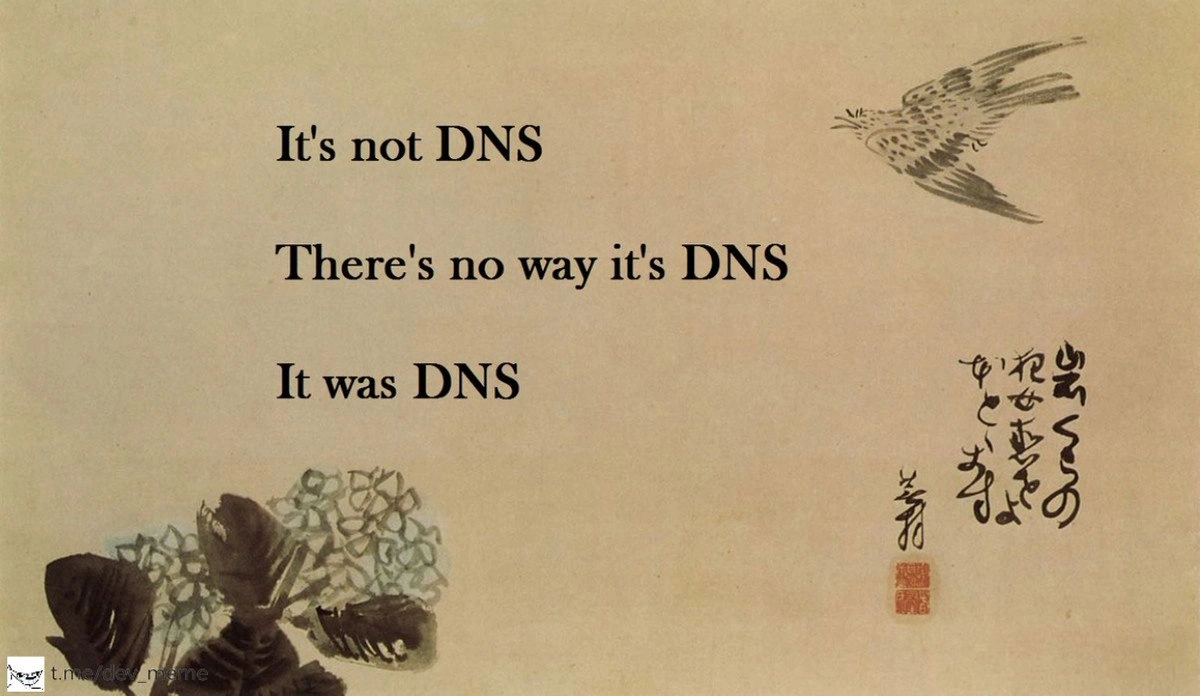
Outside the CVE context, the three-line structure is still the standard emotional arc of a production incident. First comes confidence: It's not DNS. Then comes defensive confidence: There's no way it's DNS. Finally comes the ticket update written through gritted teeth: It was DNS. The parchment-like art and quiet bird make it feel like ancient wisdom, which is insulting only because it is accurate.

DNS is the perfect recurring villain because it fails indirectly. The application says the database is unreachable. The load balancer says a backend is missing. TLS validation fails because a hostname resolves somewhere unexpected. A Kubernetes service works from one pod but not another. A CDN behaves differently depending on geography. Every symptom points somewhere more glamorous, while DNS sits in the corner wearing a fake mustache and a TTL.

The DevOps and SRE pain comes from the number of places DNS state can hide. A bad A, AAAA, CNAME, MX, TXT, or SRV record is only the obvious case. There are stale recursive caches, negative caching, mismatched internal and external zones, resolvers configured by DHCP, search suffixes, conditional forwarders, systemd resolver behavior, container DNS proxies, cloud private zones, and "temporary" hosts-file entries from an outage two quarters ago. Everyone knows to check DNS; everyone also checks it too late, because hope is cheaper than packet captures.

The systemic issue is ownership. Application teams use DNS, platform teams automate it, network teams operate resolvers, security teams care about domain controllers and filtering, and vendors abstract it behind consoles that look friendly until propagation time becomes a philosophical debate. That is why fixing DNS incidents is harder than changing a record. You must find which layer believes the wrong truth, how long it will keep believing it, and which human has permission to make the lie stop.

Level 4: SIGRed Root Cause

The image reads like a calm troubleshooting poem: It's not DNS, then There's no way it's DNS, then It was DNS. The local post message, CVE-2020-1350, makes the joke sharper than the usual "bad record, stale cache, wrong resolver" routine. Posted on July 16, 2020, it sits right next to the public disclosure and patching window for the Windows DNS Server remote code execution vulnerability often called SigRed, a critical issue scored at CVSS 10.0.

That context matters because DNS is not just a phone book for the internet. It is a distributed, cached, delegation-based protocol with parsers sitting on privileged infrastructure. A DNS server receives structured network input, decodes labels, record types, lengths, compression pointers, DNSSEC-related data, and response metadata, then makes trust and routing decisions that other systems depend on. When that parser has a serious memory-safety flaw, "it was DNS" stops meaning "your A record is wrong" and starts meaning "the domain controller running DNS may be part of the blast radius."

At packet level, DNS looks deceptively simple: a client asks for a name, a server returns records. In production, the path can involve recursive resolvers, authoritative servers, forwarding rules, caches, EDNS extensions, DNSSEC material, split-horizon views, and vendor-specific server implementations. Each layer creates state and assumptions. Each parser must accept hostile input from the network and decide whether a byte sequence is a harmless answer, malformed garbage, or a weaponized request. Naturally, this responsibility often lives on a server everyone describes as "just DNS" until the pager starts reciting poetry.

The meme's minimalism works because the protocol's apparent simplicity is exactly what makes teams underestimate it. DNS has one foot in ancient internet plumbing and another in modern identity, cloud routing, service discovery, certificate validation, and corporate directory infrastructure. When a critical CVE lands in that space, the old on-call joke becomes literal incident planning: inventory DNS servers, patch Windows Server, check exposure, understand domain controller placement, and pray nobody says "temporary workaround" in the war room.

Description

A parchment-colored image styled like traditional Japanese art shows a small bird at the upper right, plant leaves at the lower left, and vertical calligraphy with a red seal on the right. Large centered text reads, "It's not DNS", then "There's no way it's DNS", then "It was DNS". The meme is a troubleshooting haiku about the recurring realization that mysterious connectivity, service discovery, or production failures often reduce to DNS after everyone initially dismisses it. It is especially familiar to backend, SRE, and sysadmin teams dealing with caches, propagation delays, stale records, split-horizon zones, and resolver behavior.

Comments

1
Anonymous ★ Top Pick DNS is the distributed system that lets every outage begin as denial and end as cache invalidation.
  1. Anonymous ★ Top Pick

    DNS is the distributed system that lets every outage begin as denial and end as cache invalidation.

Use J and K for navigation