Skip to content
DevMeme
169 of 7435
The Unfortunate Case of Analysis Abbreviation
CodeQuality Post #207, on Mar 7, 2019 in TG

The Unfortunate Case of Analysis Abbreviation

Why is this CodeQuality meme funny?

Level 1: The Nickname That Stuck

Imagine a kid named Analiese who gets her name shortened on every school list to the first four letters — and now it's printed on the class door, the yearbook, and the gym roster, and no one can reprint them all. That's what happened here: programmers shortened the word "analysis" to its first four letters to save typing, accidentally creating extremely embarrassing names all over their project, and someone finally snapped and left a note begging everyone to stop. It's funny because the mistake is so innocent, so avoidable, and — once it's spread everywhere — so very hard to undo.

Level 2: Why a Four-Letter Shortcut Becomes a Forever Problem

Key concepts hiding in this screenshot:

  • Naming conventions — agreed rules for identifiers (snake_case like anal_check, camelCase like analCheck). They exist so code reads predictably. The flaw shown here: a convention can be followed perfectly and still produce a name no human should say in standup.
  • Abbreviation risk — shortening words saves keystrokes but destroys meaning, and occasionally creates new, worse meaning. Modern style guides (and autocomplete) have mostly killed the incentive: typing analysis_ costs nothing when your editor finishes it for you.
  • Code review — the checkpoint where a colleague reads your change before merge. Its job isn't just bug-catching; it's exactly this — a second human who would have said "absolutely not" at the first anal_insert().
  • Refactoring / renaming — changing names without changing behavior. Sounds trivial, but if a name leaks into APIs, file formats, or databases, renaming breaks other people's code. Early-career lesson: names are forever more often than you'd think, so spend the extra five seconds.
  • Linters — automated style police (eslint, pylint, etc.). You can literally write a rule banning identifier prefixes; this codebase clearly predates, or ignores, such tooling.

The relatable junior moment: the first time you confidently name something (final_v2_REAL, doStuff(), or an unfortunate abbreviation), ship it, and then watch it appear in error logs, dashboards, and meeting slides for the rest of your tenure.

Level 3: Naming Things, the Second Hardest Problem

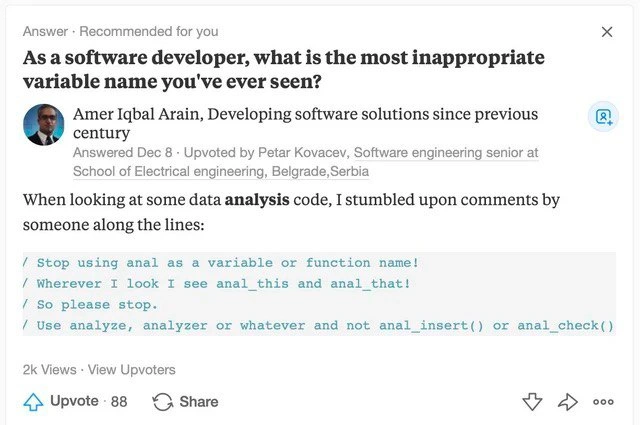
A Quora answer to "As a software developer, what is the most inappropriate variable name you've ever seen?" delivers a perfect specimen of the genre: a developer spelunking through data analysis code finds a comment block that is less documentation than cry for help:

/ Stop using anal as a variable or function name! / Wherever I look I see anal_this and anal_that! / So please stop. / Use analyze, analyzer or whatever and not anal_insert() or anal_check()

Several things make this resonate with anyone who's done legacy code archaeology. First, the abbreviation itself is locally rational: in an era of 80-column terminals, snake_case conventions, and verbose identifiers like analysis_results_insert_record, truncating analysis to its first four letters follows the exact same logic as str, int, cfg, and tmp. The author of anal_insert() wasn't being crude — they were being consistent. That's the deeper joke: a perfectly applied convention producing a perfectly horrifying result. Abbreviation schemes are context-free; human language is not.

Second, note the medium of the protest. Not a code review comment, not a lint rule, not a PR rejection — a plaintive comment inside the code, addressed to no one and everyone, like a message in a bottle. That tells you everything about the engineering culture: there was no review gate where anal_check() could have been stopped, so the only available governance mechanism was graffiti. Every veteran has found one of these — the // WHY ARE WE LIKE THIS comment — and knows it means the org chart failed before the codebase did.

Third, the persistence problem. By the time someone writes "wherever I look I see anal_this and anal_that," the identifiers have metastasized across call sites, serialized field names, maybe a database schema and a public API. Renaming is now a breaking change with a migration plan, which is why these names survive for decades. The famous aphorism holds — there are only two hard things in computer science, cache invalidation and naming things — and this screenshot is what happens when the second one loses, then becomes unfixable because of everything downstream.

Description

This image is a screenshot of an answer from a Q&A website, likely Quora, where a user asks, 'As a software developer, what is the most inappropriate variable name you've ever seen?'. The answer, provided by Amer Iqbal Arain, recounts discovering a desperate plea within code comments while working on data analysis code. The screenshot displays the comments verbatim: '// Stop using anal as a variable or function name!', '// Wherever I look I see anal_this and anal_that!', '// So please stop.', and '// Use analyze, analyzer or whatever and not anal_insert() or anal_check()'. The humor stems from the unfortunate abbreviation of 'analysis' to 'anal,' leading to a codebase littered with unintentionally inappropriate function and variable names. It's a perfect, real-world example of why clear and unambiguous naming conventions are crucial in software development to avoid confusion and maintain professionalism

Comments

8
Anonymous ★ Top Pick There are two hard problems in computer science: cache invalidation, naming things, and off-by-one errors. The author of this code clearly struggled with the second, and now every future developer has to deal with the first-degree embarrassment
  1. Anonymous ★ Top Pick

    There are two hard problems in computer science: cache invalidation, naming things, and off-by-one errors. The author of this code clearly struggled with the second, and now every future developer has to deal with the first-degree embarrassment

  2. Anonymous

    Nothing humbles a senior codebase faster than SonarQube ignoring the quadratic hotspot yet blowing up CI over 42 occurrences of anal_insert() - apparently static analysis has better taste than our data analysis

  3. Anonymous

    The senior architect who approved 'anal_' as the abbreviation for 'analysis' in the coding standards is the same one who wondered why the offshore team kept declining his code review invitations

  4. Anonymous

    The two hardest problems in computer science: cache invalidation, naming things, and explaining to HR why grep found 47 calls to anal_check() in prod

  5. Anonymous

    This is why senior architects insist on full words in identifiers - not because of the extra keystrokes, but because they've seen what happens when 'analysis' meets autocomplete in a client demo. The real technical debt here isn't the abbreviated names; it's the therapy bills for the poor soul who had to present `anal_insert()` to stakeholders during a code walkthrough

  6. Anonymous

    The variable name so backend, even regex linters practice plausible deniability during scans

  7. Anonymous

    Nothing torpedoes a CodeOwners review faster than 'anal_insert()' - it fails the linter, the grep audit, and the HR firewall in one call

  8. Anonymous

    Abbreviating “analysis” to “anal” is how you learn the hardest part of observability isn’t metrics - it’s explaining the logs to Legal

Use J and K for navigation