Feeling like a cowboy coder… until future-you rereads that saloon of spaghetti
Why is this CodeQuality meme funny?
Level 1: Past You vs Future You
Imagine you hastily build a big LEGO castle without using any instructions. At the time, you feel like a master builder, proudly showing it off. But then you leave it on a shelf and come back to it after a long summer. Now you need to add a new tower, but… you have no idea how you put this castle together! Pieces are connected in strange ways, and there’s no map or guide. You scratch your head like, “How on earth did I do this?” It’s funny because you made it, yet even you can’t figure it out later. This meme is joking about that feeling: being super confident when you first create something, then feeling completely confused by it when you return later. It’s like writing a secret note to yourself and then not being able to read your own handwriting – Past-You thought it was clear, but Future-You is totally baffled. The lesson is simple: try to keep things clear and tidy today so that future-you won’t be scratching their head tomorrow.
Level 2: Cowboy Coding Consequences
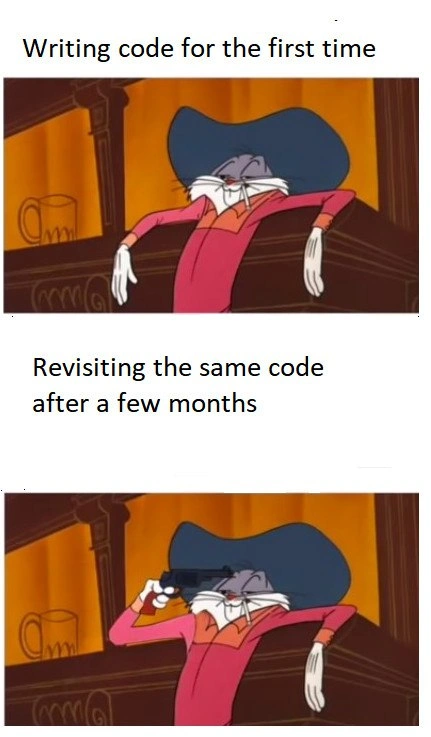
In this meme, our favorite wisecracking rabbit, Bugs Bunny, is dressed as a cowboy in a saloon. In the top image, he’s relaxed and self-assured, just like a developer who’s writing code for the first time on a new project or feature. Everything feels straightforward in that moment. In the bottom image, Bugs looks shocked and suspicious (his eyes hidden under the brim of his hat) – this is “revisiting the same code after a few months.” It represents the developer’s expression when they return to their own code and can barely recognize what they were thinking. The joke is basically saying: code can turn into a foreign land if you leave it for a while, especially if you wrote it hastily.
Let’s break down some terms and concepts here, because this meme is packed with developer lingo about CodeQuality and TechnicalDebt:
Cowboy coder – This is a nickname for a programmer who writes code with a free-spirited, shoot-from-the-hip approach. Imagine a cowboy in the Wild West who doesn’t follow the town rules. A cowboy coder similarly doesn’t follow team guidelines or best practices; they might skip design discussions, ignore documentation, and just code away solo. Sure, they can move fast and get things working, but there’s a big downside: their code often ends up disorganized or fragile. In the meme, the first panel’s Bugs Bunny is the picture of a cowboy coder – confident and unconstrained.
Spaghetti code – This is a term developers use to describe code that’s tangled and messy, like a bowl of spaghetti. If you’ve ever seen cooked spaghetti, you know how all the noodles twist and knot together unpredictably. Now imagine code where the flow of execution (the order in which things happen) loops and jumps around in a confusing way. It might have lots of goto statements (in older languages), deeply nested loops and conditions, or just no clear structure. Spaghetti code is hard to follow and even harder to maintain. In the meme’s caption, they say “saloon of spaghetti.” That’s a playful mix of the cowboy saloon setting and the idea of spaghetti code – implying the codebase became a messy saloon full of spaghetti-like logic. In real life, when you’re writing code initially, you might not notice it’s turning into spaghetti. Only later, when you revisit it, do you see the tangles.
Revisiting after a few months – Why is a few months gap such a big deal? Because of something every programmer experiences: forgetting the details. Our brains purge the minutiae of the code we wrote once we move on. So, code that felt crystal-clear in our mind in July might look totally alien by October. There’s even a saying: “Code you wrote 6 months ago might as well have been written by someone else.” Here, that someone else is still you, but future-you doesn’t have the same mental map past-you did. If the code wasn’t written clearly, coming back to it is like opening a book to a random chapter in a language you’re only partly fluent in.
Code quality – This refers to how readable, maintainable, and error-free the code is. High code quality means other developers (including future-you) can easily understand what the code does and why. It usually implies good structure (functions that do one thing well, clear naming, etc.), comments or documentation where needed, and tests to ensure everything works as expected. Low code quality (like in cowboy coding) might still run okay, but it’s internally chaotic – variables with meaningless names like
dataorflageverywhere, functions hundreds of lines long doing too many things at once, duplication of logic, and so on. Initially, nobody might notice those issues because, hey, the program works! But later, poor code quality makes every change risky and time-consuming. In the meme, the painful expression on Bugs in panel 2 is developer pain caused by low code quality: “How am I supposed to fix or update this thing I wrote?”Technical debt – This is a metaphor that treats quick-and-dirty coding like borrowing money. You gain a short-term benefit (you got the feature working fast, or met a deadline) but you incur a “debt” that must be paid off later (in the form of extra work or problems). Writing messy code under time pressure is like taking on debt: it’s easier now, but it interest. That interest might be: 1) having to rewrite big chunks later, 2) debugging weird bugs for hours because the code is so convoluted, or 3) slower development on new features because you’re scared to touch the old code (you fear it will break). In our meme, when future-you is staring in despair at the code, that’s the interest payment coming due. The fun you had cowboy-coding with swagger is over, and now you realize how much refactoring work is needed to clean this up.
Refactoring – This means improving the internal structure of code without changing what it does externally. Think of it like tidying up a messy room: you’re not buying new stuff, just organizing what’s there so you can find things and move around more easily. After a few months, when you open up your old code and see the mess, you might say, “Ugh, this needs refactoring.” Maybe you’ll break a giant function into smaller ones, rename
var1andvar2to something meaningful, add comments explaining the tricky parts, or write tests to cover the edge cases. Refactoring is a normal part of software development because code that was written quickly or early (when you had less knowledge) can almost always be improved later. A junior developer might not refactor immediately (you might be just happy it works!), but part of growing is learning to continuously clean up your code so that future visits aren’t so painful. Bugs Bunny’s change in expression essentially says, “I really should have refactored this or written it cleaner from the start.”Legacy code – Typically, this term is used for older code inherited from someone else or an earlier time (often without tests or documentation). But here’s the twist: your own code can become legacy code if enough time passes or if it was written in a rush. After a few months, you may not remember the context or the quirks, so you approach it like legacy code left by a stranger. You might even find yourself asking the same questions you’d ask of any legacy system: “Why the heck did they do it this way?” and “Is it safe to change this?” Future-you in the meme is treating past-you’s code as legacy – possibly even mumbling “Who wrote this garbage?” before sadly realizing the answer.
All of this boils down to a lesson for anyone learning to code: write code with tomorrow in mind. It’s normal as a newcomer (or even experienced dev under pressure) to just focus on making it work today. You might feel like Bugs in the first image – triumphant with your clever solution – and that’s fine, enjoy that moment! But remember, coding is also about communication: you’re communicating with the future (other developers or yourself in the future) through the code. If you take a little extra time to name things clearly (total_sales instead of ts), add a comment for that weird workaround, or break down a complex function into simpler pieces, you’re going to thank yourself later. Otherwise, a few months down the road, you might end up just like Bugs Bunny in that second panel: hat lifted, eyes squinting, asking “What did I even do here?” with a tumbleweed of confusion rolling by. It’s a rite of passage in the CodingLife: we all have that one cringe-worthy source file from our past that we open gingerly, as if disarming a bomb. This meme laughingly captures that universal developer experience.
Level 3: Spaghetti Western Showdown
Ah, the classic cowboy coder showdown: you swagger into the codebase like a gunslinger, slinging lines of code with reckless abandon. At first, it feels glorious – the feature works, the bug is dead, and you’re leaning back like Bugs Bunny in that saloon, confident and smug. This first panel captures that developer bravado: the code’s freshly written and you’re thinking, “I’m a rockstar, look at this elegant solution.” But fast-forward a few months, and future-you steps back into that very same saloon of code only to find a spaghetti-filled crime scene. The second panel – Bugs lifting his hat with squinting, shadowed eyes – is basically you squinting at your own inscrutable logic, muttering “What in tarnation was I thinking?” as tumbleweeds blow through your brain.
The humor here hits hard because it’s too real: every seasoned developer has re-read their own code and felt like they’re debugging someone else’s delirious masterpiece mess. In this wild west of software, cowboy coding (charging ahead to solve problems with little planning or process) often leads to code that’s quick on the draw but ugly in the light of day. You were in such a rush to shoot down the problem that you didn’t bother to holster any comments or tests for later. So when future-you comes along, it’s a duel at high noon with a stranger – except the stranger is past-you who left behind a legacy of tangled logic. It’s a spaghetti western in code form: a drama where the hero (past-you, the confident coder) and the beleaguered sheriff (present-you, the maintainer) are the same person, fighting over code that’s turned into a chaotic frontier.
On a technical level, this meme pokes fun at code maintainability (or the lack thereof). The first-time implementation felt “elegant” only because everything was fresh in your head. You knew where every function and variable lived – or so you thought. But code has a way of turning into a cryptic riddle once you lose that context. Variables named x or temp that made sense at 2 AM, deeply nested logic that “just worked” without explanation, clever hacks that saved a few minutes – all these come back to bite with a vengeance. This is the essence of technical debt: those speedy cowboy solutions are like loans you took out against your future productivity. The interest comes due when you revisit the code: now you pay back time (and sanity) trying to decipher and refactor it. It’s hilarious in hindsight – we’ve all run a git blame expecting to curse some clueless developer, only to discover we ourselves wrote this spaghetti. “Who wrote this nonsense? …Oh.” Cue Bugs Bunny’s bewildered face.
Why is fixing it so hard? Because messy code is a rat’s nest – touch one part and who knows what breaks elsewhere. Future-you realizes there was no clear structure or modular design; it’s all tightly-coupled like a knot of noodles. Ironically, what felt “smart” or at least expedient during the initial coding (like jamming all logic into one function, or copy-pasting code for that one special-case) ends up gumming up development later. Refactoring this after months is daunting: there are no tests to catch regressions because cowboy coders “ain’t got time for tests.” There’s no documentation – past-you assumed future-you would just remember. Ha! That’s like assuming you’ll remember where every single cactus is in the desert you crossed once. In reality, six months later, your own code might as well have been written by a mysterious stranger with a vendetta against you. This meme perfectly exaggerates that “oh no… it was me all along” revelation.
Under the humor, there’s a bittersweet truth about Developer Experience (DX): writing maintainable code is as important as writing working code. The meme resonates because it reminds us of the gap between initial success and long-term clarity. In a healthy development process (code reviews, unit tests, clear design), someone might have caught that your “saloon of spaghetti” needed cleanup before it turned into a haunt. But in the real world, deadlines loom, and the “if it ain’t broke, don’t fix it” mindset prevails – until future-you (or some poor colleague) has to be the code janitor. The Looney Tunes visual is spot-on: today’s confident hero can become tomorrow’s baffled fool facing legacy code head-on. It’s a comedic cautionary tale: Always code as if the next developer to read it is a crazed gunslinger who knows your address – because that next developer might just be you, partner. 🤠🔫
Description
Two - panel Looney Tunes meme. Panel 1 caption: “Writing code for the first time.” Below it, Bugs Bunny leans confidently against a wooden saloon bar, wearing an oversized dark-blue cowboy hat and a red outfit; he smirks with relaxed eyelids, conveying swagger. Panel 2 caption: “Revisiting the same code after a few months.” The same scene is shown, but Bugs lifts the brim of his hat while a dark shadow covers his squinting eyes, now looking bewildered and strained. The background still shows the brown bar and a faint mug outline. Technically, the meme jokes about code maintainability: code that felt elegant during initial implementation can become opaque and painful later, underscoring issues of readability, refactoring needs, and accumulated technical debt that haunt developers revisiting their own ‘legacy’ code
Comments
8Comment deleted
January-me: “Relax, it’s just a lightweight event-sourced CQRS helper.” June-me, squinting under the brim: “Partner, why does an Equals() override spin up its own Kafka topic?”
The git blame that points to you is less painful than the git blame that points to you six months ago with a commit message that just says "fixed stuff"
The real tragedy isn't that you wrote bad code - it's that you wrote it with such confidence that you didn't leave a single comment explaining *why*. Now you're debugging your past self's hubris, one cryptic variable name at a time, wondering if 'temp2_final_ACTUAL' was ironic or just desperate
'It made perfect sense at the time' - the eternal epitaph for every engineer's personal tech debt
Writing it: swagger. Revisiting it months later: monocle - turns out the “temporary hack” graduated into a system invariant and somehow got an SLA
First pass: ‘elegant abstraction’; six months later: forensic analysis with tiny glasses, a missing runbook, and git blame pointing at you
after sleep* Comment deleted
*short disturbtion Comment deleted