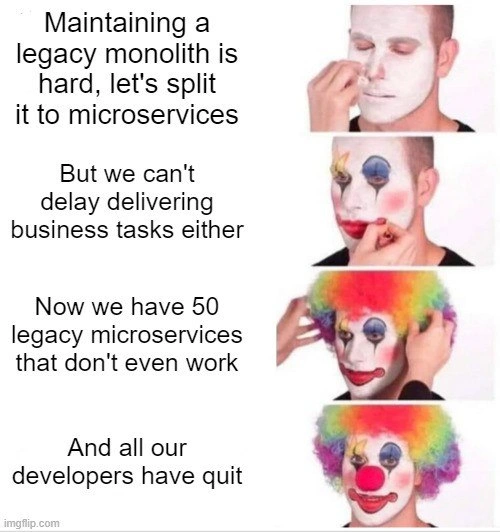
The Legacy Microservices Clown Show
Why is this DesignPatterns Architecture meme funny?
Level 1: Many Broken Boxes
This is like having one messy closet and deciding the solution is to dump everything into fifty smaller boxes while still being told to clean the house at the same speed. Now the mess is spread everywhere, nobody knows which box has the shoes, and everyone is tired of looking. The joke is that splitting one hard software system into many pieces can make life worse if the team does not also organize the pieces properly.
Level 2: Monoliths And Microservices
A monolith is an application built and deployed as one main unit. Many older systems are monoliths, but a monolith is not automatically bad. It can be simple to run because the code, data access, and business logic are all in one place.
Microservices split an application into smaller services. One service might handle users, another payments, another notifications, and another search. This can help teams move independently when the boundaries are clear and each service has a real owner.
The meme shows what happens when the split is rushed. The team starts with a hard-to-maintain monolith. They decide to split it. Then they keep delivering business features at the same time, so they never get enough space to design the split properly. The result is:
Now we have 50 legacy microservices that don't even work
That is worse than the original problem because there are now many pieces to deploy, monitor, test, and debug. If one service fails, other services may fail too. If one API changes, callers may break. If nobody knows who owns a service, bugs sit around while teams argue about responsibility.
Good microservices require good engineering habits: clear boundaries, automated tests, deployment pipelines, logs, metrics, tracing, documentation, and ownership. Without those, microservices do not remove technical debt. They give technical debt more places to hide.
Level 3: Distributed Clown Makeup
The clown format is brutal because each stage looks like a reasonable compromise at the time. First: maintaining a legacy monolith is hard. True. The deploys are scary, the code paths are tangled, the database has tables named after decisions nobody admits making, and every new feature feels like renovating a hospital during surgery.
Second:
But we can't delay delivering business tasks either
Also true, and that is where the trap closes. A successful microservices migration is not just "create service folders until the architecture diagram looks employable." It requires time for domain modeling, data migration, API contracts, deployment automation, monitoring, alerting, security boundaries, test strategy, ownership, and rollback plans. If leadership demands the migration happen while feature velocity remains untouched, the team quietly pays with evenings, incident risk, and eventually resignation letters.
The anti-pattern being mocked is cargo-cult microservices. Someone sees that large engineering organizations use many services and concludes that many services caused the success. What gets skipped is the supporting machinery: platform teams, mature CI/CD, observability, service discovery, on-call rotations, schema governance, backward-compatible API discipline, and enough engineers to own the boxes on the diagram. Without that, each "service" becomes a smaller monolith with worse logs.
The phrase "50 legacy microservices" is especially mean because it captures architectural decay perfectly. A monolith can hide coupling in function calls. Microservices expose coupling as network dependencies, version drift, duplicated business rules, and production-only race conditions. The code may be split into repositories, but the release process is still coupled. The data may be split into databases, but reporting still wants one truth. The teams may own services, but the customer workflow crosses six of them and fails whenever one pager is on silent.
This is also a human-cost meme. The final panel is not "and latency increased" or "and our dashboards are messy." It is:
And all our developers have quit
That matters. Bad architecture is not only CPU time and cloud spend. It is cognitive load. It is alert fatigue. It is developers spending more time finding which service owns a bug than fixing it. It is onboarding that requires a tour of fifty repos and three secret environment variables named TEMP_NEW_FINAL. The architecture did not merely fail technically; it made the job miserable enough that people left.
Level 4: The Distribution Tax
The four-stage clown makeup progression starts with a familiar modernization premise:
Maintaining a legacy monolith is hard, let's split it to microservices
and ends with:
And all our developers have quit
That escalation is not just organizational satire. It is a compact distributed-systems warning: splitting a codebase does not split the underlying complexity unless the domain boundaries, data ownership, failure modes, and operational model are also split cleanly. Otherwise, the team has not decomposed a monolith; it has serialized its pain over the network.
A monolith has many problems, but it also has one underrated virtue: many operations happen inside one process, one deployment unit, one database transaction boundary, and one debuggable runtime context. Once those responsibilities become separate services, the system inherits the classic distributed constraints. Calls can time out. Messages can arrive twice, late, or never. One service can deploy a breaking schema assumption while another still speaks yesterday's contract. A customer action that used to be one function call now becomes a choreography of retries, idempotency keys, sagas, outbox tables, circuit breakers, compensating actions, trace IDs, and someone muttering "eventual consistency" like it is a bedtime story.
This is where the theoretical tax appears. Distributed systems have partial failure: one component can be broken while the rest still appears alive. They have coordination costs: agreeing on state across machines is slower and harder than reading memory. They have consistency trade-offs: when data is replicated or shared across services, the system must choose what happens under latency, partitions, and concurrent writes. These are not microservice implementation details. They are physics with YAML.
The meme's third panel says:
Now we have 50 legacy microservices that don't even work
That line is the real architecture corpse. "Legacy" is not a property of being old; it is a property of being hard to change safely. You can create legacy software on day one if every service shares a database, calls every other service synchronously, lacks ownership, has no contract tests, emits useless logs, and requires five teams to approve a field rename. Congratulations: the monolith now has distributed deadlocks and a Slack channel.
Description
The image uses the four-stage clown-makeup meme, with a person becoming progressively more clown-like in each row. The text reads: "Maintaining a legacy monolith is hard, let's split it to microservices," then "But we can't delay delivering business tasks either," then "Now we have 50 legacy microservices that don't even work," and finally "And all our developers have quit." The joke criticizes cargo-cult microservices migrations done without time, ownership, observability, or a coherent domain model. It captures how a rushed attempt to modernize a monolith can multiply legacy problems into distributed technical debt.
Comments
4Comment deleted
They did not break the monolith into services; they gave every hidden coupling its own pager.
Not funny. I would laugh if I were not one if the last developers in the similar case ( Comment deleted
We also had downtime issues with fines to developers Comment deleted
So some have quit with debts Comment deleted