Skip to content
DevMeme
3381 of 7435
The Honest Pass Statement
Languages Post #3714, on Sep 17, 2021 in TG

The Honest Pass Statement

Why is this Languages meme funny?

Level 1: The Official Placeholder

This is like a teacher asking you to put something in every box on a worksheet, and one box lets you write "nothing here" so the teacher knows you did not forget it. Python's pass is that note. The joke is that the documentation sounds serious, but its whole message is simply: this command does absolutely nothing, and sometimes that is exactly what you need.

Level 2: The Empty Block

Python is a programming language where spacing matters. If you write a statement that starts a block, Python expects indented code underneath it. This creates a practical problem: sometimes you want the block to exist, but you do not want it to do anything yet.

That is where pass comes in. It is a control flow statement that means "there is code here on purpose, but the code has no action." For example:

if user_is_admin:
    pass
else:
    print("Access denied")

The if branch is not missing by accident; pass fills the space so Python can parse the program. Developers use it when sketching a class, writing a function stub, or handling a case where no operation is required.

The meme works because the documentation text is so literal. Most technical documentation explains complicated behavior. This one explains a language feature whose behavior is exactly absence of behavior. The post message says "Python has some useful commands," which makes the crop funnier because the "useful command" shown is useful precisely because it does nothing.

Level 3: Productive Nothingness

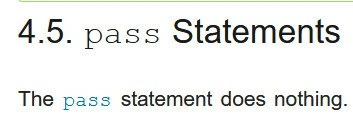
The crop is brutally simple:

4.5. pass Statements

The pass statement does nothing.

That sentence is funny because it is both a perfectly accurate technical specification and a deadpan anti-joke. Documentation usually spends its time clarifying behavior, warning about edge cases, and defending the reader from ambiguity. Here, the whole semantic payload is: this Python statement exists so that nothing happens. No side effect. No calculation. No secret runtime ceremony. Just syntactically valid emptiness.

For experienced developers, the humor is not that pass is useless. It is that doing nothing is sometimes a required operation in a language grammar. Python uses indentation to define blocks, so constructs like if, for, while, class, and def need a body. When you want to reserve the shape of a block without implementing it yet, pass lets the code remain valid:

class PaymentProvider:
    pass

That little nothing is a legitimate placeholder, and every codebase eventually accumulates placeholders with more confidence than implementation. pass is the official syntax of "we will come back to this," which the fossil record suggests is how TODOs become architecture.

The documentation style sharpens the joke. The heading looks formal: numbered section, monospace keyword, clean typography. Then the explanation refuses to dress up the feature. It does not say "initiates a null control-flow operation" or "yields execution without mutation." It says the thing everybody would say after reading the keyword behavior: it does nothing. In a field that can turn "copy a file" into a service mesh migration, that level of honesty feels almost impolite.

There is also a subtle CodeQuality lesson hiding under the Python joke. pass is fine when it is intentional: an empty subclass, a stub during development, a placeholder for an exception handler you truly mean to ignore. It becomes dangerous when it swallows work that should happen or errors that should be visible. The same statement that cleanly marks "nothing needed here" can also become the duct tape over a broken alert.

Description

The image is a cropped documentation screenshot with the heading "4.5. pass Statements" and a single sentence underneath: "The pass statement does nothing." The word "pass" is styled like inline code in a monospace font, while the rest of the text appears in a clean documentation layout. The humor comes from the blunt literalness of Python's no-op statement being documented with a no-frills sentence that itself feels like a joke. For developers, it is a compact reminder that sometimes the most accurate specification is also the funniest one.

Comments

13
Anonymous ★ Top Pick Python looked at TODO-driven development and gave it a first-class syntax node.
  1. Anonymous ★ Top Pick

    Python looked at TODO-driven development and gave it a first-class syntax node.

  2. @kitbot256 4y

    def func(): # TODO func() This is not gonna work. "pass" saves the day.

    1. @nuntikov 4y

      None would work too

      1. @kitbot256 4y

        Yes. In this exact case even return is fine. But pass is more obvious when you look at it later.

  3. @nuntikov 4y

    Or return

  4. @nuntikov 4y

    Or literally any literal

    1. Deleted Account 4y

      literal?

    2. Deleted Account 4y

      def foo(): "sausage"

  5. @nuntikov 4y

    Heh

  6. @nuntikov 4y

    "literally any literal"

  7. @borkick 4y

    Ellipsis works fine as well def foo(): …

    1. @Four_Velocity 4y

      ++ I think ellipsis is better for empty funcs pass is better for if.else/match.case/try.except statements

  8. @ZgGPuo8dZef58K6hxxGVj3Z2 4y

    Ich passe. (I am passing?)

Use J and K for navigation