
The Circular Logic of Software Documentation
Description
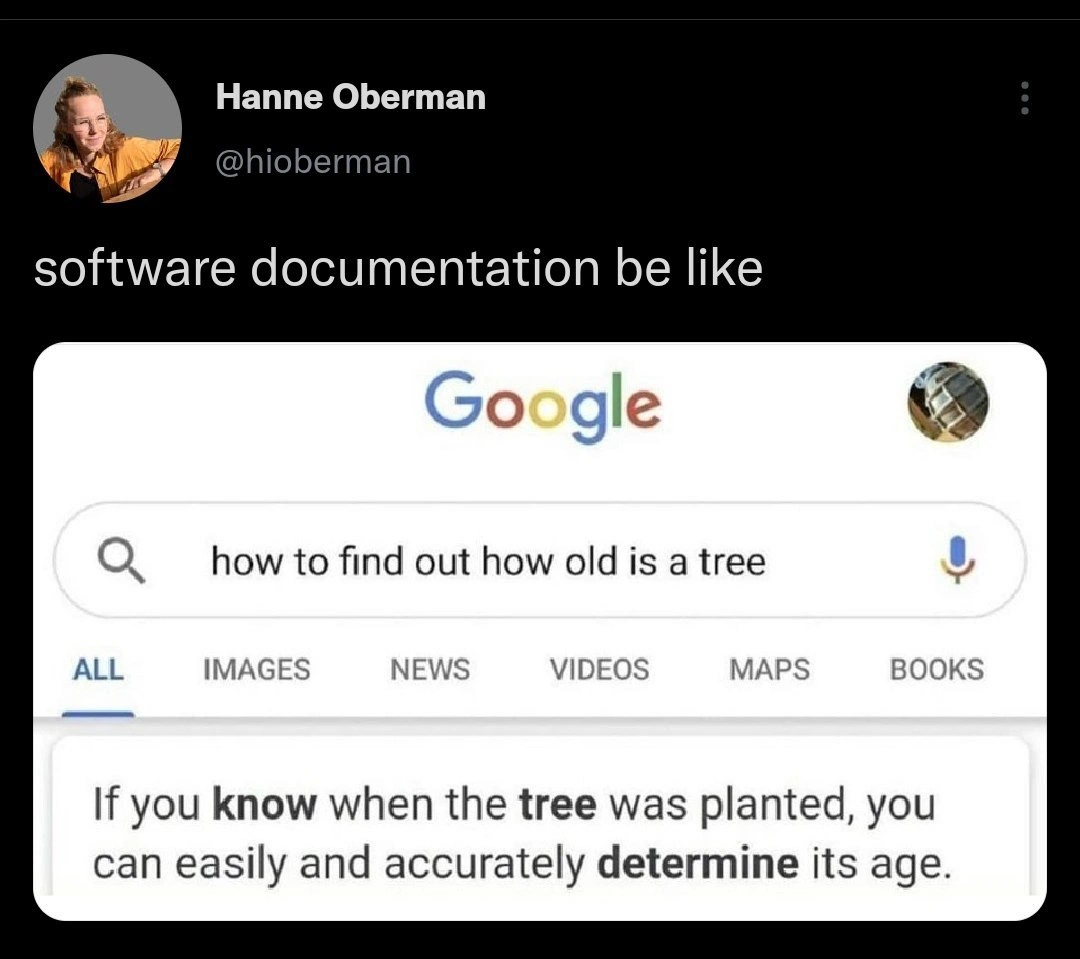
A screenshot of a tweet from user Hanne Oberman (@hioberman) that reads, 'software documentation be like'. Below this text is a cropped image of a Google search result. The search query in the bar is 'how to find out how old is a tree'. The featured snippet below provides the unhelpful answer: 'If you know when the tree was planted, you can easily and accurately determine its age.' The meme brilliantly captures the frustration developers feel when documentation is tautological or assumes the reader already possesses the key information they are seeking. It's a common scenario where a guide on setting up a new library, for example, might contain a prerequisite step that is impossible to complete without the library already being set up, creating a classic chicken-and-egg problem that stalls development
Comments
7Comment deleted
The API documentation says 'Authentication is simple: just provide a valid token in the header.' The section on how to generate a valid token just says 'See authentication endpoint.'
Distributed systems doc: “To prevent split-brain, simply guarantee the network never partitions.”
This is the same documentation that explains how to debug production issues by saying "First, reproduce the problem locally" - right after you've spent three hours explaining why it only happens under specific load conditions with real user data at 3 AM on Tuesdays
This is the documentation equivalent of 'To fix the bug, simply ensure the code works correctly' - technically true, completely useless, and somehow still passing code review. It's the same energy as API docs that say 'Returns: the result' or Stack Overflow answers that link back to your own question. The real kicker? This type of circular documentation usually comes from the same systems that have 47 pages explaining their revolutionary new logging framework but zero examples of actual usage
Docs: 'Know the planting date.' Reality: grep -r 'initial commit' across a monolith's git history - if the merges didn't erase it
Feels like the runbook that said, ‘For zero‑downtime releases, release with zero downtime’ - cool, I’ll just negotiate with CAP and ship to prod
Enterprise docs: “To call the API, include Authorization: Bearer <token>. To get <token>, POST to /token with Authorization: Bearer <token>.”