Skip to content
DevMeme
150 of 7435
Public Misconceptions About HTML
WebDev Post #187, on Feb 28, 2019 in TG

Public Misconceptions About HTML

Why is this WebDev meme funny?

Level 1: The Word That Sounds Like a Doctor Visit

A trivia book says that one out of every ten Americans, when asked what "HTML" means, guessed it was a disease you catch from another person. Actually, HTML is just the hidden set of instructions that tells your web browser how to display a page — every website is made of it, the way every house is made of bricks and beams you never see. The joke is the mix-up: it's like hearing the word "lasagna" and guessing it's a type of weather. The letters look mysterious and vaguely medical, so people who never learned them reached for the scariest-sounding answer — and an entire profession has been giggling about it ever since.

Level 2: What HTML Actually Is (Not Contagious)

HTML stands for HyperText Markup Language. It's not a virus, a disease, or even a programming language in the strict sense — it's a markup language: structured text that tells a browser what a page contains (headings, paragraphs, links, images) so the browser can render it. Every webpage you have ever visited arrived as HTML. Right-click any page, choose "View Source," and you're looking at it — angle brackets like <h1>, <p>, and <a href="..."> wrapping ordinary text.

The trio juniors learn together:

  • HTML — structure (what things are)
  • CSS — presentation (what things look like)
  • JavaScript — behavior (what things do)

The meme is also a gentle inoculation for early-career developers against two real phenomena. First, survey statistics travel without their error bars: a coupon company's promotional poll became a "fact" in a printed book because it was funny, not because it was rigorous — the same dynamic that turns "developers spend 80% of time debugging"-style numbers into gospel. Second, the curse of knowledge: once you know what HTML is, it becomes genuinely hard to remember not knowing, which is why documentation and onboarding so often fail beginners. The 1-in-10 figure is best treated not as ammunition for smugness but as a reminder of who you're building for.

Level 3: The Literacy Gap, Peer-Reviewed by a Trivia Book

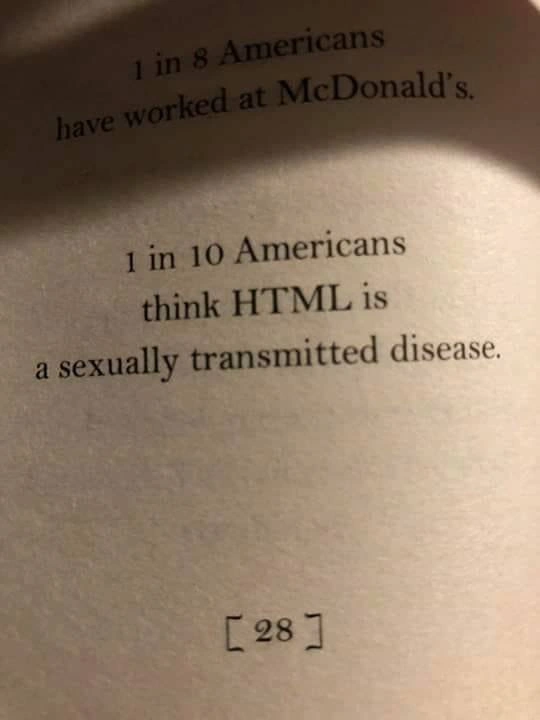
The photographed page — page 28 of what is clearly a printed trivia book, serif typeface and all — pairs two facts:

1 in 8 Americans have worked at McDonald's.

1 in 10 Americans think HTML is a sexually transmitted disease.

The second line isn't invented for the joke. It traces to a widely reported 2014 survey (run by coupon site Vouchercloud, polling roughly 2,400 American adults) in which about 11% of respondents identified HTML as an STD. The same survey found people guessing that a gigabyte was a South American insect and MP3 was a Star Wars robot. Methodologically it was a marketing survey, not NSF research — multiple-choice questions practically engineered to harvest a viral headline — and developers should apply the same skepticism here they'd apply to a vendor benchmark. But the reason it stuck for a decade, ending up immortalized in dead-tree trivia books, is that it quantified something the industry already knew: the vocabulary that structures developers' entire working lives is noise to most of the population.

The juxtaposition with the McDonald's statistic is doing quiet editorial work. One in eight Americans has direct lived experience of the fry station; far fewer have ever seen the markup language that delivers every job application, news article, and banking session to their screen. The web succeeded because of that invisibility — good abstraction means users never need to know <table> from a table — yet the same invisibility produces the support tickets every developer recognizes: "the internet is broken," relatives asking you to fix a printer because you "do computers," and product requirements written by people for whom the browser is a sealed appliance. The acronym confusion is also understandable from the outside: HTML genuinely does pattern-match to medical acronyms like HPV and HIV — four capital letters, clinical vibe — and the original channel post's caption leaned into exactly that with its own pun: "Hope you aren't C positive." (Hepatitis C, the C programming language — a dual infection.)

The lasting professional lesson hiding in the gag: never assume baseline technical vocabulary. The 11% aren't stupid; they answered a question about a domain they were never taught, in an education system where "computer literacy" long meant Microsoft Word. Anyone who has watched a stakeholder nod through a sentence containing "API," "DNS," and "cache" should recognize that the gulf cuts both ways — most developers couldn't pass a pop quiz on actuarial terms either.

Description

This image is a close-up photograph of a printed page from a book, showing two humorous, albeit likely fabricated, statistics. The text is in a classic serif font on off-white paper. The first, slightly out-of-focus statistic at the top reads, '1 in 8 Americans have worked at McDonald's.' The main, more prominent statistic below it states, '1 in 10 Americans think HTML is a sexually transmitted disease.' At the bottom of the page, the number 28 is enclosed in brackets. The humor stems from the absurd misconception, highlighting the vast gap between the tech world and the general public's understanding of foundational web technologies. For developers, it's a funny and relatable jab at the technical illiteracy they often encounter when trying to explain their work to non-tech-savvy friends or family

Comments

8
Anonymous ★ Top Pick I tried to explain to a friend that HTML isn't a disease, it's just a bunch of tags. He asked if they were contagious
  1. Anonymous ★ Top Pick

    I tried to explain to a friend that HTML isn't a disease, it's just a bunch of tags. He asked if they were contagious

  2. Anonymous

    Told Legal our new CSP blocks “unsafe-inline”; after hearing 10% think HTML is an STD, they approved the policy under “mandatory protection measures.”

  3. Anonymous

    The other 9 out of 10 Americans think HTML is a programming language, which honestly might be the more concerning statistic for those of us debugging their JavaScript

  4. Anonymous

    To be fair, HTML does spread through unprotected copy-paste, has no cure - only workarounds - and you usually catch it from a div you met on Stack Overflow

  5. Anonymous

    This statistic perfectly encapsulates why we spend half our time explaining to stakeholders that 'making it look pretty' isn't just about changing the CSS color values. Though to be fair, after debugging nested div soup and fighting specificity wars for 15 years, sometimes I wish HTML *was* something you could just get vaccinated against

  6. Anonymous

    HTML isn’t an STD - if markup is spreading via unescaped innerHTML, that’s XSS; use output encoding and stop the outbreak

  7. Anonymous

    The only thing HTML ever transmits is XSS - hence our CSP and DOM sanitization prophylactics

  8. Anonymous

    1 in 10 think HTML's an STD? Explains why RFPs demand 'no tables' like it's a public health crisis

Use J and K for navigation