Skip to content
DevMeme
1740 of 7435
Richard Stallman's Daily Workout Routine
OpenSource Post #1945, on Aug 21, 2020 in TG

Richard Stallman's Daily Workout Routine

Why is this OpenSource meme funny?

Level 1: The Floor Is Lava

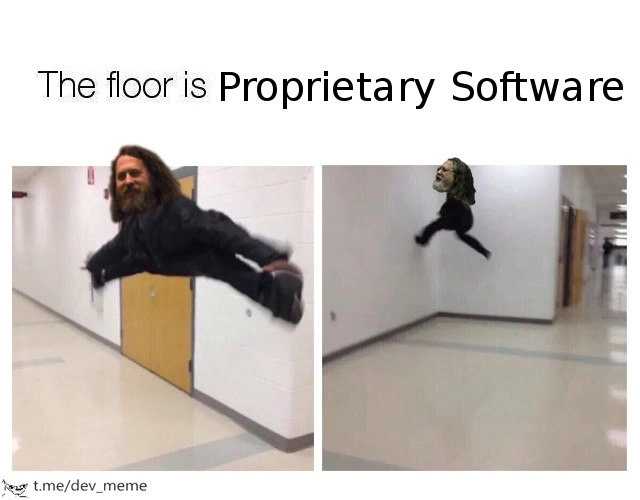
Imagine you and your friends are playing a pretend game where the floor is made of hot lava. 🔥 You jump on couches, climb on tables, and do anything to avoid stepping on the ground, because in the game if you touch the floor, you “get burned.” Now, picture a grown-up version of that game happening in an office hallway! In the meme’s photo, a programmer is stretching out against the wall, mid-jump, to avoid touching the floor – just like you would avoid lava. But in this pretend scenario, the “lava” is something called proprietary software, which is basically software that’s kept secret and not shared with others. This programmer really loves only using software that everyone can share and see (we call that open-source software). So, he’s acting like the other kind of software (the secret, closed kind) is as dangerous as a floor of hot lava. The joke is showing in a very silly, physical way how much he dislikes the “secret” software: he’d practically climb the walls rather than step on it. 😂 Even if you don’t know the tech words, it’s funny because he’s treating software he doesn’t like just like kids treat a lava floor – something to jump away from as far as possible!

Level 2: Open vs Closed Code

This meme might look silly at first, but it’s actually making a point about open-source enthusiasts and their aversion to closed-source programs. The text says, “The floor is Proprietary Software,” and the picture shows a developer literally jumping up against the walls of a hallway, desperately avoiding touching the floor. This is a play on the familiar childhood game “the floor is lava.” If you’ve never played it: kids imagine the ground is molten lava and hop onto chairs, couches, or anything off the floor to avoid “burning up.” It’s a fun make-believe challenge where touching the floor means you lose.

In this case, the “lava” on the floor is Proprietary Software – which is a fancy term for software that is not open for everyone to see or change. The meme jokes that some developers (especially those big into open-source) would rather cling to walls and perform wild acrobatics than let their feet (or hands, in a work sense) touch proprietary code. In other words, they’ll do anything to avoid using closed-source tools. If you’ve ever heard a programmer say, “Ugh, is there an open-source version of this? I really don’t want to use a paid closed product,” – that’s exactly the attitude being exaggerated here. It’s an inside joke about how strongly some devs prefer open solutions.

Now, what is the difference between open-source software and proprietary software? It comes down to access and rights. Open-source software is software whose source code (the human-readable instructions that programmers write) is freely available. Anyone can inspect it, download it, and usually modify it as well, as long as they follow the license rules. For example, the operating system Linux is open-source: thousands of developers around the world can and do read Linux’s code, suggest changes, and create their own versions. Other examples are Mozilla Firefox (a web browser) or Apache web server – their code is out in the open for the community to maintain. Using open-source is like having a recipe for a dish: you can see all the ingredients and steps. If you want, you can tweak the recipe or improve it and share those improvements with others. This fosters a collaborative environment where developers from anywhere can contribute and DevCommunities grow around shared projects. It’s a very transparent approach.

On the flip side, proprietary software is closed-source, meaning the source code is kept secret by the company or individual who owns it. You usually have to buy a license or get permission to use proprietary software, and even then, you only get the final product (the program that runs), not the “recipe” behind it. Take Microsoft Windows or Adobe Photoshop as classic examples – you can’t download their source code; you just get the executable application. If something goes wrong or you’re curious how a feature is implemented, you’re out of luck; only the makers have access to the code. It’s like a secret family recipe at a restaurant: you can enjoy the dish, but you’ll never be allowed into the kitchen to see how it’s made. You have to trust the chef and accept the dish as-is.

Because of these differences, many developers have strong preferences. Those who love OpenSourceCulture enjoy the freedom and community of open software. They like knowing that if there’s a bug, they (or someone out there in the world) can potentially fix it. They can also build on top of open-source code without asking permission, which is great for innovation. There’s a sense of shared ownership – a feeling that “we’re all in this together,” building something for the common good. These devs often hang out in online forums, contribute to projects on GitHub, and are proud of the collective effort.

In contrast, proprietary software tends to come from companies that guard their code closely. That’s not always a bad thing – it often means the company takes on full responsibility for maintenance, updates, and support. Many businesses actually prefer this: if something breaks, they can call up the vendor’s support line and say, “Hey, fix your product.” With open-source, there isn’t always a dedicated support hotline (you might be relying on community goodwill or your own skills to solve a problem). This is where corporate culture and open-source culture sometimes clash. Companies with a more traditional mindset feel safer with contracts, warranties, and clear accountability – all typically offered by proprietary software vendors. Meanwhile, open-source folks feel safer when they have control of the code and no dependencies on a single provider.

The meme exaggerates the open-source folks’ perspective. In reality, a developer who dislikes proprietary software won’t actually parkour over a hallway floor. What they will do is avoid choosing a closed-source tool if they can find an open alternative. For example, say there’s a task at work: you need a database system or a code library to accomplish something. A proprietary option might come with a slick interface and professional support, but require a purchase or have a restrictive license. An open-source dev will say, “Isn’t there an open-source library for this that we can use instead?” They might spend extra time researching or configuring a free tool just to steer clear of the closed one. It’s a bit like a chef insisting on making a sauce from scratch rather than buying a secret formula sauce – sure, the pre-made sauce might save time, but the chef wants full knowledge (and control) of what’s inside.

So, in the image, the programmer on the wall is that chef who refuses the bottled sauce. They are literally shown as avoiding even touching the proprietary product. This conveys an almost comical level of commitment to the open-source principle. The humor is in the relatable extreme: plenty of developers prefer open-source, but seeing that preference visualized as the floor being lava is unexpected and funny. It’s one of those DeveloperMemes where you laugh because it’s a tad true. Many in the field have heard colleagues half-jokingly say things like, “Ew, I don’t want to use that, it’s proprietary,” as if it’s something dirty. This meme just takes that sentiment and cranks it up to 100.

Another thing to note is the use of the “the floor is X” meme format. This was a viral template where people captioned images of themselves or others in mid-jump or clinging to walls with phrases like “The floor is lava” or any idea they wanted to humorously avoid. In our case, the_floor_is_meme is applied to a very programmer-specific fear – closed software. The hallway leap photo is a known hallway_leap_template used in these memes to show someone avoiding an imaginary hazard on the ground. By labeling the floor “Proprietary Software,” the meme creators immediately let us know what this dev is dodging. It’s a visual shorthand: no lengthy explanation needed, you see the text on the floor and the person avoiding it, and you get the joke. This format is popular in TechHumor because it’s simple and flexible. Tech memes often repurpose general meme formats to speak to specific geeky topics. Here, an average person browsing might just see a silly jump, but a developer will connect it to all those meetings and threads arguing about open vs closed solutions.

In summary, at this level we understand that the meme is saying: “Open-source developers hate proprietary (closed-source) software so much, they’d rather act like the floor is lava than even touch it.” It’s a humorous take on the open_source_vs_proprietary debate. You don’t need decades of experience to find it funny – just knowing what open-source means, what proprietary means, and recalling that goofy lava game from childhood is enough. It’s an exaggeration, of course. In reality, avoiding closed-source software is done by picking different tools, not by physical stunts. But the over-the-top image drives the point home in a memorable way. For anyone new to the concept, this meme also indirectly teaches the values of the open-source community: freedom, transparency, and a touch of stubborn idealism, all rolled into one funny picture.

Level 3: The Cathedral vs The Bazaar

At first glance, this meme is a masterful collision of childhood play and developer ideology. The top caption reads “The floor is Proprietary Software, and below we see a programmer literally flying off the wall in a hallway to avoid touching the floor. For seasoned engineers, this instantly conjures the classic “the floor is lava” game – but instead of molten rock, the open-source devotee here treats closed-source code as the burning pit of doom. It’s a hilarious exaggeration rooted in a very real culture clash: the long-standing battle of open source vs proprietary in software development.

On the surface, it’s just slapstick TechHumor. But why do developers find this so relatable? Because many of us have felt this exact impulse. Experienced devs know that embracing proprietary software often comes with strings attached – opaque code, restrictive licenses, and that sinking feeling of vendor lock-in. The meme’s humor comes from truth: some developers will do acrobatics (figuratively, we hope) to avoid using a closed-source tool. We’ve all seen the senior engineer who, given the choice between a well-known paid product and an obscure open-source library, insists on the open one as if the alternative were radioactive. The image of a person clinging to the wall rather than touch the ground perfectly visualizes that attitude. It satirizes how open-source culture sometimes views closed code as untouchable, almost a contamination of their pristine open ecosystem.

This dramatic avoidance has deep roots in the software licensing debate that has raged for decades. Open-source licenses (like the GNU GPL, MIT, or Apache licenses) grant users freedom – the freedom to inspect the code, modify it, contribute back, and redistribute. In contrast, proprietary licenses lock down the code tighter than Fort Knox: you can use the software (usually if you pay for it or abide by strict terms), but you can’t see how it works or change it. That fundamental difference creates a philosophical divide. Open-source enthusiasts see software as a communal effort and a public good, while proprietary software is seen as secretive and profit-driven. This meme takes that contrast to the extreme by equating proprietary programs with molten lava – something so dangerous that an open-source fan wouldn’t touch it even with a ten-foot pole. It’s poking fun at the almost religious fervor with which some devs avoid closed code.

To veterans in the field, there’s an element of relatable humor bordering on PTSD here. Many of us remember a 3 A.M. incident where a critical system broke, and the bug was buried in a third-party proprietary library. With closed software, you’re stuck waiting on the vendor’s mercy to fix it; you can’t just crack open the code and patch it yourself. That feeling of helplessness is exactly why some developers swear off proprietary dependencies entirely. They’ve been burned before (not by actual lava 😄, but perhaps by a nasty licensing surprise or a vendor going out of business). The meme’s extreme visual – our ninja-like dev avoiding the floor – perfectly captures the “Nope! Not gonna rely on that closed black-box again!” sentiment. It’s DeveloperHumor that taps into a shared trauma: dealing with opaque systems that you can’t control or fix.

There’s also a rich developer culture clash embodied here. In many corporate culture settings, using enterprise-grade proprietary software is considered the “safe” choice. You might even hear an old saying: “Nobody ever got fired for buying IBM.” Traditionally, managers felt more secure paying for official support, warranties, and a vendor to hold accountable. But to an open-source advocate, that corporate logic sounds like willingly putting on handcuffs. They’d argue that relying on proprietary solutions leaves you at the mercy of a single company’s decisions. What if the vendor decides to hike prices, discontinue the product, or neglect a feature you need? An open-source solution, by contrast, can be maintained or forked by the community if the original creators leave. The meme exaggerates this debate by showing the developer literally leaping away from the “safe,” commercially supported floor. It humorously highlights how what one group sees as stability (the solid floor) another group sees as danger (hot lava). Talk about a developer_culture_clash!

Historically, this “floor is lava” avoidance of closed software harkens back to the early days of the free software movement. The meme’s title even echoes the tone of free software pioneers like Richard Stallman, who famously equated proprietary software with a lack of freedom (he once described non-free software as an injustice, something no one should ever be forced to use). In the 1990s, there was a famous metaphor in a book called The Cathedral and the Bazaar that captures this divide. The Cathedral represented the closed, centralized development of proprietary programs – carefully crafted behind walls by a select few. The Bazaar represented the open-source approach – a noisy open marketplace where anyone can set up shop, contribute, and collaborate. Our meme’s hero vaulting off the wall is essentially a bazaar-dweller rebelling against stepping foot in the cathedral! It’s a witty nod to how far some devs will go to champion the bazaar’s open values, even in a world still full of cathedrals.

Even the format of the meme itself – the “the floor is ___” template – has history in internet culture. It became popular around 2017, with people posting images of themselves (or others) climbing furniture or walls to avoid touching a floor labeled as something they hate (from serious things like “responsibility” to jokey things like “JavaScript” 😜). By using this hallway_leap_template, the meme creators tapped into a familiar visual language that developers online already find funny. It’s instantly clear what it means: avoid X at all costs. So when X = “Proprietary Software,” every engineer who has ever groaned at a locked-down tool gets the joke without further explanation. It’s DeveloperMemes meets real-world dev debates.

In summary, the humor works on multiple levels. Technically inclined folks appreciate that it’s satirizing real issues of OpenSourceSoftware and control. Socially, anyone involved in DevCommunities knows there’s a proud tribe of open-source purists who indeed behave as if closed code is cursed. And visually, it’s just plain funny – a grown developer treating software choices with the melodrama of a kid avoiding lava. The meme manages to be a light-hearted take on a serious sentiment: a reminder that in the programming world, ideology and preference can be just as strong as a child’s imagination. By the time you’re an experienced engineer, you’ve seen how passionate people can get about these things, so you can’t help but chuckle when that passion is depicted as an epic hallway leap. After all, in the journey of software development, one person’s stable floor is another person’s burning lava pit.

Description

A two-panel meme based on the 'The Floor is Lava' format. The top of the image has the text: 'The floor is Proprietary Software'. The panels below show a person, whose head has been replaced with that of Richard Stallman (a well-known free software activist), athletically jumping and contorting his body to avoid touching the floor of a hallway at all costs. In the first panel, he is seen mid-air, parallel to the ground, pushing off a wall. In the second, he is leaping across the corner of the hallway. The humor is derived from the literal interpretation of Stallman's fierce, lifelong opposition to proprietary (closed-source) software, portraying him physically recoiling from it as if it were molten lava. For senior developers and those familiar with tech history, this is an inside joke celebrating a foundational figure of the open-source movement in a playful, absurd way
Comments

7
Anonymous ★ Top Pick I'm not saying my laptop is fully Stallman-approved, but I did have to compile my own kernel just to get the WiFi to stop using a proprietary blob. Now, if you'll excuse me, I have to go write my own BIOS in Emacs
  1. Anonymous ★ Top Pick

    I'm not saying my laptop is fully Stallman-approved, but I did have to compile my own kernel just to get the WiFi to stop using a proprietary blob. Now, if you'll excuse me, I have to go write my own BIOS in Emacs

  2. Anonymous

    Nothing sends a staff engineer wall-running faster than procurement suggesting an Oracle driver - rewriting it in Rust is still cheaper than parsing the license

  3. Anonymous

    Me explaining to the board why we need a seven-figure Oracle license while simultaneously maintaining three different open-source forks that do the same thing but with "more freedom."

  4. Anonymous

    When your entire tech stack is GPL-licensed and someone suggests integrating a proprietary SDK with restrictive licensing terms - suddenly every surface in the office becomes a viable perch. The real floor is lava moment comes during the architecture review when the PM asks 'why can't we just use [insert closed-source enterprise solution]?' and you have to explain that some of us have principles... and also don't want to deal with vendor lock-in, audit nightmares, and licensing fees that scale with revenue

  5. Anonymous

    Leaping from vendor lock-in: we'll fork the AGPL, wire SSO/SCIM ourselves, and save on licenses - until the only maintainer quits and our freedom becomes the new lock-in

  6. Anonymous

    When the floor is proprietary software, I parkour - per-core licensing, a license-server SPOF, and a surprise true-up will deprecate your budget faster than any rewrite

  7. Anonymous

    Proprietary floors: one touch and you're in eternal vendor support purgatory - no forks, no escapes

Use J and K for navigation