Skip to content
DevMeme
1739 of 7435
The Ultimate Interview Flex: Understanding Regex
Interviews Post #1943, on Aug 20, 2020 in TG

The Ultimate Interview Flex: Understanding Regex

Why is this Interviews meme funny?

Level 1: Big Brag, Big Surprise

Imagine you’re in class and one of your friends suddenly claims, “I can solve a huge 1000-piece jigsaw puzzle in just five minutes!” 😮 You’d probably turn your head with wide eyes and an open mouth, completely surprised, right? Because that’s an unbelievable thing to say – puzzles that big usually take hours or days! In this meme, the job candidate is making a similar kind of giant brag (but about a coding skill), and the employer is as shocked as you would be. It’s funny and silly: someone said they’re awesome at something super hard, and everyone is like, “Wait, really?!” That big claim leads to a big surprise reaction, just like how you’d feel if a friend said they did the impossible.

Level 2: Regex Riddles

Regular expressions, often just called regex, are like little puzzles we use in programming to find patterns in text. Think of regex as a special string of characters that can match text like “find all words that start with A” or “check if this looks like an email address.” They’re extremely powerful for tasks like searching through logs, validating input formats, or doing find-and-replace in code. But here’s the catch: regex syntax is notoriously cryptic. It’s full of symbols that have special meanings, and when you put a bunch of them together, the result can look like gibberish to the untrained eye. For instance, "^" means start of a line, "$" means end of a line, \d means any digit, . means any character, * means “repeat this 0 or more times,” and so on. Combine these in complex ways, and you get a dense pattern that is very exact about what it matches – and very hard to read at first glance.

In the meme’s text, the conversation goes like this:

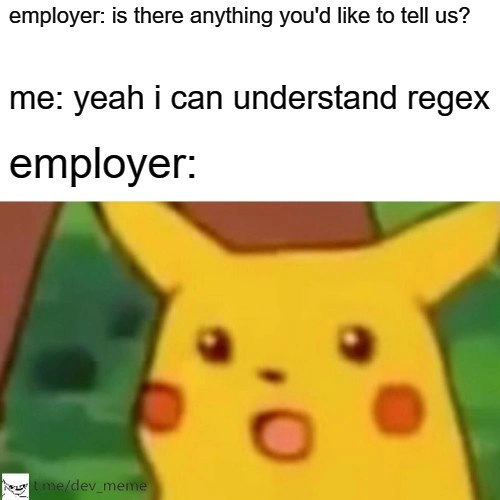
  • Employer: “Is there anything you’d like to tell us?” (a typical interview question, often an opportunity for the candidate to add something about their skills or maybe confess something humorous)
  • Me (the candidate): “Yeah I can understand regex.” (delivered as a bold claim about skill)
  • Employer: [surprised Pikachu face] (no words, just the famous image indicating shock or disbelief)

Why is that funny? Because saying “I can understand regex” is a bit like saying “I’m fluent in a very difficult secret code.” Regex is considered a kind of black magic in programming – many developers struggle with it, even experienced ones. It’s actually part of CS fundamentals (regex is based on theoretical computer science for pattern matching), but using it in real life often feels more like an art than a science. So if someone calmly asserts they fully comprehend it, it comes off as either a joke or a huge boast. The employer’s stunned reaction (the Surprised Pikachu image) basically says “Wait… seriously? You’re claiming that?” in a fun, exaggerated way.

To get a sense of why regex expertise is such a brag, just look at a typical regex pattern. Here’s an example regex that checks if a string is in the format of an email address:

const emailPattern = /^[A-Za-z0-9._%+-]+@[A-Za-z0-9.-]+\.[A-Za-z]{2,}$/;
// A typical email validation regex - notice how cryptic it looks!

Don’t worry if that looks like line noise to you – that’s the point! All those symbols and brackets define very specific rules (for example, the part before the @ allows letters, numbers, and some punctuation). Even this relatively short regex is hard to read. Now imagine much larger ones used for complex tasks. They can span multiple lines and include weird constructs that even seasoned programmers have to slowly untangle character by character. Understanding one of those big regex patterns without breaking a sweat is almost a superpower.

In a normal technical interview, candidates highlight skills like knowing certain programming languages, frameworks, or having good problem-solving abilities. Saying “I understand regex” in that context is unusual. It’s a bit of InterviewHumor in itself – it’d probably make the interviewers chuckle or raise their eyebrows. They might even follow up with a playful test like, “Oh, you do? What does this pattern do?” just to see if the claim holds. The meme exaggerates the surprise for comedic effect using Pikachu’s face. Surprised Pikachu is a well-known meme picture of the Pokémon with its mouth agape and big round eyes, typically used online to humorously show shock or astonishment when something unexpected is said. Here, it represents the employer being taken aback.

So, putting it together: The candidate’s statement “I can understand regex” is the punchline. It’s a relatable joke in tech because regex has a reputation for being hard to fully grasp. The employer’s stunned silence (via Pikachu) is basically the world going “ no way, did you really just claim that?” It’s all in good fun – a nod to the fact that regex is a riddle that even many professionals find challenging. If you’re new to coding, just know that regex is one of those things people both love and fear. Mastering it is like being really good at solving a very tricky puzzle, which is why bragging about it gets a shocked laugh in the software developer community.

Level 3: Backreference to Reality

In a technical interview scenario, boasting “I can understand regex” is the kind of statement that makes every seasoned developer in the room smirk or gasp. Why? Because regular expressions are the ultimate double-edged sword in programming. They’re incredibly powerful, but also notoriously arcane. There’s even a famous joke among developers:

“Some people, when confronted with a problem, think: ‘I know, I’ll use regular expressions.’ Now they have two problems.”

That tongue-in-cheek quote illustrates the paradox: regex can solve a complex text processing task, but using one carelessly can introduce headaches of its own. So when a job candidate proudly does a regex flex by claiming full mastery, experienced folks instantly recall every nightmare they've had debugging a dense regex pattern at 2 AM. The employer’s stunned reaction (hilariously depicted with the wide-eyed Surprised Pikachu meme) reflects the collective sentiment: “Did they really just say they completely understand regex?!” It’s the kind of boast that triggers equal parts admiration and skepticism in any senior engineer’s heart.

Consider what real regex mastery entails from a veteran developer’s perspective:

  • Cross-Flavor Knowledge: Regex isn’t one uniform thing – the syntax and features vary across languages and tools. Mastery means knowing the differences between JavaScript’s regex, Python’s re, Rust’s fancy regex crate, or the POSIX BRE/ERE nuances. Most of us stick to one or two flavors and Google the rest. Claiming you’ve got them all down is bold.
  • Readability (or Lack Thereof): Let’s face it, complex regex patterns can look like cartoon swearing – pure gibberish of symbols. For example, an email validation regex might be a single line of punctuation and brackets so cryptic that even the person who wrote it has to mentally unpack it each time. Seasoned devs joke that regex are “write-only code” – easy to write (with effort) but a pain for anyone else (or your future self) to read.
  • Bug Magnets: Off-by-one errors and edge cases are lurking everywhere. A missing ^ anchor or an extra + can turn a precise matcher into a permissive mess without you noticing. Veteran engineers have all been burned by a regex that was almost right but failed on some weird input (cue hours of debugging). Truly understanding regex means anticipating all those quirky cases — not easy.
  • Performance Pitfalls: Experienced devs know that regexes can be surprisingly expensive. We learn to be wary of certain patterns (like nested quantifiers (.+)+) that can blow up runtime. If someone says they know regex inside-out, you’d expect them to be the person who can prevent the dreaded scenario where a regex-based solution locks up production because of catastrophic backtracking on a long string.

Now picture an interview setting (the classic hall of technical legends and humility). The interviewer asks, “Is there anything you’d like to tell us?” — perhaps expecting a modest confession or an extra skill. The candidate deadpans, “Yeah, I can understand regex.” Instantaneously, the interviewer’s face turns into that meme: shock, disbelief, maybe a hint of amused respect. In the realm of InterviewHumor, this situation is golden. It flips the script: instead of pretending to downplay a weakness, the candidate claims supreme command over one of the trickiest, most esoteric tools in programming. It’s like saying, “I’ve mastered the dragon that routinely burns even senior developers.”

For developers, this meme is hilariously relatable. We’ve all wrestled with a seemingly simple regex that turned into a hours-long puzzle. We remember the sweat from trying to get a complex pattern just right (perhaps during a coding task or whiteboard session). So an employer hearing “I understand regex” might be thinking: “Either this person is a genius, or they don’t know what they don’t know.” The InterviewProcess has a way of revealing exaggeration, and regex is a classic area where Dunning-Kruger (overestimation of one’s ability) can lurk for the less experienced. A savvy interviewer might even follow up: “Oh, you do? Could you quickly sketch a regex for matching palindromes or balancing parentheses?” – a sly test to see if that confidence holds up. At the same time, if genuine, such a claim would indeed be impressive. It’s a mix of “No one truly masters regex, do they?” and “Wow, this person went there.”

In essence, the humor springs from the disconnect between how difficult regex really is and how casually the candidate asserts expertise. It pokes fun at both the relatable developer experience of struggling with regex and the absurdity of treating it as a trivial bragging point. The Surprised Pikachu employer encapsulates every developer’s reaction: that wide-eyed, slightly bemused face that says, “You what?!” The meme gets a laugh precisely because anyone who’s spent time in the trenches of code (especially dealing with text parsing or log scraping) knows that understanding every regex is a Herculean feat. As a community, developers bond over these “gotcha” moments – and nothing says “gotcha” like a confidently dropped regex bomb in an interview.

Level 4: Beyond Regular

To truly master regular expressions, one must dive into the depths of computer science theory. Regular expressions (regex) aren’t just handy text-matching tricks; they correspond to the formal concept of regular languages in automata theory. In fact, the very term comes from 1950s research by mathematician Stephen Kleene – yes, the Kleene star operator * in regex is named after him! Every regex pattern you write can, in theory, be translated into a finite automaton (a state machine that processes input strings). Mastery would mean you understand how any given pattern transitions through states to accept or reject input. This is serious CS_Fundamentals territory: you’re talking about the same concepts taught in university courses on automata and formal languages.

But modern regex engines are a complex beast. While the theory says a regex can be implemented as an efficient automaton, many programming languages implement regex with backtracking algorithms. This can lead to infamous performance problems like catastrophic backtracking, where a seemingly innocuous pattern takes exponential time on certain inputs. A true regex guru knows these edge cases cold – they can look at a pattern and anticipate if it might hang on something like “aaaaaaaa”. They also know the subtle differences between regex flavors: POSIX, PCRE, JavaScript’s engine, Python’s re module, each with its own quirks and support for advanced features. Some flavors even go beyond “regular” – for example, backreferences (\1 and beyond) and lookahead/lookbehind assertions give regex engines a kind of memory, letting them match patterns that pure theoretical regular expressions couldn’t (technically venturing into context-free or even Turing-complete territory in extreme cases!). In other words, modern regex can do things that break the original rules, and an expert would be aware of exactly where those boundaries lie.

Considering the history: early computing legends like Ken Thompson brought regex from theory to practice (Thompson’s early text editor QED and the Unix grep tool helped popularize regex for real-world use). Over the decades, regexes have grown from a neat theoretical concept to a powerful, bordering-on-magical tool in every developer’s toolkit. With great power comes great complexity, though – new features piled on, from lazy quantifiers to Unicode classes, making “complete understanding” a moving target. So when someone boldly claims they’ve conquered this ever-evolving, theory-laden domain, it’s no wonder any seasoned computer scientist or engineer might raise an eyebrow. The claim isn’t just “I know a handy trick,” it’s “I have internalized an entire class of algorithmic pattern matching and its historical evolution” – an assertion as extraordinary as it sounds, hence the employer’s surprised Pikachu level reaction.

Description

A meme using the 'Surprised Pikachu' format to joke about technical skills in a job interview. The image is structured with three lines of text at the top, followed by the image of Pikachu. The text simulates a conversation: 'employer: is there anything you'd like to tell us?', 'me: yeah i can understand regex', 'employer:'. Below this dialogue is a close-up image of the Pokémon character Pikachu, looking utterly shocked with wide eyes and an open mouth. A small watermark for 't.me/dev_meme' is present in the bottom-left corner. The humor lies in the perceived difficulty and esoteric nature of Regular Expressions (regex). While many developers can write regex, the ability to read and understand complex patterns written by others is considered a rare, almost mythical skill. The candidate's confident declaration is treated as a stunning revelation, hence the employer's Pikachu-faced shock. It's a highly relatable joke for developers who have struggled with the notoriously dense syntax of regex
Comments

7
Anonymous ★ Top Pick Understanding your own regex from six months ago is a senior-level skill. Understanding someone else's is grounds for an immediate principal engineer promotion
  1. Anonymous ★ Top Pick

    Understanding your own regex from six months ago is a senior-level skill. Understanding someone else's is grounds for an immediate principal engineer promotion

  2. Anonymous

    Mentioned I can mentally debug a 300-char PCRE with nested look-behinds - HR instantly upgraded the role from “Senior Engineer” to “in-house cryptographer/exorcist.”

  3. Anonymous

    The only person who truly understood regex was Larry Wall, and even he just wrote Perl as an elaborate cry for help

  4. Anonymous

    Claiming you understand regex in an interview is like saying you've achieved enlightenment - technically possible, but the shocked reaction suggests most people assume you're either lying or have transcended normal human limitations. The truth is, we all 'understand' regex... until we need to modify someone else's pattern at 2 AM, then suddenly we're all just copying from Stack Overflow and praying to the parsing gods that we don't accidentally match the entire internet

  5. Anonymous

    Anyone claiming to “understand regex” is either writing the engine - or the reason your p99 doubled from catastrophic backtracking last sprint

  6. Anonymous

    Told the boss I’m fluent in regex; now I’m on-call for every PCRE-vs-RE2 mismatch and the occasional O(n!) outage

  7. Anonymous

    Regex mastery in interviews: the rare flex where juniors bluff, mids sweat, and seniors silently smirk knowing it's eternal tech debt

Use J and K for navigation