Skip to content
DevMeme
1741 of 7435
The Emotional Rollercoaster of CI/CD Notifications
BuildSystems CICD Post #1946, on Aug 21, 2020 in TG

The Emotional Rollercoaster of CI/CD Notifications

Why is this BuildSystems CICD meme funny?

Level 1: Excitement to Disappointment

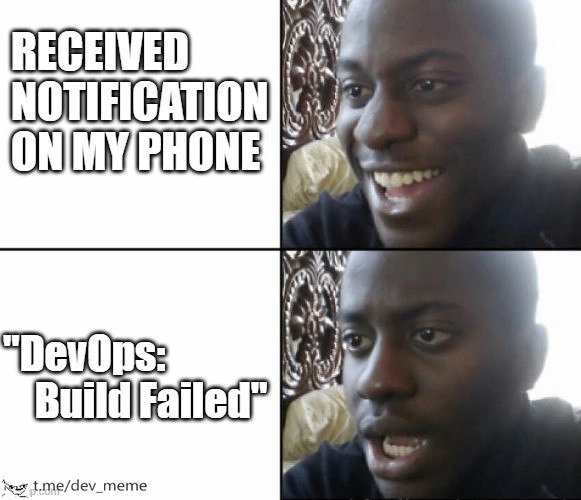
Imagine you hear your phone ding! and you get all excited because you think maybe a friend sent you a fun message or you got a new high score notification from a game. You grab your phone with a smile, ready for some good news. But when you look at the screen, it’s actually a message saying something bad happened at work (like a problem with a project you were working on). Your big smile drops into a frown immediately. That’s exactly what’s happening in this picture. In the first part, the man is super happy just because he got a notification – it’s like expecting a nice surprise. In the second part, he’s disappointed because the notification turned out to be bad news (his work build failed, which means something he was coding isn’t working right). It’s the feeling of think you’re getting a treat, but it turns out to be a chore. We find it funny because we totally understand that little emotional roller coaster: first yay! then oh no… in a matter of seconds.

Level 2: CI/CD Crash Course

Let’s break down what’s happening in this meme in simpler technical terms. In modern software teams, when developers write code, they use Continuous Integration (CI) systems to automatically build and test that code. CI/CD stands for Continuous Integration/Continuous Deployment. The idea is that every time you integrate new code into the main codebase, an automated build pipeline runs to make sure everything still works. This pipeline usually includes steps to compile the code (or otherwise prepare it), run a suite of automated tests, and even deploy the application if everything passes (that latter part is the CD). If any step in this process fails – say a test doesn’t pass or the code doesn’t compile – the system marks the build as failed.

For example, a typical CI pipeline might do something like this:

  1. Fetch code – Pull the latest code changes from the repository (e.g., from GitHub).
  2. Build – Compile the code or otherwise assemble the application. For instance, if it’s a Java project, run mvn package, or if it’s JavaScript, maybe run npm build.
  3. Test – Run automated tests. This could be dozens or hundreds of tests checking that the code’s logic is correct and that new changes didn’t break existing features.
  4. Package/Deploy – If all tests pass, package the app or deploy it to a test environment. This could mean creating a build artifact (like a .jar file, a Docker image, etc.) or even deploying to a server for further testing.

If any of those steps encounter an error (for example, a test fails, or the code doesn’t compile due to a syntax error), the pipeline will immediately stop and report a build failure. In other words, your changes didn’t make it through the gauntlet successfully.

Now, what does the phone notification in the meme mean? Many CI systems (like Jenkins, CircleCI, Travis CI, GitLab CI, GitHub Actions, etc.) can send out alerts when a build fails. These alerts can come via email or chat apps (like a message in Slack or Microsoft Teams) or through a mobile app notification. The meme text “DevOps: Build Failed” is likely the title of such a notification. It might be that the company has a tool or a bot named “DevOps” that sends out the alert. For instance, a Slack bot message might appear as from “DevOps” with the content “Build Failed”. So when the developer’s phone buzzes, the preview on the lock screen literally shows DevOps: Build Failed. In plainer terms: the developer got a message on their phone from the automated build system saying something went wrong with the latest code.

For a junior developer or someone new to these concepts, here’s why that matters: a failed build means the code changes you or a teammate just made didn’t pass all the checks. It could be a minor issue, like a unit test that expected 2+2 to equal 4 but got a different result, or maybe a file didn’t conform to the coding style guidelines. But it needs fixing before the code can move forward. Teams often configure these instant notifications so that whoever is responsible knows right away. It’s much better to find out five minutes after you commit the code via an alert, rather than days later or after it’s been deployed and caused bigger problems. This quick feedback loop is at the heart of DevOps culture – catching issues early and often.

However, the meme is highlighting the emotional side of this quick feedback. Imagine you just pushed your code changes and stepped away for a coffee. Suddenly your phone lights up. In that moment, you might think, “Oh, maybe someone messaged me or I got some interesting news!” – that’s a little moment of excitement. But then you read it and it says the build failed. Immediate mood crash. You realize, “Ah, I introduced a bug or a test didn’t pass. Gotta go back and fix it now.” The top text “RECEIVED NOTIFICATION ON MY PHONE” with a happy face reflects that initial yay, a notification! feeling. The bottom text "DevOps: Build Failed" with the disappointed face reflects the oh no, it’s work... and something’s broken feeling. It’s a little bit of developer humor showing how we can get emotionally invested in these seemingly small things like a build status.

To put it simply, developers set up these phone notifications for CI/CD alerts so they can respond quickly when there’s an issue. It’s an important part of keeping the software development process running smoothly. But the downside is your phone might buzz at inconvenient times with bad news. This meme wouldn’t be funny if it was, say, a positive notification (like “Build Succeeded” or “Deployment Successful”). It’s specifically funny (in an I can relate to this way) because it’s always the bad news that seems to arrive when you least want it. Pretty much every developer remembers the first time they broke the build: you push code, then get that dreaded email or message saying something failed. Your heart sinks a little as you click through to see the logs. It’s almost a rite of passage in software teams. The good news is, it’s usually quick to fix once you identify the problem (maybe run the tests again, see which one failed, and correct the code). And you learn to be a bit more careful next time.

In summary, the meme is about a CI build failure notification popping up on a developer’s phone and completely reversing his expression from happy to upset. It highlights a common scenario in DevOps-driven development: the instant feedback loop of build systems. For a newcomer, just know that “build failed” means something in the code needs to be fixed, and that developers have a sort of love-hate relationship with these alerts. We love knowing immediately when our code has issues (so we can fix them), but we hate seeing that red failure message – especially when we were hoping for good news!

Level 3: Continuous Interruption

This meme hits a little too close to home for developers living in the world of Continuous Integration. The top panel’s excited grin paints that split-second of optimism when your phone buzzes – maybe it’s a friend, maybe production is finally quiet – only to be sucker-punched by the bottom panel: the lock-screen reading “DevOps: Build Failed.” It’s the quintessential DevOps twist of joy-to-dread via push notification. Seasoned engineers know this routine by heart. In a modern CI/CD pipeline, a phone notification often means your code just broke the build. The humor comes from the Pavlovian roller-coaster: we’re trained to perk up at any notification (tiny dopamine hit 📱), then immediately deflate seeing it’s another build failure alert. That facial expression reversal in the meme? It’s basically a developer’s heart rate graph when Jenkins pings them at 5 PM on Friday.

On a deeper level, the meme riffs on DevOps pain points and alert fatigue. Continuous Integration was supposed to make life easier by catching issues early, but it has a dark side: Continuous Interruption. Every time someone pushes code, the build pipeline springs into action – compiling code, running tests, packaging apps – and if anything goes wrong, it sounds the alarm. In theory, it’s fantastic for code quality. In practice, it means developers live in a state of mild anxiety, bracing for that “🚨 CI/CD ALERT: Build Failed” message. It might be a trivial unit test failure or something actually on fire, but the DevOps culture of instant feedback doesn’t discriminate. Your phone buzzes, you feel a jolt of “What now?!” because nine times out of ten, it’s not your buddy sending a meme – it’s a pipeline telling you something broke. The meme nails this emotionally: our brains uniformly interpret unexpected phone buzz as “maybe good news,” but DevOps notifications have conditioned us to assume the worst.

Why is “DevOps: Build Failed” so dreaded? Because a broken build is effectively a productivity roadblock. In many teams, a failing CI build stops the whole assembly line – new code can’t be merged or deployed until it’s fixed. It’s a big red blinking FAIL sign in your project’s face. And if you were the one who pushed the latest changes, well… it’s on you to fix it. Experienced devs joke that CI actually stands for “Continuously Interrupting” your workflow. One moment you’re in deep focus coding a new feature, the next your phone or Slack is nagging “Hey, pipeline failed – drop everything!” Over time, this can become a form of Deployment Anxiety: even hitting the Merge button can make your stomach do a flip, because you’re half-expecting that humiliating alert soon after. The meme’s text formatting (“DevOps: Build Failed” in quotes) even looks like an automated message from some pipeline bot (perhaps a Jenkins or GitLab CI notifier) – it’s the kind of dry, system-generated tone that has ruined many a developer’s coffee break.

Real-world war stories echo this meme’s sentiment. Maybe you recognize the scenario: you finally head to lunch after running all tests (they were green on your machine!), then your phone screen lights up with your CI app’s icon. Ping: Build #1047 – FAILED. Your once-delicious burrito now tastes like panic as you scramble to recall what could have broken. Or it’s late at night, and a subtle vibration on the nightstand means your mobile DevOps alert just dragged you out of sweet dreams. (“Failed build? Wait... who pushed at midnight?!”) Many of us have been conditioned to dread certain notification sounds because they’ve heralded dozens of such continuous integration calamities. It’s practically DevOps humor folklore: the broken build that strikes at the worst possible time. We laugh, but only to keep from crying – because we’ve lived it.

Of course, behind the comedy is a commentary on build system reliability (or lack thereof). In a perfect world, builds wouldn’t fail so often – ideally, your test suite is solid, your environments are consistent, and everyone runs tests locally before committing. But in reality, things go wrong frequently:

  • A unit test that passed on a developer’s laptop might fail on the CI server (“Works on my machine!” 🙄). Maybe the CI environment is case-sensitive or lacks the locale settings the dev unknowingly had, and now a test asserting some output is off by a character.
  • An integration test could be flaky – perhaps it relies on an external service or time-based logic. It passes 9 out of 10 times, and of course, it chooses the CI run to falter.
  • There could be a newly introduced bug in the code (we’re all human) or a missing dependency. A developer might have forgotten to include a new config or library, so the build breaks during the package stage.
  • Sometimes the build script itself fails – maybe a shell script exited with the wrong status, or the container ran out of memory compiling huge code. Continuous Integration pipelines bring all these fragile pieces together.

Given these possibilities, a build failure isn’t rare. Veteran developers have almost a superstitious attitude: if everything’s green for too long, something’s about to go wrong. It’s common for teams to set up CI/CD alerts that broadcast in chat channels or send emails on failures. In some setups, the notification might literally be titled “DevOps: Build Failed” if the DevOps team’s bot is issuing the alert. The meme perfectly encapsulates that conditioned reflex: phone buzz = check notification = see build failure = sigh deeply.

Over time, teams try to combat the alert fatigue. Good DevOps practice suggests making builds more resilient and notifications smarter – e.g. alert only the person who broke the build, or don’t spam at 3 AM for non-production issues. But even with improvements, you can’t eliminate the core issue: code will break and somebody’s going to find out at an inconvenient moment. The old-school approach of doing big merges at the end of the week was even worse (imagine 20,000+ lines of unintegrated code causing a catastrophic failure—talk about heart attack). So CI/CD saved us from that nightmare by giving quick, incremental feedback. Yet, it created a new rhythm in developers’ lives: a constant stream of tiny failures and fixes. It’s death by a thousand cuts versus guillotine – most devs reluctantly prefer the cuts, but hey, it still stings when your pocket buzzes with bad news.

Historically, this “joy -> dread” pattern was different. In the early days, you might get a nightly build email the next morning saying something failed – a slower feedback loop, but at least your phone wasn’t lighting up every other hour. Now, with real-time pipelines and SRE/DevOps culture, the expectation is to respond immediately. Culturally, there’s often pressure: the build should always be green. Some teams even use funny rituals: e.g. whoever breaks the main build has to wear a silly hat, or gets a “Build Breaker” trophy on their desk. It’s humor used as a coping mechanism for what is essentially a team-wide productivity halt. If the build stays red too long, everyone’s blocked and managers start hovering. So that one little notification can send ripples of dread through an entire squad. The meme captures the exact moment that dread begins – the dev’s face says, “Oh no… what did I do (or what did someone do) this time?”

In short, this meme is a snapshot of developer life in the CI/CD era. It’s funny because it’s true: our phones connect us to everything, including our code’s successes and failures. That “Build Failed” alert transforms a mundane buzz into a mini-crisis. The top image’s joy turning into the bottom image’s dismay is a perfect visual metaphor for DevOps folks. It’s the face you make when you realize the only notification you got all day was not a friend or a loved one – it was Jenkins/TeamCity/GitHub Actions (take your pick) telling you that your latest commit broke something. Welcome to modern software development: even our phones troll us with Build Failure messages. And yes, we’ve all learned to laugh about it... after fixing the darn build, of course.

[Phone buzzes] 📲 
Notification: "DevOps: Build Failed"
Developer: *...closes eyes, takes a deep breath...* 😖

Description

A two-panel 'Disappointed Black Guy' meme format. The top panel features a close-up photo of a young Black man smiling brightly and looking hopefully to the side, with the overlayed text in a bold, white, all-caps font: 'RECEIVED NOTIFICATION ON MY PHONE'. The bottom panel shows the same man, but his expression has drastically changed to one of shock, despair, and disappointment. The corresponding text reads, '"DevOps: Build Failed"'. There is a small watermark for 't.me/dev_meme' in the bottom-left corner. This meme perfectly captures the emotional whiplash developers experience. The initial dopamine hit from a phone notification, often associated with personal messages or social media, is instantly crushed by the dreaded alert of a broken build. For senior engineers, this is a universally understood pain point - a failed build halts progress, requires immediate context switching, and often kicks off a frustrating debugging session within the CI/CD pipeline
Comments

7
Anonymous ★ Top Pick I've configured my build notifications with two distinct sounds: a cash register 'cha-ching' for a successful build, and the sound of my pager from 2004 for a failure. Both give me PTSD
  1. Anonymous ★ Top Pick

    I've configured my build notifications with two distinct sounds: a cash register 'cha-ching' for a successful build, and the sound of my pager from 2004 for a failure. Both give me PTSD

  2. Anonymous

    Metrics don’t lie: the only sub-100 ms latency in our entire CI/CD stack is the push notification telling me the build blew up

  3. Anonymous

    The only notification that can turn a senior engineer's dopamine hit into an adrenaline spike faster than 'Build Failed' is 'Rollback initiated in prod' - at least with build failures, you haven't broken anything for customers... yet

  4. Anonymous

    That split-second between seeing 'DevOps notification' and reading 'Build Failed' is when you experience all five stages of grief simultaneously - and instantly recall every shortcut you took in that last commit. Bonus points if it's 4:47 PM on a Friday and you just merged to main without running tests locally because 'the CI will catch it.'

  5. Anonymous

    Phone buzzes: “DevOps: Build Failed” - not the code, just entropy in the pipeline: mutable runners, expired tokens, and the artifact repo playing CAP theorem roulette

  6. Anonymous

    DevOps builds: 50% chance of failure, 100% chance of notifying the entire org at 3 AM

  7. Anonymous

    Nothing kills dopamine faster than a push alert that your monorepo’s 300‑job CI matrix went red because someone converted a Makefile tab to a space

Use J and K for navigation