Skip to content
DevMeme
4937 of 7435
The Agony of a FizzBuzz Interview That Never Ends
Interviews Post #5404, on Sep 7, 2023 in TG

The Agony of a FizzBuzz Interview That Never Ends

Why is this Interviews meme funny?

Level 1: When 2+2 Takes Too Long

Imagine a teacher is testing someone who says they want to be a math tutor. The teacher starts with the simplest question: "What is 2 + 2?" Now, we all know the answer is 4, and it should only take a second to answer. But imagine the candidate sits there for a long, long time – 5 minutes, 10 minutes, now 30 minutes – and they still haven’t given the correct answer. The teacher is sitting across from them, smiling politely and waiting calmly, but inside the teacher is probably very surprised and a little worried. The teacher expected this question to be super easy, like a warm-up, and didn’t think it would be a struggle at all.

This situation is funny in a kind of awkward way. It’s obvious to everyone that "2 + 2" is basic, so seeing someone struggle with it for so long feels absurd. You feel a mix of secondhand embarrassment for the person who can’t answer and sympathy for the teacher who has to sit through this. But the teacher stays professional: they keep a straight face and patiently let the person try, even though inside they might be thinking, "Oh no, this isn’t going well." In the meme, the cat is like that teacher. The cat’s serious, patient look is the teacher’s outward calm, and the fact that the cat is just sitting there makes it silly. The whole joke is basically: someone is taking forever to do something really simple, and the person in charge has to remain calm and not show how shocked they are. Even if you’re not a programmer, you can understand that feeling – it’s like watching a friend completely blank on an easy question and giving them an encouraging smile while you both secretly know it shouldn’t be this hard.

Level 2: FizzBuzz 101

Let's break down what's happening in simpler terms. In a typical programming technical interview, the interviewer will often ask the candidate to solve a very basic problem to prove they know how to code. FizzBuzz is one of the most common examples of this. The problem goes like this: "Write a program that prints the numbers from 1 to 100. But for multiples of 3, print the word 'Fizz' instead of the number. For multiples of 5, print 'Buzz'. And for numbers that are multiples of both 3 and 5, print 'FizzBuzz'." It's a little puzzle that tests if someone knows how to use loops and if/else conditions.

For example, the beginning of the FizzBuzz sequence would output:

  • 1
  • 2
  • Fizz (because 3 is a multiple of 3)
  • 4
  • Buzz (because 5 is a multiple of 5)
  • Fizz (6 is a multiple of 3)
  • 7
  • 8
  • Fizz (9 is a multiple of 3)
  • Buzz (10 is a multiple of 5)
  • 11
  • Fizz (12 is a multiple of 3)
  • 13
  • 14
  • FizzBuzz (15 is a multiple of both 3 and 5)

...and it would continue like that up to 100. The rules are very straightforward. To solve it, you typically use a loop to go through each number and a few conditional checks. A number is a "multiple of 3" if dividing it by 3 leaves no remainder. In programming, we'd say number % 3 == 0 as a check (using the modulo operator % which gives the remainder of division). So, if (i % 3 == 0) means "if i is divisible by 3." Similarly, i % 5 == 0 checks if a number is divisible by 5. Using these conditions, the program decides whether to output "Fizz", "Buzz", "FizzBuzz", or the number itself.

For an experienced programmer, FizzBuzz is almost too easy — it’s something you can code in a couple of minutes once you know how. It’s often one of the first exercises taught in programming classes after learning loops. That’s why interviewers use it: it quickly shows if a person has grasped the absolute basics of writing code. If someone struggles a lot with FizzBuzz, it might mean they're not comfortable with simple programming logic yet. Sometimes it can also mean the person is very nervous. Interviews are stressful, and even an easy question can feel hard when you're under pressure. Have you ever been put on the spot and blanked on something simple you knew? It happens! But generally, since FizzBuzz is so fundamental, taking more than, say, 10-15 minutes on it is a big warning sign in an interview setting.

Now, the meme scenario: the candidate has been working on this FizzBuzz problem for 30 minutes and still hasn’t finished. From the interviewer's perspective, this is a huge red flag. It suggests the candidate either doesn't understand how to solve the problem or is completely frozen by anxiety. By that point, the interviewer likely realizes the person isn’t going to successfully complete the task. However, in an interview, the interviewer should remain polite and patient. This is what we mean by staying professional. Even if the interviewer is internally disappointed or frustrated, they won't show it openly. They’ll keep a neutral, encouraging tone, maybe saying things like "Let's think it through step by step" or giving a small hint, rather than showing any annoyance. The goal is to make the candidate feel at ease (or at least not humiliated), because berating them wouldn’t help anyone. There’s also an HR aspect here: you want to represent your company well by treating all candidates with respect, even if they’re not doing well.

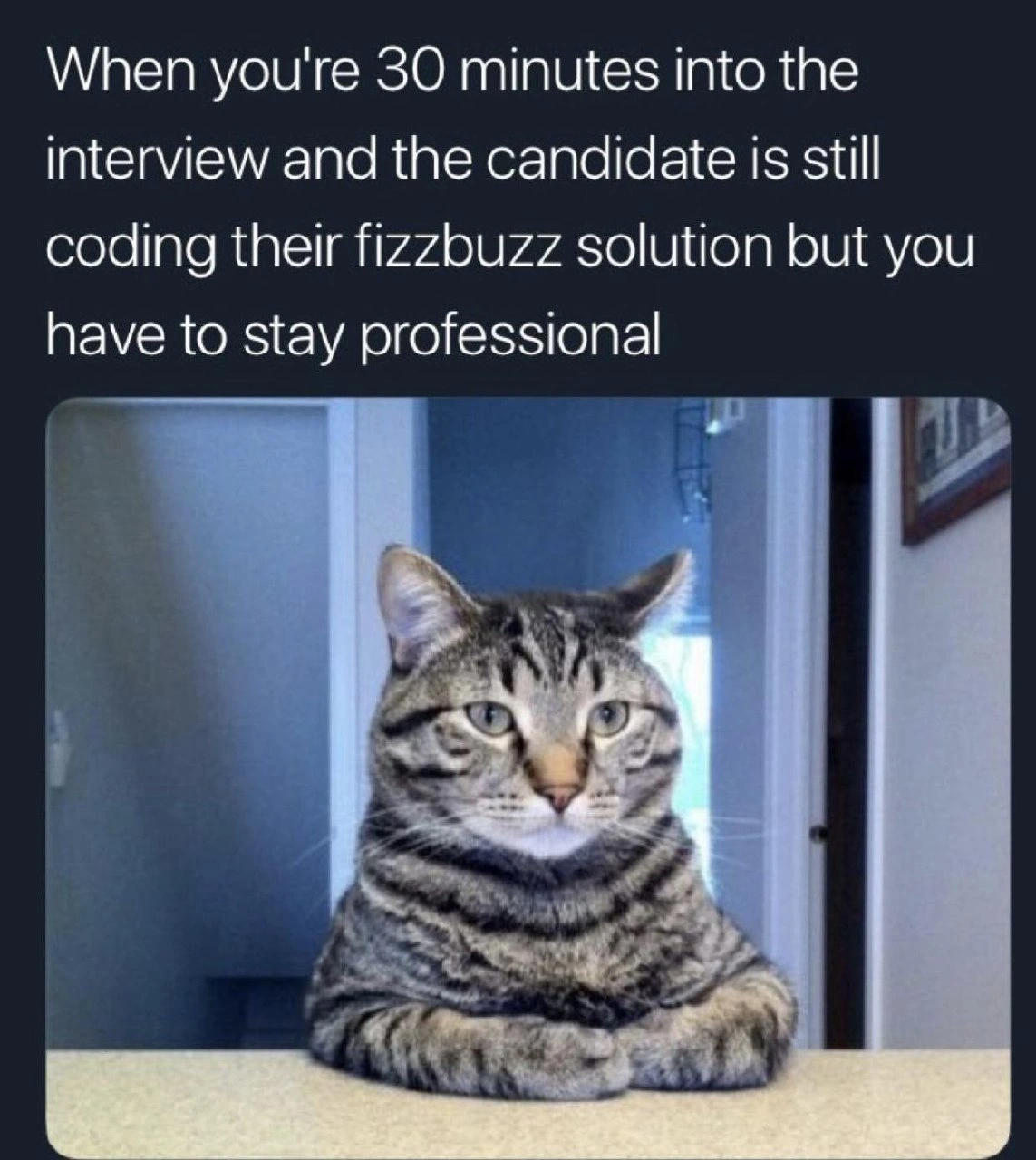
The picture of the cat in the meme is a funny way to depict this situation. The cat is sitting very properly, almost like a person in a suit might sit at a desk, with an expression that doesn’t give away any emotion. Cats often have this look as if they're quietly judging you, which is why the meme is extra humorous. We imagine the cat as the interviewer who is silently judging the situation but has to keep looking calm. The cat's folded paws and steady stare resemble an interviewer folding their hands and kindly watching the candidate, saying nothing critical. It’s a perfect image for InterviewHumor because it takes a serious scenario (a job interview) and makes it absurd by involving a cat behaving like a stern boss.

For the struggling_candidate, this is basically a nightmare scenario. If you've ever been that candidate, you know it feels awful. You're aware that this problem is supposed to be easy – maybe you even practiced it at home – but in the heat of the moment, your brain just isn't cooperating. As more time passes, you start panicking, which makes it even harder to think clearly. The interviewer (or the cat representing the interviewer) might be perfectly nice and calm, but you can sense that things aren't going well. The humor here has a compassionate side: many developers see this and chuckle because they've either witnessed it or lived it. It’s a CodingHumor inside joke about how even simple tasks can go horribly wrong under pressure. The meme is basically saying, "We've all seen someone flub FizzBuzz, and it's painfully funny and awkward every time."

In short, this meme shows a very junior vs senior moment in a coding career. A senior person (the interviewer) is calmly watching a junior person (the candidate) struggle mightily with a beginner-level question. It's funny to those of us in tech because FizzBuzz is infamous for being easy – so easy that it's the punchline of many jokes. Yet, the situation happens often enough in real life that it’s recognizable. The cat’s composed, patient face represents how an interviewer has to behave: staying courteous on the outside, even if they're astonished on the inside. That combination of an absurdly prolonged FizzBuzz attempt and the interviewer’s forced poker face is what makes the meme amusing and relatable.

Level 3: FizzBuzz Fiasco

In the world of technical interviews, the classic FizzBuzz test is practically a meme of its own. It's a super-basic coding challenge often used to filter out candidates who lack fundamental programming skills. The task? Write a program that prints the numbers 1 through 100, but replace multiples of 3 with "Fizz", multiples of 5 with "Buzz", and multiples of both 3 and 5 with "FizzBuzz". In terms of computer science, this is as simple as it gets: a single loop (linear time $O(n)$) with a few straightforward conditional checks. There are no tricky algorithms, no data structures to optimize – just basic logic. In fact, the fizzbuzz_problem became famous after a blog post pointed out how shockingly many self-proclaimed developers couldn't solve it. Ever since, FizzBuzz has been a go-to sanity check in the TechnicalInterviewProcess to catch folks who might have padded their resume but can't actually code.

So when an interview stretches to the 30-minute mark and the candidate is still grinding on FizzBuzz, we have a situation that is equal parts comedy and horror for the interviewer. It's the kind of InterviewHumor that makes you laugh nervously because it's so real. A senior engineer conducting the interview will immediately recognize this as a red flag. By minute five, it’s usually clear whether a candidate can handle the basics. By minute thirty, the outcome is almost certain. The meme highlights a JuniorVsSenior dynamic here: what's a 5-minute task for a seasoned dev can become an endless saga for a junior. At its core, this is developer humor poking fun at the gap between what a candidate claims they can do and what they can actually deliver under pressure.

Now let's talk about that stoic cat. In the image, a grey tabby cat sits upright behind a counter, front paws neatly folded, staring ahead with a deadpan, business-like expression. This cat might as well be the interviewer trying to stay professional. No matter how painfully obvious the situation is, the interviewer must maintain a calm, polite demeanor. The cat's face is the epitome of silent judgment combined with patience. There's even a popular notion of the silent_judging_cat in internet culture — pets that look like they’re quietly evaluating your decisions. Here, the cat is channeling pure professionalism under pressure. Internally, the interviewer might be screaming, "You've got to be kitten me — it's just FizzBuzz!" (pardon the cat pun), but externally they're as composed as this feline, giving nothing away.

This contrast between inner thoughts and outward behavior is where the humor really shines. The interviewer is essentially performing emotional gymnastics: professionalism_under_pressure means no eye-rolling, no smirks, not even raised eyebrows. They might gently prompt the candidate or just sit patiently, but they're definitely suppressing the urge to facepalm. We've all been there in some form. Maybe you've interviewed someone who froze on a simple question, or you've been on the other side, nervously blanking out on basics you actually knew. The meme hits on that shared experience. It’s a staple of CodingHumor in tech circles to swap stories like, "Remember the guy who took 45 minutes to write FizzBuzz?" followed by empathetic groans.

To appreciate just how basic FizzBuzz is, here’s a quick example of a correct solution in Python pseudocode (which would look similar in Java, JavaScript, etc.):

for i in range(1, 101):                 # loop from 1 to 100
    if i % 15 == 0:                     # if divisible by both 3 and 5
        print("FizzBuzz")
    elif i % 3 == 0:                    # if divisible by 3 (and not 5)
        print("Fizz")
    elif i % 5 == 0:                    # if divisible by 5 (and not 3)
        print("Buzz")
    else:
        print(i)

Any entry-level developer is expected to come up with something like this pretty quickly. There are even more concise solutions (using string concatenation or ternary logic), but the above is clear and gets the job done. A candidate struggling_candidate for 30 minutes here might be doing things like writing overly complex if-statements, checking every number in an inefficient way, or just getting tripped up on syntax errors and logic. Common rookie mistakes include forgetting to handle the "FizzBuzz" case first (so 15 prints wrong), or printing Fizz and Buzz separately instead of FizzBuzz for the combo. By the time those mistakes are still unresolved at the half-hour mark, the interviewer has seen enough to know this hire is probably not happening.

Yet, like our feline interviewer, they keep a straight face. From a Career_HR perspective, it's important to give every candidate a fair chance and a respectful experience, even if they're floundering. You don’t want to crush someone or behave rudely, because that reflects poorly on the company and on you as a professional. So the interviewer remains courteous, saying things like "Take your time, no rush," while internally thinking "Oh dear..." This meme perfectly captures that awkward balancing act. It's funny to seasoned developers precisely because it’s a scenario that feels too real – a blend of secondhand embarrassment and "there but for the grace of God go I". We laugh, we cringe, and we maybe double-check that our next interviewee can actually code a loop. After all, nothing builds an interviewer’s character (or gallows humor) like having to smile through a 30-minute FizzBuzz fiasco.

Description

A popular meme format featuring a grey and black tabby cat sitting upright at a table with its paws neatly folded, looking directly at the viewer with a serious, slightly judgmental expression. The image is captioned with white text on a dark background above the cat: 'When you're 30 minutes into the interview and the candidate is still coding their fizzbuzz solution but you have to stay professional'. The humor stems from the juxtaposition of the cat's human-like, professional posture with the exasperating scenario described. FizzBuzz is a notoriously simple programming problem used in early-stage interviews to filter out candidates who lack the most basic coding skills. A candidate taking 30 minutes to solve it is a major red flag, and the cat's expression perfectly captures the interviewer's internal struggle to maintain composure and professionalism in the face of such incompetence
Comments

20
Anonymous ★ Top Pick 30 minutes on FizzBuzz? Forget time complexity, at this point we're measuring the solution's half-life
  1. Anonymous ★ Top Pick

    30 minutes on FizzBuzz? Forget time complexity, at this point we're measuring the solution's half-life

  2. Anonymous

    Keeping a straight face while the candidate architects FizzBuzz as an eventually-consistent, event-sourced microservice - thirty minutes in and we still don’t have a single modulo

  3. Anonymous

    After 15 years of conducting interviews, you realize the real FizzBuzz test isn't whether they can solve it - it's whether you can maintain your poker face when they start implementing a factory pattern with dependency injection for a problem that needs three if-statements

  4. Anonymous

    The FizzBuzz problem: simultaneously the most trivial coding challenge and the most reliable predictor of whether someone can actually code. When a candidate hits the 30-minute mark on a problem that should take 5, you're not just watching them struggle with modulo operators - you're witnessing the exact moment your hiring pipeline's time complexity degrades from O(1) to O(please-make-it-stop). At least the cat's composure reminds us that maintaining professional decorum is itself a senior engineering skill, especially when you're internally calculating the opportunity cost of this interview in terms of PRs you could have reviewed

  5. Anonymous

    Thirty minutes into FizzBuzz, I quietly switch the rubric from algorithms to forecasting our mentorship burn rate and start drafting the onboarding runbook

  6. Anonymous

    FizzBuzz: turning O(n) basics into an exponential test of interviewer patience

  7. Anonymous

    Minute 30 of FizzBuzz: calculating our hiring funnel’s precision/recall and debating a circuit breaker - SLO: modulo within five minutes

  8. @deadgnom32 2y

    https://github.com/EnterpriseQualityCoding/FizzBuzzEnterpriseEdition

  9. @Daler_XYZ 2y

    What does fizzbuzz means?

    1. @uebuntu 2y

      FizzBuzz is a game that has gained in popularity as a programming assignment to weed out non-programmers during job interviews. The object of the assignment is less about solving it correctly according to the below rules and more about showing the programmer understands basic, necessary tools such as if-/else-statements and loops. The rules of FizzBuzz are as follows: For numbers 1 through 100, • if the number is divisible by 3 print Fizz; • if the number is divisible by 5 print Buzz; • if the number is divisible by 3 and 5 (15) print FizzBuzz; • else, print the number.

      1. @Daler_XYZ 2y

        Got it, thanks, never heard about this

        1. @ZgGPuo8dZef58K6hxxGVj3Z2 2y

          It’s a small problem that gives insight of how well the programmer can improvise. Like Fizz, Buzz can be made by 2 if statements, maybe even the Fizz Buzz FizzBuzz. But if you add another rules then the programmer must come up with an eleganter solution than just have a bunch of if statements checking each possibility…

          1. @SamsonovAnton 2y

            Indian style: print "1" print "2" print "Fizz" print "4" print "Buzz" ... print "98" print "Fizz" print "Buzz"

            1. @SamsonovAnton 2y

              Advanced Indian style: switch (i) { case 1: printf("%i\n", i); break; case 2: printf("%i\n", i); break; case 3: printf("Fizz\n"); break; ... }

              1. @SmirnGreg 2y

                No, it's worse, the first one was O(n), this one is O(nlogn) unless optimizer converts it to the 1st solution anyway

                1. @SamsonovAnton 2y

                  Won't it be just a O(1) jump table?

                2. @SamsonovAnton 2y

                  Oh, I got it: you referred to the entire 1 to 100 loop, not just the switch statement. However, by "Advanced" I didn't mean "more effective", but rather "more impressive" — looking more sophisticated.

              2. @ZgGPuo8dZef58K6hxxGVj3Z2 2y

                I love this community, the sarcasm 💀😂

            2. @ZgGPuo8dZef58K6hxxGVj3Z2 2y

              💀💀💀💀💀😂😂😂

        2. @klemaai 2y

          so frustrating nobody yet invented a website you can search thing at

Use J and K for navigation